
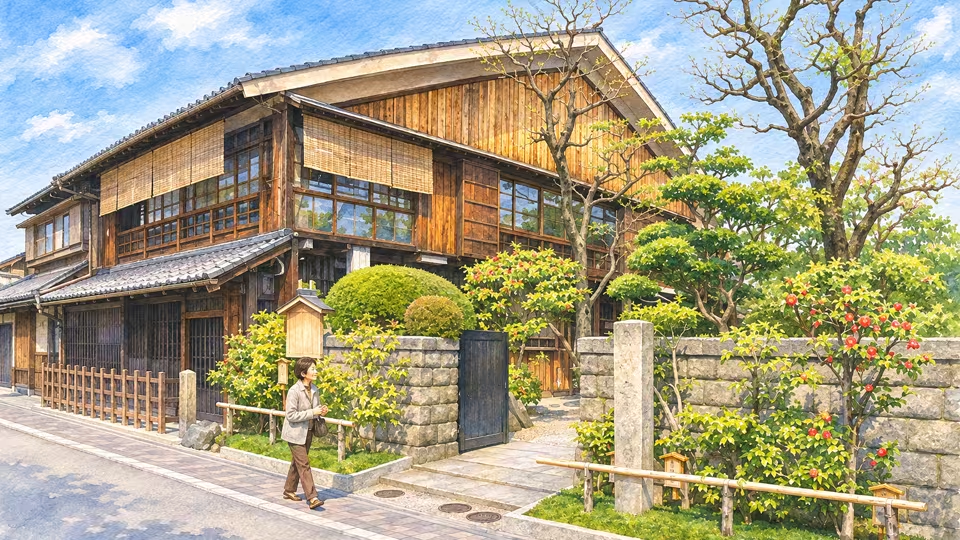
01An Inn at the River Port
Teradaya stands on a quiet street beside a narrow channel of the Uji River in Fushimi, the southern district of Kyoto. Today the place feels like a backwater, but in the Edo period (1603–1868) this was one of the busiest transport hubs in central Japan. Fushimi was Kyoto’s river port. Passenger boats called sanjikkoku-bune ("thirty-koku boats," named for their cargo capacity in rice measure) ran up and down the Yodo River between here and Ōsaka. Travelers bound for the capital landed at Fushimi and continued on foot; those heading for Ōsaka boarded here in the evening and drifted downstream overnight.
To serve them, the riverbank was lined with funayado, boat inns that offered lodging, meals, and booking for the river passage. Teradaya was one of these. It had a particular clientele: retainers of the Satsuma domain, the powerful southern Kyūshū domain ruled by the Shimazu family, used it regularly when moving between Kyoto and Ōsaka. Satsuma also kept a residence in Fushimi a short walk away, a fact that would matter more than once.
Teradaya was one of the largest boat inns in Fushimi. Its sixth-generation master, Isuke, died at thirty-five, and from then on the business was run by his widow, Otose (1829–1877), the daughter of an innkeeping family in Ōtsu who had married into Fushimi at eighteen. She is remembered as generous and fearless, a landlady who sheltered the political activists of the day, known collectively as shishi ("men of high purpose"), without asking too many questions. Sakamoto Ryōma called her okā, "mother," and wrote about her warmly in his letters home.
Within four years, Teradaya was the scene of two famous episodes of violence. In 1862 Satsuma samurai killed one another in its rooms. In 1866 Sakamoto Ryōma barely escaped from it with his life.
02Kyoto in 1862
To understand the first incident you have to understand the mood of 1862. Two years earlier, in 1860, the shogunate’s chief minister Ii Naosuke had been assassinated outside the Sakuradamon gate of Edo Castle. The shogunate’s authority was cracking, and a movement under the slogan sonnō jōi, "revere the emperor, expel the barbarians," was spreading among lower-ranking samurai and masterless ronin.
In the spring of 1862 Shimazu Hisamitsu, the father of the young Satsuma lord and the domain’s real power, marched about a thousand troops from Kagoshima to Kyoto. His aim was conservative. He wanted to use Satsuma’s military weight to push a program of kōbu gattai, "union of court and shogunate," and to force personnel reforms on the shogunate. He had no intention of overthrowing it.
Many radicals read his march very differently. They expected the arrival of the Satsuma army to be the signal for a rising, and they converged on Kyoto and Ōsaka. Inside Satsuma itself, a group of young radicals led by Arima Shinshichi plotted with outsiders, among them Maki Izumi of Kurume and the court retainer Tanaka Kawachinosuke, to assassinate the pro-shogunate regent Kujō Hisatada and the shogunate’s governor in Kyoto, Sakai Tadayoshi, and to bring their heads to Hisamitsu. The idea was to present him with a fait accompli and drag him into open revolt.
One man who might have mediated was absent. Saigō Takamori had disobeyed Hisamitsu’s order to wait for him at Shimonoseki and hurried to Ōsaka to meet the activists. Hisamitsu had him arrested and sent into exile in the southern islands.
03The Night of May 21, 1862
On the 23rd day of the fourth month of Bunkyū 2, which corresponds to May 21, 1862, Arima and his companions left the Satsuma residence in Ōsaka, came up the river by boat, and gathered upstairs at Teradaya, ready to move on Kyoto that night.
Hisamitsu learned of the plan. He chose nine of his best swordsmen, among them Narahara Kihachirō, Ōyama Kakunosuke, and Michishima Gorobē, and sent them to Fushimi. Their orders were to persuade the plotters to come and see Hisamitsu, and, if they refused, to cut them down on the spot.
The envoys called for the leaders. Arima, Tanaka Kensuke, Shibayama Aijirō, Hashiguchi Sōsuke, and a few others came down to the ground floor. The two sides were fellow clansmen, many of them friends, some trained in the same school of swordsmanship. The talk went nowhere. One of the envoys, Michishima Gorobē, shouted "By order of our lord!" and struck Tanaka, and the room exploded into a close-quarters sword fight.
The best-known moment of the night belongs to Arima. According to the traditional account, he grappled with Michishima and pinned him, then called to a young comrade, Hashiguchi Yoshinojō, to stab him along with his opponent. Hashiguchi drove his sword through Arima’s back and into Michishima, and both men died. The line became a byword for Satsuma resolve, though it comes down to us through later retellings, and the exact wording varies.
When it was over, six of the radicals were dead or dying: Arima, Shibayama, Hashiguchi Sōsuke, Nishida Naogorō, Deshimaru Ryūsuke, and Hashiguchi Denzō. Tanaka Kensuke and Moriyama Shingozaemon were badly wounded and were later ordered to commit suicide, as was Yamamoto Shirō, who refused the order to return home. On the envoys’ side, Michishima was killed.
Upstairs, more than twenty men were still armed and waiting. Among them were several who would become leading figures of Meiji Japan, including Saigō Jūdō (Takamori’s younger brother), Ōyama Iwao, and Mishima Michitsune. Narahara, it is said, put down his sword and went up alone to talk them out of it. They surrendered and were taken to the Satsuma residence, and twenty-one of them were shipped home to confinement. The non-Satsuma activists were dealt with separately; Tanaka Kawachinosuke and his son, supposedly being handed over to Satsuma, were killed on board ship and thrown into the sea, an episode Satsuma preferred to forget.
Otose, for her part, kept her daughter and the inn’s cash box safe through the fighting, and Satsuma afterwards paid for the damage to be repaired.
04What the Incident Achieved
The Teradaya Incident was a purge carried out by Satsuma against its own men, and it worked in Hisamitsu’s favor. The imperial court saw that he could control his radicals, and it backed him. He went on to escort an imperial envoy, Ōhara Shigetomi, to Edo and pressed the shogunate into appointing Hitotsubashi Yoshinobu as guardian to the shogun and Matsudaira Shungaku as head of political affairs. On his way back, men of his retinue killed a British merchant at Namamugi, which led to the bombardment of Kagoshima by the Royal Navy in 1863.
The dead of Teradaya were awkward martyrs for Satsuma: they had defied their lord, yet they had died for the imperial cause. After the Meiji Restoration the nine radicals who died were honored as the "Nine Martyrs of Teradaya." Their graves are at Daikoku-ji, a temple in Fushimi that served as a prayer temple of the Shimazu family and is nicknamed "the Satsuma temple," a short walk from the inn. Narahara, who had climbed the stairs alone, later became governor of Okinawa Prefecture under the name Narahara Shigeru. Of the young men he talked down, Saigō Jūdō and Ōyama Iwao both became field marshals.
05Ryōma Arrives
Sakamoto Ryōma, the second figure in Teradaya’s story, was a ronin from the Tosa domain (modern Kōchi) who had left his domain without permission and spent the mid-1860s as a go-between, trader, and organizer with close links to Satsuma. Traveling between Kyoto and Ōsaka under Satsuma protection, he naturally used Teradaya as a base, and Otose looked after him.
The woman who became his wife, Narasaki Ryō, usually called Oryō, also lived there for a time. She was the daughter of Narasaki Shōsaku, a Kyoto physician who had been imprisoned in the Ansei Purge of 1858–59 and died of illness in 1862 after his release, leaving the family poor. Ryōma met her around 1864, and by Oryō’s later account the two held a private wedding that summer. Ryōma asked Otose to take her in, and Oryō worked at the inn under the name Oharu, as Otose’s adopted daughter.
06The Night of March 9, 1866
In the first month of Keiō 2 (early 1866), Ryōma helped broker a secret agreement in Kyoto between Satsuma, represented by Saigō Takamori and Komatsu Tatewaki, and Chōshū, the rival domain represented by Kido Takayoshi. The Satsuma–Chōshū Alliance brought together the two domains that would later lead the overthrow of the shogunate.
A day or two later, on the 23rd of the first month (March 9, 1866), Ryōma came back to Teradaya with Miyoshi Shinzō, a retainer of Chōfu, a branch domain of Chōshū, assigned as his bodyguard. Ryōma carried a six-shot Smith & Wesson revolver, a gift from the Chōshū leader Takasugi Shinsaku. Miyoshi carried a short hand spear.
The Fushimi magistrate’s office, the shogunate’s local police authority, had been watching Ryōma. At around two in the morning, officers surrounded the inn.
Oryō was in the bath on the ground floor when she noticed men gathering outside. She ran up the back stairs to warn Ryōma and Miyoshi. Popular novels and television dramas have her dashing upstairs naked; the scene rests on Oryō’s own reminiscences given decades later, in which she says she threw a robe over herself, and the exact details cannot be checked.
The officers forced their way upstairs. Ryōma fired his revolver and Miyoshi fought with his spear. In the struggle an officer slashed at Ryōma’s gun hand; both his thumbs were badly cut, and he could no longer reload. The two men got out at the back, made their way through neighboring houses, and hid at a nearby timber merchant’s.
Ryōma, too badly hurt to go on, sent Miyoshi alone to the Satsuma residence in Fushimi for help. Ōyama Hikohachi of the residence came by river boat with a few men and brought Ryōma in. Once he was inside the Satsuma compound, the magistrate’s men could do nothing. Saigō, hearing the news in Kyoto, sent an army doctor and posted guards.
07The "First Honeymoon"
To let Ryōma’s hands recover, Satsuma arranged passage for him and Oryō on the domain ship Mikuni-maru, which left Ōsaka in the third month, and they spent the spring of 1866 in Satsuma. They took the waters at Hinatayama and at Shiohitashi hot spring in the Kirishima mountains and climbed Takachiho-no-mine, where, in Ryōma’s own account, they pulled up the Ama no Sakahoko, a sacred upturned spear on the summit, to see what it looked like. Ryōma described the trip in a long letter to his sister Otome, complete with a sketch of the mountain.
The trip is often called "the first honeymoon in Japan." That label is a later one; the concept did not exist in 1866, and other couples have been put forward as having got there first. It is now a fixture of tourism in both Fushimi and Kirishima.
Ryōma had less than two years to live. On the 15th day of the eleventh month of Keiō 3 (December 10, 1867), he was assassinated at the Ōmi-ya, a soy-sauce dealer’s house in Kyoto’s Kawaramachi district.
08Fire in 1868
In January 1868 the Battle of Toba–Fushimi broke out between the forces of the former shogunate and the new government armies led by Satsuma and Chōshū. Fushimi was one of the main battlegrounds. Satsuma troops, based at Gokōnomiya Shrine, shelled the Fushimi magistrate’s office, held by Aizu troops and the Shinsengumi; the office burned, and so did much of the town.
That brings us to the question many visitors ask: is this the building where all this happened?
09Is This the Original Building?
For many decades Teradaya presented itself as a survivor from the Bakumatsu period, the closing years of shogunate rule. Visitors were shown sword cuts, a bullet hole, and the bath Oryō was said to have used, and most people left believing they had stood in the very room.
Historians had long said otherwise, and in 2008 the issue reached the media. The City of Kyoto examined the records and on September 24, 2008 announced its conclusion: the Bakumatsu building had burned in the fighting of 1868, and the present building was put up later on the plot immediately to the west. The original inn stood on the lot to the east, now city-owned land with stone monuments and a statue, which looks like Teradaya’s garden.
When the present building went up is less clear. It was registered in 1905, and the city’s own description says only that it was rebuilt afterwards. A 2023 paper argued that the inn was not completely destroyed in 1868, that it reopened within months on the western plot using salvaged materials, and that it was heavily remodeled around 1906, so that the building should not be dismissed as a later replica. That argument is still new.
Either way, the house you enter does not stand where the events happened and is not the building of 1862 or 1866 as it was, and the sword marks, bullet hole, and bath cannot be treated as evidence of either incident. It is still a genuine old townhouse with the layout of a riverside inn.
10Walking the Site
Teradaya is a few minutes’ walk from Chūshojima Station on the Keihan line. Paper lanterns bearing the inn’s name hang at the entrance. Inside, open to visitors for a fee (the building has long also taken overnight guests), you can see the bath presented as Oryō’s and the staircase associated with her dash upstairs. On the upper floor is the "Plum Room" (Ume no Ma), presented as the room Ryōma used. A hanging scroll portrait of Ryōma is said to have been painted by a local artist at Otose’s urging, because she feared for his life. The displays are best read as a memorial built around the story rather than the original scene.
The open lot to the east is the site of the original inn. It holds a stone marking the historic site, a monument to the nine Satsuma men killed in 1862, and a statue of Ryōma, with a city signboard explaining the 1862 incident. Nearby Kyōbashi bridge was the heart of the old port, where the river boats docked and where inns and official lodgings for traveling lords once crowded together. Outside the winter months, replica jikkoku-bune boats leave from Benten Bridge behind the Gekkeikan Okura Sake Museum and run to the Misu lock, giving a view of Fushimi’s sake breweries from the water.
If you have time, walk on to Daikoku-ji to see the graves of the nine Satsuma men; the inscription is said to be in Saigō Takamori’s hand. Otose is buried at Shōrin-in, also in Fushimi. The site of the Fushimi magistrate’s office and Gokōnomiya Shrine, where Satsuma made its headquarters in 1868, are within walking distance. The Ryōma-dōri shopping street beside the inn shows how thoroughly modern Fushimi has adopted him. On this short stretch of waterside street, Satsuma men cut each other down in 1862, and four years later Ryōma escaped out the back in the dark.