
01A Shrine Born of Fear
Kitano Tenmangū stands on the northwestern edge of central Kyoto, just north of Imadegawa Street. Today it is one of the busiest shrines in the city. Students come in winter to hang wooden prayer plaques (ema) asking to pass their entrance exams; on the 25th of every month the approach fills with stalls selling old kimono, pottery and junk; in February the plum trees bloom and the whole precinct smells faintly sweet.
The deity here is Sugawara no Michizane, a ninth-century scholar and statesman who is worshipped across Japan as Tenjin, the god of learning. But the shrine was not founded to honor a great scholar. It was founded because the court and people of Heian-kyō, the capital that became Kyoto, believed that Michizane’s angry ghost had returned from exile as a thunder god and was killing his enemies. Kitano Tenmangū began as an act of appeasement, and almost everything you see here, from the bronze and stone oxen to the plum trees, traces back to that story.
02A Scholar Who Rose Too High
Michizane was born in 845 into the Sugawara, a family of court scholars. His grandfather and father had both held the post of monjō hakase, professor of literature and history at the state academy, where young aristocrats studied Chinese classics and poetry. Michizane followed them, passing the court’s most demanding examination and becoming a professor himself. He was famous as a writer of Chinese verse, and later collections of his poetry, Kanke Bunsō and Kanke Kōshū, are still read.
In 886 he was sent to serve as governor of Sanuki Province on the island of Shikoku, an assignment that took him out of the capital for four years. On his return he caught the attention of Emperor Uda, who wanted counterweights to the Fujiwara, the aristocratic clan whose leaders dominated court politics by marrying their daughters to emperors. Michizane, talented and without Fujiwara connections, was exactly what Uda needed. He rose quickly. In 894 he was appointed ambassador to Tang China, and he responded by recommending that the missions be suspended, arguing that China was in turmoil and the voyage too dangerous. The court agreed, and no further official embassy was sent.
When Uda abdicated in 897 in favor of his son, Emperor Daigo, he left instructions urging the young ruler to rely on Michizane. In 899 Michizane became Minister of the Right (udaijin), one of the two highest posts in the government, alongside Fujiwara no Tokihira as Minister of the Left. For a man of his modest lineage, it was an extraordinary height, and it made him enemies.
03Exile to Dazaifu
In the first month of 901, Michizane was suddenly stripped of his office and appointed provisional deputy governor of Dazaifu, the government outpost in northern Kyūshū. The charge was that he had plotted to depose Daigo in favor of Prince Tokiyo, Uda’s son and Michizane’s son-in-law. Most historians see the affair, known as the Shōtai Incident after the era name, as a political maneuver by Tokihira and his allies. Michizane’s sons were exiled too.
Before he left the capital, Michizane is said to have composed a short poem to the plum tree in his garden, asking it to send its fragrance on the east wind and not to forget the spring though its master was gone. The poem became one of the most famous in Japanese literature, and a later legend says the tree loved him so much that it flew overnight to Dazaifu to join him. The "flying plum" still has its namesake at Dazaifu Tenmangū in Kyūshū.
The Dazaifu post was exile in all but name. Michizane had no real duties and little income, and he lived in poor quarters writing poems of grief. He died there on the 25th day of the second month of 903, at the age of 57 by modern count. According to legend, the ox pulling his coffin stopped and would not move, and he was buried where it lay. A temple rose over the grave, and that site became Dazaifu Tenmangū. The story, together with associations between Michizane and the ox in later tradition, is why oxen are the sacred messengers of Tenjin shrines.
04The Thunder Comes to Kyoto
In the years after Michizane’s death, the capital suffered a series of calamities that people came to read as his revenge. Tokihira died in 909, still in his thirties. In 923 Crown Prince Yasuakira, Daigo’s son and Tokihira’s nephew, died at twenty-one. His young son, named heir in his place, died two years later. Plague, drought and floods struck the city.
The court tried to make amends. In 923 Michizane was posthumously restored to his rank of Minister of the Right and promoted, and the decree of his exile was burned. It was not enough. In the summer of 930, lightning struck the Seiryōden, the emperor’s residential hall in the palace, during a meeting of officials, killing the courtier Fujiwara no Kiyotsura and others. Emperor Daigo, already in poor health, collapsed after the event, abdicated, and died within months.
The lightning strike fused Michizane’s ghost with the god of thunder in the popular imagination. Thunder deities had long been called tenjin, "heavenly gods," and the fields of Kitano, northwest of the palace, already held a small shrine to a thunder god where, it is said, prayers for good harvests were offered. Over the following decades the word Tenjin came to mean, above all, Michizane.
05Oracles and a Shrine at Kitano
The shrine’s own tradition describes its founding through oracles. In 942 a woman named Tajihi no Ayako, living in the western part of the city, received a message from Michizane asking to be enshrined at the Ukon no Baba, the riding grounds of the Right Palace Guards at Kitano. Too poor to build a shrine there, she worshipped him at a small shrine at her home. Two shrines named Ayako Tenmangū, one within Kitano’s grounds and one in Shimogyō Ward, trace their origins to her. In 947 a boy named Tarōmaru, son of Miwa no Yoshitane, a priest from the Hira shrine in Ōmi Province, received a similar oracle. With the help of Saichin, a monk of the nearby Asahi-dera temple, a shrine was raised at Kitano, and 947 is counted as the year of Kitano Tenmangū’s founding.
In 959 Fujiwara no Morosuke, then Minister of the Right and a nephew of Tokihira, greatly enlarged the buildings and presented offerings. That a leading member of the very family blamed for Michizane’s fall should pay for his shrine shows how seriously the Fujiwara took the danger.
06From Vengeful Spirit to Imperial Patron
Over the next generations the court adopted the shrine. In 987 Emperor Ichijō sent an envoy to confer the divine title "Kitano Tenman Daijizai Tenjin," and the Kitano Festival began that year under court sponsorship. In 993 Michizane was posthumously raised to Minister of the Left with the highest court rank, and later that year to Chancellor (daijō daijin), the highest office of state. In 1004 Emperor Ichijō made the first imperial visit to the shrine, and Kitano was later counted among the Twenty-Two Shrines that received regular imperial offerings.
At the same time the character of Tenjin softened. Michizane the poet and scholar came forward, and Tenjin became a patron of poetry, calligraphy and learning. The great illustrated handscroll Kitano Tenjin Engi Emaki, painted around 1219 and known as the Jōkyū version, tells the whole story, from Michizane’s life and exile to the thunder in the palace and the founding of the shrine. Its scene of the lightning strike, with demons and fire bursting into the palace, is one of the most famous images in Japanese art. The scroll belongs to the shrine and is a National Treasure.
07A Shrine-Temple Complex
Until the 1860s, Kitano was not a shrine in the modern sense. Like most major religious sites in premodern Japan, it combined kami worship and Buddhism. From 1004, when a Mount Hiei monk was appointed its administrator (bettō), it was run by monks of the Tendai school, and for centuries the post was held by the abbot of Manshu-in, an aristocratic Tendai temple in northern Kyoto. Buddhist monks served in its halls.
The shrine was also an economic power. In the medieval period the jinin, lay dependents of the shrine living in the Nishinokyō district to its south, held a monopoly on producing kōji, the mold culture used in brewing sake. When the shogunate canceled that monopoly, the jinin barricaded themselves in the shrine in 1444, and the buildings burned in the fighting that followed.
The Ashikaga shoguns patronized Kitano too. The third shogun, Ashikaga Yoshimitsu, built a large sutra hall here, where mass sutra readings were held for the souls of Yamana Ujikiyo and others he had crushed in the Meitoku Rebellion of 1391. Nothing of it survives at Kitano.
08Hideyoshi’s Great Tea Party
The most famous single day in the shrine’s history came on the first day of the tenth month of 1587. Toyotomi Hideyoshi, the warlord who had just completed his conquest of Kyūshū and was close to unifying Japan, held the Kitano Great Tea Gathering (Kitano Ōchanoyu) in the pine groves around the shrine.
Hideyoshi had posted notices in Kyoto and other cities inviting anyone who loved tea, regardless of status, to attend with a kettle and a cup. Those without tea could bring roasted grain instead. He displayed his collection of famous tea utensils, set up his portable golden tea room, and the leading tea masters of the day, Sen no Rikyū, Tsuda Sōgyū and Imai Sōkyū, served tea alongside him. Accounts put the number of tea booths at around 800, some at 1,500. The event was announced for ten days but ended after one; one explanation is that news arrived of a rising in Higo Province in Kyūshū. The shrine’s tea offering ceremony on December 1 recalls the gathering.
A few years later, in 1591, Hideyoshi enclosed Kyoto inside a long earthen rampart and moat called the Odoi. A section of it survives along the western edge of Kitano Tenmangū, now a nationally designated historic site, shaded by maple trees.
09Hideyori’s Main Hall
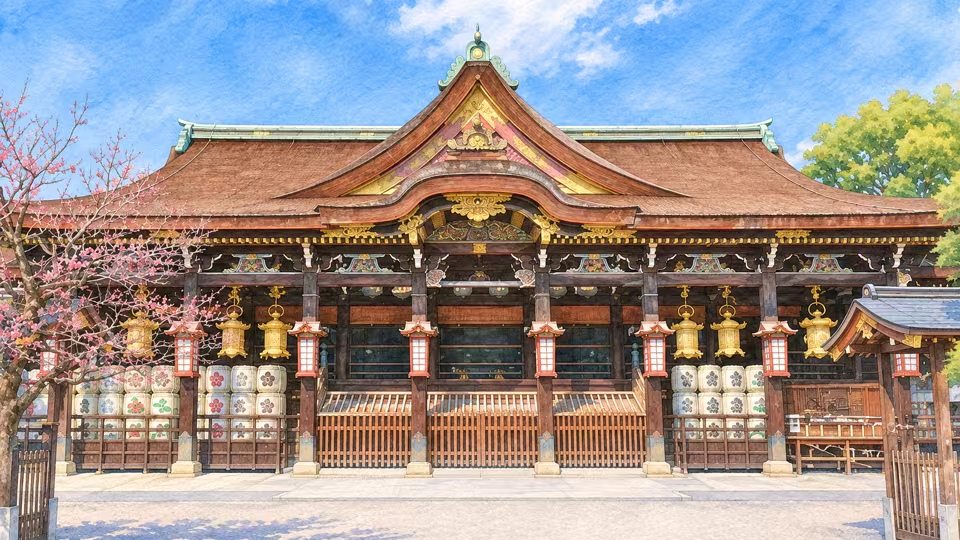
The main buildings you see today were donated by Hideyoshi’s son, Toyotomi Hideyori, and completed in 1607. Although the Tokugawa had taken power after the battle of Sekigahara, the Toyotomi still held Ōsaka Castle and great wealth, and Hideyori sponsored the rebuilding of many temples and shrines in the Kyoto region. Kitano was among the most important.
The complex links the main sanctuary (honden) and the worship hall (haiden) with a stone-floored connecting hall (ishi-no-ma), with a side hall for music attached to the worship hall. The many roofs meeting at different angles give the style its name, yatsumune-zukuri, "eight-ridge construction." The arrangement of front hall, connecting room and sanctuary is the plan later called gongen-zukuri, made famous by the Tōshōgū shrine at Nikkō, and Kitano is one of its earliest surviving examples. The buildings were listed as protected in 1897 and designated a National Treasure in 1959. Look at the carved and gilded details on the front of the worship hall for a taste of Momoyama-period display.
The gate in front, the Sankōmon or "Gate of the Three Lights," dates from the same period and is an Important Cultural Property. The three lights are the sun, moon and stars, but only the sun and moon appear among its carvings. Tradition says no star was carved because, seen from the Daigokuden, the great audience hall of the old imperial palace, the Pole Star shone directly above this gate and completed the trio on its own. It is one of the shrine’s "seven wonders." The plaque reading "Tenmangū" on the gate is in the hand of Emperor Go-Sai. The surrounding corridors, openwork fence, rear gate and east gate are also Important Cultural Properties.
10Modern Times
The Meiji government’s order of 1868 separating Shinto and Buddhism ended almost a thousand years of mixed worship. Buddhist buildings and images were removed, the monks were returned to lay life, and the shrine’s connection with Manshu-in was cut. It was renamed Kitano Jinja and ranked as a government shrine of the middle grade (kanpei chūsha). After the Second World War it took back the name Kitano Tenmangū.
In modern Japan the scholar has completely eclipsed the thunder god. Students crowd the shrine before exams, and school groups stop to rub the heads of the reclining oxen, which is said to bring wisdom. On February 25, the anniversary of Michizane’s death, the Baikasai plum festival is held, and geiko and maiko (as geisha and apprentices are called in Kyoto) from Kamishichiken, the neighboring geisha district, serve tea outdoors among the plum trees. Kamishichiken is often called Kyoto’s oldest geisha quarter; its name, "Seven Upper Houses," is traditionally traced to seven teahouses built from timber left over from a shrine renovation in the Muromachi period.
In early October the Zuiki Festival, said to have begun with harvest offerings by the shrine’s Nishinokyō dependents, carries a portable shrine whose roof is thatched with taro stems and decorated with vegetables and grains, a thanksgiving for the harvest.
11Walking the Grounds
Enter through the great torii on Imadegawa Street and walk north. Along the approach you will pass the first of the many ox statues; there are dozens in the precinct. People rub the part of the ox that corresponds to an ailing part of their own body, or its head for better grades.
Pass through the two-story Rōmon gate and you reach the Sankōmon. Stand underneath and look for the sun and moon among the carvings. Beyond it is Hideyori’s worship hall. Walk around the side to see the overlapping roofs that connect it to the main sanctuary behind.
Dozens of smaller shrines surround the main hall. Among them is the Jinushi-sha, the shrine to the deities of the land, which is said to predate Kitano Tenmangū itself. The treasure hall, open only at certain times of year, holds several versions of the Engi scrolls and swords including Onikirimaru, also called Higekiri, a blade said to have been handed down in the Minamoto family.
In late winter, the plum garden holds around 1,500 trees of about fifty varieties. In autumn, enter the maple garden (Momiji-en) on the west side, where a path runs along the surviving stretch of Hideyoshi’s Odoi rampart and down to the Kamiya River. Leaving by the east gate, a short walk brings you to the stone-paved streets of Kamishichiken.