
01A Temple That Is a Mountain
Mount Hiei rises on the northeastern edge of Kyoto, with the city spread out below it on one side and Lake Biwa on the other. Its highest summit, Ōhiei, stands 848 meters above sea level. If you have come up by cable car and ropeway, you may be expecting a single temple compound with a gate and a wall. Enryaku-ji is not that. It is a scatter of halls, chapels, residences and mausoleums spread across the mountaintop forest, all of which together make up one temple.
The mountain is divided into three precincts, known as the Three Pagodas (santō): Tōdō, the Eastern Pagoda; Saitō, the Western Pagoda; and Yokawa, farther north. Each was once subdivided into valleys where monks’ lodgings stood, giving the old phrase "three pagodas, sixteen valleys." At its height, tradition says, there were three thousand lodgings on the mountain. That number is a figure of speech, but it captures how large the community became.
For roughly eight centuries this mountain was the headquarters of the Tendai school of Buddhism, the guardian of the imperial capital, a landholder and moneylender, and a military power that emperors feared. It was also the place where most of the founders of Japan’s later Buddhist schools received their training. In 1571 the warlord Oda Nobunaga burned it. What you see today is largely the product of the rebuilding that followed.
02Saichō Climbs the Mountain
The temple’s founder, Saichō, was born in 767 in Ōmi Province, the region around Lake Biwa, near the foot of Mount Hiei. He entered the provincial temple of Ōmi as a boy, was ordained a novice in 780, and in 785 received full ordination at Tōdai-ji in Nara, the great state temple of the old capital. The normal path from there led to a career in the Nara monastic establishment. Instead, Saichō went back to his home province and climbed Mount Hiei to live as a hermit.
In 788 he built a small hall on the mountain and enshrined an image of Yakushi, the Medicine Buddha, which tradition says he carved himself. He called it Ichijō Shikan-in, a name that refers to the "One Vehicle" teaching of the Lotus Sutra and to the meditation practice of calming and contemplation. This hall is the origin of the Konpon Chūdō, the main hall you can visit today, and 788 is counted as the founding year of Enryaku-ji.
Saichō had been reading the works of Zhiyi, the sixth-century Chinese master who founded the Tiantai (in Japanese, Tendai) school on Mount Tiantai in China. Tiantai taught that the Lotus Sutra was the culmination of the Buddha’s teaching and that all beings could attain buddhahood. This conviction guided the rest of Saichō’s life.
In 794 Emperor Kanmu moved the capital to Heian-kyō, modern Kyoto. Mount Hiei lay to its northeast, the direction from which, according to Chinese-derived geomancy, malevolent influences entered. The mountain temple came to be regarded as the spiritual guardian of the capital’s "demon gate," and Saichō gained the court’s attention and patronage.
03The Journey to China
In 804 Saichō sailed to Tang China with an official embassy. On another ship in the same fleet was a then-obscure monk named Kūkai, who would later found the Shingon school. Saichō went to Mount Tiantai, where he studied under the Tiantai masters Daosui and Xingman and received the bodhisattva precepts. He also received esoteric Buddhist initiation in Yuezhou and instruction in Chan (Zen) meditation. After about eight months in China he returned in 805 with a large collection of copied texts.
Saichō’s training was later summarized as four lineages: the perfect teaching of the Lotus Sutra, esoteric Buddhism, Zen, and the precepts. This breadth defined the mountain. It would let later generations draw very different practices from the same source.
In 806 the court granted the Tendai school two annual ordinands. These were state-sanctioned ordination slots: each year two men could be ordained as Tendai monks, one to study Tendai meditation and one to study esoteric ritual. This grant is treated as the official founding of the Tendai school in Japan. The same year Emperor Kanmu died, and Saichō lost his strongest supporter.
For a time Saichō and Kūkai cooperated. Saichō borrowed esoteric texts from Kūkai and received initiation from him, and sent his disciple Taihan to study with him. The relationship broke down when Kūkai declined to lend certain texts and Taihan chose to stay with Kūkai.
04The Ordination Platform and the Temple’s Name
The struggle that consumed Saichō’s last years concerned ordination. Under the system of the day, a monk had to receive the full monastic precepts at one of three government-approved platforms, at Tōdai-ji in Nara or at temples in the far east and far west of the country. Tendai novices therefore had to go down to Nara, and many of them never came back.
Saichō argued that a Mahāyāna monk needed only the bodhisattva precepts, and that these should be conferred on Mount Hiei itself. Trainees would then remain on the mountain for twelve years of study and practice. He set out the program in a set of regulations for students in 818 and 819. One line from them is still widely quoted at Enryaku-ji: a person who lights up one corner of the world is a national treasure. The Nara clergy fought the proposal hard, and Saichō wrote a long treatise in reply.
He did not live to see the outcome. Saichō died on Mount Hiei in the sixth month of 822, at the age of fifty-six by the traditional count. Seven days later the court approved a Mahāyāna ordination platform on the mountain. In 823 Emperor Saga granted the temple the name Enryaku-ji, taken from the Enryaku era in which it had been founded. Being named after an era was a rare honor.
In 866 the court gave Saichō the posthumous title Dengyō Daishi, "Great Teacher Who Transmitted the Teaching." It was the first time the title daishi had been granted in Japan. His tomb is at Jōdo-in, on the path between the Eastern and Western Pagoda precincts.
05Ennin, Enchin and a Bitter Split
Saichō’s disciple Gishin became the first abbot of the Tendai school, a post called the Tendai zasu that was appointed by the court. The school’s weak point was esoteric Buddhism, which Kūkai’s Shingon school had mastered and which the court valued highly. Two later abbots went to China to fill the gap.
Ennin, the third abbot, sailed in 838 with the last official embassy to Tang China. He studied at Mount Wutai and in Chang’an and was caught up in Emperor Wuzong’s persecution of Buddhism before he managed to return home in 847. His diary of the journey is one of the most valuable eyewitness accounts of late Tang China. Back on Mount Hiei he introduced a form of chanted meditation on the Buddha Amida, built new halls, and strengthened the school’s esoteric practice.
Enchin, the fifth abbot, was in China from 853 to 858. After his return he became associated with Onjō-ji, also called Mii-dera, a temple at the foot of the mountain beside Lake Biwa. The followers of Ennin and Enchin later quarreled over the abbacy. In 993 Enchin’s followers were driven off the mountain and settled at Onjō-ji. From then on Enryaku-ji was called the Sanmon, "Mountain Gate," and Onjō-ji the Jimon, "Temple Gate." The two fought each other for centuries, and Enryaku-ji’s monks burned Onjō-ji many times.
06Ryōgen and Genshin
Fires were a recurring part of the mountain’s life. A blaze in 966 destroyed much of the Eastern Pagoda precinct. The eighteenth abbot, Ryōgen, rebuilt it and reformed discipline and scholarship, and is remembered as the restorer of the temple. He is popularly called Ganzan Daishi, because he died on the third day of the new year. Folk tradition credits him with driving off a plague demon by turning himself into a horned, skeletal figure. Paper charms showing that figure, the Tsuno Daishi, are still pasted by doorways in Kyoto and Shiga. Ryōgen’s close ties to the Fujiwara regent house brought estates and aristocratic novices to the mountain, which made the temple richer and more worldly.
Ryōgen’s disciple Genshin lived in retirement at Yokawa. In 985 he completed Ōjō yōshū, The Essentials of Rebirth in the Pure Land, with vivid descriptions of the hells and of Amida’s paradise. The book shaped how Japanese aristocrats imagined death and salvation, and it fed the devotion that produced Amida halls such as the Phoenix Hall at Byōdō-in.
07The Mountain Monks
By the late Heian period, the eleventh and twelfth centuries, Enryaku-ji controlled large estates and housed a large population of monks, some of whom were armed. These warrior monks are known as sōhei; people in Kyoto called the Hiei monks yama hōshi, "the mountain monks."
Their most famous tactic was the gōso, the forceful petition. When the temple wanted something from the court, its monks carried the portable shrines of Hiyoshi Taisha, the shrine at the eastern foot of the mountain that served as Enryaku-ji’s protector, down into Kyoto and left them at the palace gates. The shrines were understood to carry the deity itself, so the court did not dare to touch them, and it often gave in. Kōfuku-ji in Nara did much the same with the sacred branches of Kasuga Shrine, and the two temples together were known as "the southern capital and the northern peak."
The Tale of the Heike reports that the retired emperor Shirakawa, the most powerful man of his age, named three things he could not control: the waters of the Kamo River, the dice in the game of sugoroku, and the monks of the mountain.
The temple’s power lasted into the Muromachi period. It was tied to moneylenders and sake brewers in Kyoto, held land across Ōmi, and clashed with rival temples and with the new schools of Buddhism. In 1536 its monks, with the support of the Rokkaku family of southern Ōmi, attacked the Nichiren temples of Kyoto and burned all twenty-one of them. The shogunate fought the temple too. Ashikaga Yoshinori, who had himself been Tendai abbot before he was made shogun, moved against the mountain in 1435; monks set fire to the Konpon Chūdō and died inside it in protest. In 1499 the warlord Hosokawa Masamoto burned parts of the mountain again. Nobunaga was not the first to do so.
08The Mother Mountain of Japanese Buddhism
Almost every founder of the new Buddhist movements of the Kamakura period, the late twelfth and thirteenth centuries, trained on Mount Hiei. Hōnen, founder of the Pure Land school, studied there for decades before he committed himself to the recitation of Amida’s name in 1175 and went down to Kyoto to teach. Shinran, founder of True Pure Land Buddhism, spent about twenty years on the mountain before leaving in 1201 and becoming Hōnen’s disciple. Eisai, who brought Rinzai Zen from China, and Dōgen, who founded Sōtō Zen, were both ordained on Hiei. Nichiren, founder of the school that bears his name, studied there as a young man.
Many of them left in conflict with the mountain, and Enryaku-ji often pressed the court to suppress them. The temple’s petitions against Hōnen’s movement contributed to the persecution of 1207, when Hōnen and Shinran were sent into exile. The mountain’s hostility to the Nichiren school lasted into the sixteenth century.
The reason so many schools came out of one mountain lies in Saichō’s design. By bringing the Lotus Sutra, esoteric ritual, meditation and devotion to Amida together in one curriculum, he created a place where a student could take one thread and make it the whole cloth. That is why Enryaku-ji calls itself the mother mountain of Japanese Buddhism.
09Nobunaga’s Fire, 1571
The best-known event in the temple’s history took place on the twelfth day of the ninth month of Genki 2, which was September 30, 1571, in the Julian calendar.
In 1570 Oda Nobunaga was at war with Asakura Yoshikage of Echizen and Azai Nagamasa of northern Ōmi. When their armies marched into southern Ōmi that autumn, Nobunaga turned back to meet them, and they withdrew onto Mount Hiei. Nobunaga demanded that the temple either side with him or stay neutral, and warned that he would burn the mountain if it continued to shelter his enemies. The temple did not comply. The armies faced each other below the mountain for about three months before a truce was arranged through the court and the shogun Ashikaga Yoshiaki.
The next year Nobunaga came back. His troops burned Sakamoto, the town at the eastern foot of the mountain, then went up and set fire to the halls. The Konpon Chūdō and the other great buildings of the Eastern Pagoda were destroyed, and monks, laypeople, women and children were killed. Ōta Gyūichi, Nobunaga’s retainer and biographer, wrote that several thousand died. The Jesuit missionary Luís Fróis gave a similar picture.
Archaeological work on the mountain has complicated this account. Excavations have found burning that can be tied to 1571 mainly around the Konpon Chūdō and the Great Lecture Hall; many other burned layers date from earlier fires, and evidence for destruction across the whole mountain is thinner than the written sources suggest. Some historians argue that many monks were by then living in Sakamoto rather than on the summit, and that much of the killing took place there. The scale of the event is debated. There is no debate that it ended Enryaku-ji’s existence as an independent military and political power.
Nobunaga gave the Sakamoto area to his general Akechi Mitsuhide, who built Sakamoto Castle on the lakeshore. Eleven years later Mitsuhide turned on Nobunaga at Honnō-ji. Some later writers suggested that the burning of Mount Hiei turned Mitsuhide against his lord, but that is speculation.
10Rebuilding
After Nobunaga’s death in 1582, Toyotomi Hideyoshi allowed the temple to rebuild and contributed funds. In 1595 he had a hall moved from Onjō-ji to the Western Pagoda precinct to serve as its Shaka Hall. It is the building now called the Tenbōrin-dō. Built in 1347, it is the oldest Buddhist hall on the mountain.
The large-scale reconstruction came under the Tokugawa shoguns. The Tendai monk Tenkai, an adviser to Tokugawa Ieyasu and his successors, was central to it. Tenkai later founded Kan’ei-ji in Edo and gave it the mountain name Tōeizan, "the Hiei of the East."
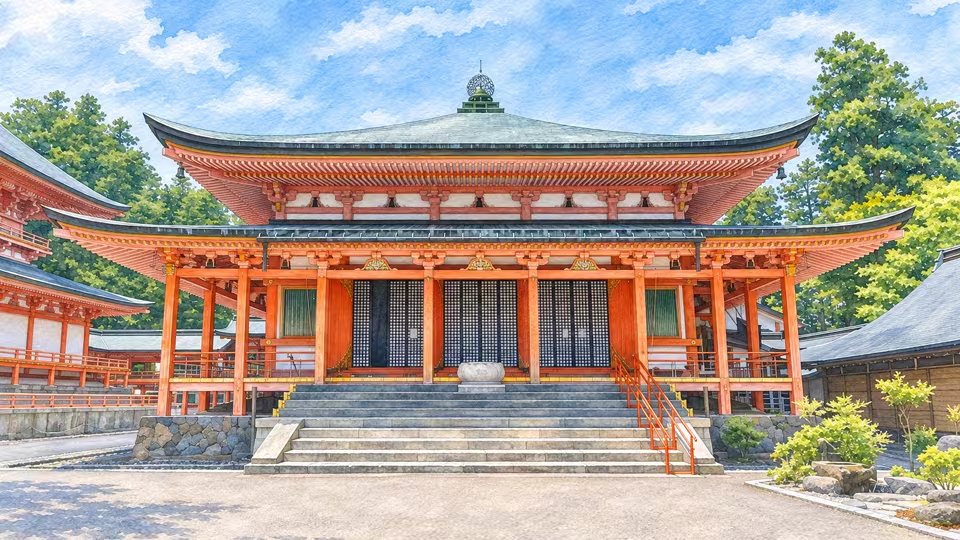
The present Konpon Chūdō was rebuilt on the orders of the third shogun, Tokugawa Iemitsu, after the earlier rebuilt hall collapsed in a storm in 1631. The new hall is officially dated to 1640; the temple and many guides give 1642. The hall is a National Treasure, and the corridor that encloses its courtyard is an Important Cultural Property. Several other Edo-period buildings, including the Ordination Hall in the Eastern Pagoda precinct and the paired halls in the Western Pagoda precinct, are Important Cultural Properties.
The Meiji government’s separation of Shinto and Buddhism after 1868 cut the old ties between Enryaku-ji and Hiyoshi Taisha. In the twentieth century fire struck again. Yokawa Chūdō was destroyed by lightning in 1942 and rebuilt in 1971. The Great Lecture Hall of the Eastern Pagoda burned in 1956 and was replaced by moving a hall built in 1634 for the Tōshōgū shrine at Sakamoto.
In 1994 Enryaku-ji was inscribed on the UNESCO World Heritage List as part of the Historic Monuments of Ancient Kyoto. In 2016 the Konpon Chūdō entered a major restoration. The copper roof of the main hall has been entirely re-covered, and work continues on the wooden-board roof of the corridor and the painted interior. While the work goes on the interior may be closed for periods, with the proxy Yakushi image and the undying lamp moved to the nearby Manpai-dō.
11The Marathon Monks and the Undying Lamp
Enryaku-ji is still a place of practice. Saichō’s twelve-year retreat is still kept: a monk serving as jishin, attendant to the founder, stays at Jōdo-in for twelve years without leaving the mountain, tending Saichō’s tomb.
Better known is the kaihōgyō, "circling the mountain," attributed to Sōō, a disciple of Ennin who founded Mudō-ji on the southern slope. Practitioners wearing white robes, straw sandals and a distinctive hat leave in the middle of the night and walk a circuit of about thirty kilometers in the early years, longer later on, stopping to pray at hundreds of sacred sites. The full practice of a thousand days is spread over seven years. After the seven-hundredth day the practitioner undergoes the dōiri, nine days in a hall at Mudō-ji without food, water, sleep or lying down, chanting the mantra of the deity Fudō. Only about fifty monks are recorded as having completed the thousand days since Nobunaga’s fire.
Inside the Konpon Chūdō burns the Fumetsu no Hōtō, the "lamp of the Dharma that never goes out," said to have been lit by Saichō. In fact the flame was lost in 1571. According to the usual account, when the hall was rebuilt it was relit from Risshaku-ji, the mountain temple at Yamadera in present-day Yamagata Prefecture, which tradition says Ennin founded in 860 and which had received a share of the flame from Hiei. Monks add oil every day.
12Walking the Mountain
Most visitors begin at the Eastern Pagoda. The Konpon Chūdō is the center. When the interior is open, the outer area where you stand is raised; the inner sanctuary lies well below it, a dim space where the lamps hang before the closed shrine of the Yakushi image. The arrangement, with the sacred images at the level of the officiating monks and below the worshippers, is characteristic of Tendai main halls. The main image is a hidden Buddha and is not normally shown. If the interior is closed for the restoration, you can see the proxy image and the lamp at the Manpai-dō.
Up the stone steps opposite is the Monju-rō, a two-story gate. Beyond is the Great Lecture Hall, which displays portraits of the founders who trained on the mountain, Hōnen, Shinran, Eisai, Dōgen, Nichiren and others. Nearby is the Kaidan-in, the Ordination Hall, an Edo-period Important Cultural Property and the descendant of the platform Saichō fought for and never saw. The Amida Hall and the Hokke Sōji-in Tōtō pagoda are twentieth-century reconstructions. The Kokuhō-den museum holds the temple’s treasures.
A path leads north through the cedars to the Western Pagoda, about twenty minutes on foot. Along the way is Jōdo-in, Saichō’s tomb, its grounds swept spotless. Then come two identical halls joined by a corridor, the Jōgyō-dō and Hokke-dō, nicknamed the Ninai-dō, "the halls carried on a pole," after a legend that the warrior monk Benkei once shouldered them. Farther down is the Shaka Hall, the Tenbōrin-dō, the oldest building on the mountain. Because it stood at Onjō-ji in 1571, it escaped Nobunaga’s fire. A small late-Muromachi hall in the Western Pagoda area, the Ruri-dō, is said to be the only building on the mountain that survived it.
Yokawa lies several kilometers farther north, reached by the mountain bus. Its Chūdō, rebuilt in 1971, has the profile of a ship. Nearby are the Ganzan Daishi Hall, where Ryōgen lived and where visitors still draw fortune slips, and the Eshin-dō, associated with Genshin. Yokawa is quieter than the other precincts, and it is the best place to feel what a monastic mountain once was.
If you go down on the Sakamoto side, you come to Hiyoshi Taisha and the old town of Sakamoto, where retired monks once lived in residences called satobō. Its walls of fitted stone were built by the Anō stonemasons, whose techniques were later used in the stone foundations of castles across Japan.