
01The View from the Pond
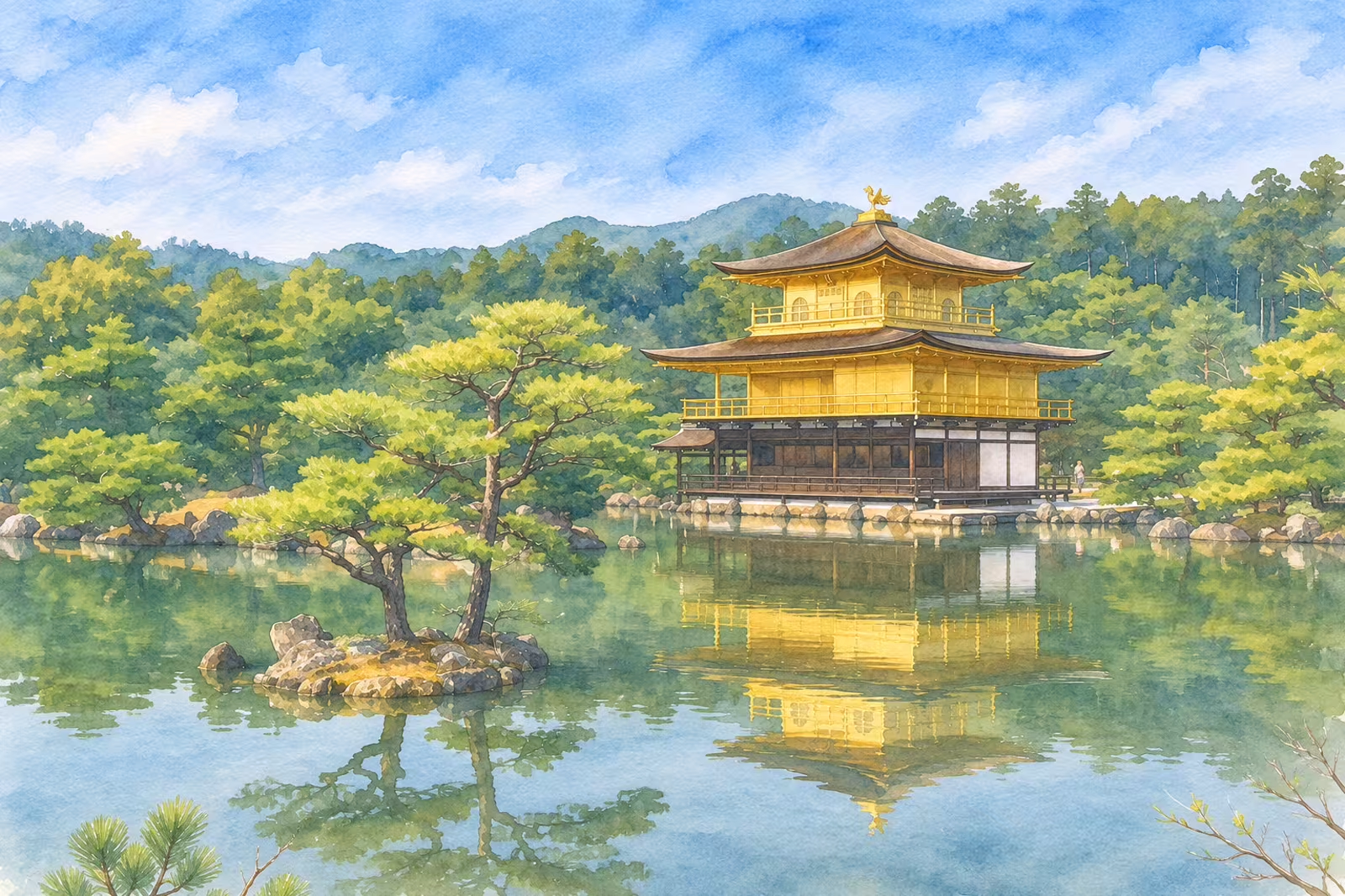
You come through the gate, follow the path for a minute, and then the trees open onto a still pond. On the far side stands a three-story pavilion, its upper two floors covered in gold leaf, its reflection lying almost unbroken on the water. This is the view on every postcard, and almost every visitor sees Kinkaku-ji first from exactly this spot.
The temple’s formal name is Rokuon-ji, "Deer Park Temple," and it belongs to the Shōkoku-ji branch of Rinzai Zen. "Kinkaku," the Golden Pavilion, was originally a nickname for the building alone, and it came to stand for the whole temple. The pavilion’s own name is the Shariden, the Relic Hall, because its top floor was made to house relics of the Buddha.
The building in front of you is not six hundred years old. It was rebuilt in 1955, after a young monk burned the original to the ground in 1950, and its gold was replaced again in the 1980s. What has lasted is the setting: the pond, its islands and rocks, and the line of Mount Kinugasa behind. To understand why this place exists, you have to go back before it was a temple at all, to when it was the private estate of a court noble, and then the palace of the most powerful man in Japan.
02A Court Family’s Villa
In the thirteenth century this stretch of hillside north of Kyoto belonged to Saionji Kintsune, a court aristocrat. The Saionji family held an unusual position: they were the court’s official go-between with the Kamakura shogunate, the warrior government in the east. That role brought them both rank and wealth. In the 1220s Kintsune built a villa here together with a family temple called Saion-ji, which gave the family its name.
Court literature of the period describes the estate, known as Kitayama-dai or the "Northern Hills residence," as one of the most lavish in the capital, with halls, a pond and a waterfall. The pond garden you see today probably reuses parts of that earlier landscape.
The Saionji fortunes did not survive the fall of the Kamakura shogunate in 1333. In 1335 Saionji Kimimune was accused of plotting to kill Emperor Go-Daigo and was executed. The family continued, but the northern villa slowly decayed. Sixty years later it found a new owner.
03Yoshimitsu Moves North
Ashikaga Yoshimitsu was the third shogun of the Muromachi shogunate, the warrior government based in Kyoto. He inherited the title as a child and spent his career consolidating power. In 1392 he brought an end to more than half a century of rival imperial courts, the Northern and Southern Courts, when the southern emperor handed over the imperial regalia and the two lines were reunited.
At the very end of 1394 by the Japanese calendar (January 1395 in ours), Yoshimitsu handed the office of shogun to his eight-year-old son Yoshimochi and took for himself the post of Grand Chancellor (daijō daijin), the highest office in the civil court. Within six months he resigned that too and took Buddhist vows, eventually under the name Dōgi. Retirement and ordination did not mean stepping back. He gave up titles, not authority.
In 1397 Yoshimitsu acquired the old Saionji estate, reportedly in exchange for lands in Kawachi province, and began building on a grand scale. He moved in two years later, and the Shariden was finished at about the same time. The new complex, Kitayama-dono, was not a country retreat. It became his residence, his audience hall, his venue for Buddhist ceremonies and banquets, and in practice the center of government. The shogun’s official palace in the city, the "Palace of Flowers," was left to Yoshimochi.
Kitayama-dono contained a main hall, reception halls, chapels and many other buildings. The Shariden was only one of them. Standing at the pond today, you are looking at one corner of a much larger palace whose other buildings have long gone.
04Three Floors, Three Styles
The pavilion is famous for using a different architectural style on each floor.
The ground floor, called the Hōsui-in, follows shinden style, the domestic architecture of the Heian aristocracy, with plain wood and shutters that open onto the water. It was never gilded. The second floor, the Chōon-dō, is built in the style of a warrior residence and houses an image of Kannon, the bodhisattva of compassion; its exterior is covered in gold. The top floor, the Kukyōchō, is in the Zen style imported from China, with bell-shaped windows, gold inside and out, and it held the relics. A gilt bronze phoenix stands on the roof.
Guides often read this as a statement of Yoshimitsu’s position: courtier at the bottom, warrior in the middle, Buddhism at the top. It is a tidy reading, and it may be more tidy than the builders intended. What the stacked styles do show is that Yoshimitsu moved among three worlds at once: he led the warrior class, held the highest rank in the imperial court, and was the greatest patron of the Zen monasteries.
The pavilion was also meant to be used, not only looked at. With the pond, the islands and the surrounding halls it formed a setting for boating parties, poetry, music and Buddhist rites. Approaching by boat, or sitting on the ground-floor veranda just above the water, was how it was first experienced.
05Diplomacy and an Emperor’s Visit
The most important events at Kitayama-dono were about authority.
In 1401 Yoshimitsu sent an embassy to Ming China. The following year Chinese envoys came back with his returning mission, carrying a letter from the Jianwen Emperor that addressed him as "King of Japan"; Yoshimitsu’s reply styled him "your subject, the King of Japan." Over the next few years Ming and Korean envoys were received at Kitayama-dono several times. From 1404 official trade followed, conducted under a system of tallies, called kangō, that identified licensed ships. Copper coins, silk, books and paintings flowed into Japan, and the trade made Yoshimitsu very rich.
Accepting the title "King of Japan" meant entering the Chinese tributary order as a subordinate of the Ming emperor. The Ming restricted foreign trade to rulers who sent tribute and acknowledged the emperor as their overlord, so there was no other way to open official commerce. Yoshimitsu had tried before. In the 1370s he sent two missions in the shogunate’s name, and both were turned away, in part because a shogun was a servant of the emperor and had no standing to deal with the Son of Heaven. The Ming had also already recognized Prince Kaneyoshi, the Southern Court’s commander in Kyūshū, as "King of Japan." Only in 1401, with the courts reunited and Yoshimitsu writing as a retired, ordained grandee rather than as shogun, did the approach succeed.
The terms troubled people at the time. Zuikei Shūhō, a Zen monk of the mid-fifteenth century who compiled the diplomatic anthology Zenrin kokuhōki, criticized Yoshimitsu’s letters for calling himself a subject and for using the Ming reign name. Yoshimitsu’s son Yoshimochi turned away a Ming envoy in 1411 and suspended the tribute missions, and distaste for the subordinate form is usually counted among his reasons; the sixth shogun, Yoshinori, resumed them in 1432. From the Edo period onward, and above all in the emperor-centered histories and school textbooks of the late nineteenth and early twentieth centuries, Yoshimitsu became a byword for selling out the nation’s dignity.
Since the later twentieth century historians have tended to read the episode within the East Asian order of its time. The title was for use abroad; Yoshimitsu never called himself king at home, and the court and the emperor carried on as before. What subordination bought was trade revenue and a diplomatic channel that he alone controlled: it was he, not the emperor, who dealt with China. That is also why the title is often linked with the usurpation theory discussed below. Some see it as Yoshimitsu building an authority alongside the throne; others see nothing more than a practical route to trade. Both views still have defenders.
In the spring of 1408 Emperor Go-Komatsu visited Kitayama-dono and stayed for many days. Yoshimitsu staged the visit lavishly, and his favorite young son, Yoshitsugu, was conspicuous throughout. The following month Yoshitsugu, still in his early teens, came of age in a ceremony at the imperial palace modeled on that of an imperial prince, and was immediately given senior court rank.
These episodes are the basis of a well-known theory that Yoshimitsu meant to place Yoshitsugu on the throne and replace the imperial line with his own. The theory has been popular, but contemporary court diaries offer no direct evidence for it, and most recent scholarship rejects it. What is clear is that Yoshimitsu gathered warrior, court and religious authority into his own hands, and Kitayama-dono was where he displayed it.
A few weeks after the emperor left, Yoshimitsu fell ill with a respiratory illness. He died at Kitayama-dono on May 31, 1408 (Julian calendar), aged forty-nine. The court proposed to honor him with the title of retired emperor; Yoshimochi declined it, citing the lack of precedent.
06From Palace to Temple
Yoshimochi did not move into his father’s palace. Relations between them had been cool, and he reversed several of Yoshimitsu’s policies, eventually suspending the tribute trade with China. Most of the buildings at Kitayama were dismantled and given to other temples, and the palace disappeared within a few years.
In accordance with Yoshimitsu’s wishes, the part containing the Shariden became a Zen temple in 1420, named Rokuon-ji after his posthumous Buddhist name, Rokuon-in. Its nominal founder was the great Zen master Musō Soseki, who had died before Yoshimitsu was born; naming an honorary founder in this way was a common practice that tied a temple to a respected lineage. Rokuon-ji was attached to Shōkoku-ji, the monastery Yoshimitsu had founded in Kyoto, and it remains part of that network today.
So the surviving piece of a shogun’s palace became a temple that prayed for his soul. That change is the main reason the pavilion lasted. Palaces were taken apart when their owners died; temples had communities whose job was to keep them.
07Wars, Imitators and Repairs
The Ōnin War, which began in 1467 and lasted a decade, left much of Kyoto in ashes. The temple grounds served as a camp for the Western army, and many of its buildings burned, but the Shariden survived.
Yoshimitsu’s grandson Yoshimasa, the eighth shogun, later built his own retreat in the eastern hills, modeled on Kitayama-dono. Its pavilion, the Kannon Hall, is now known as Ginkaku, the Silver Pavilion, though it was never covered in silver; the name appeared in the Edo period as a counterpart to Kinkaku. The two buildings are often used to contrast the showy culture of Yoshimitsu’s time with the quieter taste of Yoshimasa’s.
In the seventeenth century the temple was restored under abbots such as Hōrin Shōshō, whose decades-long diary, the Kakumeiki, is a major source for cultural life in early Edo-period Kyoto. The Sekka-tei teahouse near the exit is said to have been built for Hōrin by the tea master Kanamori Sōwa to receive the retired Emperor Go-Mizunoo; the original burned in the early Meiji years, and the present building dates from 1874.
After the Meiji Restoration the temple lost most of its landholdings, and from 1894 it opened the garden and pavilion to the public for an admission fee. Between 1904 and 1906 the government carried out a full dismantling and repair of the Shariden. The measured drawings and records made then would prove essential half a century later. In 1929 the pavilion was designated a National Treasure.
08The Fire of 1950
In the early hours of July 2, 1950 the Shariden caught fire and burned completely, along with the statue of Yoshimitsu kept inside. The fire had been set by Hayashi Yōken, a twenty-one-year-old trainee monk at the temple and a student at Otani University.
Hayashi was born in 1929 in Nariu, a village on the Japan Sea coast now part of Maizuru; his father, the priest of the local temple, had died before the fire. He had a severe stammer and few friends. After setting the fire he climbed Hidari-Daimonji, the hill behind the temple, took an overdose of sleeping pills and stabbed himself, but survived and was arrested. His explanations of why he did it shifted: resentment of beauty, anger at the temple’s commercialism, despair at his own situation. In December 1950 he was sentenced to seven years, later reduced under an amnesty. He developed tuberculosis and mental illness in prison, was released straight into hospital in October 1955, and died in March 1956, aged twenty-six. His mother, summoned to Kyoto the day after the fire, threw herself from the train near the Hozu gorge on her way home.
The fire shocked the country. Mishima Yukio turned it into his novel The Temple of the Golden Pavilion (1956), an interior study of a young man’s obsession with beauty that became one of his best-known works. Mizukami Tsutomu spent years researching Hayashi’s life and wrote about him in fiction and in the non-fiction Kinkaku Enjō ("The Burning of the Golden Pavilion"), focusing on poverty, disability and family. The two treatments see the same event very differently, and they are still read side by side.
09Rebuilt in Gold
Funds were raised quickly, and in 1955 the Shariden was rebuilt using the drawings from the Meiji repair.
The rebuilders faced an awkward fact: before the fire the Golden Pavilion had not looked very golden. By then, gold leaf survived on the exterior only on the top floor; none was visible on the second. The rebuilders, working from their judgment of the original design, gilded both upper floors. The pavilion you see is therefore far brighter than the weathered building that people actually saw for centuries; how closely it matches Yoshimitsu’s own can only be inferred.
The gold applied in 1955 was thin and soon dulled. In 1986–87 the temple carried out a major restoration using leaf about five times the normal thickness: some 200,000 sheets, about twenty kilograms of gold, at a cost of around 740 million yen. The shine you see today dates from that work. The cypress-shingle roof has been replaced periodically since.
As a reconstruction, the pavilion could not regain National Treasure status. The garden, however, was designated a Special Historic Site and Special Place of Scenic Beauty, and in 1994 Rokuon-ji was inscribed on the UNESCO World Heritage List as part of the Historic Monuments of Ancient Kyoto.
10Walking the Route
The visitor route runs one way: around the pond past the pavilion, then up the hill and back down.
The pond, Kyōko-chi, "Mirror Pond," contains several islands, including Ashiwara-jima and the Crane and Turtle islands, and many named rocks said to have been presented by provincial lords. One, the Kusen-hakkai stone, takes its name from the "nine mountains and eight seas" of Buddhist cosmology.
Passing behind the pavilion you can see the ground floor and the eaves at close range. North of the abbot’s quarters is a pine trained into the shape of a boat, the "land-boat pine," said to have been planted by Yoshimitsu himself and counted among the three great pines of Kyoto. Further up is a small waterfall, the Ryūmon-baku or Dragon Gate Falls, with a "carp stone" at its base, referring to the legend of the carp that leaps the falls and becomes a dragon, a metaphor for effort in Zen training.
Along the path are the spring where Yoshimitsu supposedly drew water for tea and another where he washed his hands; these "Yoshimitsu used it" stories are temple lore and best enjoyed as such. The small pond called Anmin-taku is said to preserve part of the Saionji-era garden, and the white-snake mound on its island is said to honor the Saionji family’s guardian deity.
Near the exit is the Sekka-tei teahouse, whose name means something like "best at evening," for the view of the pavilion in late light, and beyond it the Fudō-dō, a small hall dedicated to the guardian deity Fudō Myōō. It is said to have been rebuilt by the warlord Ukita Hideie in the late sixteenth century and is the oldest building standing in the grounds.
11What You Are Looking At
Kinkaku-ji is often presented as a pure image of Japanese beauty. Behind it, though, is a particular man who wanted particular things. Yoshimitsu wanted to gather the authority of warriors, court and monasteries into himself, and to be seen doing it. Kitayama-dono was built for that purpose, and the gold was part of the display.
When he died, his son took the palace apart and its political meaning vanished with it. The pavilion that remained survived as part of a temple through civil war and centuries of decline, was destroyed by a troubled young man in the twentieth century, and was rebuilt by public subscription. What stands by the pond today combines Yoshimitsu’s design, Meiji-era surveys, the 1955 reconstruction and the gold of 1987.
Standing at the water’s edge, you are looking at one man’s ambition at the end of the fourteenth century, and at the many later decisions to keep it.