
01The Platform Over the Trees
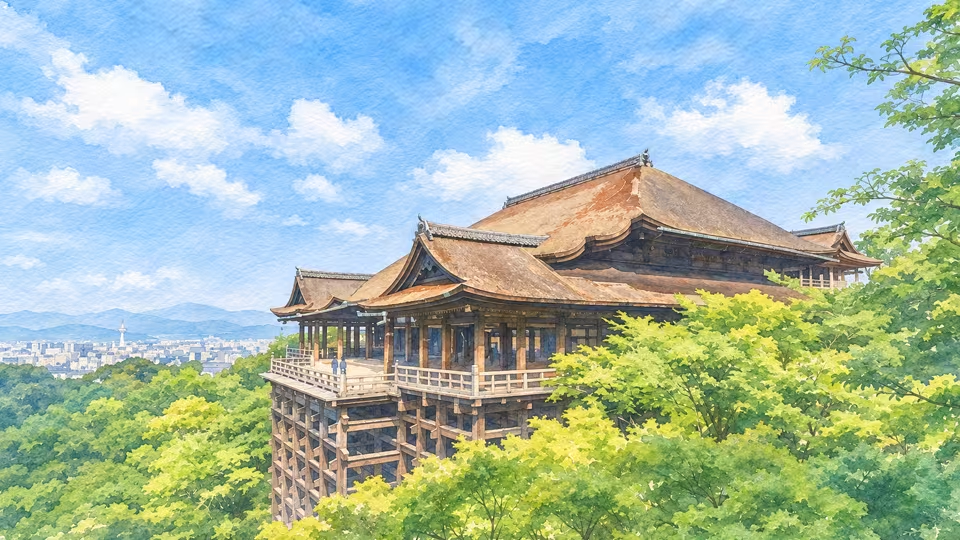
Most visitors reach Kiyomizu-dera the same way: up Kiyomizu-zaka, the steep shopping street lined with pottery and sweets shops, through the vermilion Niōmon gate, past a three-storied pagoda, and finally onto a broad wooden deck that seems to float over a wooded ravine. Below you is a slope of maple and cherry trees. Beyond them lies the city of Kyoto, flat and gray, ringed by mountains. This deck is the butai, the "stage" of Kiyomizu, and it is the image most people carry away from the temple.
The stage is not a separate viewing platform. It is the front of the Main Hall (Hondō), which sits on the western face of Mount Otowa, one of the hills of the Higashiyama range on Kyoto’s eastern edge. Half the hall rests on solid ground; the other half projects over the slope on a scaffold of massive zelkova pillars. This building technique, called kakezukuri ("hanging construction"), was used for mountain temples across Japan, but nowhere on this scale. The lattice of pillars and crossbeams holds together without nails.
The hall you see is not as old as the temple’s history. Kiyomizu-dera traces its founding to 778, but fire destroyed it many times. The present Main Hall was rebuilt in 1633 with funds from the third Tokugawa shogun, Tokugawa Iemitsu. It was designated a National Treasure in 1952, and the temple was inscribed as part of the "Historic Monuments of Ancient Kyoto" World Heritage Site in 1994.
The temple’s story runs along three threads. One is devotion to Kannon, the bodhisattva of compassion, for whom the temple was built. One is Sakanoue no Tamuramaro, the general who fought the peoples of northern Japan and who is honored here as the temple’s patron founder. The third is the people of Kyoto, who for a thousand years have climbed this hill to pray, to drink the spring water, and to look at the view.
02A Monk, a Hermit, and a Spring
The founding is told in the temple’s own legends, chiefly the Kiyomizudera engi (the temple’s origin chronicle). Like most such accounts, it mixes history with miracle.
According to the story, in 778 a monk named Kenshin from Kojima-dera, a temple in Yamato province near Nara, had a dream telling him to go north in search of clear water. He traveled to Mount Otowa in Yamashiro province, where he found a spring falling from the rocks. Beside it lived an old hermit dressed in white who called himself Gyōei Koji ("Gyōei the lay practitioner") and said he had long been waiting for Kenshin to arrive. The hermit gave Kenshin a piece of sacred wood, asked him to carve an image of Kannon from it, and then walked off to the east and was never seen again. Kenshin came to believe the old man had been Kannon in human form. Kenshin later took the name Enchin and is revered as the temple’s founding monk.
The spring is the Otowa Waterfall, which still runs beneath the Main Hall, and it gave the temple its name: kiyomizu means "pure water." Today the water falls in three thin streams from a stone channel, and visitors line up with long-handled cups to drink. A popular modern explanation assigns each stream a benefit, such as success in study, luck in love, or long life. The temple itself presents the water simply as pure and sacred, and asks that visitors drink from one stream only.
03The General and His Wife
The second figure in the story is Sakanoue no Tamuramaro (758–811), one of the most famous soldiers of early Heian Japan.
The legend says that in 780 Tamuramaro came to Mount Otowa hunting deer, because he wanted venison to help his pregnant wife regain her strength. At the spring he met Enchin, who told him that killing living things was a grave sin. Tamuramaro went home moved by the encounter and told his wife, Miyoshi no Takako. She too turned to Kannon, and the couple donated their own residence, which was taken apart and rebuilt on the mountain as a hall for the Thousand-Armed, Eleven-Headed Kannon that Enchin had carved.
Tamuramaro went on to a career that made him a legend in his own right. Under Emperor Kanmu, the court waged repeated campaigns against the Emishi, the peoples of northeastern Honshū who resisted rule from the capital. In 797 Tamuramaro was appointed sei-i taishōgun, "great general who subdues the barbarians," the title later used by the shoguns of the samurai era. In 802, while he was building Isawa Castle in Mutsu province, the Emishi leaders Aterui and More surrendered to him with their followers. Tamuramaro brought them to the capital and asked that they be spared and sent home to keep the peace, but the court nobles refused, and the two men were executed in Kawachi province.
According to temple tradition, in 798 Tamuramaro and Enchin rebuilt the Main Hall. In 805 a decree from the Council of State granted the temple grounds to Tamuramaro, giving the temple official standing, and in 810 Emperor Saga sanctioned it as a place of prayer for the protection of the state, traditionally under the name Kita Kannon-ji. The story that Tamuramaro prayed here before his campaigns and won through Kannon’s protection comes mainly from the temple’s own legends and later Noh drama. Tamuramaro is remembered as the temple’s hongan, its founding patron. The Tamura-dō, also called the Founder’s Hall, still holds images of Tamuramaro, his wife, and Enchin.
In 1994, the 1,200th anniversary of Kyoto’s founding as capital, a monument to Aterui and More, inscribed "Heroes of the Northern Sky," was erected on the temple grounds to console the spirits of the two leaders whose lives Tamuramaro had failed to save. It stands near the Main Hall, so that the conqueror and the conquered are now remembered on the same hillside.
04Court Ladies and Kannon
During the Heian period (794–1185), Kannon worship spread widely among the aristocracy. Kiyomizu was close to the capital, and its Kannon had a reputation for answering prayers. Aristocratic women in particular came here for sanrō, retreats in which a worshipper stayed in the hall for days or weeks, chanting sutras and hoping for a sign from Kannon in a dream.
Sei Shōnagon, the court lady who wrote The Pillow Book around the year 1000, describes the crowded, noisy atmosphere of a retreat at Kiyomizu, with chanting and people coming and going through the night. Kiyomizu also appears in The Tale of Genji and in many miracle stories in the Konjaku Monogatari-shū, a twelfth-century collection of tales. Later, the Noh plays Yuya and Tamura were set here; Tamura retells Tamuramaro’s campaigns as a story of Kannon’s protection.
This religious life explains the stage. It was built as a place to offer music and dance to Kannon, whose image sits inside the hall facing out across it. The two wings that flank the stage are generally thought to have been where musicians sat. The butai was a stage for the bodhisattva’s eyes first, and a scenic overlook second.
The stage appears early in the written record. A twelfth-century anecdote tells how Fujiwara no Narimichi, a courtier famed for kemari (the aristocratic game of keeping a ball in the air with the feet), walked the length of the stage railing while kicking a ball. Later, the Gikeiki, a fourteenth- or fifteenth-century tale of the warrior Minamoto no Yoshitsune, set the duel between Yoshitsune and the giant monk Benkei on the stage at Kiyomizu; Benkei loses and becomes Yoshitsune’s loyal follower. The scene is fiction, but its setting shows how famous the stage already was.
05Caught Between Nara and Mount Hiei
Kiyomizu-dera belonged to the Hossō school of Buddhism and was for centuries a branch temple of Kōfuku-ji in Nara. That affiliation made it a target.
In the late Heian period, Kōfuku-ji and Enryaku-ji, the great Tendai monastery on Mount Hiei northeast of Kyoto, were rivals with armed forces of their own, the warrior-monks known as sōhei. Kiyomizu was Kōfuku-ji’s foothold in the capital, and it lay within easy reach of Hiei. In 1165, at the funeral of Retired Emperor Nijō, monks of the two temples quarreled over the order in which their temple plaques were to be displayed. In the aftermath, warrior-monks from Enryaku-ji descended on Kiyomizu and burned it. The episode is told in the first book of The Tale of the Heike. The temple’s own illustrated origin scrolls later added a miracle: the principal Kannon image flew out of the burning hall and came to rest in a cypress tree. Similar attacks followed in later decades.
The worst destruction came with the Ōnin War (1467–1477), the conflict between rival lords that devastated Kyoto. In 1469 fighting in the Higashiyama hills left Kiyomizu almost entirely in ashes.
06Rebuilding by Donation
The recovery after the Ōnin War was led by a monk named Gan’ami, a fundraising priest known as a kanjin hijiri. Such priests traveled through towns soliciting donations from anyone who would give, from warlords to street vendors, and organized ordinary people to contribute labor. Gan’ami began rebuilding the Main Hall and other structures in the 1470s, though he died before the work was finished.
This kind of fundraising changed the temple’s relationship with the city. Kiyomizu came to depend on the small gifts of many people rather than on aristocratic patronage, and it became one of the most popular temples among commoners. The sub-temple Jōju-in, said to have grown out of Gan’ami’s lodging, later took charge of temple administration and finances. The Niōmon gate and the Umatodome stable beside it date from the first half of the sixteenth century; they survived the next great fire and are the oldest buildings standing today.
07Iemitsu’s Kiyomizu
In 1629 a fire destroyed the Main Hall and much of the temple. The Tokugawa shogunate, which was restoring Kyoto’s great religious institutions as a show of authority and piety, paid for the reconstruction. Between 1631 and 1633 the West Gate, the Shaka-dō, the Three-Storied Pagoda, the Main Hall, the Okunoin, the Sutra Hall, and other buildings were completed. Most of what you see today comes from this campaign.
Including its side wings, the Main Hall measures roughly 36 meters across and about 30 meters deep. Its hipped roof is covered with layers of cypress bark (hiwadabuki), giving it a soft, low silhouette. Inside, the outer sanctuary is open to worshippers, while the inner sanctuary holds the principal image, an Eleven-Headed, Thousand-Armed Kannon kept in a closed shrine. It is a hibutsu, a "secret Buddha," shown to the public only once every 33 years.
The stage stands on eighteen zelkova pillars, the longest about 12 meters, and its floor of some 166 cypress boards is about 13 meters above the ground, roughly the height of a four-story building. The pillars are linked by horizontal tie-beams called nuki that pass through them, forming a rigid grid fixed by joinery and wedges. The structure has enough flexibility to ride out earthquakes.
The Three-Storied Pagoda, rebuilt in 1632, rises about 30 meters, making it one of the tallest three-storied pagodas in Japan. The West Gate, built in 1631, looks straight out over the city to the west and was once a place to watch the sunset and contemplate the Western Paradise of Amida Buddha.
08"Jumping From the Stage at Kiyomizu"
Japanese has an idiom, Kiyomizu no butai kara tobioriru, "to jump from the stage at Kiyomizu," meaning to take a bold plunge. It began as a literal practice.
In the Edo period (1603–1868), a popular belief held that if you leapt from the stage with a wish in your heart and survived, the wish would be granted; if you died, you would be reborn in paradise. The diary kept by Jōju-in recorded these incidents. Researchers counting the entries found about 234 jumpers over roughly 170 years from the mid-Edo period to the 1860s; some 34 died, a survival rate of about 85 percent. Most were commoners from Kyoto and its surroundings.
The slope beneath the stage was then covered with trees and soft earth, which explains why so many lived. In 1872 Kyoto Prefecture banned the practice, and it faded away.
09Gesshō and the End of the Shogunate
Kiyomizu also has a place in the drama of the 1850s. Gesshō, a former head priest of Jōju-in who had handed the post to his younger brother Shinkai in 1854, was a supporter of the movement to restore imperial rule and expel foreigners, and a close friend of Saigō Takamori of Satsuma domain. When the shogunate launched the Ansei Purge in 1858 to crush its opponents, Gesshō became a wanted man. Saigō escorted him to Satsuma, but the domain refused to shelter him. With no way out, the two men threw themselves into Kagoshima Bay together. Saigō was pulled from the water and survived; Gesshō died. He was 46 by the traditional Japanese count. Shinkai was later arrested in the purge and died in prison.
A monument on the temple grounds commemorates Gesshō, Shinkai, and Saigō. The garden of Jōju-in, known as the "Moon Garden," borrows the hill behind it as scenery, is a designated Place of Scenic Beauty, and is opened to the public only for limited periods.
10The Modern Temple
The separation of Shinto and Buddhism ordered by the Meiji government in 1868 hit Kiyomizu hard. Its parent temple Kōfuku-ji was devastated, government orders confiscated most of Kiyomizu’s lands, and the move of the capital to Tokyo took away many patrons. Sub-temples were merged. During the anti-Buddhist wave, townspeople carried stone Buddhas from their neighborhoods to the temple for safekeeping; they now stand together as the Thousand Stone Buddhas. Recovery began in 1875 under a new abbot, Sonobe Ninkei, and after the 1897 law for the preservation of old shrines and temples the Main Hall underwent major repairs, completed in 1902. Jishu Shrine, the shrine to the local deity that had long been part of the temple complex, became an independent Shinto shrine.
In the twentieth century the temple recovered. In 1965 it left the Hossō school and founded its own, the Kita Hossō school, with Kiyomizu-dera as head temple. Ōnishi Ryōkei, abbot from 1914 and the leader of the revival, died in 1983 at the age of 107.
Since 1995 the Japan Kanji Aptitude Testing Foundation has announced its "Kanji of the Year" at Kiyomizu each December. The temple’s chief abbot, Mori Seihan, brushes the character in giant form at the temple, and the event has become one of Kyoto’s year-end rituals.
From 2008 the temple carried out a long program of repairs to its halls and pagodas. The most visible part was the replacement of the Main Hall’s cypress-bark roof, which kept the hall wrapped in scaffolding from 2017 until 2020.
11Walking the Grounds
Begin at the Niōmon. Guardian figures stand in its side bays, and the stone lion-dogs in front are unusual: both have open mouths, rather than the usual pairing of one open and one closed. Beside the gate is the Umatodome, a stable where visiting nobles once tied their horses, a rare surviving Muromachi-period structure.
Beyond the gate are the West Gate and the pagoda, then the Sutra Hall and the Tamura-dō. The Zuigu-dō, built in 1735, offers the tainai meguri: you walk in total darkness through a basement passage, guided only by a rope of large prayer beads, until you reach a stone carved with a Sanskrit letter that is lit from above. The experience represents rebirth in the womb of a bodhisattva.
Pass through the Todoroki-mon gate into the Main Hall. The interior is dim, with the inner sanctuary at the center. Step onto the stage and look ahead and to the left: the small platform of the Okunoin, across the ravine, is where the famous photographs of the Main Hall are taken.
North of the Main Hall is Jishu Shrine, once the temple’s guardian shrine and popular with those praying for a good match. It has two "love-fortune stones" set some distance apart; walking from one to the other with your eyes closed is said to bring success in love. The shrine has been closed since 2022 for restoration work.
From the Main Hall, follow the path past the Shaka-dō and Amida-dō to the Okunoin, then descend the steps to the Otowa Waterfall. From below, look up at the stage: only from here do you see the full forest of pillars holding it up. A short walk south leads to the Koyasu Pagoda, dedicated to a Kannon who protects childbirth. Its viewpoint shows the whole hanging structure against the hillside, the clearest picture of how the hall and the valley fit together.