
In premodern Japan a disaster was rarely only a natural event. Epidemics emptied the court, fires reshaped cities, and famines brought down reputations and set off riots. The ten sections below run in chronological order, from an epidemic that began around Dazaifu in 735 to the Tenpō famine of the 1830s. Nine of them follow a single disaster: smallpox, lightning and earthquakes, urban fire, volcanic eruption and crop failure. The seventh is different: it describes a response rather than one disaster, the town fire brigades Edo created from 1718 to cope with its repeated great fires.
The disaster sections describe what happened and then what the court, the shogunate, the domains and ordinary people did about it. The responses fall into three broad kinds: prayer, offerings, new era names and the appeasement of angry spirits; tax remission, relief rice and paid relief work; and, later, lasting institutions such as fire brigades and grain reserves. Death tolls for most of these events are estimates that vary widely, and they are given here with that caution.
01The Tenpyō Epidemic and the Four Fujiwara Brothers
In the eighth month of 735 the Shoku Nihongi recorded many deaths from disease around Dazaifu, and by the year’s end "pea sores," most likely smallpox, had spread across the realm. In 737 the epidemic reached nearly the whole country and the capital at Heijō; in the sixth month the court suspended its audience because so many officials were sick. Between the fourth and eighth months the four Fujiwara brothers who ran the government, Fusasaki, Maro, Muchimaro and Umakai, all died.
Emperor Shōmu blamed his own lack of virtue, ordering a review of imprisonments, burial of the dead, relief and an amnesty; the year’s taxes were remitted and nearly 1,000 monks and nuns ordained. In the sixth month the Council of State sent the provinces of six circuits a directive on nursing the sick: keep warm, rest, eat thin rice gruel, with relief for the poor from provincial stores. It is among the earliest government documents in Japan on an infectious disease. Tachibana no Moroe then led the court, and the epidemic formed the most direct background to Shōmu’s edict for the Great Buddha in 743.
02Calamity and a Resentful Spirit, 901–993
The Heian court had a familiar way to read unnatural deaths and epidemics: they might come from the wrongly condemned, and the remedy was to acknowledge the wrong, restore titles and offer worship. In 863 a goryōe at Shinsen’en sought to quell disease this way. Sugawara no Michizane was demoted to Dazaifu in 901 and died there in 903.
When Crown Prince Yasuakira died in the third month of 923, the Nihon kiryaku noted that people blamed Michizane’s resentful spirit. The next month the court restored him as Minister of the Right, raised his rank, annulled the edict of 901 and soon changed the era name. In the sixth month of 930, as officials met in the Seiryōden to discuss prayers for rain during a drought, lightning struck and killed Fujiwara no Kiyotsura and others; Emperor Daigo fell ill, abdicated and died. A shrine rose at Kitano around 947, the later Kitano Tenmangū, and in 993 Michizane was named Chancellor. Each death had ordinary causes, but the restored office, the annulled edict and the honors of 993 were real acts of government.
03The 995 Epidemic
According to the Nihon kiryaku, an epidemic arose in Kyūshū in the first month of 994, spread through the provinces and hit the capital hardest, killing "more than half" its people, a loose phrase; 67 officials of the Fifth Rank and above died. The court recited sutras, made offerings, declared amnesties and gave relief. Frightened by rumors of a plague deity in the streets, people stayed indoors and crowded to draw water from a well said to protect them, and a spirit-pacifying festival at Funaokayama is recorded as a popular initiative. The disease is usually identified as smallpox.
The era was changed to Chōtoku in the second month of 995, but in the fourth and fifth months the disease tore through the aristocracy. Michikane, made chancellor late in the fourth month, died of it early in the fifth, the "seven-day chancellor," and eight ministers and counselors died that year. With the top of the council emptied, Emperor Ichijō, pressed by his mother Senshi, gave Fujiwara no Michinaga the right to inspect documents, and in the sixth month Michinaga, thirty by the traditional count, became Minister of the Right. The epidemic reordered the regents’ succession within months.
04Drought, Disease, Summer Snow and Earthquake, 1360–1361
In the middle of the war between the Northern and Southern Courts, Kyoto suffered drought in 1359 and 1360, and from 1360 an epidemic spread. In the fifth month the court ordered the Onmyōdō rite at the four corners and borders. In the third month of 1361 the Northern Court changed the era to Kōan, citing pestilence, smallpox, celestial anomalies and war, so smallpox was probably part of the outbreak. In the sixth month Emperor Go-Kōgon sent a sutra copied in his own hand to the Gion Shrine, today’s Yasaka Shrine.
That same month snow fell in several places in the Kinai, and strong earthquakes brought down the wall of Hōryū-ji and the main hall of Shitennō-ji. Estate records report rotted wheat at Tara-no-shō and storm-flattened rice at Yano-no-shō, with losses varying from place to place. To the courtiers and monks who left records, drought, disease, earthquake and war were all signs of a disordered realm, met with the same tools: new era names, prayer, sutra reading and worship of plague deities. No reliable figures survive for deaths or rice prices.
05The Great Fire of Meireki
In the middle of the first month of 1657, fires broke out at Honmyō-ji, Koishikawa and Kōjimachi and burned for two days, destroying nearly everything inside the outer moat, most of the low-lying districts, and Edo Castle’s keep and its main, second and third enclosures. The fire brigades of the day protected only the castle and warrior quarters. Accounts of the dead range from about 37,000 to more than 100,000. The shogunate buried unclaimed bodies at Ushijima in Honjo, where the temple Ekō-in was founded. Hayashi Razan lost his house, his copper book storehouse and his books, and died days later.
The shogunate had four daimyo run gruel kitchens at six sites, distributing about 6,000 koku of rice, capped rice prices and granted 10,000 kan of silver to townspeople. Branch-house residences and temples were moved out, firebreaks and wide avenues laid out, Ryōgoku Bridge built and land east of the Sumida opened; standing fire brigades followed in the ninth month of 1658. The main palace was rebuilt by 1659, but the keep never was. Relief and reconstruction drained much of the shogunate’s early reserves.
06The Hōei Eruption of Mount Fuji
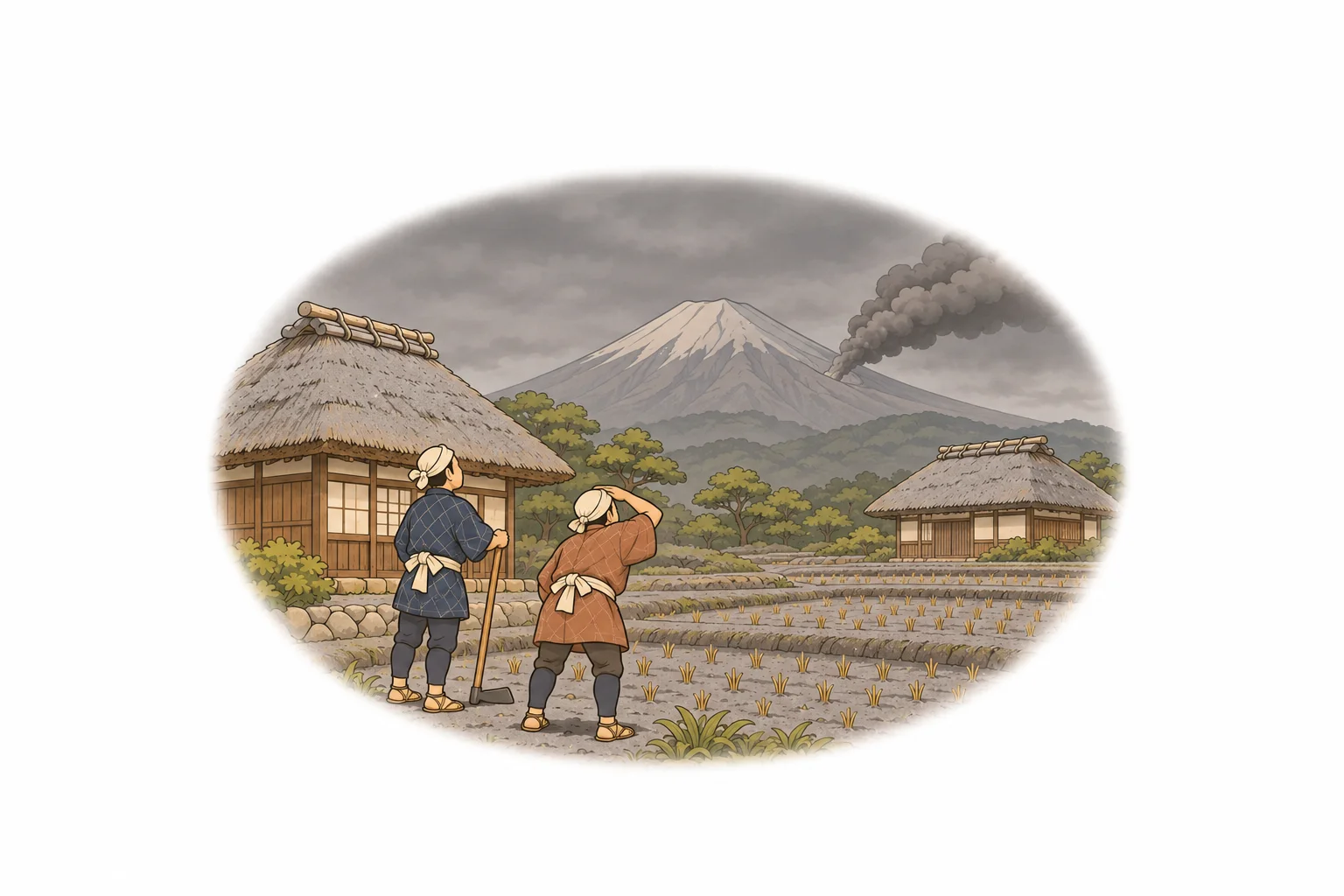
Early in the tenth month of 1707 the Hōei earthquake struck along the Nankai Trough, and its tsunami hit the Pacific coast from the Izu Peninsula to Kyūshū; more than 5,000 deaths can be counted with certainty. Forty-nine days later, late in the eleventh month, Fuji’s southeastern flank split open in an eruption that went on for sixteen days. Westerly winds carried the ejecta east: in Subashiri 37 houses burned and the other 39 collapsed, and Edo received 2 to 4 centimeters of ash. Arai Hakuseki remembered white ash falling like snow, then turning black. No record has been found of anyone killed directly by the eruption, but fields on the eastern slopes lay buried.
In the intercalated first month of 1708 the shogunate took more than 56,000 koku of Odawara land under direct rule, put the intendant Ina Tadanobu in charge of recovery, and levied 2 ryō per 100 koku across the country. The levy brought in 488,770 ryō, of which only about 62,500 can be confirmed as spent on the stricken area. Sand washed into the Sakawa River, the Ōguchi embankment broke in the sixth month, and floods followed almost every year.
07A City That Kept Burning: Edo’s Town Fire Brigades
The daimyo fire brigades made permanent in 1643 and the standing brigades of 1658 existed first to protect the castle and warrior quarters; commoner districts fought fires with whoever they could gather. Tokugawa Yoshimune became shogun in 1716 and in 1717 appointed Ōoka Tadasuke South City Magistrate. In 1718 an order required about six wards around any fire to send thirty men each, but a scheme based simply on counting wards caused constant confusion.
In 1720 the system was reorganized into forty-seven iroha brigades west of the Sumida and sixteen in Honjo and Fukagawa. An order that year encouraged plaster walls and tile roofs without requiring them, since converting a house was almost a rebuild. In 1730 the brigades were grouped into ten large divisions. By the later eighteenth century tobi laborers, who knew timber buildings and could pull them down in a fire’s path, formed their core. The town brigades did not spare Edo the great fires of 1772 and 1806, but firefighting in the commoner city had become a public duty.
08The Tenmei Famine
The Tenmei famine began with the poor harvest of 1782 and eased around 1788, and is generally thought the deadliest of the Edo period’s three great famines. In 1783 the cold yamase wind blew along the Pacific coast of Tōhoku, and many villages in the Morioka (Nanbu), Hachinohe and Hirosaki (Tsugaru) domains harvested almost nothing. Hirosaki kept shipping tax rice out before the harvest, local stocks ran out, and Aomori townspeople rioted; the domain recorded more than 81,000 deaths from hunger and disease between that autumn and the next summer.
Matsudaira Sadanobu, lord of Shirakawa from the tenth month of 1783, brought in grain from outside, and Uesugi Harunori of Yonezawa is said to have bought rice from Echigo and Sakata. Both domains lost far fewer people, though claims that no one starved should not be taken literally, and their southern location helped. Blame centered on Tanuma Okitsugu, who lost power soon after the shogun Ieharu died in the eighth month of 1786. Large riots broke out in Ōsaka and Edo in the fifth month of 1787; in the sixth month Sadanobu became chief senior councilor, and the Kansei reforms introduced reserve rice, community granaries and an Edo reserve fund.
09Asama’s Tenmei Eruption and Kanbara Village
Asama’s great eruption fell into this crisis already under way. The mountain began rumbling in the fourth month of 1783, and around twenty separate eruptive events followed over three months. In a climax of about fifteen hours early in the seventh month the column rose into the stratosphere and pumice struck Karuizawa. The next morning a huge flow of rock and soil rushed down the northern slope and buried Kanbara village, leaving 477 dead and 93 survivors. The debris entered the Agatsuma River as the Tenmei mudflow and ran down the Tone to Chōshi and Edo Bay; the total toll is usually given as about 1,500 or 1,624.
The shogunate sent Negishi Yasumori to survey the damage, paid victims in its own villages to work on relief construction, and in 1784 ordered the Hosokawa of Kumamoto to repair the rivers; villages in daimyo and bannermen’s lands received far less. Neighboring notables took in the survivors, had them swear to be one family and paired widows with widowers, with marriages from the tenth month of 1783. Kanbara’s recovery stalled, with 39 households in 1831. Excavation from 1979 showed that the Kannon hall stairway had only fifty steps.
10The Tenpō Famine
In the spring and summer of 1833 much of Japan outside the west was cold and wet, and the usual account puts the harvest in Ōshū at three tenths of normal or less. In 1836 cold damage returned, and even Ōsaka and Edo ran short of rice. Domains opened granaries and ran soup kitchens, but their embargoes on rice leaving their borders made it harder for hungry regions to buy food. The Gunnai Disturbance in Kai broke out in the eighth month of 1836, and the Kamo Uprising in Mikawa in the ninth.
Relief shelters opened in Edo in the tenth month of 1836, the city office bought rice with the savings fund built up since the Kansei reforms, and more shelters followed at Shinagawa, Itabashi, Senju and Naitō-Shinjuku in the third month of 1837, and Edo saw no riots on the scale of 1787. In Ōsaka the magistrate shipped rice to Edo as the shogunate wished, and in the second month of 1837 Ōshio Heihachirō rose in revolt. The shogunal count fell from about 27.06 million in 1834 to about 25.92 million in 1840. The famine left disorder that the Tenpō reforms set out to address.
11Closing
Across these ten episodes the tools changed. The Nara and Heian courts relied on sutras, amnesties, new era names and the appeasement of spirits, alongside tax relief, rice handouts and the nursing directive of 737. The Tokugawa shogunate added national levies, direct administration of stricken land and organized town fire brigades, and after the Tenmei famine it made grain reserves a standing policy, which paid off in Edo during the Tenpō famine. Yet whether a domain kept its rice or sold it, and whether relief reached villages beyond the shogun’s own, still shaped how many people died.