
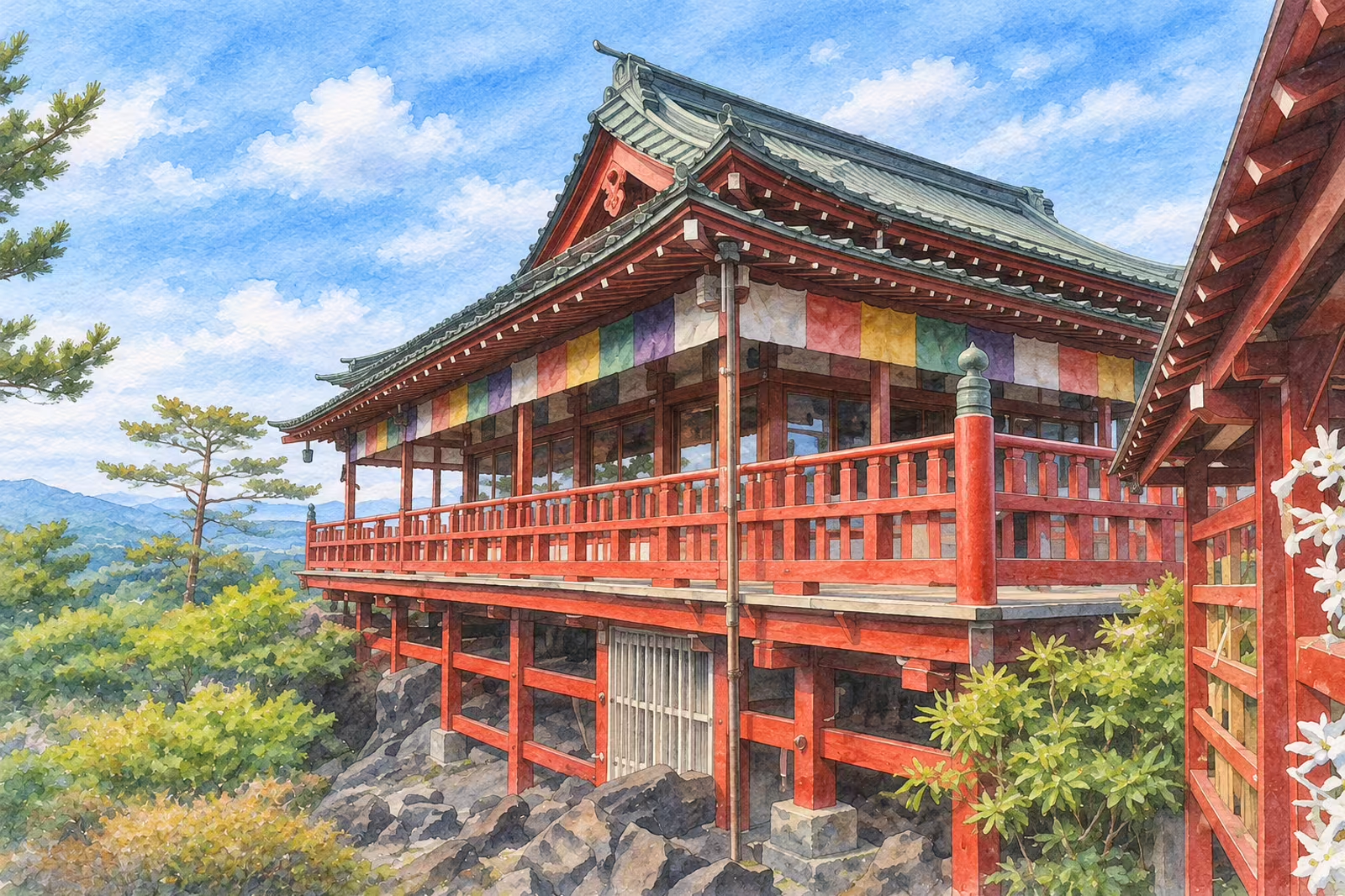
Mount Asama is an active volcano on the border between Gunma and Nagano prefectures. In its great eruption of 1783, the village of Kanbara on the northern slope was buried within minutes by a hot debris flow. Most villagers died; only those who reached the Kannon hall on high ground in the village survived. Today the Kanbara Kannon-dō in Tsumagoi, Gunma, its buried stone steps and the nearby local history museum record one of the deadliest volcanic disasters of the Edo period and the rebuilding of the village afterward.
01The Eruption of 1783
Asama erupted repeatedly from the spring of 1783, growing more violent over the summer. The climax came on August 5, 1783 (the eighth day of the seventh month of Tenmei 3). A massive flow of rock and earth poured down the northern slope; it is now often called the Kanbara debris avalanche, though its exact nature, whether a pyroclastic flow or a debris avalanche, is still debated. It swallowed Kanbara village in minutes. According to records, 477 of the village’s roughly 570 inhabitants were killed. About 93 survived.
The flow then plunged into the Agatsuma River and became a mudflow, destroying villages along its banks before entering the Tone River; bodies and wreckage were carried downstream as far as the area near Edo. The total death toll is generally put at around 1,500. The same eruption sent down the lava flow on the northern slope known today as Onioshidashi.
02The Kannon Hall and the Survivors
The Kannon hall originally stood at the top of about 50 stone steps. After the disaster only the top 15 remained above ground, and they came to be seen as the steps that divided the living from the dead. Excavations beginning in 1979 found the remains of two women at the bottom of the buried steps, generally thought to be one woman carrying another on her back when the flow overtook them.
After the disaster, wealthy farmers from neighboring villages took in the survivors and supplied food. According to tradition, they arranged for survivors who had lost their families to marry one another and form new households, so that the village could be rebuilt on the same site. The shogunate also sent officials to oversee relief and recovery.
03What Can Be Seen Today
The present Kannon-dō is a small hall rebuilt after the disaster, and the 15 surviving steps lead up to it; part of the lower steps uncovered by excavation is also on display. A group of local residents still takes turns caring for the hall and holds memorial services every year. The nearby Tsumagoi Local History Museum displays household objects excavated from the buried village along with materials on the disaster. As of the 2020s Asama remains a continuously monitored active volcano.