
01A mountain, not just a shrine
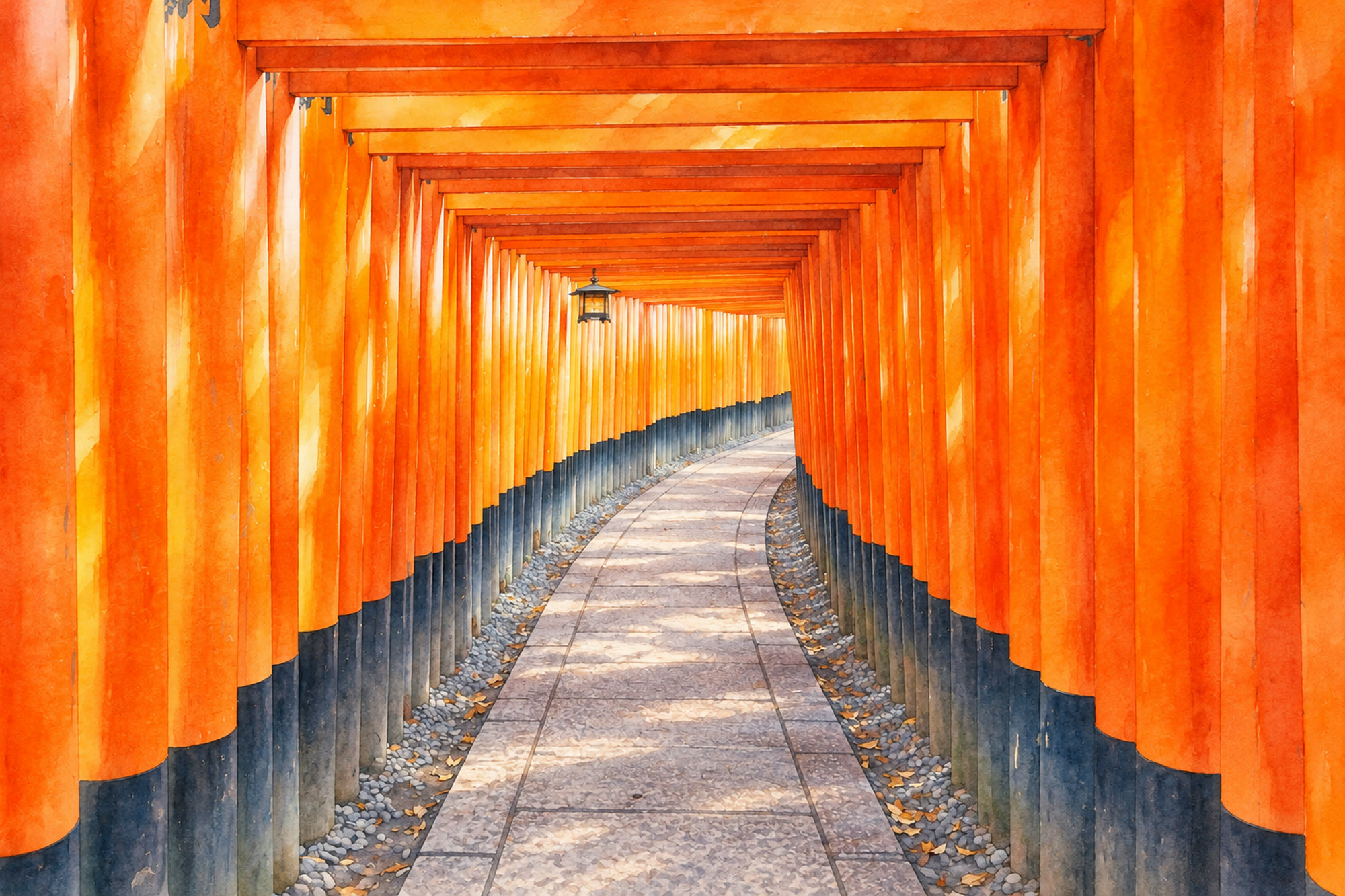
Most visitors arrive at Fushimi Inari Taisha with one picture in mind: a tunnel of vermilion gates, lit in stripes by the sun coming through the gaps. That tunnel is real, and it is magnificent, but it is only the doorway. Behind the main buildings rises Mount Inari, a wooded hill of 233 meters at the southern tip of the Higashiyama range that runs down the east side of Kyoto. The whole mountain is the sacred ground. Its paths are lined with thousands of torii, its slopes crowded with stone altars, small shrines, tea houses and fox statues, and a full circuit to the summit and back takes two to three hours.
The shrine is the head of the Inari network, the most widespread form of shrine worship in Japan. Inari shrines are commonly said to number about 30,000. They range from grand establishments to a red gate and a box-sized altar on an office rooftop or in a farmyard. All trace their deity, in principle, to this hill in the Fukakusa district of southern Kyoto.
Inari began as a god of rice. Over the centuries the deity also took on the protection of trade, craft, industry and household fortune, and that double character explains much of what you see. The mountain’s early history belongs to an immigrant clan and the Heian court; its present appearance, gate after donated gate, belongs to the merchants and ordinary worshippers of the last four hundred years.
02The Hata and the flying rice cake
In the 5th and 6th centuries a kin group known as the Hata settled in the Kyoto basin. Later tradition claimed descent from the First Emperor of Qin, but their origins most likely lay on the Korean Peninsula. They brought skills in silk weaving, irrigation, engineering and finance, and they developed land across the basin, from Uzumasa and Saga in the west to Fukakusa in the south. Kōryū-ji temple in Uzumasa and Matsuo Taisha shrine in the western hills are both associated with them. The Nihon shoki, the court chronicle completed in 720, mentions a Hata no Ōtsuchi of Fukakusa who grew rich through trade and was employed by Emperor Kinmei to manage the court’s finances, a sign that the Fukakusa Hata were known for their wealth early on.
The shrine dates its founding to 711, on the first Horse day of the second month, when Hata no Irogu worshipped the deity on the peaks of Mount Inari. The most famous story about this comes from the Yamashiro Fudoki, a gazetteer of Yamashiro Province compiled on court orders in the 8th century. The book itself is lost, but passages survive because later authors quoted them. According to one such fragment, Irogu was so rich in rice that he used a rice cake as an archery target. When his arrow struck, the cake turned into a white bird and flew off to a mountain peak, where rice began to grow. The shrine was named Inari, written in that passage with characters meaning "rice grows." Later generations of the family, the story adds, regretted their ancestor’s waste and transplanted trees from the shrine to their homes to worship.
The tale is a place-name legend, not a record of events. But it ties Inari to rice from the very beginning and makes the Hata its first worshippers. The characters now used for the name, 稲荷, can be read as "carrying rice sheaves," matching the later image of the deity as an old man bearing rice on his shoulder.
Hata descendants went on serving as priests of the shrine. A second priestly lineage, the Kada, also served here; some scholars think the Kada represent a local group that worshipped on the mountain even before the Hata arrived. Both families held hereditary priestly offices until the Meiji government abolished hereditary shrine posts in 1871.
03Five deities and three peaks
The summit ridge of Mount Inari has three peaks, called Ichi-no-mine, Ni-no-mine and San-no-mine, the first, second and third peaks, in descending order of height. In early times each had its own shrine: the upper, middle and lower shrines.
Today the main hall enshrines five deities, together known as the Inari Ōkami. The central figure is Ukanomitama no Ōkami, whose name contains an old word for grain and food. Alongside are Sadahiko no Ōkami, usually identified with the guiding deity Sarutahiko of the ancient chronicles, and Ōmiyanome no Ōkami, a goddess associated with service in the imperial palace. Tanaka no Ōkami and Shi no Ōkami, who complete the five, are less clearly defined and are generally thought to be local deities of the area. Each occupies one bay of a main hall five bays wide.
The usual pairing links Ukanomitama with the lower shrine, Sadahiko with the middle and Ōmiyanome with the upper. The three peaks still carry stone sanctuaries marking where those shrines once stood.
04Guardian of Tō-ji
When Emperor Kanmu moved the capital to Heian-kyō in 794, Fukakusa became the southern edge of the new city. At the city’s southern gate stood two official temples, Tō-ji and Sai-ji, and in 823 Emperor Saga handed Tō-ji to the monk Kūkai, who made it a center of Shingon esoteric Buddhism. From then on the destinies of Inari and Tō-ji were joined.
Inari became Tō-ji’s guardian deity. Medieval Shingon writers explained the link with a legend: Kūkai, as a young man in Kii Province, met a tall old man carrying rice sheaves and cedar branches and recognized him as a god; years later the old man arrived at Tō-ji’s south gate with his family, and Kūkai welcomed him and offered him Mount Inari as his seat. This story was shaped long after Kūkai’s time, as Shingon absorbed Inari into its own world.
Earlier and more reliable is an entry in the official records. In the first month of 827 Emperor Junna fell ill, and diviners blamed the anger of the Inari deity, whose trees had been cut to build Tō-ji’s five-story pagoda. The court sent an envoy to the shrine and granted the deity the court rank of junior fifth, lower grade. The episode shows that by the early 9th century Mount Inari’s god had a direct, if uneasy, connection with Tō-ji’s construction, and that the court was beginning to honor it.
The deity’s rank rose steadily and, according to the records, reached senior first rank, the highest possible, in 942. That is why Inari shrines across Japan display the words "Shōichii Inari Daimyōjin," "Inari Great Deity of Senior First Rank," on banners and plaques. The 10th-century Engishiki code listed Inari among the most important shrines of the realm, and in the Heian period it became one of the "upper seven" of the Twenty-Two Shrines to which the court sent offerings in times of crisis.
The tie to Tō-ji survives in the Inari Festival each spring. The portable shrines carrying the deities travel from the mountain to a temporary resting place in southern Kyoto and later return. On the way back they stop before Tō-ji, where monks present offerings to the gods, a ritual that outlasted the formal separation of Shinto and Buddhism in the Meiji era.
05Climbing the mountain in the Heian age
In the Heian period courtiers and commoners alike climbed Mount Inari on the first Horse day of the second month, said to be the day the deity first descended to the mountain. The pilgrimage, known as Inari-mōde, took worshippers up to the lower, middle and upper shrines in turn, and it was hard going.
Sei Shōnagon, the court lady who wrote The Pillow Book around the year 1000, left the most vivid account. She set out early one Horse day, she writes, but by the time she reached the middle shrine she was so exhausted she wanted to weep, and she asked herself why she had chosen that day of all days. It was already mid-morning. Other pilgrims passed her with ease. A woman of about forty strolled by and told her companion that she meant to make the round seven times that day; she had already done three, four more were nothing, and she would be down by early afternoon. Sei Shōnagon envied her. The passage brings the mountain of a thousand years ago vividly to life: crowds, steep paths, and pilgrims who made the climb again and again.
Heian pilgrims also brought home a sprig of cedar from the mountain, the shirushi no sugi, or "cedar of the sign." If it stayed green, the prayer would be granted; if it withered, one came back and tried again. The shrine still gives out cedar-sprig talismans at the Hatsuuma festival on the first Horse day of the second month.
One point is easy to miss: the "middle shrine" Sei Shōnagon struggled up to was on the mountain. In her day the shrine’s main sanctuaries stood on the peaks, not at the foot where visitors now begin.
06Down the mountain, and into the fire
When the main sanctuaries moved down to the foot of the mountain is not entirely clear. The usual account holds that in 1438 the sixth Ashikaga shogun, Ashikaga Yoshinori, ordered new buildings at the base and the deities were brought down, making the foot of the mountain the shrine’s center. By the middle of the 15th century, at any rate, the lower precinct had become the heart of the shrine.
It had little time to settle. In 1467 the Ōnin War broke out between the Eastern army of Hosokawa Katsumoto and the Western army of Yamana Sōzen, and Kyoto became a battlefield. Mount Inari overlooked the southern approaches to the city and was too useful to be left alone.
In the third month of 1468 a man named Honekawa Dōken occupied the mountain with a band of ashigaru, the lightly armed foot soldiers of the age, recruited largely from the urban poor and notorious for raiding, burning and looting. Dōken had been an investigator under the city’s police office and knew Kyoto’s underworld well; the Eastern side took him on and used Mount Inari as a base to harass the Western army’s supply lines. The Western army attacked the mountain in force. Dōken was killed, and the shrine buildings burned.
Rebuilding took three decades. Priests went out on fund-raising tours across the country, and in 1499 the new main hall was completed. It still stands, the oldest of the shrine’s principal buildings, and is an Important Cultural Property. It is built in the flowing-roof nagare style, five bays wide, with an additional roof projecting over the steps in front, a combination sometimes called the Inari style.
07Hideyoshi’s gate and the Edo boom
After a century of war, Toyotomi Hideyoshi reunited Japan and spent lavishly in and around Kyoto: the Jurakudai palace, the Great Buddha of Hōkō-ji, the earthen ramparts around the city, and in his last years a castle at Fushimi, a short distance south of the shrine.
The great two-story gate at the shrine’s entrance, the Rōmon, is traditionally said to be his gift. The shrine owns a written vow in which Hideyoshi prayed for the recovery of his mother, Ōmandokoro, and promised to donate 10,000 koku if she got well. According to shrine tradition, she did, and the gate was his thank-offering. Some had doubted whether the tradition matched the documents, but when the gate was dismantled for repair in 1973, an ink inscription dated 1589, the same year as the vow, was found on it. It is among the largest shrine gates in Japan and is an Important Cultural Property.
The Edo period was when Inari truly became a god of the people. As commerce grew, Inari turned from a guardian of rice fields into a patron of business. Merchant houses, neighborhoods, workshops and even samurai mansions invited the deity in by establishing branch shrines, spirit divided from the head shrine and installed in a new home. Edo, the shogun’s capital, had so many small Inari shrines that a popular saying listed the city’s commonest sights as "Ise-ya shop signs, Inari shrines, and dog droppings." The head shrine at Fushimi issued talismans and licensed branch shrines throughout the country.
The custom of donating torii also began in this period. A worshipper would offer a gate in hope of a wish being granted, or in thanks once it was, playing on the idea of a prayer "passing through." Over the following centuries those gates multiplied until they covered the mountain.
08Kada no Azumamaro and the birth of kokugaku
South of the Rōmon stands a modest old house beside a small shrine. The house belonged to Kada no Azumamaro, and the shrine, Azumamaro Jinja, honors him.
Azumamaro (1669–1736) was born into the Kada family of Inari priests. He studied the family’s Shinto learning and poetry, then turned to the ancient texts, the Nihon shoki and the poetry anthology Man’yōshū, seeking in them the native thought of Japan before Buddhism and Confucianism. He lectured in Edo, and late in life he is said to have submitted to the shogunate a petition to found a school of national learning. The school was never built, but the petition came to be regarded as the founding statement of kokugaku, "national learning."
The movement was carried on by Kamo no Mabuchi, Motoori Norinaga and Hirata Atsutane, and these four are traditionally counted as its great masters. Norinaga’s study of the Kojiki, Atsutane’s restoration Shinto and, through them, strands of the loyalist thought of the late Edo period, all descend from this line. It is a side of Fushimi Inari few visitors notice: a shrine famous for popular devotion was also the starting point of a scholarly tradition. The house, a rare surviving example of an Edo-period priest’s residence, is a national Historic Site, and students now come to Azumamaro Jinja to pray for success in exams.
09Meiji reforms and the fox
In 1868 the new Meiji government ordered the separation of Shinto and Buddhism. Inari had been bound up with Shingon for centuries, and the Buddhist halls, images and clergy on the mountain and in the precinct were removed. In 1871 the shrine was ranked as a major imperial shrine, the highest grade in the new state system. After the Second World War, when state Shinto was dismantled and shrines became independent religious corporations, the shrine took its present name, Fushimi Inari Taisha, in 1946. It marked the 1,300th anniversary of its founding in 2011.
The separation left Inari in two forms. The shrine network headed by Fushimi worships the Inari Ōkami. A Buddhist tradition, which had long identified Inari with the esoteric deity Dakiniten, continues in temples such as Toyokawa Inari in Aichi Prefecture, which is in fact a Sōtō Zen temple. A place called "Inari" in Japan may therefore be either a shrine or a temple.
And then there are the foxes. Stone foxes guard the Rōmon, flank the main hall and sit before nearly every small altar on the mountain. They hold things in their mouths: a key, a jewel, a scroll, a sheaf of rice. The key is usually explained as the key to the rice granary, the jewel as the deity’s spiritual power. The fox is Inari’s messenger, not Inari itself. Why a fox is debated; a common explanation is that foxes haunted the rice fields and ate the mice that damaged the crop, and in medieval times the fox imagery of Dakiniten strengthened the link. Fried tofu came to be offered as the fox’s favorite food, which is why inari-zushi, rice in a pouch of fried tofu, and kitsune udon, "fox noodles," carry the names they do.
10The thousand gates and the stone mounds
The Senbon Torii, "thousand torii," are the two parallel tunnels of gates just behind the main hall, and the name is often stretched to cover all the gates on the mountain. Each gate faces up the slope. Climbing, you see only vermilion; turning to come down, you see black inscriptions on the back of every pillar: the donor’s name, often a company, and the date of dedication. As of 2026, estimates put the gates on the mountain at around 10,000, from large ones you walk through to miniature gates a hand’s width high set before small altars. They are wooden, painted in a vermilion lacquer known as Inari-nuri, a color usually said to ward off evil and to embody the power of the harvest.
The gates are not old. Wood rots in Kyoto’s humid summers, and gates are donated for fixed periods and replaced as they decay. Most of those standing today are a few decades old at most, and old ones are constantly taken down as new ones go up. The spectacle took shape gradually from the Edo period onward and reached its present density in modern times.
The other thing that fills the mountain is the otsuka, stone mounds. Each is a small stone tablet carved with the name of a deity, often a personal form of Inari with its own name, set up by a worshipper and furnished with miniature gates, stone foxes and offerings. The custom flourished from the Meiji era onward, and the mounds are said to number more than ten thousand, clustered in dense groups on the slopes. They express private relationships between individuals and their gods, something distinct from the shrine’s formal worship of the five deities, and they give the upper mountain its crowded, slightly uncanny atmosphere.
11A walk up the mountain
Start at the Rōmon, Hideyoshi-era and guarded by its pair of foxes. Beyond it is the outer worship hall of 1840, hung with metal lanterns, and behind that the main hall of 1499, the oldest major structure in the precinct. All three are Important Cultural Properties.
Following the path north and behind the main hall brings you to the entrance of the Senbon Torii. The custom is to keep to the right-hand tunnel going up and the left coming down. At the far end is the Okusha Hōhaisho, the inner hall for worshipping the mountain from a distance, where many visitors turn back. Behind it stand two stone lanterns topped with round stones, the omokaru-ishi, "heavy-light stones": make a wish and lift one, and if it feels lighter than you expected, the wish will come true.
Above, the gates and mounds grow denser. At Kumataka-sha, by the pond called Shin-ike, tradition says that if you clap your hands, the direction of the echo points toward a lost person or thing you are looking for. Farther on, the junction called Yotsutsuji opens onto a broad view over Kyoto, and many walkers stop there. Those who continue make the loop over San-no-mine, Ni-no-mine and finally Ichi-no-mine, the summit and the site of the ancient upper shrine, before descending back to Yotsutsuji.
On the way you pass through every layer of the shrine’s history: the Hata worshipping on the peaks, Heian pilgrims toiling up with their cedar sprigs, the shrine rebuilt at the foot of the mountain after the Ōnin War, Hideyoshi’s gate, the merchants’ gates of Edo, the stone mounds of modern believers, and the new torii still going up every year. Almost nothing on the mountain is ancient. The habit of climbing it to pray is.