
01A Temple on Three Levels
Chion-in sits at the foot of the Higashiyama hills on the eastern side of Kyoto, between the temple of Shōren-in to the north and Maruyama Park and Yasaka Shrine to the south. It is the head temple of the Jōdo school, the "Pure Land" school of Japanese Buddhism, which today counts thousands of temples across Japan. The first thing most visitors see is its enormous two-story gate, and it is easy to assume the place was built on this scale from the start. In fact it began as the small hermitage where an old monk spent his last months.
The grounds climb the hillside in three steps. At the bottom are the gate and the approach road. Up a steep flight of stone stairs is the middle terrace, with the great Founder’s Hall, the Amida Hall, the abbot’s quarters and the bell tower. Higher still, on the wooded slope, are a small hall called the Seishi-dō and the tomb of the founder, Hōnen. The layout runs roughly backward through time. The hilltop is the oldest part, where Hōnen lived and was buried; the vast buildings below were put up four centuries later by the Tokugawa shoguns.
So Chion-in tells two stories. One is about Hōnen and a simple, radical idea: that anyone at all could be saved by calling on the Buddha Amida. The other is about the first Tokugawa rulers, and why the military government in Edo poured so much money into a temple in the old imperial capital.
02Hōnen and the Nenbutsu
Hōnen was born in 1133 in Mimasaka Province, in what is now Okayama Prefecture, the son of a provincial warrior family. Later biographies say that his father was killed in a local feud when Hōnen was a boy, and that the dying man told his son not to seek revenge but to become a monk. The details come from accounts written after Hōnen’s death, but the scene became a fixture of how the Jōdo school tells its founder’s life.
As a youth Hōnen went up to Enryaku-ji, the great Tendai monastery on Mount Hiei northeast of Kyoto. He became known for his learning. Yet he was troubled by a problem he could not solve: the long disciplines of Tendai practice were out of reach for nearly everyone. By his own later account the answer came in 1175, when he read a commentary by the Chinese Pure Land master Shandao (Zendō in Japanese). Shandao taught that single-minded recitation of Amida’s name was the practice that accorded with the Buddha’s vow. Hōnen concluded that anyone who recited the nenbutsu, the phrase "Namu Amida Butsu" ("I take refuge in Amida Buddha"), would be reborn in Amida’s Pure Land through the power of the Buddha’s vow, not through their own merit. The Jōdo school dates its founding to that year.
Hōnen left the mountain and settled at Yoshimizu in the Higashiyama hills, close to where Chion-in stands now. People of every kind came to hear him: court nobles such as Kujō Kanezane, who would serve as regent, as well as warriors, commoners and women. Until then, rebirth in the Pure Land had generally been tied to building temples, commissioning images, keeping precepts and other forms of merit that required wealth and leisure. Hōnen reduced the requirement to a spoken phrase. That was what drew people to him, and it was also what alarmed the established temples.
In 1198, at Kanezane’s request, Hōnen wrote the Senchaku hongan nenbutsu shū (Passages on the Selection of the Nenbutsu in the Original Vow), a systematic argument that among all Buddhist practices the nenbutsu should be chosen above the rest. He allowed it to circulate only among his disciples, knowing how it would be received.
03Exile and the Ōtani Hermitage
As the nenbutsu movement spread, Enryaku-ji and the powerful Kōfuku-ji in Nara petitioned the court to suppress it, accusing its followers of ignoring the precepts and disparaging other practices. Hōnen had his disciples sign a pledge of good conduct, but the pressure kept building.
The breaking point came from the palace. According to the records, two of Hōnen’s disciples, Jūren and Anraku, held nenbutsu services that were attended by ladies-in-waiting from the household of Retired Emperor Go-Toba, and some of the women took the tonsure while Go-Toba was away from the capital. Go-Toba was furious. In 1207 the exclusive nenbutsu was banned, Jūren and Anraku were executed, and Hōnen was stripped of his clerical status and exiled. His official place of exile was Tosa on the island of Shikoku, though he actually stayed in Sanuki. Among the disciples exiled at the same time was Shinran, who was sent to Echigo and would later found the True Pure Land school.
Hōnen was pardoned at the end of that year but still barred from the capital, and he spent several years at Katsuo-dera in Settsu Province. In 1211 he was finally allowed to return and moved into a hermitage at Ōtani in Higashiyama, traditionally placed where the Seishi-dō stands today. He was old and frail.
Two days before his death, at the request of his disciple Genchi, he wrote a short statement known as the Ichimai kishōmon (One-Sheet Document), summing up his teaching: no learning was needed, only wholehearted recitation of the nenbutsu. He died at Ōtani on the 25th day of the first month of Kenryaku 2 (February 29, 1212, in the Julian calendar), at the age of 78 (80 by the traditional count). The Jōdo school’s great annual memorial service for him, the Gyoki, still centers on Chion-in; it was once held in the first month and has been held in April since 1877.
04The Grave Raid and Genchi’s Revival
Hōnen’s disciples buried him beside the hermitage. His death did not end the hostility. In 1227 monks from Mount Hiei again demanded that the nenbutsu be banned and threatened to dig up Hōnen’s grave and throw his remains into the Kamo River. His followers removed the body first, moved it from place to place, and in the following year cremated it at Awao in the western hills of Kyoto. The temple of Kōmyō-ji there is still closely associated with Hōnen’s remains.
The Ōtani site fell into neglect. It was revived by Genchi, also known as Seikanbō. Tradition holds that he was a grandson of the Taira general Taira no Shigemori, entrusted to Hōnen as a boy after the fall of the Taira, and that he served at Hōnen’s side until the end. In 1234 Genchi restored the tomb, built a hall and enshrined an image of Hōnen there. Chion-in counts Hōnen as its founder and Genchi as its second abbot, and treats this as the real beginning of the temple. Its formal name is Kachōzan Chion-kyōin Ōtani-dera. "Chion" is usually explained as "knowing one’s debt of gratitude," that is, to one’s teacher.
05Rivals and War in the Middle Ages
After Hōnen’s death his followers split into several lines: the Chinzei branch based in Kyūshū, the Seizan branch around the western hills of Kyoto, and the line that grew from Shinran’s teaching into the separate True Pure Land school, among others. Chion-in started as the base of Genchi’s small circle. Over time it merged with the Chinzei line and competed with other Kyoto Pure Land temples, such as Chion-ji (popularly called Hyakumanben) and Shōjōke-in, over which of them carried Hōnen’s true lineage and should lead the school.
By the late Muromachi period Chion-in had pulled ahead. From 1523 it was in dispute with Chion-ji over the right to forward Jōdo monks’ applications for imperial honors to the court, and in 1575 Emperor Ōgimachi issued an edict recognizing Chion-in as the head temple of the Jōdo school and routing requests for the privilege of wearing incense-colored robes through it.
Those were violent years in Kyoto. During the Ōnin War, which began in 1467, Chion-in’s buildings burned in 1468 and the abbot Shurin fled with the monks and Hōnen’s image to Ikadachi in Ōmi Province, returning only when the fighting died down. Even in the late 16th century, under Toyotomi Hideyoshi, Chion-in is generally thought to have been a temple of moderate size. The Seishi-dō on the upper slope, rebuilt in 1530, survives from this period and is the oldest building on the grounds.
06Why Tokugawa Ieyasu Chose Chion-in
The transformation of Chion-in into a great temple was almost entirely the work of the Tokugawa. The family, originally the Matsudaira of Mikawa Province, had long been Jōdo believers. Their family temple in Mikawa, Daiju-ji, belonged to the school, and after Tokugawa Ieyasu moved to the Kantō he made Zōjō-ji in Edo the Tokugawa family temple. Ieyasu’s battle banner carried a Pure Land motto: "Renounce this defiled world, seek the Pure Land."
In 1602 Ieyasu’s mother, Odai no Kata, died at Fushimi Castle. Some records say her funeral was held at Chion-in; her remains were later buried at Denzū-in in Edo. In 1603 Ieyasu made the temple the Tokugawa family’s temple in perpetuity and granted it lands of just over 703 koku, and from 1604 he ordered a sweeping expansion, taking in part of the neighboring grounds of Shōren-in, that gave the temple roughly its present shape.
In 1607 he also arranged for Prince Ryōjun, a son of Emperor Go-Yōzei, to enter Chion-in. From then until the early Meiji years the temple was headed by abbots of imperial birth, a status known as miya monzeki. For the shogunate this raised the temple’s standing and tied the shogun’s house to the imperial house through a great temple in the emperor’s own city.
A popular theory adds a military motive. Chion-in and its neighbor Shōren-in stand on high ground with stout walls and gates, overlooking the road that enters Kyoto from the east, and could have served as a Tokugawa strongpoint on the eastern side of the city, balancing Nijō Castle on the west. The idea is widely repeated, but there is no clear documentary evidence for it, and it is best taken as a reading of the site’s layout.
07Hidetada’s Sanmon Gate
Ieyasu died in 1616, and the work continued under the second shogun, Tokugawa Hidetada. The Sanmon, the great gate you see from the street, was completed in 1621.
It is a two-story gate about 24 meters high and about 50 meters wide, among the largest wooden temple gates in Japan. The name sanmon refers to the "three gates of liberation" through which one passes to enlightenment. The upper story enshrines a crowned Shakyamuni Buddha with the Sixteen Arhats, and its ceilings and beams are painted with dragons, celestial beings and floral patterns. A huge plaque reading "Kachōzan" hangs on the front; it is said to be in the hand of Retired Emperor Reigen. The upper floor is usually closed and opened only at certain times.
Also kept upstairs are two plain wooden coffins, the subject of one of the temple’s best-known stories. According to legend, the official in charge of construction, Gomi Kin’emon, carved wooden images of himself and his wife and placed them in the coffins, then took his own life to atone for running far over budget. The tale was already told in the Edo period and exists in several versions; whether it happened cannot be confirmed, but the coffins are real.
The steep stone stairs straight ahead of the gate are called the Otoko-zaka, "men’s slope"; a gentler path to the side is the Onna-zaka, "women’s slope." Only at the top of the steep stairs does the roof of the Founder’s Hall come into view.
08The Fire of 1633 and Iemitsu’s Rebuilding
In 1633 a great fire swept through Chion-in and destroyed most of the buildings put up under Ieyasu and Hidetada. According to the temple’s records the Sanmon and the sutra repository survived, as did the Seishi-dō on the slope above, which is why the gate you see is still Hidetada’s original.
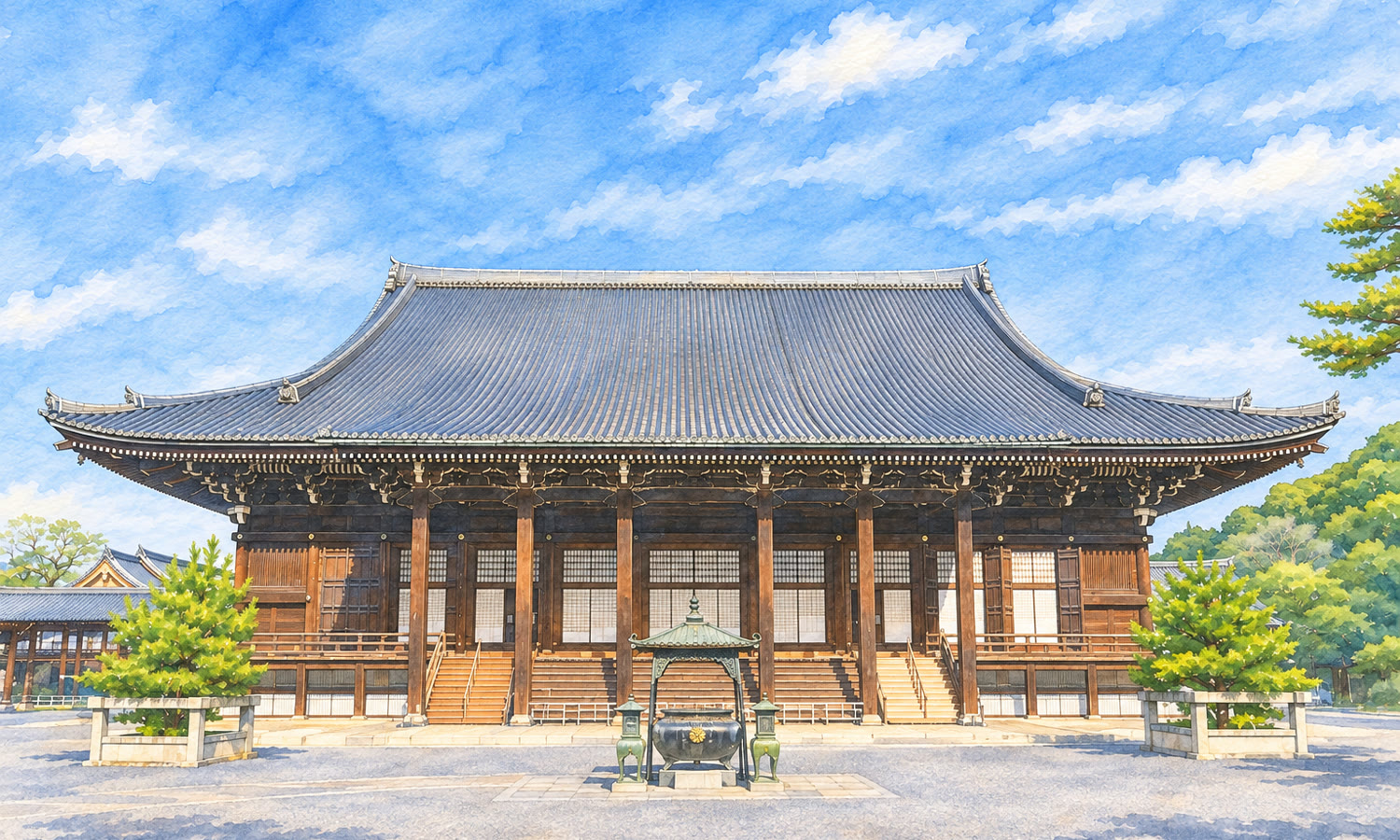
The third shogun, Tokugawa Iemitsu, paid for the rebuilding. The Founder’s Hall, or Miei-dō, which enshrines the image of Hōnen, was completed in 1639. It is about 45 meters wide and about 35 meters deep, among the largest wooden Buddhist halls in Japan, and fronts a broad stone-paved courtyard where crowds gather for the Gyoki and other ceremonies. Like the Sanmon, it is a National Treasure.
The Large and Small Abbot’s Quarters were completed in 1641, and the assembly hall and the Chinese-style gate were rebuilt in the same period; the bell tower followed in 1678. All are now Important Cultural Properties. The sliding-door paintings in the Large Abbot’s Quarters are by painters of the Kanō school. One of them, according to temple lore, showed sparrows painted so lifelike that they flew out of the picture, leaving blank space behind.
The great bell, cast in 1636, is about 3.3 meters tall, about 2.8 meters across at the mouth and weighs around 70 tonnes. With the bells of Tōdai-ji and Hōkō-ji it is often named among the largest temple bells in Japan. On New Year’s Eve a team of 17 monks rings it: one leans backward holding the main rope tied to the striking beam while the other 16 haul on ropes in unison, calling out as they swing. The scene is a fixture of Japanese year-end television.
09Chion-in since Meiji
After the Meiji Restoration the miya monzeki system was abolished, Tokugawa patronage disappeared, and the temple’s lands were taken by the state. As head temple of the Jōdo school, Chion-in survived on the support of believers across the country. The Amida Hall was rebuilt and completed in 1910.
In the 21st century, as part of the commemoration of the 800th anniversary of Hōnen’s death, the Miei-dō underwent a major conservation project lasting about nine years and completed in 2020, with roof tiles and timbers examined and repaired one by one. The image of Hōnen was moved out during the work and returned when it was finished. The hall you see today is the result.
The temple’s treasures include several National Treasures. One is a Kamakura-period painting of Amida and twenty-five bodhisattvas sweeping down a mountainside on clouds to welcome a dying believer, nicknamed the "swift descent" for its sense of speed. Another is the 14th-century illustrated biography of Hōnen in 48 scrolls, one of the longest picture scrolls produced in Japan. Both are shown only at special exhibitions.
10A Walk through the Grounds
Coming from the street or from Maruyama Park, stop first at the Sanmon. Look up at the plaque and the massive bracketing under the eaves. This is the 1621 original and the largest building surviving from the time of Ieyasu and Hidetada.
Pass through the gate and climb the Otoko-zaka to the middle terrace. The courtyard in front of the Miei-dō is wide, and turning back you can see the roof of the Sanmon with the city beyond. Under the eaves at the front of the Miei-dō, look for an old umbrella tucked between the beams: the "forgotten umbrella." One legend says the master carpenter Hidari Jingorō left it there as a charm against evil; another says a white fox left it in thanks after the abbot Reigan built it a new home, promising to protect the temple. Because umbrellas are linked with rain, it is also taken as a charm against fire. Both are legends.
From the Miei-dō a corridor leads to the assembly hall and the abbot’s quarters. The floorboards chirp like warblers as you walk; these "nightingale floors" are said to have warned of intruders, and they are the easiest of the temple’s "seven wonders" to experience for yourself. On a cedar door in the abbot’s quarters corridor is a painted cat whose eyes seem to follow you from every side. South of the abbot’s quarters is an early Edo pond garden, now a national Place of Scenic Beauty, traditionally linked with Kobori Enshū, though the connection is unproven.
Walk on to the bell tower, then climb the stone steps up the hill to the Seishi-dō. Hōnen was regarded as an incarnation of the bodhisattva Seishi (Mahāsthāmaprāpta), and the hall is named for that belief. Built in 1530, it is the oldest building at Chion-in and is traditionally said to mark the site of the Ōtani hermitage where Hōnen died. As of 2026 the hall is undergoing a full dismantling repair begun in 2024. Above and behind it is Hōnen’s mausoleum, the place where the whole temple began more than 800 years ago.
On the way down, look for a large rock by the road near the Black Gate north of the Sanmon. It is the Uryū-ishi, the "melon stone," where, the story goes, a melon vine once sprouted overnight and bore fruit. It is another of the seven wonders.