
01Where You Are Standing
Shikina-en is a royal garden on the Shikina plateau in the south of Naha, a short distance below Shuri, the old capital of the Ryūkyū Kingdom. The Ryūkyū Kingdom ruled Okinawa and the surrounding islands from the fifteenth century until Japan annexed it in 1879. Its kings, of the Shō family, lived in Shuri Castle, and Shikina-en was one of their country retreats. People in Shuri called it Shikina Udun, "the Shikina palace," and because it lay south of the castle it was also known as Nan’en, the Southern Garden. A second royal villa east of the castle, Uchaya Udun, was correspondingly the Eastern Garden.
The garden was built for royal leisure, but its most famous use was diplomatic. When a new Ryūkyūan king came to the throne, the Chinese emperor sent envoys to confirm him in office. These envoys, called sappōshi in Japanese (cefeng shi in Chinese, "investiture envoys"), spent months in Ryūkyū, and the court took them to Shikina-en to be entertained. Much of what you see here was arranged with those guests in mind.
02A Garden Completed in 1799
The garden is generally dated to 1799, during the reign of King Shō On. A tradition holds that work began under his predecessor, King Shō Boku, as early as 1783, though this is uncertain, and some accounts place completion around 1800. The timing matters. Shō On had come to the throne as a boy, and a Chinese investiture mission for him was expected. It arrived in 1800, led by the chief envoy Zhao Wenkai and the deputy envoy Li Dingyuan. A new garden, ready just before their arrival, gave the court somewhere fitting to receive them away from the formalities of Shuri Castle.
03The Investiture System
Ryūkyū’s relationship with China began in the 1370s, when King Satto of Chūzan, one of the island’s rival kingdoms, answered an invitation from the first Ming emperor and began sending tribute. From then on each new king requested investiture, and China sent a pair of envoys, a chief and a deputy, across the East China Sea. Their missions numbered several hundred people. They sailed in large ships, which the Ryūkyūans called ukwanshin, "crown ships," arriving on the summer monsoon and leaving months later when the winds turned.
In Naha the envoys lodged in an official guesthouse, the Tenshikan. The investiture ceremonies took place at Shuri: a memorial rite for the late king, then the reading of the imperial edict naming the new one, in the courtyard before the main hall of the castle. Around these ceremonies the court staged a sequence of banquets, traditionally counted as seven, including feasts at the Mid-Autumn Festival and the Double Ninth. Between banquets the envoys were taken sightseeing, and after 1799 Shikina-en was a highlight of these outings.
There was a complication. Since 1609, when the Shimazu lords of Satsuma in southern Kyūshū invaded, Ryūkyū had been under Satsuma’s control while continuing to present itself to China as an independent tributary kingdom. During an investiture mission, Satsuma officials in Naha kept out of sight and visible signs of Japanese influence were put away. A royal garden for the envoys was part of how the kingdom showed itself to China.
04The Spring of Nurtured Virtue
On the western side of the garden, steps lead down to a spring, Ikutoku-sen, the "Spring of Nurtured Virtue." Water seeps from the porous Ryūkyū limestone into a stone-lined basin and then flows toward the main pond. The masonry of the spring, with its arched outlets and carefully fitted stones, is some of the finest stonework in the garden.
Beside it stand two stone steles with inscriptions in praise of the spring, both written by Chinese envoys. One, the Ikutoku-sen stele, is by the chief envoy Zhao Wenkai of the 1800 mission. The other, inscribed with four characters wishing long life through its sweet water, is by Lin Hongnian, chief envoy of the 1838 mission that invested King Shō Iku. Zhao’s deputy, Li Dingyuan, later published Shi Ryūkyū ji (Record of an Embassy to Ryūkyū), an account of the mission that is still read for its descriptions of the islands. The basin is also home to a rare freshwater red alga, Shima-chisuji-nori, which is protected as a national Natural Monument.
05The Terrace Without a Sea View
At the highest point of the garden is a viewpoint called Kankōdai, the "Terrace for Encouraging Farming." From it you look south over the hills, fields and villages of southern Okinawa. You cannot see the sea. The hexagonal shelter on it now was built in the Taishō period (1912–1926); in the kingdom’s time, it is said, tents were put up here for the Chinese envoys to rest when they visited near the end of their stay.
A popular story holds that this was deliberate: Ryūkyū is a small island country, and almost every high point offers a view of the ocean, so the court chose a spot where the envoys would see only land and conclude the kingdom was larger than it was. The story is widely told, but it is a later explanation and no contemporary source confirms the builders’ intention. The name itself points to the Confucian ideal of a ruler who promotes agriculture.
06Reading the Garden
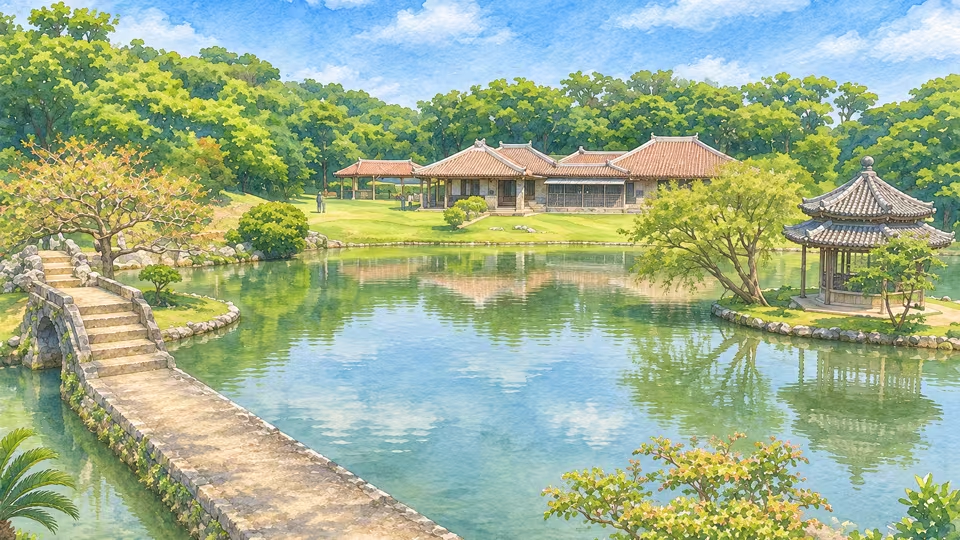
The garden covers about 40,000 square meters. It is a stroll garden, a Japanese garden type in which a path circles a pond and the views change as you walk. A large, irregular pond, known as the Shinji-ike because its outline was likened to the character for "heart," fills the center. Two arched bridges of Ryūkyū limestone, Chinese in design and high enough for boats to pass beneath, lead to a wooded central island; one is finely dressed, the other built of weathered rocks from the seashore. A third bridge, so small it takes only a few steps to cross, leads to a separate islet with the Rokkakudō, a wooden hexagonal pavilion with deep eaves. Its roof tiles are black, imitating Chinese black-glazed tiles, in contrast to the red tiles of the other buildings. The present pavilion is the second to stand on the spot. Where the pond overflows, a carved stone outlet sends water down into a shaded hollow; an octagonal pavilion once stood below it.
On the shore stands the Udun, the villa itself: a single-story wooden building with a red tile roof and fifteen rooms. The reception rooms face the pond; behind them were rooms for sleeping, dressing, cooking and bathing. It follows the plan of an upper-class residence on a larger and more refined scale, built of inumaki (podocarpus) wood, with tatami floors, paper screens and decorative alcoves. It was enlarged twice in the early twentieth century and now consists of several wings joined by wooden corridors around small inner courtyards. From inside, the pond, the pavilion, and the woods beyond are framed by the open sides of the rooms.
The design draws on three traditions. The overall layout is Japanese; the pavilion and bridges are Chinese; the materials, the red tiles, the limestone and the subtropical planting are Ryūkyūan. For envoys from China, the garden presented a kingdom with its own character.
07After the Kingdom
In 1879 the Meiji government abolished the Ryūkyū domain and created Okinawa Prefecture, an event known as the Ryūkyū Disposition. The last king, Shō Tai, was moved to Tokyo. Shikina-en remained the private property of the Shō family and survived intact into the twentieth century. It was designated a national Place of Scenic Beauty in 1941.
08Destruction in 1945
In the Battle of Okinawa in 1945, the Japanese Thirty-Second Army made its headquarters beneath Shuri Castle, and the area around Shuri was among the most heavily bombarded places in the campaign. Shikina lies just to the south. The villa, the pavilion and the bridges were destroyed and the garden’s trees burned. For decades afterward the site lay in ruins.
09Rebuilding
Okinawa returned to Japanese administration in 1972. The city of Naha began restoring Shikina-en in 1975, working from prewar photographs, surveys and documents. The bridges, the pavilion, the villa and the paths were rebuilt over roughly twenty years, with the work essentially completed in the mid-1990s. The villa was finished in 1992, using inumaki wood brought from Kyūshū because the tree had become scarce in Okinawa. In the same year Shō Hiroshi, great-grandson of King Shō Tai, donated the garden to the city.
Shikina-en was designated again as a national Place of Scenic Beauty in 1976 and raised to a Special Place of Scenic Beauty in 2000. In the same year it was inscribed on the UNESCO World Heritage List as one of the components of "Gusuku Sites and Related Properties of the Kingdom of Ryūkyū," together with the Shuri Castle site, Sēfa-utaki and other places.
What you see today, then, is largely a reconstruction. The villa, the pavilion and the bridges are postwar rebuilds; the pond, the landform, and parts of the stone walls and the spring’s masonry preserve more of the original fabric.
10A Walk Around the Garden
The red-tiled main gate was reserved in the kingdom’s time for the royal family and for escorting Chinese envoys; staff used the plainer side gate. Near the entrance stands the banya, a small guardhouse. From here a curving path runs between stone walls under heavy trees, and the pond stays hidden. The path leads to Ikutoku-sen; go down to see the spring, the two steles and, if you look carefully, the red alga in the water. Beyond the spring, notice how the walls change from neatly fitted hexagonal stones to rough, plant-covered rock.
Back on the path, the view opens and the pond appears. Walking around it, you see the arched bridges, the hexagonal pavilion and the villa across the water in turn. Enter the villa and look back at the garden from the rooms: this is the view the king and his guests had at a banquet.
On the south side, climb Kankōdai and look south to test the story of the hidden sea. On the way back, look for the Fune-ageba, a stone slipway by the pond where pleasure boats were launched and stored. A slow circuit takes about an hour.