
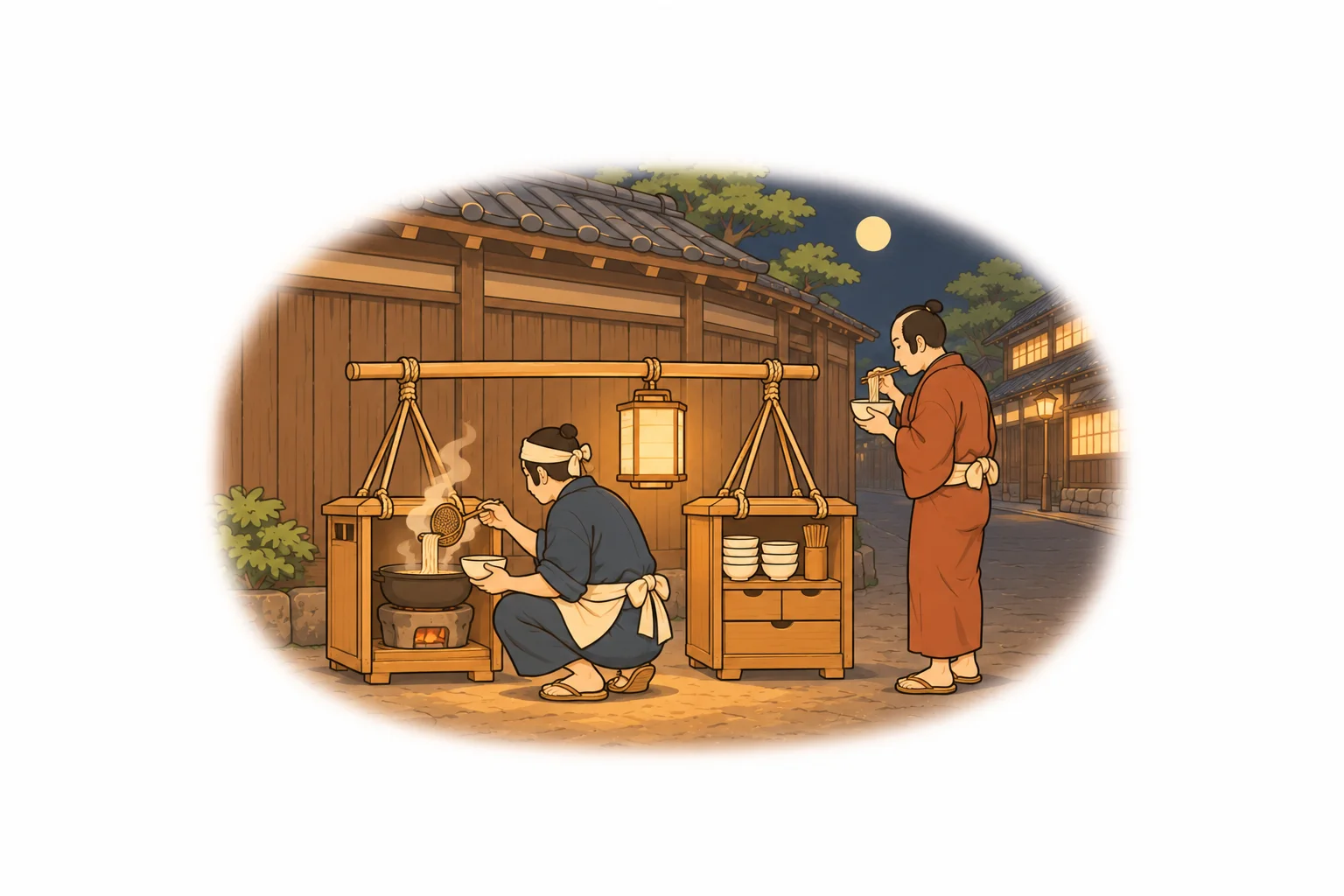
By the 18th century Edo was a city of about a million people, and an unusual number of them were single men: samurai posted to the capital with their lords, craftsmen and shop hands who had come from the provinces to make a living. They lived in cramped rented rooms and often had no kitchen of their own. The best way into their lives is not through shoguns and councilors but through the things they handled every day.
Here are ten of them. The first four are about eating and fear: three street foods, and the enemy that kept one of them out on the street, fire. The next two are the public life outside the tenement door, the bathhouse and the neighborhood school. The last four are pleasures that cost a few dozen coins. One yardstick keeps coming back: a 16-mon bowl of buckwheat noodles.
01Ni-hachi Soba: Fast Food for a City of Bachelors
Edo’s surplus of men began with sankin-kōtai. In the sixth month of 1635, Tokugawa Iemitsu’s Kan’ei Code made regular attendance in Edo a written duty for daimyo; in 1642 the fudai lords were added to the rotation, and most daimyo settled into a pattern of one year in Edo and one at home, while their wives and heirs lived permanently in the capital. The constant traffic drew people and money into the city.
Many of those men had no kitchen, so cheap, quick food sold well, and soba was the classic example. To keep the noodles from breaking, makers mixed in wheat flour, most often eight parts buckwheat to two parts wheat, the "ni-hachi" blend. From the early 18th century, Edo noodle shops and stalls hung "ni-hachi" signs and sold a bowl for 16 mon, which gave rise to a second explanation: two times eight is sixteen. Both readings survive. Edo diners dipped only the bottom third of their cold noodles, and people moving house gave soba to their new neighbors, a pun on soba, "beside you."
02Nigiri Sushi: A Bite of Edo-mae
The most refined counter meal in Japan began at an Edo street stall. Nigiri sushi is generally thought to have taken shape around the Bunsei era (1818–1830), and Hanaya Yohei (1799–1858) of Ryōgoku is often named its creator, though the true inventor cannot be pinned down. Edo nigiri was said to be two or three times today’s size, made with brownish red vinegar brewed from sake lees, and nearly every topping was prepared: gizzard shad salted and vinegared, tuna marinated in soy sauce, conger eel simmered and glazed. In an age without refrigeration, this work, called shigoto, was the craft, and it still is.
"Edo-mae" meant the sea in front of Edo, today’s Tokyo Bay. Its fish went to the market on the north bank at Nihonbashi, said to have been started by fishermen Ieyasu brought from Tsukuda in Settsu. It stayed there until the Great Kantō Earthquake of 1923, after which it moved to Tsukiji. The bridge itself was made the starting point of the Five Highways in 1604.
03Tempura: Frying Pans Out on the Street
Tempura became a popular food in Edo in the second half of the 18th century. Stall keepers battered and fried shrimp, conger eel and scallop from Tokyo Bay and sold them on bamboo skewers; customers dipped them in a shared bowl of sauce and ate standing up, reportedly for a few mon a stick.
Why on the street? The usual explanation is that Edo’s crowded wooden houses made a big pot of hot oil indoors too dangerous. The fear had a history. In the middle of the first month of 1657, three fires broke out over two days, sweeping through nearly everything inside the outer moat and most of the low city and destroying the keep and the main, second and third enclosures of Edo Castle. This was the Meireki fire, and death tolls in the records range from over 37,000 to more than 100,000. Afterward the shogunate cleared firebreaks and wide streets and built Ryōgoku Bridge to open land east of the Sumida; the castle keep was never rebuilt. Tempura moved indoors only in the late Edo and Meiji years.
04The Matoi: Town Fire Brigades and the "Flowers of Edo"
After the Meireki fire the shogunate created a samurai fire force in 1658, but warrior brigades protected the castle and samurai districts first and townspeople’s quarters largely fended for themselves. That changed with the town fire brigades organized under Ōoka Tadasuke. In 1718 the town magistrate’s office ordered about six neighboring blocks to send 30 men each to any fire; the scheme proved chaotic, and in 1720 it was reorganized into 47 Iroha brigades west of the Sumida and 16 in Honjo and Fukagawa.
With no effective pumps, the method was to pull down houses in the fire’s path, and the core of the brigades came to be tobi, scaffolding workers used to heights. Each brigade had its matoi; its bearer climbed the roof to be torn down and waved it to mark where the fire would be stopped. "Fires and fights are the flowers of Edo," went the saying, and this guide to how the city kept going notes that it described these men. Even so, the brigades did not prevent the great fires of 1772 and 1806.
05The Sentō: No Baths in the Tenements
An Edo-period account records that in 1591 a man named Ise Yoichi opened a steam bath near Zenigame Bridge, charging one Eiraku coin, and this is often treated as the start of the Edo sentō. Wooden tenements had no baths and residents feared fire, so bathhouses spread to every neighborhood.
Edo bathhouses were called yuya. The tub sat in an inner room behind a low wall you ducked under, the zakuroguchi, a name usually explained as a pun: mirrors were polished with pomegranate juice, and "a mirror needs" (kagami iru) sounds like "stooping to enter." Mixed bathing persisted for a long time despite repeated bans. Upstairs, men could drink tea, play board games and talk, and Shikitei Sanba set his comic book Ukiyoburo in a bathhouse to capture the chatter of ordinary Edo people.
Bath trips even named a household object. Furoshiki means a cloth spread at the bath, and as public bathhouses filled the city and people carried their things there in a wrapped cloth, the word spread with them. The cotton tenugui towel used for scrubbing was another Edo essential.
06The Terakoya: Townspeople Who Could Read
Edo children learned their letters at terakoya, private neighborhood schools found in towns and villages alike, which taught reading, writing and the abacus with practical texts ranging from letter formats to merchants’ accounts. Scholars’ estimates of Edo literacy vary widely, but there is little dispute that most townspeople’s children in the cities could read popular books written in kana. The hand they copied had a pedigree too: in Japanese calligraphy, the Shōren-in style was renamed Oie-ryū in the Edo period and became the standard script of government documents and everyday writing.
More readers meant a book trade. As this guide to Edo townspeople’s culture explains, from the mid-18th century local Edo publishers issued illustrated fiction, prints, play texts and travel guides. Books were not cheap, so lending libraries sent men door to door with stacks of titles on their backs. A record from 1808 counts more than 650 lenders in Edo.
07Ukiyo-e: A Picture for the Price of Noodles
"Ukiyo" first meant a world of sorrow; in the Edo period the same sounds came to mean the fashionable, pleasure-seeking world of theaters, licensed quarters, blossom viewing and the latest clothing. Ukiyo-e pictured that world. In 1765 Suzuki Harunobu and his carvers and printers increased the color blocks from two or three to several, sometimes more than ten, and the full-color nishiki-e print took its lasting form. Each print was the work of publisher, designer, carver and printer, and a common estimate puts a late-Edo print at around 20 mon, close to the price of a bowl of soba.
Katsushika Hokusai was born in Honjo in 1760 and spent most of his life on the east bank of the Sumida, today the Sumida Hokusai Historic Area. Many scholars date the start of Thirty-six Views of Mount Fuji to 1830–1831; the series grew to 46 prints and made heavy use of imported Prussian blue. Fuji is often not the subject; the eye goes to a cooper at work inside a huge barrel or to travelers clutching their hats in a gale. The boats tossed in The Great Wave were fast craft carrying fresh fish to Edo.
08Kabuki: A Day at the Theater
Kabuki began with Okuni’s performances in Kyoto around 1603. The shogunate barred women from the stage in 1629 and banned young men’s kabuki in 1652, leaving adult men only, so the plays had to win on skill and story. In the Genroku era Ichikawa Danjūrō I created aragoto in Edo: red-lined faces and heroes who beat whole gangs single-handed, exactly to the taste of a city of laborers and bachelors.
This guide to the people of an Edo town describes a day at the theater. The shogunate licensed the Nakamura-za, Ichimura-za and Morita-za, known as the Edo Three Theaters. Performances ran from early morning to evening, audiences brought boxed lunches, and portraits of star actors sold as prints like modern celebrity photos. During the Tenpō Reforms in 1842–1843 all three were moved to Saruwaka-chō in Asakusa, which promptly became the new theater district.
09Rakugo: One Storyteller, a Whole Tenement
Cheaper than the theater was the yose. Rakugo became a profession in late 18th-century Edo: in 1798 Sanshōtei Karaku I began charging admission at the Shitaya Inari shrine, usually counted as the start of Edo’s yose; by the Bunsei era there were said to be more than 120 of them, with admission reputedly about the price of a bowl of soba.
The audience was the cast. Classic stories feature Hachigorō and Kumagorō from the tenements, a stingy landlord, a drunk, and slow-witted Yotarō. In the beginner’s favorite Toki Soba, a customer pays for a 16-mon bowl one coin at a time, asks the hour at "eight," hears "nine," and skips a coin; a bystander tries the trick the next night, comes too early, and overpays. To read theater, storytelling, prints and street food as one route, see How Edo Had Fun, which runs from kabuki to soba.
10Senryū: Edo in Seventeen Syllables
The last item is the shortest. Haiku master Matsuo Bashō left the Nihonbashi area in the winter of 1680 for a hut in Fukagawa, named for the banana plant a disciple gave him; today the spot is the Fukagawa Bashō-an–Bashō Memorial Museum. At the end of the third month of 1689, Bashō and Kawai Sora set off by boat from Fukagawa to Senju and headed north on the journey that became Oku no hosomichi (The Narrow Road to the Deep North).
Senryū uses the same 5-7-5 form without seasonal words and looks at people instead of nature. Karai Senryū, a ward headman in Asakusa, was the most popular judge, and from 1765 his choices were collected in Haifū yanagidaru, so the form took his name. One famous verse says an official’s baby learns early to clench and unclench its hand. Senryū also recorded the dinner table: by the late 1820s verses were joking about the new hand-pressed sushi, and an 1828 volume already mentions tempura on soba.
11Closing
Put together, these ten things show that Edo life was rarely grand: noodles eaten standing up, a soak behind the zakuroguchi, a print for 20 mon, an evening of stories for the price of a bowl of soba. All of it came out of a city that kept burning down and being rebuilt. Summer added one spectacle for everyone. In 1733 the shogunate held a water-god festival near Ryōgoku on the Sumida, traditionally said to have included fireworks; they returned every year at the river opening, and crowds shouted "Tamaya!" and "Kagiya!" Edo fireworks burned only orange-red, and some pyrotechnicians today still include a few of these old-style shells in their shows.