
01A City Mostly of Strangers
Around 1720, Edo was one of the largest cities in the world. It had roughly a million people, more than London or Paris at the time. Edo is the old name for Tokyo, and it had grown from a modest castle town after 1603, when Tokugawa Ieyasu made it the seat of his shogunate, the military government that ruled Japan for the next two and a half centuries.
About half of those million people belonged to the samurai class: lords, their retainers, their servants and families, living in walled compounds that covered most of the city’s land. The other half were chōnin, literally "people of the town." They were the merchants, craftsmen, laborers, peddlers and their families who did not hold samurai status, and they were packed into a small share of the city’s ground, chiefly the low-lying districts around Nihonbashi, Kanda and Kyōbashi, east of the castle.
Many of these townspeople were not from Edo at all. Big merchant houses from Ise, Ōmi (around Lake Biwa) and Kyoto ran branch shops in the city while keeping their head offices back home. Young men from the countryside came in to work as laborers, servants or peddlers. Edo even had a joke about itself: the three things you saw everywhere were "Ise-ya shops, Inari shrines and dog droppings." Ise-ya was a common shop name among Ise merchants, and Inari was the fox-attended god of harvests and business whose tiny shrines stood on almost every block.
The result was a city with a strange demographic shape. A survey in the early eighteenth century found nearly two men for every woman among the townspeople. The imbalance eased over time, and by the nineteenth century a generation who called themselves Edokko, "children of Edo," took pride in having been born and raised there.
02Landlords, Managers and Tenants
The Tokugawa order divided society into status groups: samurai at the top, then farmers, artisans and merchants. In practice the townspeople had their own hierarchy, and it was built on property.
At the top were those who owned land and buildings in a ward. Below them came the yamori, or ōya, the building managers who looked after a landlord’s property and collected rent. The word ōya still means "landlord" in modern Japanese. Most people, though, were tenants, either renting a plot and putting up their own house or, far more commonly, renting a room in a tenement. Only property holders counted as full members of the ward and took part in its affairs.
The shogunate governed the townspeople with a surprisingly thin layer of officials. Two city magistrates, the machi-bugyō, sat at the top, with three hereditary town elders beneath them, then ward headmen, and finally the ōya of each building. For a tenant, the ōya was the government. He kept the household register, passed along official notices, settled quarrels, vouched for tenants who wanted to marry or move, and could be punished himself if one of them committed a crime. Neighbors were also grouped into units that shared responsibility for one another’s behavior.
This made the ōya a figure of real weight in everyday life, and Edo’s popular storytellers loved him. In rakugo, the comic monologue art still performed in Tokyo today, the landlord is a stock character: grumbling about unpaid rent one minute, organizing the whole alley to help a tenant in trouble the next. These are stage portraits, but they show what people expected a landlord to be.
03Life in Nine by Twelve
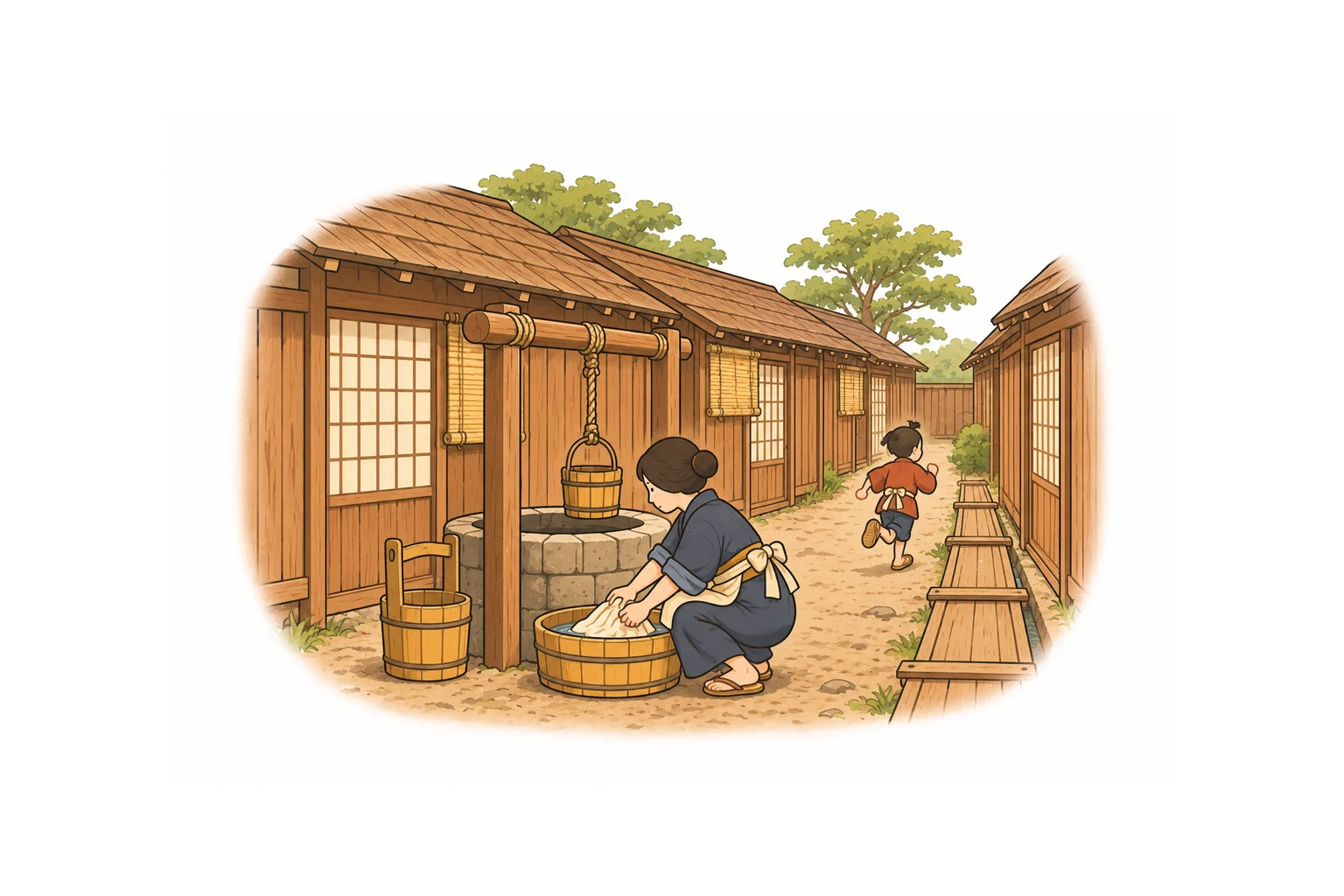
The typical home of an ordinary townsperson was a unit in a nagaya, a long, single-story wooden row house divided into several dwellings, each with its own sliding door onto a narrow alley. The standard unit was called kushaku niken, "nine feet by two ken": about 2.7 meters wide and 3.6 meters deep, roughly the size of a large parking space.
You stepped through the door onto a small earthen-floored area with a clay stove and a water jar. One step up was a single room of four and a half tatami mats. Here the family ate, slept, worked and received visitors. Bedding was folded into a corner by day. There was no bath, no toilet and almost no storage.
For a single laborer this was enough. For a family of four it was cramped, and the alley outside served as an extension of the home. Down the middle ran a drain covered with boards. Shared toilets and a rubbish heap stood at one end, and somewhere along the alley was the well, the social center of the whole block. Women gathered there to wash rice and laundry and to trade news, which is why Japanese still calls idle gossip idobata kaigi, a "well-side conference."
That well was usually not a true well. Much of low-lying Edo stood on reclaimed land near the sea, and its groundwater was often brackish. The city’s drinking water came instead through aqueducts, most famously the Kanda and Tamagawa waterworks, which carried river water into town through buried stone channels and wooden pipes. The "wells" in the alleys were access points to this network. Once a year, around the Tanabata festival, tenants drained and scrubbed their well together, an occasion that usually ended in drinking.
The toilets were part of an economy too. Human waste was valuable fertilizer, and farmers from the surrounding villages paid to collect it. The money went to the landlord or manager, and it was a meaningful part of his income. Vegetables came into the city, waste went out to the fields, and the farmland around Edo depended on the cycle.
Townspeople owned little, and they wasted less. Clothes were often bought secondhand. When something broke, a repairman came to the door: menders of pots, menders of umbrellas, replacers of sandal thongs, men who glued broken ceramics back together. A cotton kimono might be worn by an adult, cut down for a child, turned into diapers and rags, and finally burned, with the ashes sold for use in farming and laundry.
04The Great Shops and Their Boys
At the other end of townsman society stood the great merchant houses of Nihonbashi. The best known was Echigo-ya, the drapery founded by Mitsui Takatoshi in 1673. Most high-end cloth merchants of the day visited wealthy customers at home, set prices by negotiation and sold on credit, collecting payment at Bon and the end of the year. Echigo-ya sold over the counter, for cash, at fixed marked prices, and it would cut cloth to any length rather than only by the full bolt. The formula worked brilliantly. Echigo-ya grew into the Mitsukoshi department store, and the Mitsui family into one of modern Japan’s great business groups.
A shop like this was almost entirely male, and nearly everyone in it had started as a child. Boys of about ten entered as detchi, apprentices. They swept, ran errands, minded customers’ footwear and learned to write and use the abacus in the evenings. They received food, a bed and seasonal clothing, but no wages. After eight or ten years, the capable ones became tedai, clerks who served customers and handled stock and finally earned a salary. Above them were the bantō, the managers who ran departments or the whole business.
A successful bantō might eventually be allowed to open his own shop under the house name. This was called noren-wake, "dividing the curtain," after the cloth curtain hung across a shop entrance and printed with its name. The noren stood for a shop’s reputation, much as a brand does today.
The path was long. Apprentices got two holidays a year, around New Year and the midsummer Bon festival for the ancestors, when they could visit their parents. Many lived in the shop for decades and married only in their thirties or later, if at all.
Merchant families thought of the business as belonging to the house rather than to any one person. The head was a steward who had to pass it on intact. If a son proved hopeless, a family would often adopt a talented son-in-law instead. Many houses wrote down family codes urging thrift, diligence and avoidance of gambling and the pleasure quarters.
05Craftsmen, Peddlers and Fast Food
Most townspeople were neither great merchants nor apprentices but working people. Craftsmen, shokunin, made up a large share: carpenters, plasterers, roofers, tatami makers, coopers, smiths. Since Edo burned down regularly and had to be rebuilt, construction work was steady and carpenters and plasterers earned good day wages.
The Edo craftsman became a type in popular culture: quick-tempered, proud, generous, quick to defend the underdog and quicker to spend his money. A well-known saying claimed that a true Edokko "never keeps money overnight." That was a flattering self-image as much as a fact, but it reflected real conditions. A day’s pay stopped when it rained or when a man fell ill, and a fire could take everything at any moment, so saving had limited appeal.
Below the craftsmen were the street peddlers, bote-furi, who carried goods in baskets hung from a shoulder pole. The trade needed almost no capital, so newcomers from the country often started this way. From dawn onward the alleys filled with their cries: sellers of tofu, natto, clams, vegetables, fish, goldfish, wind chimes, fans. Residents knew each vendor by his call.
A city full of single men with tiny kitchens became a city of fast food. Soba noodles, tempura and sushi were all cheap street foods in Edo, eaten standing at stalls. Edo-style sushi, with a slice of fish pressed onto a ball of vinegared rice, spread in the early nineteenth century as a quick snack, and the pieces are generally thought to have been larger than today’s. Edo people also had a passion for hatsu-gatsuo, the first bonito of early summer. Prices were absurd, and a popular line joked that a man would pawn his wife to get a taste.
06Women, Marriage and Children
Women in the tenements rarely did only housework. They took in sewing and washing, made small handicrafts, worked in teahouses and eateries or ran stalls. Some taught the shamisen, a three-stringed lute, or taught girls writing and etiquette. Many townsmen’s daughters spent several years before marriage in service in a samurai household or a large merchant house. They earned money, learned refined manners and improved their marriage prospects.
Marriage among commoners was more flexible than the period’s reputation suggests. Divorce was common, and so was remarriage. Formally, a husband ended a marriage by handing his wife a short letter of divorce, called mikudari-han, "three and a half lines," after its usual length. That looks like male privilege, and legally it was, but the letter also protected the woman: it was her proof that she was free to remarry. Wives and their families often pressured husbands into writing one. A wife whose husband refused could take refuge in one of two "divorce temples," the best known being Tōkei-ji in Kamakura, and after a period of residence there she would be released from the marriage.
Children’s lives centered on the terakoya, private neighborhood schools. The name recalls an older tradition of temples teaching local children, but by the Edo period most were run in private homes by townsmen, masterless samurai, doctors, priests and quite often women. Pupils started at six or seven and brought their own low desks. There was no common curriculum. The teacher set each child work suited to his or her level and future trade, using textbooks called ōraimono, which had begun as model letters and grew to cover vocabulary, letter writing, bookkeeping, geography and the terms of particular trades. Merchants’ children drilled on the abacus; craftsmen’s children learned to read contracts and accounts.
The results showed in the book trade. Edo had a busy commercial publishing industry, and lending-library men walked the city with towering bundles of books on their backs, renting out novels, joke books, travel guides and illustrated guides to famous places. Literacy in Edo by the nineteenth century was high for any pre-modern city, though historians still argue over exact figures.
07Fire
Edo’s townspeople had a saying that was half complaint, half boast: "Fires and fights are the flowers of Edo." The city was built of wood and paper, its houses jammed together, and in winter dry winds blew down from the northwest. A fire that started in one alley could take out whole districts.
The worst was the Great Fire of Meireki in 1657. It burned for two days, destroyed the main keep of Edo Castle and much of the city, and killed tens of thousands of people; some accounts say a hundred thousand. A popular legend held that it began when a temple burned a cursed long-sleeved kimono, called a furisode, that had belonged to a series of girls who died young, and the wind carried the burning cloth onto the temple roof. Hence its nickname, the "Long-Sleeves Fire." The real cause is unknown.
After Meireki, the shogunate rebuilt with fire in mind. It moved temples and some samurai residences to the outskirts and cleared wide streets and open spaces as firebreaks. The Tokyo place name Ueno Hirokōji, "Ueno broad street," comes from one of them.
Fires kept coming anyway. In 1718, under the eighth shogun Tokugawa Yoshimune, the city magistrate Ōoka Tadasuke organized the townspeople into their own firefighting brigades, the machi-bikeshi, assigned to districts and named after the syllables of the Japanese syllabary, i, ro, ha and so on, with sixteen more brigades east of the Sumida in Honjo and Fukagawa.
There were no pumps capable of stopping a big blaze. The main technique was demolition: tearing down houses downwind of the fire to starve it of fuel. The men best suited to this were construction scaffolders, called tobi, who worked at height every day and knew how buildings were put together. They became the core of the brigades. Each brigade had a standard called a matoi, a tasseled emblem on a pole, and a fireman would plant it on a roof near the flames to show where his brigade was making its stand. Rival brigades competed for glory and sometimes brawled at the scene. Firemen were neighborhood heroes, and their short jackets printed with brigade crests were worn with swagger.
Fire also shaped habits. Merchants stored valuables in thick-walled earthen storehouses called dozō, sealing the doors with mud when a fire approached. Ordinary people kept few possessions. After each big fire, lumber dealers and builders made fortunes, prices rose, and the city went up again.
08Baths, Barbers and the Theater
Since tenements had no baths, everyone used the public bathhouse, the sentō, which cost a few copper coins. Edo people bathed often, some more than once a day. Many early bathhouses were mixed. The shogunate banned mixed bathing in 1791, during the Kansei Reforms, and had to repeat the order again and again, which tells you how well it was obeyed. Many baths simply set separate hours for men and women or ran a board down the middle of the tub.
The bathhouse was a social club. Some had an upstairs room where men drank tea, played go or shogi and talked. The barbershop, where men had their topknots dressed, was another gathering place. In the early nineteenth century the writer Shikitei Sanba set two comic books in exactly these places, Ukiyoburo ("The Bathhouse of the Floating World") and Ukiyodoko ("The Barbershop of the Floating World"). Written almost entirely in dialogue, they catch the voices of old men, housewives, children, servants and dandies with an ear that still delights readers.
For bigger entertainment there was kabuki. Edo’s licensed theaters, chiefly the Nakamura-za, Ichimura-za and Morita-za, ran programs from early morning until evening. Audiences brought food and spent the whole day. Star actors were celebrities whose portraits sold as woodblock prints, the ukiyo-e now famous worldwide, in the way pin-ups and fan photos sell today. During the Tenpō Reforms the shogunate, worried about public morals, moved all three theaters in 1842–43 to a new district at Saruwaka-chō in Asakusa, which promptly became Edo’s theater town.
Cheaper evenings were spent at the yose, small neighborhood halls where storytellers performed rakugo comedy and dramatic tales from history. By the nineteenth century they were scattered across the city, and a craftsman or clerk could drop in after work for a few coins.
The calendar brought its own outings. In spring, crowds went to see the cherry blossoms at Ueno, along the Sumida River and at Asukayama, a hill whose cherries Yoshimune had planted partly to give ordinary people a place for recreation. In summer, people took boats out near Ryōgoku Bridge to enjoy the cool evening air and fireworks. Every neighborhood shrine had its festival, and the processions of the two greatest, the Kanda and Sannō festivals, were allowed inside Edo Castle for the shogun to watch.
Those who saved enough traveled. Pilgrimage to the Grand Shrine of Ise was hugely popular, and neighborhoods formed associations called kō that pooled money so members could take turns going. Mount Fuji associations were popular too, and for those who could not make the climb, local shrines built miniature Fujis of earth and rock to climb instead. The pilgrimages were religious in name and sightseeing tours in fact, with inns, local foods and scenery as the real attractions. Jippensha Ikku’s comic novel Tōkaidōchū Hizakurige, about two hapless Edo men on the road to Ise, was a bestseller in the early 1800s.
09After Edo
In 1868 Edo became Tokyo, capital of the new Meiji government. The status system was abolished, so chōnin ceased to exist as a legal category. Samurai estates became ministries, schools and barracks. The Great Kantō Earthquake of 1923 and the air raids of 1945 destroyed most of what remained of the old wards.
Yet the townspeople’s way of life did not vanish all at once. Tokyo’s shitamachi, the low-lying districts along the Sumida where commoners had lived, kept narrow lanes, wooden row houses, neighborhood bathhouses and alley shrines well into the twentieth century, and pockets of it survive in places like Yanaka, Asakusa and Fukagawa. Soba, tempura and sushi moved from street stalls into restaurants. The Kanda and Sanja festivals still fill the streets every year. And in the yose halls, rakugo performers still tell stories about tenants who cannot pay the rent and the grumbling landlord who looks after them anyway.