
01The Men Who Served
The word samurai comes from an old verb, saburau, meaning "to wait upon" or "to serve." The first samurai were not lords of war. They were armed attendants who guarded the mansions of aristocrats in the capital, Kyoto, carried messages and stood ready when called.
During the Heian period (794–1185), the imperial court gradually lost its grip on the provinces. Out on the plains of eastern Japan, families who had cleared new rice land had to defend it themselves, and they trained their sons and retainers to fight on horseback with the bow. Courtiers in Kyoto found these men useful for putting down rebels and policing estates; the warrior chiefs, in turn, wanted court titles to give them standing. Out of this bargain grew great warrior networks, the most famous led by the Minamoto and Taira clans.
In the 1180s Minamoto no Yoritomo built a military government at Kamakura, south of modern Tokyo, and in 1185 destroyed the Taira. From then until 1868, warriors held real power in Japan for nearly seven centuries. This piece leaves the battles to others. It asks a different set of questions: how samurai earned a living, where they lived, what they read, what work they did in peacetime, and how the class finally disappeared.
02Warriors of the Land
A samurai of the Kamakura period (1185–1333) was first of all a landholder. He lived in a fortified house, ringed by a ditch and earthen wall, in the middle of the fields his family had cleared. Peasants worked those fields; he collected their dues, settled their quarrels and supervised planting. When war came, he rode out with his kinsmen and household men behind him.
The ideal of this world was summed up in the phrase issho kenmei, "staking one’s life on a single place." Today the Japanese say isshō kenmei with different characters to mean simply "trying one’s hardest," but the original sense was concrete: a warrior’s land was his life.
The relationship between the shogun and his vassals, the gokenin or "housemen," was a frank exchange. The shogun confirmed a warrior’s rights to his land and rewarded service with new land. The warrior, for his part, did guard duty in peacetime and fought when summoned. Loyalty came with a price tag.
That arrangement was tested when Mongol fleets attacked Kyūshū in 1274 and 1281. The housemen fought hard and the invaders withdrew, but a defensive war produced no conquered territory to hand out. One warrior from Higo province, Takezaki Suenaga, traveled all the way to Kamakura to press his claim for a reward in person. He later commissioned a set of illustrated scrolls, the Mōko Shūrai Ekotoba, showing his deeds in battle. The scrolls survive as the most vivid picture we have of those invasions, and they exist because one samurai wanted to be paid.
Early samurai were mounted archers before they were swordsmen. The old name for the warrior’s calling was "the way of bow and horse." Swords were carried, but on the battlefield the bow, and later the spear and the musket, did most of the killing.
03Leaving the Village
Through the Warring States era of the fifteenth and sixteenth centuries, many samurai still lived on their land, farming in quiet seasons and fighting in others. The man who separated them from the soil was Toyotomi Hideyoshi, who unified Japan in the 1580s and 1590s.
In 1588 Hideyoshi issued his famous "sword hunt" edict, ordering farmers to surrender swords, spears, bows and guns. The official reason was that the metal would be used in building a great Buddha statue in Kyoto; the real purpose was to disarm the countryside. Further orders forbade warriors to return to farming and farmers to leave their fields to become soldiers or merchants. At the same time Hideyoshi’s officials surveyed the land of the whole country and measured each field by its kokudaka, its estimated yield in koku of rice. One koku, about 180 liters, was roughly what one person ate in a year, and it became the standard measure of wealth.
Across the country, regional lords, the daimyō, called their warriors in from the villages to live in new castle towns. At the center stood the castle; around it, samurai residences laid out by rank; beyond them, the quarters of merchants and artisans, and a belt of temples. Many Japanese cities today, such as Kanazawa, Sendai, Kumamoto and Hikone, still follow the street plans of these castle towns.
The result was a clean break. The samurai was no longer a lord living among his fields. He was a townsman drawing an income from his lord, with a hereditary status fixed by law. In the Edo period, samurai and their families made up roughly six percent of Japan’s population.
04Paid in Rice
During the Edo period (1603–1868), when the Tokugawa shoguns ruled from the city of Edo (now Tokyo), most samurai lived on stipends, and stipends were paid in rice.
Senior retainers were granted a fief, a stretch of villages whose tax rice was assigned to them, though domain officials often collected it on their behalf. Lower-ranking men simply drew rice from the lord’s granary. The humblest received rations calculated per head, about five gō (roughly 0.9 liters) of rice a day for each "person’s allowance." A samurai’s standing could be read straight from his figures: "a 300-koku man" was comfortably placed; "thirty bales and two rations" was not.
The difficulty was that samurai were paid in rice but lived in a money economy. Rice had to be sold to buy cloth, oil, books and the gifts that social life demanded. In Edo, the shogun’s direct retainers, the hatamoto (bannermen) and lower-ranking gokenin, used brokers in the Asakusa district called fudasashi to collect and sell their rice. The brokers also lent money against future stipends. As prices rose and stipends stayed fixed by family rank, generation after generation, debt became a normal condition of samurai life. The shogunate more than once canceled or reduced debts owed to the brokers, most famously during the Kansei Reforms of the 1780s and 1790s, but it could not change the arithmetic.
Poor samurai took in side work. Lower-ranking men in Edo pasted umbrellas, made paper lanterns and toothpicks, bred goldfish and singing insects, and grew morning glories for sale.
A family of accountants in the service of the Kaga domain, centered on Kanazawa, left account books covering several decades of the nineteenth century. The Inoyama household recorded every stipend payment, every wedding and funeral expense, every loan, and the family heirlooms sold to pay them off. The historian Isoda Michifumi’s 2003 study of the books became a bestseller and then, in 2010, a film. The books show a respectable mid-ranking family running hard simply to keep up appearances.
05Warriors at Their Desks
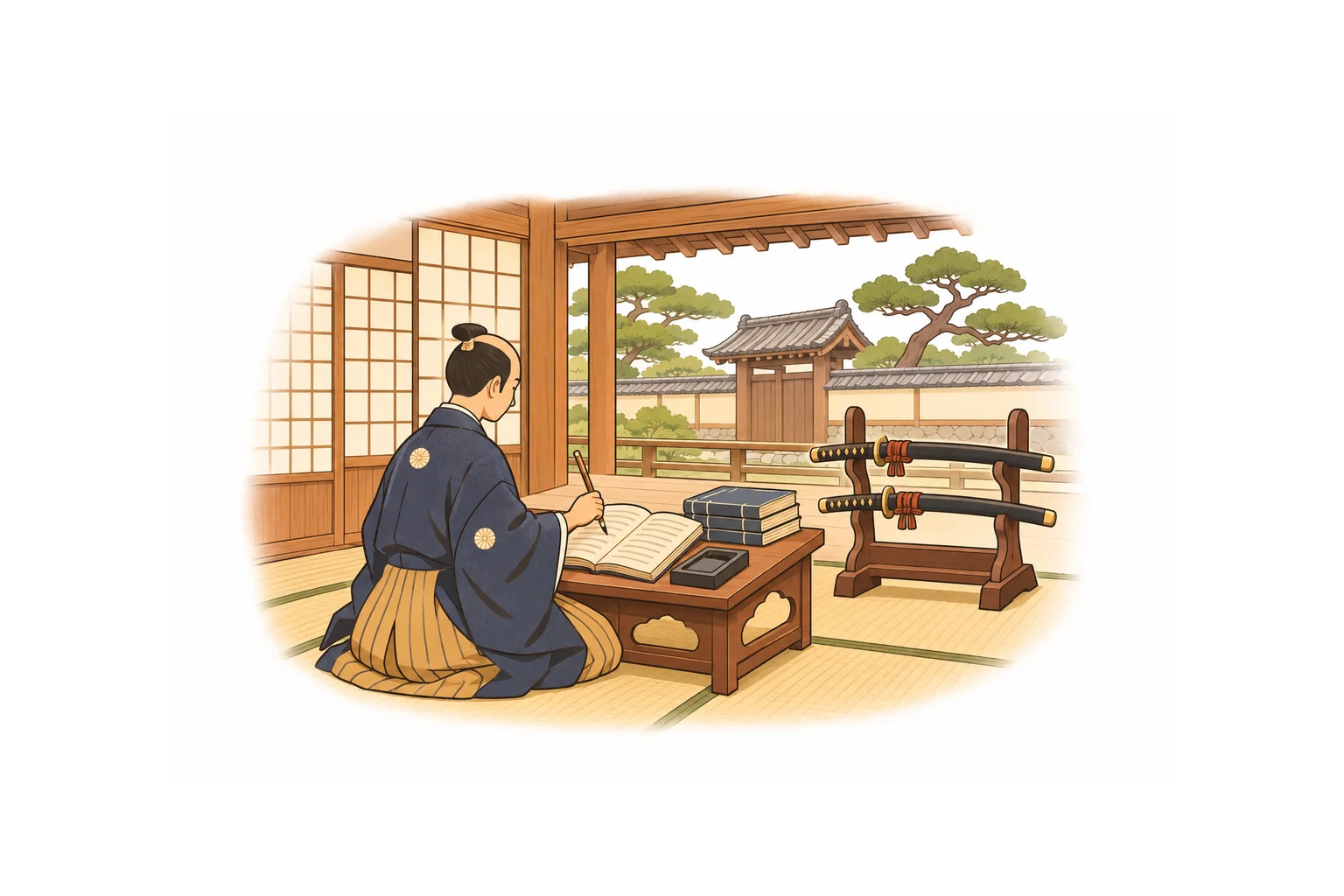
After the siege of Ōsaka Castle in 1615, Japan went about two and a half centuries without a major war. A class whose purpose was fighting had to find something else to do. What it found was government.
Nearly all administration in the shogunate and the roughly 260 domains was carried out by samurai. Their posts fell into two broad groups. Military offices, the guard units and gate wardens and night attendants, turned in peacetime largely into rosters of ceremonial duty. Civil offices handled the real business: finance, justice, temple affairs, rural administration, and the city magistrates who ran policing and courts in Edo. By the eighteenth century, the samurai with prospects were those who could draft documents, keep accounts and understand regulations.
A middle-ranking retainer of the Owari domain, around modern Nagoya, named Asahi Bunzaemon later held the post of tatami commissioner, responsible for buying and maintaining the domain’s floor mats. From 1684 to 1717 he kept a diary, later known as the Ōmu Rōchūki ("Records of a Parrot in a Cage"). There is hardly a sword stroke in it. He writes about drinking, fishing, theater, gambling, quarrels with his wife, sightseeing on official trips, and the fires, murders and public executions that enlivened the town. His job was light and his life ordinary, which is exactly what makes the diary valuable.
There were never enough posts to go around. Many of the shogun’s retainers had no office at all and were simply carried on the rolls, drawing their stipends in idleness. One of them was Katsu Kokichi, father of the statesman Katsu Kaishū. In old age he wrote a memoir, Musui Dokugen ("Musui’s Story"), describing a youth of running away from home, street fights, dealing in swords and brokering disputes in the Edo underworld. He ended it by warning his descendants not to follow his example.
Even the great lords were bound by the routines of peace. Under the system of alternate attendance, sankin kōtai, each daimyo had to spend every other year in Edo, and his wife and heir lived there permanently. Lords traveled with processions of hundreds or even thousands of retainers, and each domain kept a large compound in the capital. For a young provincial samurai, a tour of duty in Edo meant a year as a bachelor in barracks, with free days spent visiting temples, watching sumo and eating buckwheat noodles.
06The Forty-Seven and the Law
Occasionally the warrior ideal and the bureaucratic reality collided head-on. The most famous collision is the story of the forty-seven rōnin.
In 1701 Asano Naganori, lord of the small Akō domain west of Ōsaka, drew his sword inside Edo Castle and wounded Kira Yoshinaka, a senior official in charge of ceremonial. Drawing a blade in the shogun’s palace was a grave crime. Asano was ordered to commit ritual suicide that same day, and his domain was confiscated. Hundreds of his retainers lost their lord and their stipends at a stroke, becoming rōnin, masterless samurai. Kira went unpunished.
On the night of the fourteenth day of the twelfth month of Genroku 15 by the old calendar (January 30, 1703), a band of former Akō retainers led by Ōishi Kuranosuke stormed Kira’s Edo mansion, killed him, and carried his head to their lord’s grave at Sengaku-ji temple. Edo was electrified. Many saw the men as models of loyalty. Under shogunal law, however, they were a conspiracy that had carried out a private vendetta in the capital. Officials and scholars, among them the Confucian thinker Ogyū Sorai, argued over the case for weeks. In the end the shogunate ordered the men to commit suicide, granting them the honorable death of samurai rather than execution as criminals.
The story became the puppet play and kabuki drama Kanadehon Chūshingura, and it is still retold on stage and screen. It lasts because it dramatizes the central tension of Edo samurai life: men trained to put loyalty and honor above all were living in a state run by law and paperwork.
07Books as Well as Swords
Edo samurai were expected to master "the two ways," the literary and the martial, and the literary side kept growing in weight.
The shogunate promoted Confucian learning, especially the school of the Song-dynasty philosopher Zhu Xi, whose emphasis on hierarchy between ruler and subject, father and son, suited a society of fixed ranks. The scholar Hayashi Razan entered the service of Tokugawa Ieyasu, and his descendants ran the shogunate’s Confucian affairs for generations. Their family academy stood beside the Confucian shrine at Yushima in Edo. In 1790 the shogunate’s chief minister Matsudaira Sadanobu ordered that only Zhu Xi’s teachings be taught there, and in 1797 it became the official Shōheizaka Academy.
Domains founded their own schools for retainers’ sons, such as the Nisshinkan of Aizu, the Kōdōkan of Mito and the Meirinkan of Chōshū. Boys usually entered at about ten, and by the 1850s and 1860s often at seven or eight. They began with sodoku, recitation without explanation: they chanted the Analects of Confucius and the Mencius in classical Chinese until they had them by heart, and only later learned what the words meant. Many schools added mathematics, medicine and etiquette, and in the nineteenth century "Dutch learning," Western science studied through Dutch books.
Swordsmanship flourished as a school subject and a private pursuit. Dozens of fencing lineages ran training halls, and in the eighteenth century some began sparring with bamboo swords and protective armor, the ancestor of modern kendō. By the 1850s the big Edo fencing halls, such as the Chiba school of Hokushin Ittō-ryū and the Renpeikan, drew large numbers of students, and many of the young activists of the 1860s trained in them.
High literacy across the samurai class mattered enormously later on. When the old order fell, Japan already had a large body of men who could read classical Chinese, handle official documents and work within a disciplined organization, and they became the officials, officers and teachers of the new state.
08Family, Rank and Women
Samurai life was organized around the ie, the house: a name, a rank and a stipend passed down whole to a single heir, usually the eldest son. A house without a son adopted one, often a younger son from a family of matching rank, or a husband for a daughter. Adoption was everywhere in samurai society, because a house without an heir lost its stipend and vanished.
Younger sons had few good options. They could wait to be adopted into another family or live on in their elder brother’s household, often unable to marry. They were sometimes mocked as "cold-rice eaters."
Ranks within the class were sharply drawn. Upper and lower samurai in the same domain lived in different neighborhoods, wore different clothes, bowed differently and rarely intermarried. In Tosa domain on Shikoku, the lower "country samurai," the gōshi, were openly despised by the upper samurai; Sakamoto Ryōma, one of the best-known figures of the 1860s, came from such a family. Fukuzawa Yukichi, born to a low-ranking samurai of Nakatsu domain in Kyūshū, wrote in his autobiography that the system of hereditary rank was his father’s enemy, because it had kept a talented man in obscurity all his life.
Samurai women lived within tight limits. Families arranged marriages between houses of equal rank, and a wife was expected to serve her husband and his parents and to bear an heir. In practice, though, wives often ran the household budget, managed the servants, educated the children and kept up the network of gifts and visits on which a family’s standing depended. Many girls of samurai families learned to use the naginata, a long-bladed polearm. In 1868, during the siege of Aizu, a band of women fought the government army, and Nakano Takeko was killed leading a charge with a naginata.
Privilege marked samurai out from everyone else. Only they could use surnames publicly and wear the paired long and short swords. The law allowed a samurai to cut down a commoner who showed him gross disrespect, but he had to report the killing and justify it, and if the case was weak he could be punished himself. It happened far less often than legend suggests.
09Where "Bushido" Comes From
Many people today think of samurai in terms of bushidō, "the way of the warrior." In fact the word was not much used in the Edo period, and there was never a single samurai code.
Plenty of Edo writers discussed how a samurai should live, and they disagreed. In the seventeenth century the military scholar Yamaga Sokō argued that samurai, who ate without farming, had to justify themselves by moral example to the other classes, a thoroughly Confucian answer. In the early eighteenth century a retired retainer of Saga domain, Yamamoto Tsunetomo, dictated the reflections later collected as Hagakure ("Hidden by the Leaves"), which opens its most famous passage by declaring that the way of the samurai is found in death. But Hagakure circulated only privately within Saga and became widely known only in the twentieth century.
The book that made bushidō world-famous was written in English. In 1899 Nitobe Inazō, an educator who had studied in the United States, published Bushido: The Soul of Japan, explaining Japanese ethics to Western readers through comparisons with European chivalry. It became popular in Europe and America around the time of the Russo-Japanese War and was translated back into Japanese. In the decades that followed, bushidō was promoted as the spirit of the whole nation, and in the 1930s and 1940s militarists used it heavily. Much of what the word now suggests was shaped after the samurai themselves were gone.
10The End of the Samurai
In 1868 an alliance led by the Satsuma and Chōshū domains overthrew the shogunate and established a new government in the name of the Meiji emperor. Most of the men who led this revolution were themselves low-ranking samurai. Within a decade the state they built had abolished their class.
In 1869 the daimyo returned their lands and people to the emperor, and in 1871 the domains were abolished altogether and replaced by prefectures run by appointed governors. Former samurai were reclassified as shizoku, "warrior families," but the lords and domains that had employed them no longer existed. Commoners were now allowed to take surnames, choose their occupations and marry across the old lines.
The conscription law of 1873 drafted soldiers from the whole male population, ending the samurai monopoly on arms. In 1876 the government banned the wearing of swords in public and converted the remaining hereditary stipends into one-time payments in government bonds. For most lower-ranking families, the interest on those bonds was nowhere near enough to live on.
Anger boiled over in a series of uprisings, and in 1877 the greatest of them broke out in Kagoshima, with Saigō Takamori, a hero of the Meiji revolution, at its head. The Satsuma Rebellion lasted more than half a year. In the end a conscript army, largely made up of farmers’ sons, crushed the rebels, and Saigō died at Shiroyama outside Kagoshima. It was the last civil war in Japanese history.
Most former samurai adapted more quietly. They became bureaucrats, army and navy officers, policemen and schoolteachers; they founded newspapers, schools and companies. Many put their bonds into business and lost them, so often that people coined a phrase for it, "the samurai’s way of doing business." Men of samurai descent filled a large share of the leading posts in Meiji politics, the military and the universities. The class was gone, but its sons ran much of the new Japan.