
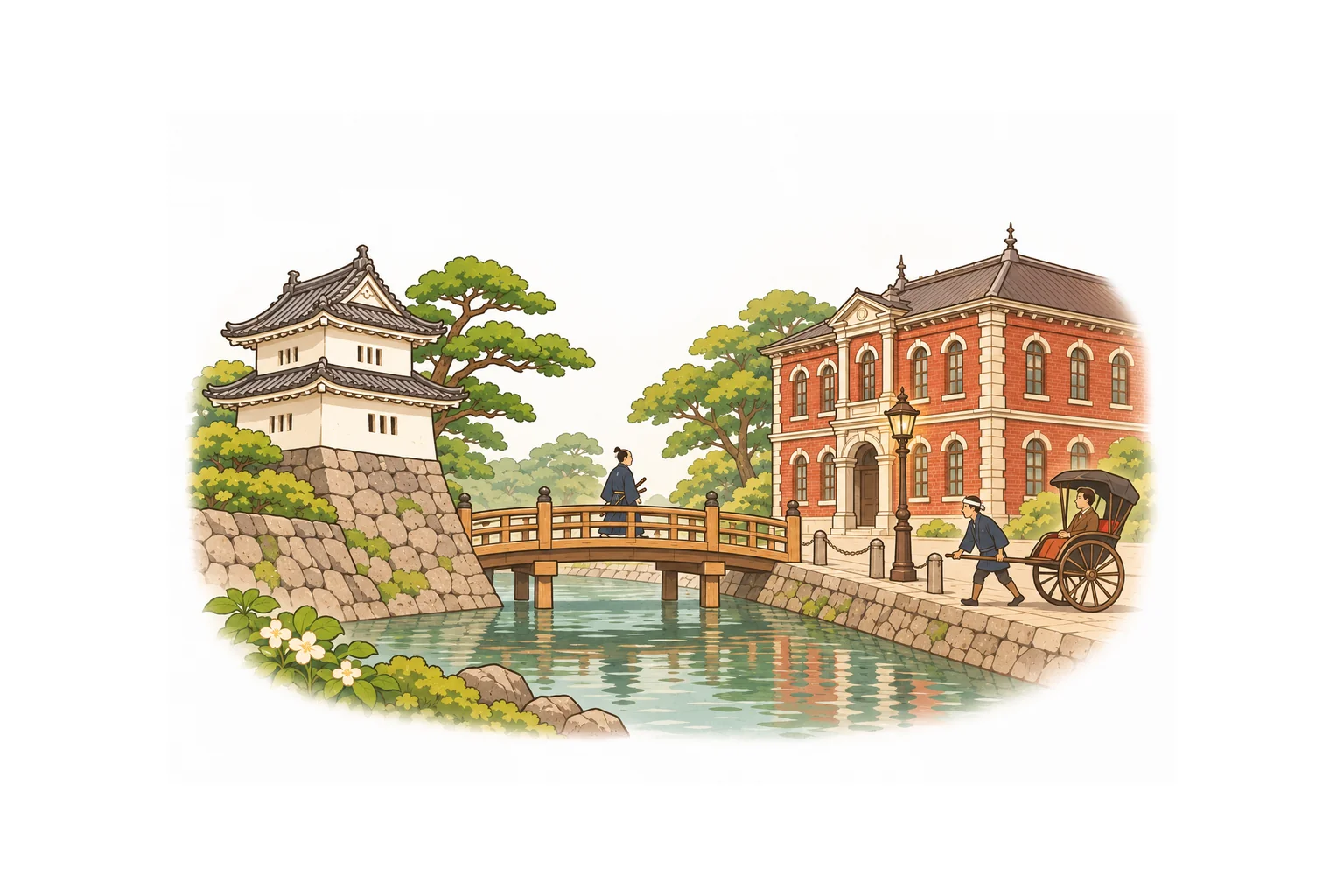
01A Village by the Bay
Visitors to Tokyo today find it hard to imagine that the ground under their feet was once tidal mud. Yet in 1590 much of what is now central Tokyo was water or marsh. Several rivers, the Sumida among them, emptied into a shallow bay, and an inlet called the Hibiya Inlet reached almost to the spot where the Imperial Palace now stands. On the low hills above the shore stood a small, run-down castle and a scattering of fishing hamlets. The place was called Edo, a name most often explained as "gate of the inlet."
The castle had been built in 1457 by Ōta Dōkan, a retainer of a branch of the Uesugi family who governed parts of the Kantō, the great plain of eastern Japan. Dōkan was remembered as a capable general and a poet; he was later murdered on his own lord’s orders. Edo then passed to the Later Hōjō, a warlord family whose real base was Odawara, farther down the coast. For them Edo was an outpost and nothing more.
In 1590 Toyotomi Hideyoshi, the man who had brought most of Japan under his control, besieged Odawara and destroyed the Hōjō. He then handed their vast Kantō lands to his most powerful ally, Tokugawa Ieyasu, in exchange for Ieyasu’s home provinces closer to Kyoto. It looked like a reward. It was also a way of moving a dangerous rival far from the political heart of the country. Ieyasu could have settled in Odawara or in Kamakura, the old seat of Japan’s first warrior government. He chose Edo instead, and Tokugawa tradition dates his formal entry to the first day of the eighth month of 1590. Later accounts describe a castle with leaking roofs and a few hundred thatched houses; these stories grew in the telling, since they made Ieyasu’s achievement look grander, but Edo was certainly no city.
What Ieyasu saw was water. Rivers linked Edo to the farmland of the Kantō plain, and the bay opened to coastal shipping. If the marshes could be tamed, Edo could become the collection point for the wealth of all eastern Japan.
02Moving Hills into the Sea
Ieyasu’s first projects were practical. He had a canal, the Dōsanbori, dug so that boats could reach the foot of the castle, and another, the Onagigawa, cut eastward to the salt pans at Gyōtoku. Salt was a strategic supply, and he wanted it close.
Everything changed after 1600, when Ieyasu won the Battle of Sekigahara, and 1603, when the emperor appointed him shogun, the military ruler of Japan. Edo was now the seat of a national government, and it needed a castle and a city to match. The Tokugawa used a method called tenka bushin, "construction for the realm": the regional lords, the daimyo, were ordered to supply labor, money and materials for the shogun’s building works. Lords from western Japan shipped huge blocks of stone from the Izu Peninsula to face the castle moats, and many of the stones still carry the carved marks of the families responsible for them.
The city needed flat land, so the builders made it. They cut down Kanda Hill, north of the castle, and dumped the earth into the Hibiya Inlet. Much of today’s Hibiya, Marunouchi and the area toward Shinbashi stands on that fill. The castle itself grew over three generations of shoguns, Ieyasu, his son Hidetada and his grandson Iemitsu, and was largely complete by the 1630s. Its moats are often described as a spiral winding outward from the center, which let the city keep growing ring by ring.
Reclaimed land brought a problem: wells dug in it gave brackish water. The shogunate first channeled water from Inokashira Pond to the city through the Kanda aqueduct. As the population kept rising, it built the Tamagawa aqueduct, completed in 1654, which drew water from the Tama River more than forty kilometers to the west. The water flowed by gravity, then through buried wooden pipes to public wells in each neighborhood. Few cities anywhere in the seventeenth century supplied water this way to so many people.
03A City Divided by Rank
Tokugawa society was built on status, and Edo’s map showed it. Sixty to seventy percent of the city’s land belonged to warrior households, the mansions of daimyo and the homes of the shogun’s own retainers; the figures vary with how the city’s limits are drawn. Temples and shrines held roughly fifteen to twenty percent. Commoners, the merchants and artisans called chōnin, got about the same share, even though they numbered about as many as the samurai. Their districts became some of the most crowded urban spaces on earth.
Geography reinforced the divide. The west of the city rose into wooded uplands, and there the samurai built their estates; this became known as the Yamanote, the "hill side." The commoners filled the flat land to the east along the rivers and canals, the Shitamachi, or "low town." Tokyo residents still use both words, and they still carry a hint of the old social difference: Yamanote for the respectable, Shitamachi for the lively and down-to-earth.
The heart of the low town was Nihonbashi, the "Bridge of Japan." A wooden bridge went up there in 1603, and soon after it was named the starting point of the Five Highways, the main roads the shogunate maintained, including the Tōkaidō along the Pacific coast to Kyoto and the Nakasendō through the mountains. Distances across Japan were measured from this bridge. Beside it lay the fish market, and along the main street stood great shops such as Echigoya, founded by the Mitsui family and the ancestor of today’s Mitsukoshi department store. In the late seventeenth century Echigoya made its name by selling cloth for cash at fixed prices, cut to whatever length the customer wanted, a novelty that drew ordinary townspeople by the thousands.
Religion had its own geography. To the northeast, the direction traditionally believed to let in evil, the monk Tenkai founded Kan’ei-ji at Ueno in 1625 as a guardian temple for the city, modeled on the great mountain monastery that guarded Kyoto’s northeast. To the south, Zōjō-ji at Shiba became another Tokugawa family temple. And in Asakusa, the ancient temple of Sensō-ji was the city’s favorite place for commoners to pray, shop and be entertained.
04A Million People and the Alternate Attendance System
By the early eighteenth century Edo probably held around a million people, which put it among the largest cities in the world. One rule did more than anything else to fill it.
In 1635 the third shogun, Iemitsu, made the system known as sankin kōtai, "alternate attendance," a formal obligation. Every daimyo had to spend alternate years in Edo and in his own domain, and his wife and heir had to live in Edo permanently, as hostages in all but name. There were more than two hundred and fifty domains, and each kept several mansions in the city staffed by hundreds or even thousands of retainers and servants. The processions that carried lords to and from Edo wound along the highways and kept inns and post towns in business. The cost drained domain treasuries, which suited the shogunate very well.
All these samurai produced nothing themselves. They had to be fed, clothed and housed, and merchants, craftsmen, porters, carpenters and cooks came from all over Japan to serve them. Roughly half of Edo’s people were of samurai status and half were commoners. Because many retainers came without families, and many laborers were young men looking for work, men greatly outnumbered women for most of the period.
Edo grew no rice of its own. Tax rice from across the country came by ship and was stored in the shogunate’s granaries at Kuramae on the Sumida River. The shogun’s lower retainers were paid in rice, but they needed cash, so brokers called fudasashi collected and sold their stipends for them, and lent them money against future payments. Many brokers grew rich. Many samurai fell into debt. A warrior outranked a merchant on paper, but by the eighteenth century the merchant often held the warrior’s IOUs.
05How the City Worked
The commoner districts were governed by two city magistrates, the machi bugyō, known as North and South after the locations of their offices. They took turns month by month handling lawsuits, policing and administration. Their staff numbered only a few hundred, far too few to manage half a million townspeople directly, so the system leaned on the townspeople themselves. Three hereditary town elders passed orders down to ward headmen, who kept population registers, settled quarrels and announced new regulations. Households were grouped into units of five that answered for one another. Landlords of the long wooden tenement houses, the nagaya, collected rent but were also responsible for their tenants’ behavior.
Waste was a resource. Farmers from surrounding villages came into the city to buy human excrement for fertilizer and sold vegetables on the return trip. The waste of wealthy households fetched higher prices, and tenement landlords counted the sale of their tenants’ waste as part of their income. Peddlers bought up old clothes, used paper, candle drippings and ashes. Visitors from Europe in the nineteenth century were often struck by how clean Edo’s streets were compared with those of their own cities.
A city full of single men ate out. Stalls sold buckwheat noodles, tempura and sushi to customers who ate standing up and moved on. The style now called Edomae, "in front of Edo," a slice of fish from the bay pressed onto a small mound of vinegared rice, became popular in the early nineteenth century as fast food. Sushi as a dish was much older, but this quick hand-pressed form was Edo’s own.
06Fire
"Fires and fights are the flowers of Edo," ran a local saying. Wooden houses stood packed together, and strong northwest winds blew through the dry winter and spring. When a fire started, it could take out whole districts in hours.
The worst came in the first month of 1657, the Great Fire of Meireki. It burned for two days, destroyed the main keep of Edo Castle, most of the daimyo mansions and a large part of the commoner districts, and killed tens of thousands of people. Estimates vary widely: the usual figure is more than 100,000, while another common estimate is about 68,000, and some are lower still. Popular memory called it the Long-Sleeves Fire. According to the legend, a temple was burning a kimono believed to be cursed after it had passed among several girls who died young, and a gust of wind lifted the flaming garment into the temple roof. Nobody knows how the fire really began.
The rebuilding reshaped Edo. Some daimyo mansions and temples were moved outward. Firebreaks were cleared, and wide streets called hirokōji were laid out to stop the flames from jumping. A bridge, the Ryōgoku Bridge, was thrown across the Sumida, and the city spread onto the east bank into Honjo and Fukagawa. Ekō-in temple was founded nearby to pray for the unclaimed dead. The castle keep was never rebuilt. According to the usual account, Hoshina Masayuki, an uncle of the young shogun and his chief adviser, argued that in an age of peace a keep served no purpose and the money was better spent on the city. Its massive stone base still stands in the East Gardens of the Imperial Palace.
Firefighting improved too. At first only samurai brigades existed. In the early eighteenth century the city magistrate Ōoka Tadasuke organized brigades of commoners, named after the syllables of the Japanese kana syllabary. Their core members were scaffolding workers used to moving across roofs. With no means of pumping much water, they fought fires mainly by tearing down buildings downwind. Each brigade had its own standard, the matoi, which a fireman would plant on a rooftop in the path of the blaze, and the firemen in their marked jackets became popular heroes.
07Surrender Without a Battle
In 1853 the American commodore Matthew Perry anchored his warships off Uraga at the entrance to Edo Bay and demanded that Japan open its ports. The shogunate hurriedly built artillery islands off Shinagawa; they were called daiba, "batteries," and today’s waterfront district of Odaiba takes its name from them. Fifteen years of crisis followed. In late 1867 the last shogun, Tokugawa Yoshinobu, returned governing authority to the emperor. In the first month of 1868 his forces were beaten outside Kyoto at Toba-Fushimi by troops from the domains of Satsuma and Chōshū, and Yoshinobu fled by ship to Edo and shut himself away in a temple to show submission.
The new government’s army marched east, with a general assault on Edo set for the middle of the third month. Fighting in a wooden city of a million people would have been a catastrophe. Negotiating for the Tokugawa side was Katsu Kaishū, a former navy official, now the shogunate’s army commissioner and then its head of military affairs, who had sailed to America and knew how weak Japan was against the Western powers. Leading the imperial army in practice was Saigō Takamori of Satsuma. An earlier envoy, the swordsman Yamaoka Tesshū, had already crossed the lines to meet Saigō at Sunpu and carried back terms. On the thirteenth and fourteenth days of the third month (April 5 and 6 in the Western calendar), Katsu and Saigō met at Satsuma residences in Takanawa and Tamachi and agreed that Yoshinobu would retire to Mito, the castle would be handed over, and the warships and weapons surrendered. The assault was called off. Katsu later said he had prepared for failure too, arranging to burn the city ahead of the invaders while boats carried its people to safety.
On the eleventh day of the fourth month, Edo Castle changed hands peacefully. Not everyone accepted it. A band of Tokugawa loyalists, the Shōgitai, dug in at Kan’ei-ji in Ueno. On the fifteenth day of the fifth month the government’s troops, directed by the military planner Ōmura Masujirō, took the hill in a single day, and most of the temple’s great halls burned. The grounds later became Ueno Park, and the well-known bronze statue of Saigō with his dog stands close to where the fighting took place.
08The Eastern Capital
In the seventh month of 1868 Edo was renamed Tokyo, "Eastern Capital," as a counterpart to Kyoto in the west. The era name changed to Meiji that autumn, and in the tenth month the teenage emperor arrived in his new city from Kyoto; the castle was renamed Tokyo Castle. He went back to Kyoto briefly and returned in 1869 to stay, and the government came with him. No formal decree ever declared Tokyo the capital, a fact some people in Kyoto still mention with a smile.
The first years were hard. Alternate attendance had been relaxed in 1862, and when the domains and the shogunate disappeared, the daimyo and their retainers went home. Edo’s population fell sharply, and great estates stood empty. The new government put them to use for ministries, barracks, schools and parks. The Red Gate on the Hongō campus of the University of Tokyo was once the gate of the mansion of the Maeda lords of Kaga.
Tokyo soon became the showcase of the new Japan. In 1872 the country’s first railway opened between Shinbashi and Yokohama. That same year a fire destroyed the Ginza district, and the government rebuilt it as a model Western street of brick buildings. The main avenue was finished in 1873 and the whole brick district in 1877; gas lamps followed in 1874 and horse-drawn trams in 1882. In 1883 the Rokumeikan, a hall for entertaining foreign diplomats, opened, and Japanese officials and their wives learned to waltz there in Western dress; admirers called it progress, critics called it apish imitation. In 1889 the City of Tokyo was formally established, and the Constitution of the Empire of Japan was proclaimed in the newly built palace on the grounds of the old castle. The shogun’s fortress had become the emperor’s home.
By the end of the century the population had probably passed its Edo peak, and factories spread along the Sumida and across the eastern lowlands. When the Meiji emperor died in 1912, Tokyo was a modern capital with electric streetcars, universities and a parliament. It would be largely destroyed twice more, by the Great Kantō Earthquake of 1923 and by American bombing in 1945, and rebuilt both times.
Edo still shows through. The moats and stone walls around the Imperial Palace are the ones the first shoguns built. Neighborhood names such as Kanda, Asakusa and Fukagawa, and the winding slopes of the Yamanote, follow the old plan. Nihonbashi remains the point from which Japan’s road distances are measured. The present stone bridge dates from 1911, and an elevated expressway built before the 1964 Olympics now runs directly over it, so that the starting point of the nation’s roads sits in shadow.