
01A City Built on Water
Fifteen hundred years ago, most of what is now central Ōsaka lay underwater. To the west spread Ōsaka Bay; to the east sat a large lagoon called Lake Kawachi. Rivers flowing down from the Kyoto and Nara basins dumped silt between the two, building up marshes and sandbars. The only solid ground was a narrow ridge of high land running north into the water like a finger. This is the Uemachi Plateau, and nearly every famous old site in Ōsaka, from the castle to the temple of Shitennō-ji, stands along it.
That geography explains most of Ōsaka’s story. Ships sailing east along the Inland Sea, the sheltered waterway between Japan’s main islands, ended their voyage here. Anyone heading to the early capitals in the Nara basin, or later to Kyoto, unloaded at this point and continued by river or over the hills on foot. The ancient name for the area was Naniwa, and its harbor, Naniwa-zu, was the front door of the Japanese state. Envoys from Korea and China came ashore here, along with monks, scholars, and craftsmen. Japan’s own embassies to Tang China set out from the same harbor.
Ōsaka began as a port, and in a sense it never stopped being one. When it later became Japan’s commercial capital, it was still the rivers and the sea that made it rich.
02Naniwa: The Capital Before the Capitals
The Nihon shoki, Japan’s oldest official history, compiled in 720, says that Emperor Nintoku built a palace in Naniwa in the fifth century. It also tells a story Ōsaka people have always loved. Looking out from a height, Nintoku noticed that no cooking smoke rose from the people’s houses. Realizing they were too poor to eat, he canceled all taxes for three years and let his own palace roof leak rather than demand repairs. The story is a legend, but it gave Ōsaka a founding ruler with a good heart. The enormous keyhole-shaped burial mound just south of the city, in Sakai, is traditionally identified as Nintoku’s tomb; it is the largest such mound in Japan.
Firmer history begins in the late sixth century. In 593, according to tradition, Prince Shōtoku, the regent famous for championing Buddhism, founded Shitennō-ji on the plateau above the harbor. Its pagoda would have been the first thing a visitor saw from the water, a clear statement that this country had joined the Buddhist civilization of the continent. The buildings have burned and been rebuilt many times, most recently after the Second World War, but the temple still keeps its original site and its ancient layout of gate, pagoda, and hall in a single straight line.
In 645, Prince Naka no Ōe and his ally Nakatomi no Kamatari assassinated Soga no Iruka, head of the clan that had dominated the court, and launched a program of reforms known as the Taika Reform. The new emperor, Kōtoku, moved the court away from the old power base in Asuka to Naniwa, where a large new palace was built. Naniwa faced outward toward Korea and China, which suited reformers trying to remodel Japan on the Chinese system. The arrangement did not last. Naka no Ōe fell out with the emperor and led most of the court back to Asuka, leaving Kōtoku to die almost alone in his new palace.
In the eighth century, Emperor Shōmu rebuilt the Naniwa palace and in 744 briefly declared it his capital, during a restless period when he moved the court several times in a few years. Within a year the government was back in Nara. After that, the palace slipped out of memory so completely that no one knew exactly where it had stood. Only in the mid-twentieth century did archaeologists find its post holes and roof tiles just south of Ōsaka Castle. Today the site is an open park with a reconstructed platform for the great hall, and from the upper floors of the Ōsaka Museum of History next door you can see the ancient palace grounds and the castle in a single view.
03A Temple Becomes a Fortress Town
Once the capital settled first in Nara and then in Kyoto, Naniwa became a way station rather than a seat of power. Courtiers passed through on pilgrimages to the sacred mountains of Kumano. Sailors prayed at Sumiyoshi Taisha, the great shrine to the gods of the sea, where Japan’s embassies to China had once asked for safe passage. But for several centuries this was not a major city.
What changed that was a religious movement. Jōdo Shinshū, or True Pure Land Buddhism, taught that salvation came simply through faith in the Buddha Amida, not through learning or difficult practice. It spread rapidly among farmers, fishermen, merchants, and artisans, and its head temple, the Hongan-ji, became one of the most powerful institutions in Japan. Its believers were often called the Ikkō sect, and in several provinces they took up arms against warlords.
In the 1490s the Hongan-ji’s leader, Rennyo, built a small retreat at the northern tip of the Uemachi Plateau. Around this time the name Ōsaka, meaning "big slope," begins to appear in the records. In 1532, when the sect’s headquarters at Yamashina near Kyoto was burned by its enemies, the leadership moved to Ōsaka. The new head temple, known as Ishiyama Hongan-ji, quickly attracted thousands of followers. Merchants and craftsmen settled around it; moats and earthen walls went up. The result was a temple town that governed and defended itself in an age of civil war.
The site was too good to be left alone. Oda Nobunaga, the warlord who was forcing central Japan under his control in the 1560s and 1570s, wanted it. In 1570 the Hongan-ji’s leader Kennyo called on believers across the country to resist him, beginning a war that lasted ten years. The Mōri family of western Japan shipped food and men to the temple by sea; Nobunaga answered by building large warships, reputedly armored with iron plates, to blockade the bay. In 1580, through mediation by the imperial court, Kennyo agreed to leave. When the last defenders withdrew a few months later, the temple caught fire and, according to accounts, burned for days.
Nobunaga never built on the site. In 1582 he was killed in Kyoto by one of his own generals at the temple of Honnō-ji. The man who stepped into his place was Toyotomi Hideyoshi.
04Hideyoshi’s Castle
Hideyoshi began building Ōsaka Castle in 1583, on the ruins of the Hongan-ji. He saw what the monks had seen: high ground surrounded by water on three sides, a river leading north to Kyoto, and a harbor open to the rest of the country. A man who meant to rule all of Japan needed a base that commanded both armies and trade.
The castle was the grandest building of its age. Its main tower was decorated with gold leaf and gilded roof tiles, and visiting Jesuit missionaries and lords left awestruck descriptions. Huge stones were hauled in by the daimyo, the regional lords, whom Hideyoshi ordered to contribute labor and materials. He received lords there, held tea gatherings there, and used the castle as the stage for his new national order.
Hideyoshi also planned a city below it. He moved merchants in from Sakai and other towns, dug canals, and laid out streets. The Senba district, still Ōsaka’s wholesale and business quarter, took shape at this time. From the beginning, the castle town was as much a market as a garrison.
When Hideyoshi died in 1598, he left a young son, Toyotomi Hideyori, living in the castle with his mother, Yodo-dono. Two years later Tokugawa Ieyasu won the Battle of Sekigahara, and in 1603 he founded a new military government, the shogunate, in Edo. Yet the Toyotomi still held Ōsaka Castle and a vast fortune, and as long as they did, Tokugawa rule was not secure.
In 1614 Ieyasu found his pretext. A bell newly cast for a Toyotomi-sponsored temple in Kyoto bore an inscription containing the phrase kokka ankō, "peace and prosperity for the nation," in which the characters of Ieyasu’s name appeared split apart. He claimed it was a curse. The siege of Ōsaka came in two campaigns, in the winter of 1614 and the summer of 1615. The Toyotomi side hired tens of thousands of ronin, masterless samurai left unemployed after Sekigahara. The most famous was Sanada Nobushige, better known as Sanada Yukimura, who built an earthwork fort called the Sanada-maru outside the castle’s southern wall and inflicted heavy losses on the attackers.
The winter campaign ended in a truce whose terms required the outer moat to be filled in. The Tokugawa side filled the inner moats as well, leaving the castle defenseless. When fighting resumed the next summer, the Toyotomi forces had to fight in the open. Sanada led a charge straight at Ieyasu’s headquarters that, according to accounts, knocked down the commander’s standard, before he was killed near Tennō-ji. The castle fell and burned, and Hideyori and his mother took their own lives. More than a century of warfare in Japan was finally over.
05The Castle You See Today
After the siege the shogunate kept Ōsaka under its own direct rule, governed by officials sent from Edo rather than by any lord. From 1620 it ordered the lords of western Japan to rebuild the castle. They did not repair Hideyoshi’s castle; they buried it. Earth was piled over the old ruins and new walls and a new tower were raised on top. The message was clear: this was now a Tokugawa castle. Most of the enormous stones visitors admire today, some weighing over a hundred tons, date from this rebuilding, quarried in the Ikoma and Rokkō hills and on Inland Sea islands such as Shōdoshima, and many still bear the marks of the lords whose crews hauled them. Hideyoshi’s original stone walls were rediscovered deep underground only in the twentieth century.
The Tokugawa tower was struck by lightning and burned in 1665, and for more than two and a half centuries the castle had no main tower at all. Many of its remaining buildings were lost in the fighting and fires of 1868.
The tower that stands today was built in 1931, paid for by donations from Ōsaka’s citizens. It is made of reinforced concrete, and its exterior was modeled on a painted folding screen showing Hideyoshi’s castle. So it is a modern building on Tokugawa foundations, dressed up to look like the Toyotomi original. That mixture says something about local feeling. The person Ōsaka remembers is Hideyoshi, the man who made it a great city. People there still call him, with real affection, Taikō-san.
06The Kitchen of the Nation
Under the Tokugawa, Japan had three great cities. Kyoto was home to the emperor and the old court. Edo, the shogun’s capital, held about a million people, roughly half of them samurai. Ōsaka, with perhaps 300,000 to 400,000, was a city of townspeople, the merchants and artisans known as chōnin. It is known as tenka no daidokoro, "the kitchen of the realm," although one study argues that the phrase first appears in the modern era, coined by the historian Kōda Shigetomo while writing the official history of Ōsaka; Edo-period texts speak instead of the "kitchen of the provinces."
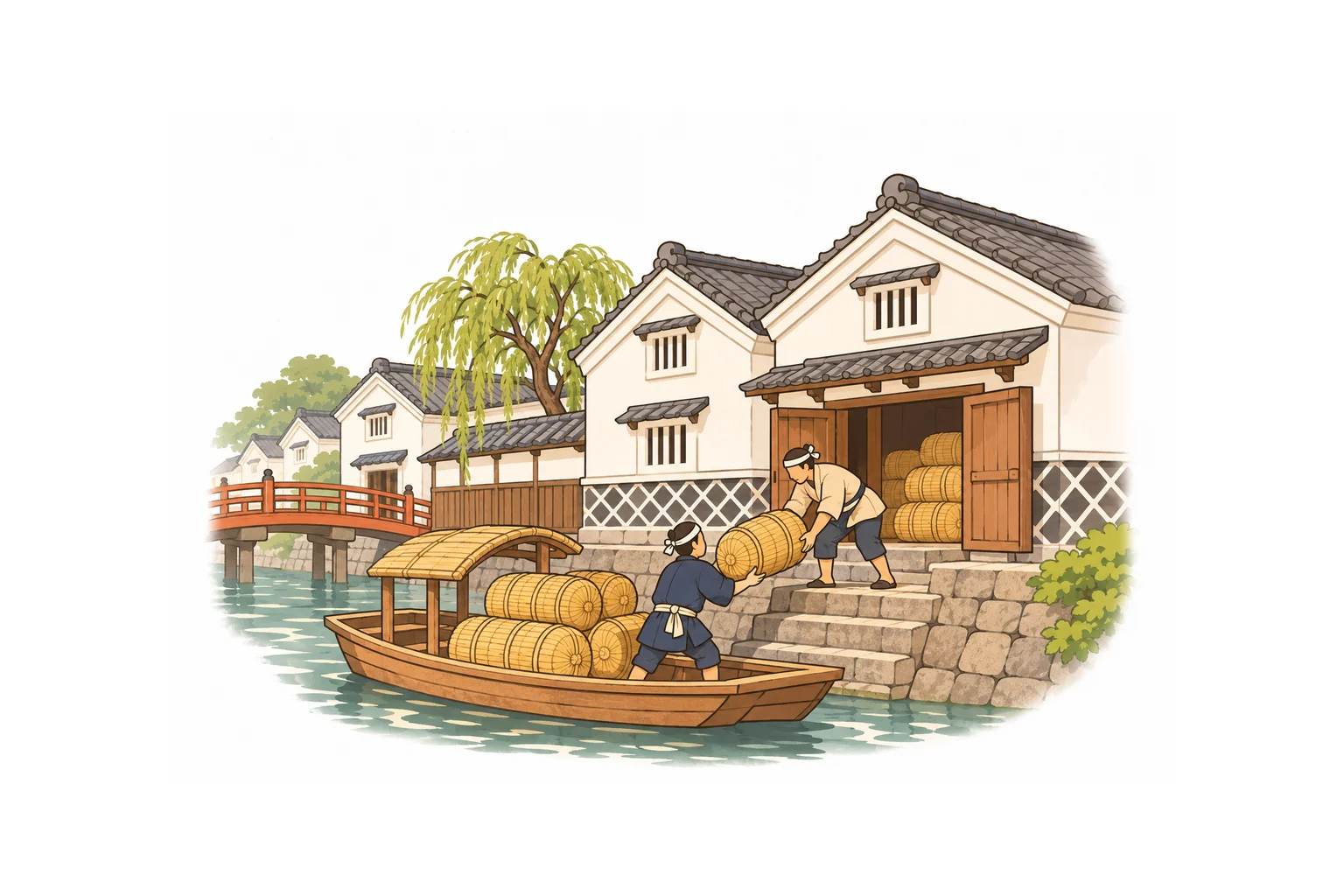
The nickname came from the way the Tokugawa economy worked. Lords collected taxes from their farmers mostly in rice, but they needed cash: to pay their retainers, to travel to Edo every other year as the shogunate required, and to support the households they had to keep there. So they shipped their rice to Ōsaka and sold it. More than a hundred domains maintained warehouse compounds, called kurayashiki, along the rivers around Nakanoshima, a long island in the middle of the city. Rice arrived by coastal shipping routes from as far away as northern Japan and was unloaded at their doors.
The trading itself happened at Dōjima, just across the river. Merchants there bought and sold not sacks of rice but certificates representing it, and prices moved daily. In 1730 the shogunate officially recognized the Dōjima rice exchange. Part of its business consisted of contracts settled only in price differences, with no rice changing hands, and it is often described as one of the world’s first organized futures markets.
In a city like this, merchants became very powerful. The Yodoya family helped develop Nakanoshima, ran an early rice market in front of their shop, and, by tradition, built a bridge at their own expense; Yodoyabashi, "Yodoya Bridge," is still the name of a busy downtown station. In 1705 the shogunate confiscated the entire fortune of the fifth head of the family, officially for living too extravagantly. It was a reminder that a merchant, however rich, ranked below any samurai. Yet lords could not manage without merchants. The Kōnoike family, who began as sake brewers, moved into shipping and then lending, and dozens of domains ended up owing them more than they could ever repay. The Sumitomo family refined copper in Ōsaka and later developed the Besshi copper mine; their business survives today as the Sumitomo group.
Even the bridges tell the story. People liked to say that Edo had its "808 neighborhoods" and Ōsaka its "808 bridges," meaning simply a great many. The real number was around two hundred, but only a dozen or so were built and maintained by the shogunate. The rest were paid for by local merchants who needed to move goods and customers across the canals. In Edo, a big bridge was a government project. In Ōsaka, it was a business investment.
07Dōtonbori and the Townspeople’s Culture
Money and leisure produced a new urban culture, and Ōsaka was at its center. Its first great flowering came around 1700, in the Genroku era.
The canal of Dōtonbori was dug in the early 1600s, financed by a merchant named Yasui Dōton. He joined the Toyotomi side and died in the summer siege of 1615 before the work was finished; his relatives completed it and named it after him. The shogunate later gathered the city’s theaters along its banks, and Dōtonbori became Ōsaka’s entertainment district, lined with kabuki playhouses and puppet theaters. The neon signs and giant mechanical crab that crowd it today are the latest layer of a very old pleasure quarter.
The puppet theater, now usually called bunraku, combines large wooden puppets with a chanter who voices every character and a shamisen, a three-stringed lute, for accompaniment. In 1684 the chanter Takemoto Gidayū opened his own theater on Dōtonbori, and his style of narration became the standard. His chief playwright was Chikamatsu Monzaemon. In 1703 a real double suicide shocked Ōsaka: a clerk from a soy-sauce shop and a courtesan killed themselves together in the woods at Sonezaki. Within about a month Chikamatsu had put the story on stage as The Love Suicides at Sonezaki. It was a sensation. Until then, puppet plays had mostly been about warriors and nobles; now an ordinary shop clerk and a prostitute were the tragic heroes, and a new genre of plays about townspeople’s lives was born. Chikamatsu went on to write more plays drawn from merchant life, in which characters are crushed between love, money, and obligation.
Ōsaka’s other great writer of the age was Ihara Saikaku. He started as a poet famous for marathon composition, reportedly reeling off more than twenty thousand verses in a single day and night, then turned to fiction. The Life of an Amorous Man follows one man’s lifetime of love affairs. The Japanese Family Storehouse and Worldly Mental Calculations are about merchants: how they made fortunes, how they lost them, and the desperate tricks they used to dodge creditors on the last day of the year, when all debts fell due. Saikaku’s Ōsaka is shrewd, practical, vain, and funny.
The merchants also cared about learning. In 1724 five Ōsaka merchants founded the Kaitokudō, an academy that taught Confucian ethics to an audience of townspeople and argued, against older prejudice, that earning profit could be honorable. One of its best-known thinkers, Yamagata Bantō, was himself the manager of a rice-trading house. A century later, the physician Ogata Kōan opened the Tekijuku in 1838 to teach Dutch and Western medicine. His students included Fukuzawa Yukichi, who went on to found Keio University, and Ōmura Masujirō, who designed the new national army after 1868.
Prosperity had limits. During the Tenpō famine of the 1830s, rice prices soared and people starved in the streets, while merchants and officials kept shipping rice to Edo. Ōshio Heihachirō, a former police official of the Ōsaka city magistrate and a Confucian scholar, sold his library to feed the poor, and in 1837 he led his students and local farmers in an uprising, setting fire to merchant houses. It was crushed within a day and Ōshio killed himself soon after, but the fire destroyed around a fifth of the city. That a former shogunate official had taken up arms in a city under the shogun’s own rule shook the whole country.
08Decline and Recovery
In the 1860s Ōsaka returned to the center of national politics. The shogun Tokugawa Iemochi based himself in Ōsaka Castle while preparing a campaign against the rebellious Chōshū domain and died there in 1866. In early 1868, after the shogunate’s forces lost the Battle of Toba–Fushimi near Kyoto, the last shogun, Tokugawa Yoshinobu, slipped out of Ōsaka Castle and sailed back to Edo. The castle burned in the confusion.
Around this time the city’s name changed in writing. The second character of Ōsaka had been written with a character meaning "slope" that contains the element for "earth"; in the early Meiji period an alternative character with the same sound replaced it. A popular explanation says the old character could be read as "return to the earth," an unlucky phrase for a city, but the real reason is not clear. The pronunciation never changed.
The Meiji Restoration hit Ōsaka hard. When the domains were abolished in 1871, the warehouse compounds lost their reason to exist, and much of the debt that lords owed Ōsaka’s merchant houses was simply written off by the new government. Old firms like Kōnoike were badly damaged. With the capital fixed in Tokyo, many feared the city would fade.
Among the people who worked to revive it was Godai Tomoatsu, a former samurai from Satsuma who had traveled to Britain in 1865 with a group of Satsuma students. He left government service to become a businessman in Ōsaka, and helped found the Ōsaka Chamber of Commerce and the Ōsaka Stock Exchange. The new government also built its national mint in Ōsaka, opening it in 1871 to strike coins in the new currency, the yen. The cherry trees along the mint’s riverside grounds are now one of the city’s favorite spring sights.
09The Manchester of the East
The real recovery came from factories. In 1882 the industrialist Shibusawa Eiichi and his partners founded the Ōsaka Spinning Company, which began operating the following year. It imported British spinning machines, ran them on steam power at a scale no Japanese mill had tried, and kept them going day and night with two shifts of workers. It made large profits, others copied it, and the Ōsaka area filled with cotton mills, then shipyards, steelworks, and chemical plants. By the late Meiji and Taishō periods, Ōsaka had come to be called the "Manchester of the East," after England’s great cotton-mill city.
The comparison fit in less flattering ways too. Coal smoke hung over the city, and workers lived in crowded, poor housing. Many of the mill hands were young women from the countryside who worked long hours and lived in closely supervised dormitories. Much of Ōsaka’s new wealth rested on their labor.
By the end of the Meiji period in 1912, Ōsaka was one of Japan’s leading industrial and commercial cities. In 1903 it hosted the Fifth National Industrial Exhibition, which drew more than four million visitors. Part of the site became Tennōji Park; another part became the amusement district of Shinsekai, "New World," whose tower, Tsūtenkaku, opened in 1912.
The later story can be told briefly. In the 1920s Ōsaka absorbed its suburbs and for a time had more people than Tokyo, earning the name "Greater Ōsaka." American air raids in 1945 burned most of the center. Rebuilt after the war, the city hosted Asia’s first world’s fair in 1970 and held another Expo in 2025.
10Reading Ōsaka Today
Ōsaka has a reputation as a city of food, comedy, and bright lights, and it lives up to it. But those things have histories. Dōtonbori’s crowds continue a theater district that is more than three centuries old. The famous local fondness for good food at a fair price, and for blunt, quick humor, is often traced to a long tradition of merchants who had to know the value of everything.
To see the older layers, walk the Uemachi Plateau from north to south. At its northern end stands Ōsaka Castle: a Hongan-ji temple and a Toyotomi castle buried below, Tokugawa stone walls above, and a 1931 tower on top. A short way south lies the open ground of the Naniwa palace. Further on is Shitennō-ji, where a slope to the west once ran down to the shore and people came at the equinoxes to watch the sun set over the bay, imagining the Western Paradise of Amida beyond it. Further south still are the fields around Tennō-ji where Sanada fell, and finally Sumiyoshi Taisha, the old shrine of the sea gods, where this city’s story first began with sailors setting out across the water.