
01A Fortress Made by Nature
An hour south of Tokyo by train, Kamakura today is a relaxed seaside town of surf shops, temple gates and schoolchildren eating snacks on the walk home. It takes some imagination to see it as a capital. Yet for about 150 years, from 1180 to 1333, this small valley was the seat of Japan’s first warrior government, and decisions made here reached every province in the country.
The reason begins with the landscape. Kamakura sits in a pocket of flat ground closed in on the north, east and west by low but steep wooded hills. The fourth side opens onto Sagami Bay and the beach at Yuigahama. In the Middle Ages there were only two ways in: by sea, or over the hills. The people of Kamakura cut narrow passes through the ridges, called kiridōshi ("cut-throughs"), and later tradition counted seven of them as the "Seven Entrances of Kamakura." A few survive. Walking the Asaina or Nagoe pass today, you move between walls of carved rock along a track barely wide enough for two horses. It is easy to see how a small force could hold such a place.
Kamakura was not chosen at random. The Minamoto, the warrior clan that would found the government there, had roots in the area. In 1063 the general Minamoto no Yoriyoshi, returning from a long war in the far north, set up a shrine near the beach to Hachiman, a god of war whom the Minamoto treated as their family protector. His descendants kept ties to the district, and Minamoto no Yoshitomo, the father of the man who would make Kamakura famous, kept a residence there.
02An Exile Comes Home
That man was Minamoto no Yoritomo, and for most of his early life he had no reason to expect power. In 1159–60 his father lost a struggle in Kyoto, known as the Heiji Disturbance, to the rival Taira clan led by Taira no Kiyomori. Yoshitomo was killed. Yoritomo, then twelve, was spared and sent into exile in Izu, a peninsula southwest of Kamakura. For twenty years he lived under watch while the Taira rose to dominate the imperial court.
In Izu he married Hōjō Masako, daughter of a local landholder named Hōjō Tokimasa. It looked like a minor match. It turned out to be one of the most consequential marriages in Japanese history, because the Hōjō family would eventually run the government Yoritomo created.
In 1180 an imperial prince, Mochihito, issued a call to rise against the Taira, and Yoritomo answered. His first battle, at Ishibashiyama, was a disaster; he hid in the hills and escaped by boat across the bay. But warriors across the Kantō, the broad plain of eastern Japan, began to join him, and within weeks he commanded a large army. That autumn he rode into Kamakura and made it his base.
What is striking is that he stayed. His younger brothers Yoshitsune and Noriyori led the armies west and destroyed the Taira in a sea battle at Dan-no-ura in 1185, but Yoritomo himself remained in Kamakura. His supporters were eastern warriors who wanted their land rights guaranteed, not court titles. Kiyomori had gone to Kyoto and become a courtier; Yoritomo seems to have understood that doing the same would cut him off from the men who made him powerful. Kamakura was far enough from the court to keep its politics at arm’s length, and close enough to the heart of the Kantō to keep his followers in hand.
The cost of that discipline fell partly on his own family. Yoshitsune, the hero of the war, accepted an appointment from the retired emperor Go-Shirakawa without his brother’s permission. Yoritomo refused to let him enter Kamakura. Yoshitsune waited at Koshigoe, just west of the town, and according to tradition wrote a long letter pleading his loyalty; whether the surviving text is genuine has long been doubted. The brothers never reconciled. Yoshitsune fled north, and in 1189 he was cornered and died at Hiraizumi.
03Building a Warrior Town
Once settled, Yoritomo moved the Hachiman shrine from the beach up to a hillside at the head of the valley. This is Tsurugaoka Hachimangū, still the center of Kamakura. Just east of it, in a district called Ōkura, he built his residence, and around it grew the offices of his government: a board to manage his vassals, an administrative office for finances and documents, and a board of inquiry to hear lawsuits. Later historians call this the Kamakura shogunate, or bakufu, a word meaning "tent government," but at first it was simply a household and its staff.
In 1182, when Masako was pregnant, Yoritomo ordered a straight avenue built from the shrine down to the sea as a prayer for a safe birth. This is Wakamiya Ōji. Its central section was raised as an embanked footpath, the dankazura, which still runs between rows of cherry trees. Stand at the top of the shrine’s stone steps and look south, and the avenue runs in a straight line toward the bay. The plan echoes the great central avenue of Kyoto, with one difference: at the head of Kyoto’s avenue stood the imperial palace, and at the head of Kamakura’s stood a warrior clan’s shrine.
In 1185 the court allowed Yoritomo to appoint military governors (shugo) in the provinces and stewards (jitō) on estates. With that, orders from Kamakura could reach land and taxes across the country. In 1192 he received the title seii taishōgun, "great general who subdues the barbarians," usually shortened to shogun.
The town filled up quickly. Warriors built homes in the side valleys, which locals called yatsu, and many of Kamakura’s place names, such as Ōgigayatsu and Hikigayatsu, still carry the word. Yuigahama became a harbor and market where goods from western Japan and China came ashore. In 1232 a breakwater of piled stones called Wakaejima was built off the eastern end of the beach so that ships could unload; its remains still appear at low tide, among the oldest surviving harbor works in Japan.
The shrine served as the town’s stage. In 1186 Shizuka, a dancer who had been Yoshitsune’s lover, was brought captive to Kamakura and ordered to dance before Yoritomo and Masako at Tsurugaoka. According to the Azuma Kagami, a chronicle later compiled by the shogunate, she sang openly of her longing for Yoshitsune. Yoritomo was furious; Masako spoke in her defense. The scene became a favorite of Noh and kabuki theater.
04Murder on the Shrine Steps
Yoritomo died in 1199, aged fifty-one. The sources are oddly quiet about how; a later account blames a fall from his horse.
His son Yoriie succeeded him but clashed with the senior vassals. His mother Masako and grandfather Tokimasa sidelined him and sent him to a temple in Izu, where he was murdered in 1204. His younger brother Sanetomo became shogun. Sanetomo was more poet than general, and his collection of verse, the Kinkai Wakashū, is still read.
On a snowy night in early 1219, Sanetomo was leaving a ceremony at Tsurugaoka Hachimangū when his nephew Kugyō, Yoriie’s son, attacked and killed him on the shrine steps. Kugyō was hunted down the same day. Yoritomo’s line was finished. A legend says Kugyō hid behind a huge ginkgo tree beside the steps before striking. That tree stood for centuries until a storm brought it down in 2010; shoots from the old stump have since grown into a young tree.
With no Minamoto heir, the Kamakura leaders brought a small boy from the Kujō family of Kyoto aristocrats to serve as shogun, and later imperial princes. These shoguns were figureheads. Real power lay with the Hōjō, whose head held the office of shikken, or regent to the shogun. A regent ruling in the name of a shogun who ruled in the name of an emperor: Kamakura had produced one of the layered arrangements that would mark Japanese politics for centuries.
The court saw an opening. In 1221 the retired emperor Go-Toba declared the regent Hōjō Yoshitoki an outlaw. Many Kamakura vassals wavered. Masako, by now a Buddhist nun, gathered them and reminded them of everything they owed Yoritomo; the Azuma Kagami records her speech, no doubt polished in the telling. The vassals rallied, marched on Kyoto, and took it within a month. Go-Toba was exiled to the Oki Islands, and Kamakura stationed officials in Kyoto to keep watch on the court. This was the Jōkyū War, and it settled the question of who held the upper hand. Masako became known as the "nun shogun."
Under the regent Hōjō Yasutoki, Kamakura reached its most stable years. In 1232 he issued the Goseibai Shikimoku, a code of 51 articles on land disputes, inheritance and the duties of officials, written in plain terms warriors could follow. It was Japan’s first law code made by and for warriors, and later warrior governments built on it for centuries.
05Zen Masters from China
One stop north of Kamakura Station is Kita-Kamakura, where two great temples, Engaku-ji and Kenchō-ji, stand in the wooded valleys. Both are Zen temples, and both were founded for monks from China.
Zen, a school of Buddhism centered on meditation and direct teaching from master to disciple, came to Japan from Song-dynasty China with the monk Eisai at the end of the twelfth century. Eisai met resistance from the established Buddhist orders in Kyoto but found backing in Kamakura: in 1200 Masako founded the temple Jufuku-ji with him as its first abbot. The plain living and strict discipline of Zen appealed to warriors.
The regent Hōjō Tokiyori went further. In 1246 a Chinese monk named Lanxi Daolong (Rankei Dōryū in Japanese) arrived in Japan, and Tokiyori invited him to Kamakura, completing Kenchō-ji for him in 1253. It was the first temple in Japan built entirely as a Zen monastery on the Chinese model, with its gate, Buddha hall and lecture hall lined up on a single axis, and its daily routine copied from Song monasteries. Old juniper trees in front of the Buddha hall are said to have been planted by Lanxi himself.
Tokiyori’s son Tokimune invited another Chinese master, Wuxue Zuyuan (Mugaku Sogen), who arrived in 1279, the year the Song dynasty fell to the Mongols. In 1282 Tokimune founded Engaku-ji for him, partly to honor the dead on both sides of the Mongol invasions. Its relic hall, the Shariden, is a fine example of the Chinese-derived Zen building style, with a steep roof and sharply upturned eaves, and is designated a National Treasure.
From the late Kamakura period the government ranked its leading Zen temples as the "Five Mountains," copying a Chinese system. The Kamakura list was fixed by the Muromachi shogunate in 1386: Kenchō-ji, Engaku-ji, Jufuku-ji, Jōchi-ji and Jōmyō-ji. These were more than places of meditation. Their monks read and wrote Chinese poetry and prose, studied Confucian texts and drafted diplomatic letters for the government. The scholarly Zen culture that later flourished in Kyoto started here.
06The Buddha in the Open Air
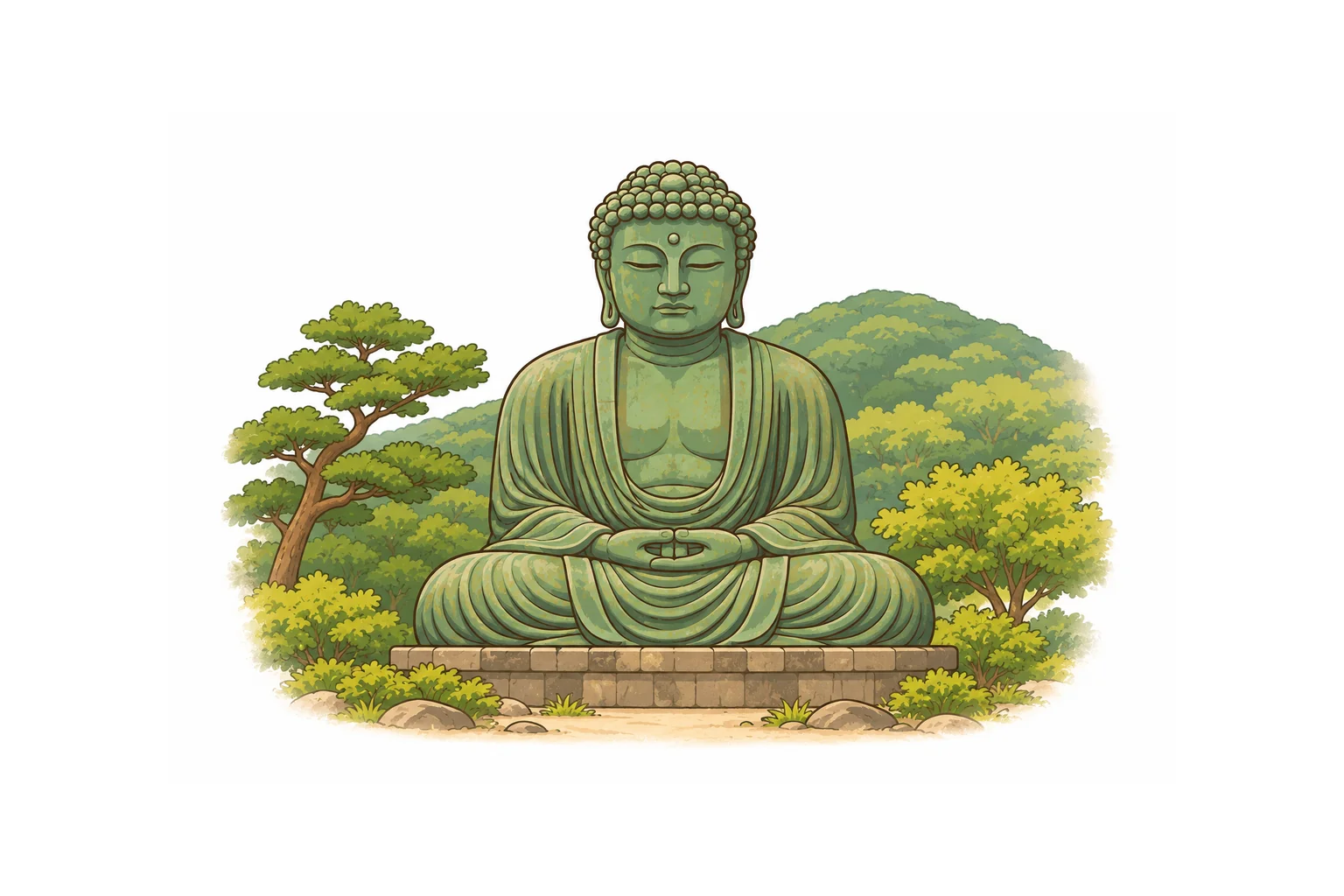
On the western side of town, at the temple Kōtoku-in, sits the Great Buddha of Kamakura, a bronze figure of Amida, the Buddha of the Western Paradise. It is a little over 11 meters tall, about 13 with its base, and weighs around 120 tons. The head is deliberately oversized and the body leans slightly forward, probably so that the figure looks well proportioned to someone standing below.
For such a famous statue, its origins are surprisingly obscure. The Azuma Kagami says a priest named Jōkō began raising funds in 1238 for a great wooden Buddha and a hall to house it, and that work on a bronze image began in 1252. Who paid for it and who cast it, the record barely says. Unlike the Great Buddha of Nara, commissioned by an emperor with the resources of the state, the Kamakura Buddha seems to have been built largely through popular donations. It reflects the spread of devotion to Amida in this period, when many people believed that simply calling on Amida’s name could bring rebirth in his paradise.
The statue once sat inside a large hall. Storms brought the hall down more than once in the fourteenth century, with collapses recorded in 1334 and 1369, and there is no record of rebuilding after that. When the Zen monk Banri Shūku visited in 1486, the Buddha already sat in the open. A popular account blames the loss of the hall on the tsunami of the Meiō earthquake of 1498, but that does not fit his record, and exactly when the hall disappeared is still debated. The Buddha has sat in the open ever since. The figure is hollow, and visitors can step inside and see the seams where it was cast in sections.
A short walk away, Hase-dera houses a tall wooden image of the eleven-headed Kannon, the bodhisattva of compassion, and its terraces look out over the bay. The Buddha, the temple and the sea make up the classic view of western Kamakura.
07The Mongols and a Fiery Prophet
By the mid-thirteenth century the Mongol Empire stretched across Eurasia. Khubilai Khan, founder of China’s Yuan dynasty, sent envoys demanding that Japan submit. The letters ended up in Kamakura, and the young regent Hōjō Tokimune rejected them. In 1274 and again in 1281, Mongol-led fleets attacked northern Kyūshū. Local warriors fought hard, storms wrecked the invading fleets, and both times the invaders withdrew. The storms were later remembered as kamikaze, "divine winds."
The fighting was in Kyūshū, but the decisions were made in Kamakura. Tokimune ordered warriors south and had a stone wall built along Hakata Bay. A well-known Zen anecdote says that Wuxue Zuyuan gave him a note reading "Do not worry" before the second invasion. Tokimune died in 1284, aged thirty-two.
Victory brought trouble. In earlier wars the winners were paid with land taken from the losers. A defensive war produced no such prize, and many warriors who had fought at their own expense went unrewarded. Resentment toward the government grew.
In these anxious years Kamakura also heard the preaching of Nichiren, a monk who taught that only faith in the Lotus Sutra could save the country. In 1260 he presented a treatise to Tokiyori warning that unless the government suppressed other sects, Japan would suffer foreign invasion and civil strife. He preached on Kamakura’s streets and attacked rival schools so fiercely that he was repeatedly persecuted. In 1271 he was taken to the execution ground at Tatsunokuchi, west of town. According to Nichiren tradition, a brilliant light appeared in the sky and the executioner could not strike; he was exiled to Sado Island instead. Many temples linked to Nichiren still stand in Kamakura’s eastern valleys.
08The Fall of 1333
By the early fourteenth century, power had narrowed to the main Hōjō line and its retainers, and many vassals were bitter. Emperor Go-Daigo plotted to overthrow the shogunate, was caught and exiled in 1332, then escaped in 1333. Revolts broke out across the country. Ashikaga Takauji, a general sent by Kamakura to crush them, switched sides and took the shogunate’s headquarters in Kyoto.
At almost the same moment, Nitta Yoshisada, a warrior from Kōzuke province north of Kamakura, raised an army and marched south. The hills did their job; Nitta’s forces were held at the passes. The war chronicle Taiheiki tells how Yoshisada went to the cape at Inamuragasaki, threw his sword into the sea as an offering to the dragon god, and watched the water draw back so his army could charge along the beach into the town. It is a legend, though some suggest he simply timed his attack to a low tide.
Kamakura burned. Hōjō Takatoki, head of the family, retreated to the temple Tōshō-ji in a valley east of the shrine and killed himself there with his kin and retainers; the Taiheiki puts the dead at more than 870. The temple is long gone. A cave in the hillside nearby, known as the Harakiri Yagura, is said to be their grave. The government that Yoritomo founded had lasted about a century and a half.
09After the Shoguns
Kamakura did not collapse at once. Ashikaga Takauji set up his new shogunate in Kyoto, but he knew the east mattered, so he left a branch government in Kamakura under his son Motouji. Motouji’s descendants held the post of Kamakura kubō, governor-general of the east, and for a time the town remained the center of eastern Japan.
The Kamakura kubō often quarreled with the shoguns in Kyoto. In the mid-fifteenth century Ashikaga Shigeuji fell out with the Uesugi family, his own deputies, and abandoned Kamakura for Koga, north of present-day Tokyo. After that Kamakura lost its political role. Its population shrank and many temples fell into decay.
In the sixteenth century the Later Hōjō, a warlord family based at Odawara with no blood tie to the Kamakura regents, rebuilt Tsurugaoka Hachimangū. Under the Tokugawa shoguns of the Edo period, Kamakura became a place of pilgrimage and nostalgia. Tokugawa Mitsukuni, lord of Mito, sponsored a gazetteer of its sites, and people from Edo came in groups to pray at the shrine, see the Great Buddha and then enjoy themselves at nearby Enoshima island.
After the Meiji Restoration of 1868, the new government ordered Shinto and Buddhism separated, and the Buddhist buildings inside Tsurugaoka Hachimangū were torn down. In 1889 the railway reached Kamakura. Its mild climate and beaches drew Tokyo politicians, businessmen and writers to build villas, and by the end of the Meiji era in 1912 the forgotten capital had become a fashionable seaside retreat. The Great Kantō Earthquake of 1923 later brought down many of its temple buildings and damaged the Great Buddha’s base, and they were repaired over the following decades.
Walk up Wakamiya Ōji today and the avenue is lined with shops and cafés. But it still runs straight to the shrine Yoritomo placed at the head of the valley, and behind the shrine the same green hills still close the town in.