
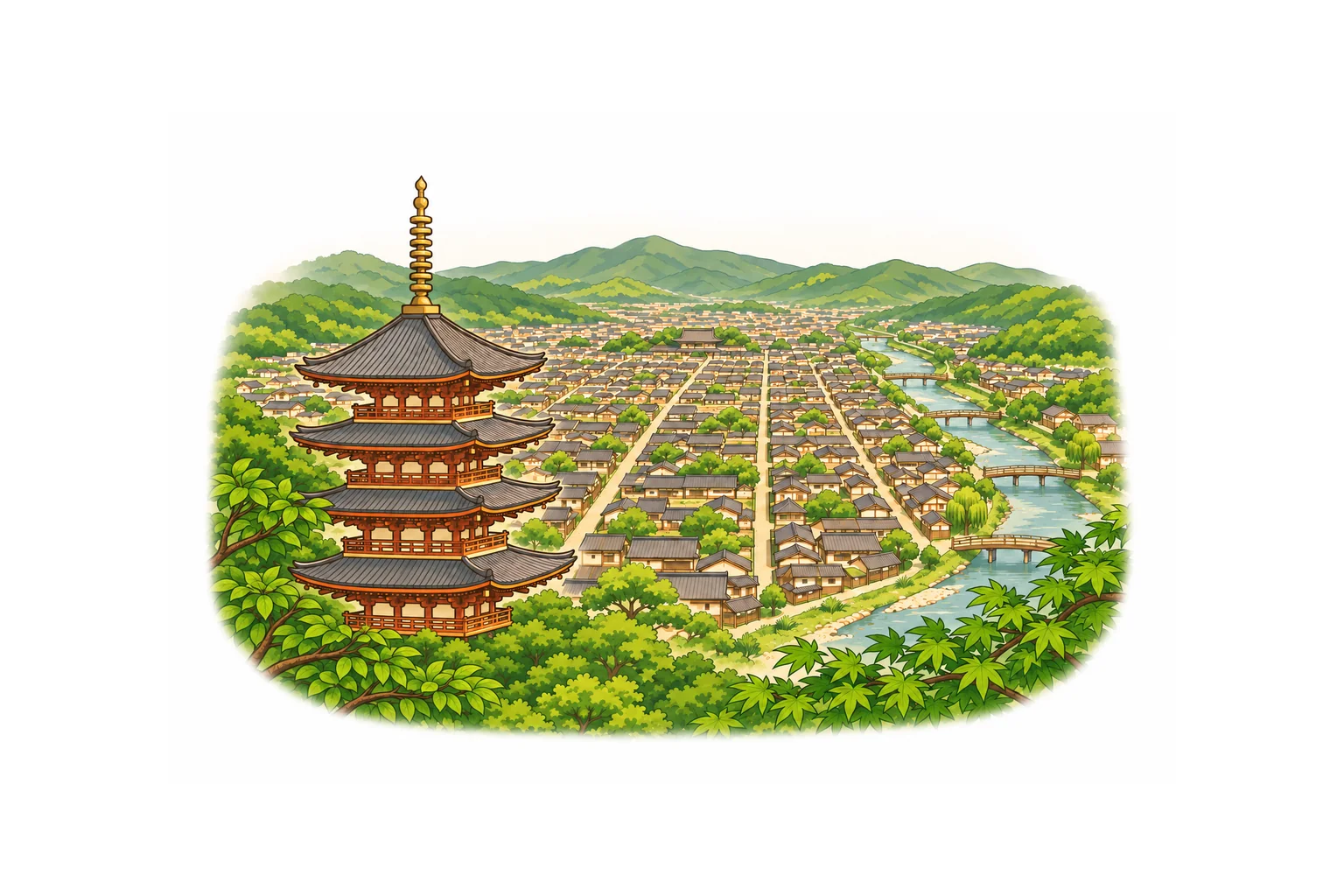
01An Emperor in Search of a Clean Start
In the 780s, Emperor Kanmu decided to abandon his capital. Nara, then called Heijō-kyō, had been the seat of government for some seventy years, and its great Buddhist temples had grown rich and politically meddlesome. Kanmu wanted distance from them, and from the court factions that had grown up around them.
His first attempt went badly. In 784 he began building a new capital at Nagaoka, southwest of present-day Kyoto. The following year the official in charge of construction, Fujiwara no Tanetsugu, was shot dead with arrows. Kanmu’s own younger brother, the crown prince Sawara, was accused of involvement, stripped of his title, and sent into exile; he refused food and died on the way. Over the next few years Kanmu’s mother and empress died, the new crown prince fell chronically ill, and floods and epidemics struck. Diviners blamed the angry ghost of Prince Sawara. Nagaoka was never finished.
In 794 Kanmu tried again, a few kilometers to the northeast, in a basin in the province of Yamashiro. He named the new city Heian-kyō, "capital of peace and tranquility." The name proved more hopeful than accurate, but the city stuck. Emperors lived there from 794 until 1869, more than a thousand years. Over time people simply called it kyō or miyako, both meaning "the capital," and from that comes the name Kyoto.
02A City Laid Out Like a Game Board
By the standards of the day, the site was close to ideal. Mountains enclosed the basin on the north, east, and west, leaving the south open. Two rivers, the Kamo on the east and the Katsura on the west, supplied water and transport. Later writers often explained the site through Chinese geomantic theory, which favored exactly this arrangement: mountains behind, water on either side, open ground in front.
The plan itself was borrowed from Chang’an, the capital of Tang-dynasty China, on a smaller scale. Heian-kyō measured roughly 4.5 kilometers east to west and 5.2 kilometers north to south. At the top center stood the palace enclosure, holding the emperor’s residence and the government ministries. From its southern gate a grand avenue, Suzaku Ōji, about 84 meters wide, ran straight down to the city’s main entrance, the Rashōmon gate. Streets crossed at right angles to cut the whole city into a grid of uniform blocks. Kyoto’s major east-west streets still carry their numbers: Shijō is Fourth Avenue, Gojō is Fifth.
Kanmu had not left Nara’s monasteries behind only to invite new ones in. Inside the city walls he allowed just two official temples, Tō-ji (East Temple) and Sai-ji (West Temple), flanking the Rashōmon. Tō-ji was later entrusted to the monk Kūkai, who had studied esoteric Buddhism in China and founded the Shingon school; its five-story pagoda, rebuilt in the 17th century, still marks the southern edge of the old city. Sai-ji declined early and survives only as a site.
The ideal grid did not last long. The western half of the city was low and marshy, prone to flooding, and people drifted away from it. By the late 10th century much of it had emptied and reverted to fields. The city’s weight shifted east, eventually spilling across the Kamo River toward the hills. The Rashōmon blew down in a storm in 980 and was never rebuilt. Akutagawa Ryūnosuke’s 1915 short story Rashōmon, which lent its title and setting to Kurosawa’s film, imagines the ruined gate as a haunt of thieves and abandoned corpses.
03Four Centuries of Court Life
For most of the Heian period (794–1185), Kyoto was above all a court city. A few thousand aristocrats held the important offices and drew income from estates across the country.
From the 10th century onward, the Fujiwara family dominated this world by marrying their daughters to emperors. When a grandson took the throne, the Fujiwara grandfather governed in his name as regent. The most successful was Fujiwara no Michinaga (966–1028), three of whose daughters became empresses. At a banquet in 1018 he is said to have composed a poem comparing himself to the full moon, lacking nothing; it has been quoted ever since as the last word in self-satisfaction.
Court culture prized refinement in everything. Aristocrats lived in mansions arranged around ponds and gardens, wore many-layered robes whose colors at the sleeve showed off their taste, and judged one another by handwriting, incense blending, and skill at poetry. Some of the finest writing came from women who served in the households of empresses. Murasaki Shikibu, a lady-in-waiting to Michinaga’s daughter Shōshi, wrote The Tale of Genji, often called the world’s first novel. Sei Shōnagon, who served Empress Teishi, a rival of Shōshi, wrote The Pillow Book, a sharp, funny collection of lists and observations. Both wrote in kana, the Japanese phonetic script, while men were still expected to write official prose in Chinese.
The palace itself suffered constantly from fire. Emperors often moved into the mansions of their in-laws while it was rebuilt. After a great fire in 1177 destroyed the main audience hall, it was never replaced, and the old palace grounds slowly emptied. The Kyoto Imperial Palace that visitors see today stands about 2 kilometers east of the original site; it began as one of those temporary residences and became the permanent palace in the 14th century. The present buildings date from 1855.
Crowded cities breed disease, and Heian-kyō was no exception. Its people believed that epidemics were the work of vengeful spirits. In 869, during an outbreak, priests set up 66 halberds, one for each province of Japan, and held rites to appease the plague deity. This is traditionally counted as the origin of the Gion Festival, still held every July. When the scholar-statesman Sugawara no Michizane died in exile in 903 after being framed by rivals, lightning strikes and sudden deaths at court were blamed on his ghost. The court posthumously restored his rank and built Kitano Tenmangū shrine to honor him. In time he became the patron deity of learning, and students still pray to him before exams.
04Monks on the Mountain
With temple-building restricted inside the city, Buddhism grew up around it. The monk Saichō had already built a hall on Mount Hiei, northeast of the city, in 788; after traveling to China in the same year as Kūkai, he founded the Tendai school there, and the monastery later received the name Enryaku-ji. The northeast was the unlucky "demon gate" in Chinese cosmology, so a great monastery there served as the capital’s spiritual guard. Enryaku-ji became Japan’s leading center of Buddhist learning. Nearly every founder of the new Buddhist movements of the 12th and 13th centuries, including Hōnen, Shinran, Eisai, Dōgen, and Nichiren, trained there before going his own way.
Enryaku-ji also maintained armed monks. When they had a grievance, they marched into the city carrying the sacred palanquin of their shrine deity, and since harming it would be sacrilege, the court usually gave in. Retired Emperor Shirakawa, the most powerful man in Japan around 1100, reportedly complained that there were only three things he could not control: the waters of the Kamo River, the roll of the dice, and the monks of Mount Hiei.
By the 11th century many believed the world had entered mappō, the age of the decline of the Buddhist law, and turned for comfort to Amida Buddha, who promised rebirth in his Pure Land. In 1052 Michinaga’s son Yorimichi converted his villa at Uji, just south of Kyoto, into a temple, Byōdō-in. Its Phoenix Hall, built the following year and reflected in a pond, was meant to give a glimpse of paradise on earth. It appears on the Japanese 10-yen coin.
On the eastern hills, temples multiplied. Kiyomizu-dera, traditionally founded in the late 8th century, is famous for its wooden stage jutting out over a ravine. The present structure dates from the 1630s. "To jump from the stage at Kiyomizu" is still a Japanese expression for taking a bold plunge.
05The Warriors Arrive
In the 1150s, feuds within the imperial family and the Fujiwara were settled by warriors for the first time, in fighting on the streets of the capital. The winner, Taira no Kiyomori, took up residence at Rokuhara on the east bank of the Kamo and became the first warrior to dominate the court. He married his daughter to an emperor and saw his grandson enthroned, following the Fujiwara playbook. Within thirty years the rival Minamoto clan had destroyed the Taira.
The victor, Minamoto no Yoritomo, set up his warrior government, the shogunate, far to the east at Kamakura. Kyoto remained the city of emperor and court, but it was no longer the only center of power. After the Jōkyū War of 1221, the shogunate posted deputies at Rokuhara to watch over it.
That changed in the 14th century, when Ashikaga Takauji overthrew the Kamakura shogunate and established his own government in Kyoto itself. The third Ashikaga shogun, Yoshimitsu, built a lavish residence on Muromachi Street, nicknamed the Palace of Flowers, which gave its name to the whole Muromachi period (1336–1573). In retirement Yoshimitsu built a villa in the northern hills with a pavilion covered in gold leaf. After his death it became the temple Rokuon-ji, better known as Kinkaku-ji, the Golden Pavilion. In 1950 a disturbed young acolyte burned it to the ground, an act Mishima Yukio turned into the novel The Temple of the Golden Pavilion. The building seen today is a 1955 reconstruction.
With shoguns and warrior lords living in the capital, Zen Buddhism flourished under their patronage. The great Zen monasteries of Kyoto, among them Tenryū-ji, Shōkoku-ji, Kennin-ji, and Tōfuku-ji, were ranked in an official hierarchy known as the Five Mountains, with Nanzen-ji placed above them all. Their monks, fluent in classical Chinese, drafted the shogunate’s diplomatic letters and managed trade with Ming China. Dry rock gardens, ink painting, and the formal preparation of tea all developed in this world. The eighth shogun, Ashikaga Yoshimasa, built a retreat in the eastern hills that became the temple Jishō-ji; its main building is called Ginkaku, the Silver Pavilion, though it was never covered in silver. The rooms Yoshimasa’s circle favored, with tatami mats covering the whole floor, sliding paper doors, and an alcove for displaying a scroll or flowers, set the pattern for the Japanese interior that survives today.
06The Ōnin War
Yoshimasa was a gifted connoisseur and a poor ruler. Lacking a son, he named his younger brother Yoshimi as heir; then his wife, Hino Tomiko, gave birth to a boy. At the same time the two great families who ran the shogunate, the Hosokawa and the Yamana, were locked in rivalry, and many warrior houses were split by their own succession quarrels. In 1467 all of these disputes merged into one war.
The Eastern Army under Hosokawa Katsumoto and the Western Army under Yamana Sōzen each summoned allies from across Japan, and they fought inside Kyoto itself. The battlefield was the city’s streets. Both sides dug trenches, threw up earthworks, and burned the neighborhoods around their positions. Yamana’s headquarters lay in the northwest of the city, an area still called Nishijin, "Western Camp," and the name now belongs to Kyoto’s famous silk brocade. The war also brought into prominence the ashigaru, lightly armed foot soldiers who looted and set fires freely; aristocrats cursed them in their diaries.
Both commanders died of illness in 1473. The fighting dragged on until 1477 and ended without a winner. Much of northern Kyoto had burned, along with aristocratic mansions, temples, and the libraries and treasures they held. Courtiers and monks fled to the provinces to find patrons among regional lords, carrying Kyoto culture with them. The shogunate never recovered its authority, and Japan slid into the century of civil war known as the Sengoku or Warring States period.
There is a well-worn joke that when an old Kyoto family speaks of "the last war," they mean the Ōnin War. It is a joke, but it says something about how deeply the city remembers it.
07The Townspeople Take Charge
After the war Kyoto shrank into two separate settlements. Kamigyō, the upper town in the north, held the remaining aristocratic and warrior households. Shimogyō, the lower town to the south, was the home of merchants and craftsmen. Each was walled and moated, with open ground between them.
The people who rebuilt the city were the machishū, the townspeople, led by wealthy pawnbrokers and sake brewers. They organized themselves by street: the houses facing each other across a single street formed a chō, or block association, which handled fire watch, policing, and the gates that closed off the street at night. Several chō combined into larger federations. In effect, Kyoto’s commoners began to govern their own neighborhoods.
The Gion Festival shows this best. Suspended during the Ōnin War, it went unperformed for 33 years until the townspeople revived it at their own expense in 1500. From then on each of the great festival floats belonged to a particular street association, which built, stored, and paraded it. The floats that roll through central Kyoto each July are still owned and maintained by those neighborhoods.
Many townspeople belonged to the Nichiren or Lotus sect, which became dominant in early 16th-century Kyoto, and its followers armed themselves. In 1536 the monks of Enryaku-ji and their allies attacked, burning all twenty-one of the sect’s head temples and much of the lower town. Kyoto burned again and again in these decades, and each time its residents rebuilt.
In 1568 the warlord Oda Nobunaga marched into Kyoto with a puppet shogun in tow. In 1571 he burned Enryaku-ji and slaughtered its inhabitants, ending centuries of monastic armed power. In 1582, while staying at the temple of Honnō-ji in Kyoto, he was attacked by one of his own generals, Akechi Mitsuhide, and died in the flames. Honnō-ji was later moved, so the temple of that name today does not stand on the spot.
08Hideyoshi Redraws the City
Nobunaga’s successor, Toyotomi Hideyoshi, reshaped Kyoto more thoroughly than anyone since Kanmu. Much of the street pattern a visitor walks through today is his.
On the old Heian palace grounds he built Jurakudai, a fortified palace of astonishing luxury, and in 1588 hosted Emperor Go-Yōzei there in a carefully staged display of his authority. Within a decade he had handed it to his nephew and heir Hidetsugu, turned against him, forced him to commit suicide, and had the palace demolished.
Around 1590 Hideyoshi also reorganized the blocks. The Heian grid squares were about 120 meters on a side, with wasted space at their centers. He cut new north-south lanes through the middle, turning squares into long rectangles so that more houses could front onto a street. The typical Kyoto townhouse, the machiya, with its narrow frontage and deep interior, is sometimes called an "eel’s bed," and its shape owes much to this reform. He gathered scattered temples into a single line along the eastern edge of town, the street still called Teramachi, "Temple Town."
In 1591 he enclosed the city in an earthen rampart and moat about 22.5 kilometers long, the Odoi. It defended the city and protected it from the Kamo River’s floods, and it defined what counted as rakuchū, "inside the capital," versus rakugai, "outside." (Raku comes from Luoyang, an ancient Chinese capital, and Kyotoites long used it for their own city.) Most of the Odoi was later leveled, but fragments survive.
At the temple of Hōkō-ji, Hideyoshi built a great Buddha larger than the one at Nara. Earthquakes and fire destroyed it, but its bronze bell survives. In 1614 Tokugawa Ieyasu seized on an inscription on that bell, claiming that a phrase reading "May the state be peaceful and secure" split the characters of his name in a deliberate curse. It was a pretext, and it led directly to the campaigns at Ōsaka that destroyed the Toyotomi family.
09The Capital Without the Government
Ieyasu ruled from Edo, today’s Tokyo, and Kyoto lost its political role. It remained the home of the emperor, though, and the shogunate kept close watch on it. In 1603 Ieyasu completed Nijō Castle as his lodging in Kyoto and a visible reminder of Tokugawa power. A shogunal governor stationed in the city supervised the court, and regulations confined the emperor to scholarship, poetry, and ritual.
Ieyasu also exploited a split in the powerful True Pure Land sect. In 1602 he granted land to the rival claimant Kyōnyo, creating a second head temple. Kyoto has had both a Nishi (West) and a Higashi (East) Hongan-ji ever since. The city was full of head temples of every sect, and pilgrims came from all over Japan.
In the Edo period (1603–1868), Kyoto was one of the "three cities" along with Edo and Ōsaka: Edo had the government, Ōsaka the trade, Kyoto the crafts and culture. Nishijin silk, Kyō-yūzen dyed fabrics, ceramics, lacquer, fans, and Buddhist altar goods set the national standard for quality. Kyoto was also the original center of Japanese commercial publishing. Its population in the 17th century was somewhere around 300,000 to 400,000, large by any world standard of the time.
The wooden city kept burning. The Great Tenmei Fire of 1788 consumed most of Kyoto, including the imperial palace. When the palace was rebuilt, its builders consciously revived Heian-period styles. Nostalgia for the ancient court had become part of the city’s character.
10Center Stage Again
When Commodore Matthew Perry’s American squadron arrived in 1853 and the shogunate signed treaties with foreign powers without the emperor’s approval, the long-sidelined court suddenly mattered. Activists from many domains, rallying under the slogan "revere the emperor, expel the barbarians," poured into Kyoto. Assassinations became routine.
To restore order, the shogunate appointed Matsudaira Katamori, lord of Aizu, as military protector of Kyoto. Under him operated the Shinsengumi, a force of masterless samurai who patrolled the streets hunting radicals. In 1864 they raided the Ikedaya inn near Sanjō, where activists from Chōshū and Tosa were meeting, and became famous overnight. A few weeks later Chōshū troops attacked the imperial palace and were driven back by Aizu and Satsuma forces in fighting around the Hamaguri Gate. The resulting fire destroyed some 28,000 houses.
Events moved fast after that. Satsuma and Chōshū, former enemies, secretly allied, with the Tosa-born Sakamoto Ryōma helping to broker the deal. In late 1867 the last shogun, Tokugawa Yoshinobu, gathered domain representatives at Nijō Castle and announced that he was returning governing authority to the emperor. A month later Sakamoto and his comrade Nakaoka Shintarō were murdered at the Ōmiya inn on Kawaramachi; who did it is still debated. Less than a month later, anti-shogunate forces seized the palace gates and proclaimed the restoration of imperial rule. In January 1868 their army clashed with shogunate forces at Toba and Fushimi on Kyoto’s southern outskirts, opening the Boshin War.
11After the Emperor Left
In 1868 Edo was renamed Tokyo, "Eastern Capital." The young Emperor Meiji first traveled there that autumn and returned to Kyoto at the end of the year; in 1869 he went east again and never returned to live in Kyoto. No decree ever formally moved the capital, and Japanese histories often call it Tokyo tento, "settling the capital at Tokyo," rather than a transfer, but the move was real. The court nobility followed the emperor, and the merchants and artisans who had served them lost their customers. Kyoto’s population fell sharply.
The city responded on its own. In 1869 its neighborhood associations pooled money to open 64 elementary schools, Japan’s first organized by school district, three years before the national government created a school system. In 1872 the prefecture sent weavers to Lyon in France to study the latest techniques and brought back Jacquard looms to revive the Nishijin silk industry.
The boldest project was the Lake Biwa Canal. Governor Kitagaki Kunimichi decided to bring water from Lake Biwa, over the mountains to the east, for transport, irrigation, and power. He entrusted the design to Tanabe Sakurō, a recent engineering graduate in his early twenties. Built between 1885 and 1890, the canal tunneled through the hills. It powered one of Japan’s first commercial hydroelectric plants, at Keage, and in 1895 Kyoto opened the country’s first electric streetcar line.
That same year Kyoto hosted a national industrial exposition and marked the 1,100th anniversary of Heian-kyō by building Heian Shrine, a reduced-scale replica of the old palace’s main hall, dedicated to Emperor Kanmu. A new festival, the Jidai Matsuri, or Festival of the Ages, sent residents through the streets in costumes from each period of the city’s history. Having lost its emperor, Kyoto began to present its past as its identity. Kyoto Imperial University opened in 1897, making the city a center of scholarship as well.
The link to the throne was not entirely cut. Under the Imperial Household Law of 1889, enthronement ceremonies were to be held in Kyoto, and both the Taishō and Shōwa emperors were enthroned at the old palace.
Kyoto largely escaped bombing in the Second World War, which is why so much of its wooden architecture survives. Walking through it today, one can read the layers: the numbered streets of Heian-kyō, Hideyoshi’s long blocks and fragments of his rampart, Edo-period townhouses, and the brick and stone of the Meiji canal.