
01A Basin Ringed by Hills
Take a train east from Ōsaka, tunnel under Mount Ikoma, and you come out into a wide, flat basin with low green hills on every side. In ancient times this was Yamato, and it is where the Japanese state took shape. From the third century onward, the rulers of Yamato were buried in enormous keyhole-shaped mounds called kofun that still dot the edges of the basin. In the sixth and seventh centuries the court sat in Asuka, at the basin’s southern end, where Buddhism first took root in Japan.
Asuka was a seat of government, but it was not yet a city. By custom, each new ruler built a new palace, and the court moved with it. Aristocrats’ houses and temples were scattered around the palace with no street plan to tie them together.
That changed in the late seventh century. The Yamato court had been badly shaken: in 663 its army was destroyed by the combined forces of Tang China and the Korean kingdom of Silla at the Battle of Hakusukinoe, and in 672 a bloody succession war, the Jinshin War, tore the court apart. The men and women who came out on top decided that Japan needed to become a state on the Chinese model, governed by written law codes known as ritsuryō. A state run by laws and bureaucrats needs a permanent capital: a place where officials report for work every day and where tax goods from every province can be delivered. Japan’s first grid-planned capital, Fujiwara-kyō, opened in 694 at the southern edge of the basin. It lasted only sixteen years.
In 710 Empress Genmei moved the court to the northern end of the basin, to a new city called Heijō-kyō. The name Nara is older than the capital: the hills just north of the site were already called Nara-yama, a name found in the Nihon shoki, so Heijō-kyō was also known as the Nara capital, and the name stuck. Except for a restless five-year interval, the court stayed there until 784, and historians call those decades the Nara period.
02A Copy of Chang’an
Heijō-kyō was modeled on Chang’an, the Tang capital and probably the largest city in the world at the time. In 704 a Japanese embassy returned from China after a gap of more than thirty years, bringing fresh reports of how Chang’an was laid out, and the decision to build a new capital followed soon after.
The plan was a rectangle about 4.3 kilometers east to west and 4.8 kilometers north to south, cut into neat blocks by straight avenues. Down the middle ran Suzaku Avenue, about 70 meters wide, from the Rajōmon gate in the south to the Suzakumon gate in the north. Behind the Suzakumon lay the Heijō Palace, where the sovereign lived and the government worked. To the east, the city bulged out in an extra district, the "outer capital," where some of the great temples would stand.
By Chinese standards it was modest, about a third of the size of Chang’an, and it never had a full outer wall. For Japan it was something entirely new. Its population is usually put at around 100,000, with estimates ranging from several tens of thousands to 200,000: the imperial family, aristocrats, several thousand officials with their households and servants, craftsmen working for the court, and laborers conscripted from the provinces.
The heart of the palace was the Daigokuden, the Great Audience Hall, where emperors were enthroned and received New Year greetings from the court. Around it were offices for the ministries. Officials wrote memos, receipts and labels in ink on thin strips of wood called mokkan, and threw them away when they were done. Archaeologists have since recovered tens of thousands of them from the palace site. They record which province sent how much fish, seaweed or salt, which official asked for leave, and how much rice a department drew. They are the everyday paperwork of a government that the official histories never bothered to describe.
The Nara period was also when Japan began writing its own story. The Kojiki (Record of Ancient Matters) was finished in 712 and the Nihon shoki (Chronicles of Japan), an official history written in Chinese, in 720. Provinces were ordered to compile gazetteers of their products and local legends. Later in the period came the Man’yōshū, a collection of more than 4,000 poems in Japanese, ranging from verses by emperors to the homesick songs of frontier guards posted to Kyūshū.
03An Anxious Emperor
The central figure of Nara’s story is Emperor Shōmu, who took the throne in 724. His consort, Kōmyō, was a daughter of Fujiwara no Fuhito, the most powerful minister of the early Nara years. Fuhito’s four sons all rose to high office, and for a time the "four Fujiwara brothers" dominated the court.
Then came disaster. Between 735 and 737 a smallpox epidemic spread from Kyūshū to the capital. It may have killed a quarter or more of Japan’s population, and in 737 it killed all four Fujiwara brothers. In 740 a son of one of them, Fujiwara no Hirotsugu, raised a rebellion in Kyūshū, demanding the removal of two of Shōmu’s advisers, the monk Genbō and the scholar Kibi no Makibi, both of whom had studied in China. The rising was crushed within months, but Shōmu left Heijō-kyō almost at once. Over the next five years he moved the court to Kuni-kyō, then to Naniwa (in present-day Ōsaka), then to Shigaraki, before returning to Nara in 745.
Shōmu looked to Buddhism for protection. Buddhist teaching held that a ruler who supported the faith would keep his realm safe. In 741 he ordered every province to build an official monastery and nunnery, the kokubunji and kokubunniji. In 743 he announced a still greater project: a giant statue of the Buddha Vairocana, known in Japan as Rushana. In the Flower Garland Sutra, Vairocana is the cosmic Buddha whose light fills every world. A ruler at the center of the realm, whose virtue reached every province, could hardly have chosen a clearer symbol.
04Tōdai-ji and the Great Buddha
Work began at Shigaraki and moved to Nara when Shōmu returned. The site was on the hills at the eastern edge of the city, and the temple built around the statue was Tōdai-ji, the "Great Eastern Temple," head of all the provincial monasteries.
Casting a seated bronze figure about 15 meters tall took everything the country could give. Figures based on old temple records put the copper at roughly 500 tonnes, along with tin, mercury, and gold for gilding. The statue was cast in eight stages from the bottom up. At one point the gold ran out; in 749 the province of Mutsu in the far north reported a gold strike and sent its first gold to the capital, and Shōmu was so delighted that he changed the era name. Later accounts claim that more than two million people took part in the work. The number cannot be checked, but it gives a sense of the scale.
To bring ordinary people into the project, the court turned to a monk it had once tried to suppress. Gyōki had spent decades preaching outside the official temple system, leading his followers in building bridges, ponds and shelters for travelers, and the government had at first treated his movement as illegal. Shōmu saw what Gyōki could do and enlisted him to raise contributions, eventually naming him the highest-ranking monk in the land. Gyōki died in 749, before the statue was finished.
In 752 Tōdai-ji held the eye-opening ceremony, the ritual that brings a Buddhist image to life by painting in its eyes. The brush was held by Bodhisena, a monk from India. Some ten thousand monks are said to have attended, and dancers and musicians performed music from China, Korea and Southeast Asia. Shōmu had by then abdicated in favor of his daughter, Empress Kōken, and attended as retired emperor. The same year saw the first performance of the Shuni-e, the early-spring rite at Tōdai-ji’s Nigatsu-dō hall in which monks swing huge burning torches along the balcony; it has been held every year since.
After Shōmu died in 756, Kōmyō gave his treasured possessions to Tōdai-ji, and they were stored in the temple’s storehouse, the Shōsōin. Among them are musical instruments from Tang China, a cut-glass bowl from Persia, and a five-stringed lute inlaid with mother-of-pearl, the only one of its kind to survive anywhere. Many of these objects have vanished in the lands where they were made but have sat in a raised wooden warehouse in Nara for more than 1,200 years.
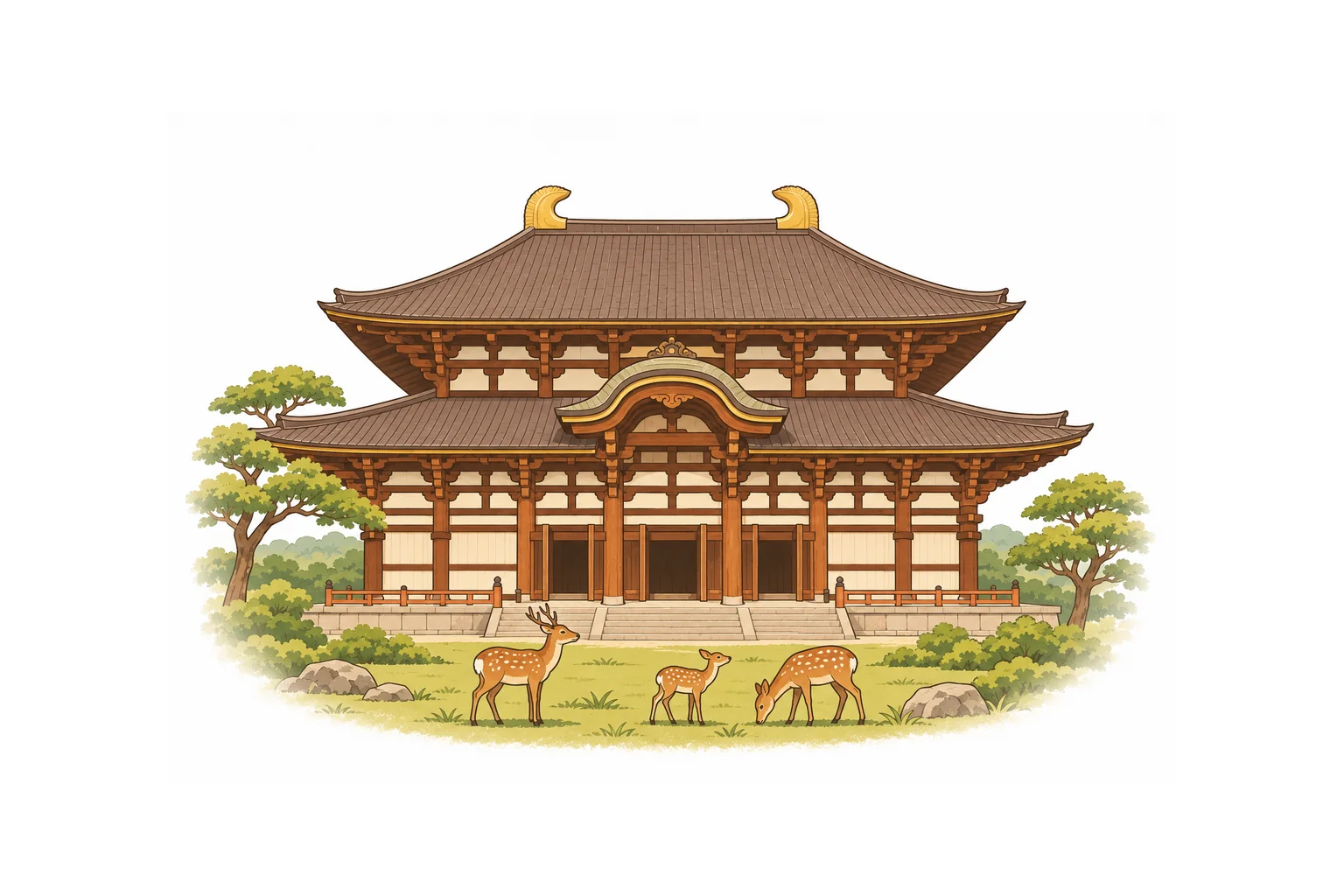
Neither the Buddha nor its hall is the original. In 1180, during the civil war between the Taira and Minamoto clans, Taira troops set fire to Nara and the Great Buddha Hall burned with the statue inside. A monk named Chōgen spent the rest of his life raising money to rebuild it, with support from Minamoto no Yoritomo. The hall was rededicated in 1195. For the new Great South Gate, the sculptors Unkei and Kaikei carved two guardian figures more than eight meters tall, and the gate and its guardians still stand. In 1567 the hall burned again in fighting between rival warlords, and the Buddha sat in the open for over a century. The present hall was completed in 1709. It is still one of the largest wooden buildings in the world, yet only about two-thirds as wide as the original. Of the statue itself, only some lotus petals on the base and a few folds of the robe over the legs survive from the eighth century.
05Jianzhen Crosses the Sea
A year after the eye-opening, an elderly blind monk came ashore in Kyūshū. His name was Jianzhen, known in Japan as Ganjin, and he came from Yangzhou in China.
Japanese Buddhism had a weakness that troubled the court. There was no proper system for ordaining monks according to the monastic code, which required a quorum of qualified senior monks that Japan could not assemble. Many people shaved their heads on their own to escape taxes, and the state had no way to tell real monks from fake ones. In 742 two Japanese monks studying in China, Yōei and Fushō, went to Jianzhen, already a renowned teacher of monastic discipline, and asked him to recommend a disciple who would go to Japan. When none of his students volunteered, Jianzhen said he would go himself.
It took him more than ten years and six attempts. Some voyages were stopped by officials, one was betrayed by a disciple who did not want him to leave, and others were wrecked by storms. On the fifth attempt his ship was blown all the way to Hainan Island in the far south. On the long journey back overland, Yōei died, and Jianzhen lost his sight. In 753, now in his sixties, he sailed with a returning Japanese embassy and finally reached Japan.
In 754 he arrived in Nara and set up an ordination platform in front of the Great Buddha. There he administered the precepts to the retired emperor Shōmu, to Kōmyō and to Empress Kōken, and ordained hundreds of monks. Japan had a legitimate ordination system at last. In 759 he founded Tōshōdai-ji on the western side of the capital as a center for teaching the monastic code. He had brought with him not only teachings but also Buddhist images, scriptures, calligraphy and medical knowledge.
Jianzhen died at Tōshōdai-ji in 763. His followers made a portrait statue of him in dry lacquer, seated with his eyes closed, and tradition says it was made while he was still alive. It is one of the earliest portrait sculptures in Japan and is still kept at the temple. Tōshōdai-ji’s main hall, its deep roof resting on a row of thick round columns, is an original eighth-century building. Far more than the rebuilt Tōdai-ji, it shows what the architecture of Nara actually looked like.
06Why the Capital Left
After Shōmu, court politics stayed tangled up with Buddhism. His daughter Kōken abdicated and then returned to the throne as Empress Shōtoku. She placed great trust in a monk named Dōkyō and raised him to the unheard-of rank of "Dharma King." In 769 an oracle arrived from the Hachiman shrine at Usa in Kyūshū, announcing that the realm would be at peace if Dōkyō became emperor. Shōtoku sent a courtier, Wake no Kiyomaro, to Usa to confirm it. He came back with a different message: the throne must go only to someone of the imperial line. Dōkyō never became emperor, and when Shōtoku died the next year he was sent into exile in the east.
The episode convinced many at court that monks and temples had come too close to power. Emperor Kanmu, who took the throne in 781 and came from a different branch of the imperial family, moved the capital in 784 to Nagaoka-kyō, north of Nara, and ten years later to Heian-kyō, the city we know as Kyoto. There were other reasons too: Nara had poor river access for moving goods, and Kanmu wanted a fresh capital for his own line, away from the entrenched aristocrats of the old one. Whatever the mix of motives, the great Nara temples stayed behind, and the new capital at first allowed only a couple of official temples inside its walls.
The palace buildings were taken apart and their timber carried off to the new capitals. Over the centuries the palace site turned into rice paddies. The temples remained.
07The Southern Capital
Once the court left, Nara became known as Nanto, the "Southern Capital," in contrast to Kyoto to the north. It did not fade into countryside. It became a city that lived around its temples.
The most powerful of these was Kōfuku-ji, the family temple of the Fujiwara, which had been moved to Nara from Fujiwara-kyō when the city was founded. Next to it stood Kasuga Taisha, the Fujiwara clan’s guardian shrine, traditionally said to have been founded in 768. In an age when Buddhas and Japanese gods (kami) were worshipped together, the temple and shrine functioned as a single institution. As the Fujiwara came to dominate the court in Kyoto during the Heian period, Kōfuku-ji grew rich on estates across the country and kept bands of armed monks, the sōhei. When the monks had a grievance, they would carry the sacred branch of the Kasuga deity into Kyoto and refuse to leave until the court gave way, which it usually did. By the medieval period Kōfuku-ji effectively governed the whole province of Yamato; the Kamakura and Muromachi shogunates generally did not appoint a military governor there, leaving the job to the temple instead.
That power is why Nara burned in 1180. Kōfuku-ji and Tōdai-ji had sided against the Taira, and Taira no Kiyomori sent his son Shigehira to punish them. The fire destroyed most of both temples. Their rebuilding gave work to Unkei and his school of sculptors, and the vigorous, realistic style of Kamakura-period sculpture grew up in the workshops of Nara.
Merchants and craftsmen settled around the temples. Houses gradually filled the grounds of the old Gangō-ji temple, creating the district now called Naramachi. Local trades followed the temples’ needs. Monks copied sutras, so Nara became famous for its ink sticks. Temple breweries produced a celebrated "monastery sake," and the Nara area is often named as one of the birthplaces of Japanese sake-making techniques. Under the Tokugawa shogunate, Nara was governed directly by a shogunal magistrate, and pilgrims came in large numbers to see the Great Buddha and Kasuga Taisha. In practice it was already a tourist town.
08Deer, and Modern Nara
The famous deer of Nara belong to Kasuga Taisha. According to the shrine’s legend, its principal deity, Takemikazuchi, came to Nara from Kashima in eastern Japan riding a white deer, so deer came to be regarded as the god’s messengers. From the medieval period onward, harming a deer was severely punished. A local legend tells of a boy who killed a deer by accident and was buried alive under stones as punishment. No one can say whether it happened, but people believed it could. Another old story has Nara residents who found a dead deer outside their door at dawn quietly dragging it to the neighbor’s house before anyone noticed.
The Meiji Restoration hit Nara hard. From 1868 the new government ordered the separation of Shinto and Buddhism, and a wave of anti-Buddhist destruction swept the country. Kōfuku-ji’s monks left en masse to become Shinto priests at Kasuga Taisha. The temple lost its lands and its buildings were left to decay. According to a widely told story, its five-story pagoda was nearly sold for scrap, the buyer wanting only the metal fittings, and survived only because tearing it down would have cost too much. With the god’s protection withdrawn, the deer population also fell sharply.
The turn came when the government began to see old temples as national treasures rather than relics of an outdated faith. Officials surveyed temple collections, and in 1884 the American scholar Ernest Fenollosa and his Japanese colleague Okakura Kakuzō persuaded the monks of Hōryū-ji, southwest of Nara, to open a shrine that had been kept sealed for centuries, revealing the Guze Kannon statue wrapped in cloth. In 1880 the land around Kōfuku-ji was designated Nara Park, which later expanded to take in Tōdai-ji, Kasuga Taisha and the wooded hills behind them. The Imperial Nara Museum opened in 1895. The deer came back under protection and are now a designated natural monument.
The palace site was rediscovered in the same spirit. Local scholars had begun working out its location among the rice fields in the late Edo period, and in the early twentieth century a local campaign led to the land being bought for preservation. Systematic excavation from the 1950s onward brought up the mokkan and the foundations of the palace halls. The Suzakumon gate was rebuilt in 1998, and the Great Audience Hall in 2010, for the 1,300th anniversary of the move to Nara. Also in 1998, the "Historic Monuments of Ancient Nara" were added to the UNESCO World Heritage list, among them Tōdai-ji, Kōfuku-ji, Kasuga Taisha, Tōshōdai-ji, Yakushi-ji, Gangō-ji and the palace site.
A walk through Nara today crosses several layers at once. Underfoot are the foundations of a capital that lasted barely seventy years. Overhead are temple roofs that have burned and been rebuilt over twelve centuries. And all around, bowing for crackers, are the deer that a shrine legend kept alive.