
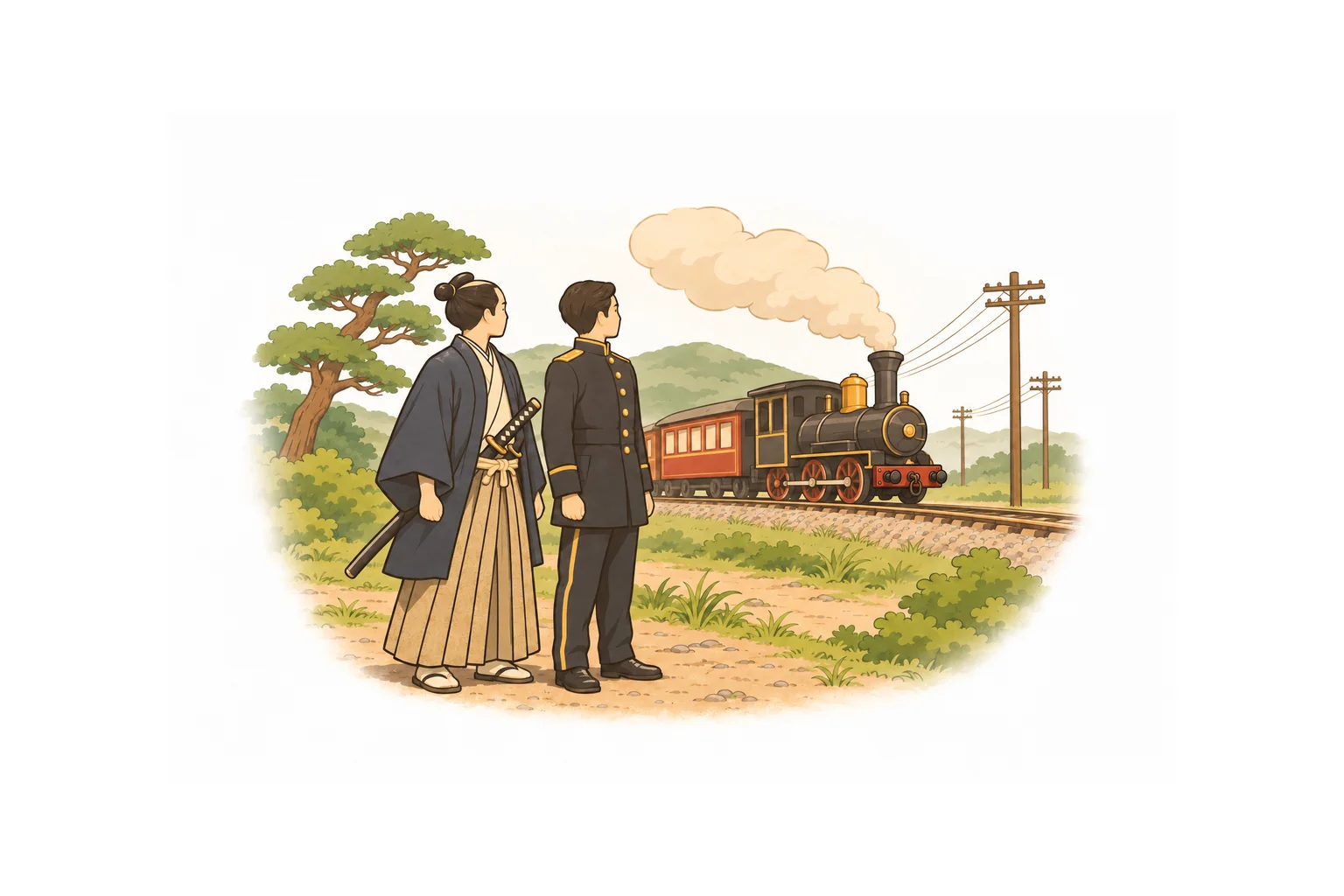
01Smoke on the Bay
On a July afternoon in 1853, four foreign warships came in against the wind off Uraga, at the mouth of Edo Bay. Two of them were steamers, trailing coal smoke from their funnels, their hulls painted dark. The Japanese called them kurofune, the "black ships." Their commander, Commodore Matthew Perry of the United States Navy, carried a letter from President Millard Fillmore asking Japan to open its ports to American ships for coal, water and supplies, to treat shipwrecked American sailors decently, and, ideally, to trade.
Japan at this time was ruled by the Tokugawa shogunate, a military government based in Edo (today’s Tokyo) that had kept the peace for two and a half centuries. Since the 1630s it had tightly limited contact with the outside world. Dutch and Chinese merchants could trade only at Nagasaki, Korea dealt with Japan through the island domain of Tsushima, and the kingdom of Ryūkyū (Okinawa) and the Ainu peoples of the north were handled through other border domains. Later generations called this policy sakoku, the "closed country," though it was more of a controlled gate than a locked door.
The shogunate was not ignorant of the world. Every year the Dutch at Nagasaki submitted a report of foreign news, and senior officials knew that Britain had beaten Qing China in the Opium War a decade earlier. That knowledge is exactly why Perry’s guns frightened them.
The senior councillor in charge, Abe Masahiro, accepted the letter and told Perry to come back for an answer. Then he did something no shogunal official had done before: he circulated a translation of the letter to the regional lords, the daimyo, and invited their opinions. Foreign policy had always been the shogun’s business alone. Asking for advice signaled to the whole country that the government in Edo did not know what to do.
Perry returned in early 1854 with a larger squadron, and the shogunate signed the Treaty of Kanagawa. It opened two small ports, Shimoda and Hakodate, to American ships. Britain, Russia and the Netherlands quickly obtained similar agreements. There was still no trade, but the gate had been pushed open.
02A Treaty Without the Emperor’s Blessing
In 1856 the first American consul, Townsend Harris, arrived at Shimoda with orders to negotiate a full commercial treaty. He spent many months telling Japanese officials about the British and French war against China, and argued that Japan would do better to sign a fair agreement with the United States now than to have harsher terms imposed by European gunboats later.
The shogunate wanted cover for such an unpopular step, so it sought the approval of the emperor. For centuries the emperors had lived quietly in Kyoto with no real political power, but in theory the shogun ruled on the emperor’s behalf. The reigning Emperor Kōmei loathed foreigners and refused.
In 1858 the shogunate’s newly appointed chief minister, Ii Naosuke, signed anyway. The Harris Treaty, followed by near-identical treaties with the Netherlands, Russia, Britain and France, opened Yokohama, Nagasaki and other ports to trade and foreign residence. Two clauses would rankle for decades. Foreigners accused of crimes in Japan were tried by their own consuls rather than Japanese courts, a privilege called extraterritoriality, and Japan could not set its own import tariffs. The Japanese came to call these the "unequal treaties."
Ii also crushed his critics in a campaign known as the Ansei Purge. Among those executed was Yoshida Shōin, a young teacher from the domain of Chōshū who ran a small private school in the castle town of Hagi. During Perry’s second visit Shōin had rowed out to an American ship and begged to be taken abroad; refused, he turned himself in. His students included Takasugi Shinsaku, Kusaka Genzui and Itō Hirobumi, and Yamagata Aritomo studied there briefly; most of them would help bring down the shogunate and then run the new Japan.
On a snowy morning in March 1860, Ii Naosuke’s palanquin was attacked outside the Sakurada Gate of Edo Castle by a band of masterless samurai, most of them from the domain of Mito. They killed him in the street. The most powerful official in the land had been cut down at the shogun’s own front door.
03Revere the Emperor, Expel the Barbarians
The slogan of the next few years was sonnō jōi: "revere the emperor, expel the barbarians." Young samurai slipped away from their domains and gathered in Kyoto, where they assassinated officials and merchants they considered too friendly to foreigners or to Edo. For the first time in centuries, the imperial court became the prize that every faction wanted to hold.
The two players that mattered most were Satsuma, at the southern tip of Kyūshū, and Chōshū, at the western end of Honshū. Both were large, wealthy domains far from Edo. Both had ancestors who fought against the Tokugawa at the battle of Sekigahara in 1600, and both had been kept out of the shogunate’s inner circle ever since.
Each learned a hard lesson about Western power. In 1862 a Satsuma procession near Yokohama met a party of British riders who failed to dismount and make way; Satsuma samurai drew their swords and killed a merchant named Charles Richardson. The following year a British squadron bombarded Kagoshima, Satsuma’s capital. Meanwhile Chōshū fired on foreign ships passing through the Shimonoseki Strait, and in 1864 a combined British, French, Dutch and American fleet destroyed its shore batteries.
Neither domain gave up on resisting the West, but both stopped believing that swords could do it. They bought modern rifles and steamships, and each quietly sent a handful of young men to study in Britain. "Expel the barbarians" was turning into something else: first remove the feeble shogunate, then build a state strong enough to stand up to the foreigners on equal terms.
Chōshū overreached in 1864, when its troops attacked Kyoto and were driven back from the palace gates by forces from Aizu and Satsuma. The shogunate launched two punitive campaigns against Chōshū. The first ended in Chōshū’s submission. The second, in 1866, was a humiliation: shogunal armies were beaten by Chōshū units armed with modern rifles, some of them commoner volunteers, and the young shogun Tokugawa Iemochi died in the middle of the campaign.
Shortly before that campaign, Satsuma and Chōshū, recently enemies, had made a secret alliance. One of the go-betweens was Sakamoto Ryōma, a samurai from the domain of Tosa who ran a shipping and trading company in Nagasaki and helped funnel Western guns to Chōshū under Satsuma’s name. Novels and television dramas have made Ryōma the most beloved figure of the era and probably inflated his role, but the alliance he helped broker was real, and it doomed the shogunate.
04The Last Shogun Steps Aside
The fifteenth and last shogun, Tokugawa Yoshinobu, took office in January 1867 (the twelfth month of Keiō 2 in the old calendar). He was capable and energetic, and he hired French officers to retrain his army. Weeks later Emperor Kōmei died, and his fourteen-year-old son Mutsuhito came to the throne. He is known to history as the Meiji Emperor.
In November 1867 Yoshinobu made a surprising move: he formally handed governing authority back to the emperor. It was a shrewd gamble. The court had no bureaucracy and no army, so it would still have to rely on the Tokugawa, who as the largest landholders in Japan would dominate any new council of lords.
Satsuma’s leaders, Saigō Takamori and Ōkubo Toshimichi, together with the court noble Iwakura Tomomi, refused to let that happen. In early January 1868 their troops took control of the palace gates, and an imperial decree proclaimed the "restoration of imperial rule," abolishing the shogunate and demanding that the Tokugawa surrender their lands. Later that month, Tokugawa forces marching from Ōsaka toward Kyoto clashed with Satsuma and Chōshū troops at Toba and Fushimi, just south of the city. The Tokugawa side had more men but broke within days, and when the southern army raised the emperor’s brocade banner, wavering domains rushed to join it. Yoshinobu fled by ship to Edo.
The civil war that followed is called the Boshin War, after the zodiac name of the year 1868. As the new government’s army closed on Edo, a city of perhaps a million people, Katsu Kaishū, who commanded what was left of the Tokugawa forces, met Saigō Takamori to negotiate. They agreed that Edo Castle would be handed over without a fight in return for sparing Yoshinobu’s life and the Tokugawa family. The castle changed hands peacefully in the spring of 1868.
The north fought on. The domain of Aizu held out longest and suffered most. After a defeat outside the castle town, twenty teenage samurai of the Byakkotai, or "White Tiger Force," retreated to the hill of Iimoriyama and tried to kill themselves; only one, Iinuma Sadakichi, was saved. The popular version says they saw smoke around the castle and wrongly believed it had fallen, but Iinuma’s own later account stresses that they chose death rather than capture. The castle held for about another month. Finally a Tokugawa naval officer, Enomoto Takeaki, sailed the remains of the shogunal fleet to Hakodate in the far north and held out in the star-shaped fort of Goryōkaku until June 1869.
05Tearing Down the Old Order
The men now in charge were mostly young, mostly lower- or middle-ranking samurai from Satsuma, Chōshū, Tosa and Hizen, plus a few court nobles. They governed in the name of a teenage emperor and moved fast.
In 1868 the emperor swore a five-article "Charter Oath" promising, among other things, that matters would be decided by public discussion and that knowledge would be sought throughout the world. The era name was changed to Meiji, "enlightened rule," and from then on each emperor would have just one era name. Edo was renamed Tokyo, "eastern capital," and the young emperor moved into the former shogun’s castle there.
The biggest problem was that Japan was still a patchwork of more than 250 domains, each with its own samurai, taxes and soldiers. In 1869 the lords of Satsuma, Chōshū, Tosa and Hizen led the way in surrendering their land registers to the emperor, and the rest followed, though they stayed on as governors. Then, in August 1871, with troops from the three strongest domains stationed in Tokyo, the government abolished the domains altogether and replaced them with prefectures run by appointed officials. The former lords were moved to Tokyo on generous pensions. There was almost no resistance, partly because many domains were deeply in debt and their lords were glad to be rid of them.
Next came the social order. Under the Tokugawa, people were born into hereditary statuses (samurai, farmer, artisan, merchant, and outcast groups below them), each with its own rules about dress, residence and marriage. The new government grouped former lords and court nobles as a new peerage, samurai as shizoku ("gentry"), and everyone else as commoners, who could now take surnames, choose their jobs, move freely and marry across the old lines. Outcast status was legally abolished in 1871, though discrimination long outlived the law.
In 1873 a conscription law required twenty-year-old men of every background to serve in the army, though heads of household, heirs and those who paid a fee were exempt, so the burden fell mostly on the younger sons of poor farmers. Its architect was Yamagata Aritomo of Chōshū. For centuries fighting had been the samurai’s privilege; now farmers’ sons carried rifles. The same year a land tax reform replaced the old rice levies, which varied with the harvest, with a fixed cash tax of 3 percent of assessed land value. It gave the state a predictable income, but farmers owed the same amount in good years and bad.
While all this was underway, nearly half the government’s senior leadership left the country. The Iwakura Mission, led by Iwakura Tomomi with Ōkubo, Kido Takayoshi and Itō among its members, sailed in late 1871 and spent almost two years in the United States and Europe. They hoped to renegotiate the unequal treaties, were rebuffed in Washington, and turned instead to looking at everything: factories, parliaments, schools, shipyards, prisons. Among the students who traveled with them were five girls; the youngest, six-year-old Tsuda Umeko, grew up in America and later founded one of Japan’s first colleges for women.
06Railways, Schools and Beef Stew
The changes reached daily life quickly. In 1872 a railway opened between Shinbashi in Tokyo and Yokohama, built under British engineers. The same year the government opened the Tomioka Silk Mill in Gunma, equipped with French machinery and staffed by young women, many from samurai families, who were meant to carry the techniques home. Raw silk was Japan’s leading export, and the foreign currency it earned paid for machines and warships.
A national school system was announced in 1872. Many villagers resented it at first, since children in school were children not working and families paid fees, and in some places schools were burned. By the end of the Meiji era, though, more than nine in ten children were enrolled. The government also switched to the Western calendar, declaring that the third day of the twelfth month of Meiji 5 would become January 1, 1873; most of that December simply vanished.
Western knowledge arrived through hired experts, known as oyatoi gaikokujin, "hired foreigners," among them British railway engineers, French legal advisers, German doctors and American agricultural scientists, and through translated books. The best-selling writer of the age was Fukuzawa Yukichi, whose An Encouragement of Learning opened with the line that heaven creates no person above or below another. His school in Tokyo became Keiō University.
City people called the new style bunmei kaika, "civilization and enlightenment." Men cut off their topknots. The Ginza district of Tokyo was rebuilt in brick after a fire and lit with gas lamps. Eating beef, long avoided, became fashionable, and restaurants serving gyūnabe, beef simmered in a pot, spread across the city. In 1876 a decree banned the wearing of swords in public by anyone but soldiers and police.
07Who Paid
The reforms gave the government money and an army. The bill fell on others.
The samurai paid first. After the domains were abolished the state was still paying stipends to several hundred thousand noble and samurai households, at times around 30 percent of its spending. In 1876 it converted the stipends into one-time government bonds. A few high-ranking families did well; most ordinary samurai received interest too small to live on, and many who tried their hand at business failed. In the space of a few years they lost their income, their swords and their monopoly on arms.
The leadership split, too. In 1873, while the Iwakura Mission was away, Saigō Takamori and his allies pushed to send an envoy to Korea, which had rebuffed Japan’s new government, and to go to war if the envoy was mistreated. The returning travelers, led by Ōkubo, insisted Japan was not ready. Saigō and several others resigned. Discontented samurai rose in revolt across western Japan over the next few years.
The largest uprising came in 1877. Saigō had gone home to Kagoshima and opened a network of private schools that drew thousands of Satsuma samurai. Early that year they marched north and besieged Kumamoto Castle. The government’s army, built on the conscription law, was made up largely of commoners, and after seven months of fighting it drove Saigō’s men back to Kagoshima. Saigō died on the hill of Shiroyama in September. This Satsuma Rebellion was Japan’s last civil war. The following spring Ōkubo was assassinated on his way to work in Tokyo; Kido had died of illness during the rebellion. Within a year, the three great architects of the Restoration were gone.
Farmers paid as well. The edict announcing conscription noted that Westerners called military service a "blood tax," meaning that a man repaid the state with his own blood; in the villages, rumors spread that the government meant to drain young men’s blood literally. In 1873 "blood tax riots" broke out across western Japan, the largest in Mimasaka (northern Okayama), where farmers also attacked land certificates, school costs and the freeing of outcasts. The rumor was the spark; the deeper grievance was losing sons’ labor. The cash land tax was hard to pay when rice prices fell, and large land-tax riots followed in 1876. In the 1880s a harsh deflation pushed rice prices down, and many farmers lost their land to debt. In 1884 indebted farmers in the Chichibu district north of Tokyo rose in arms and were put down by the army.
So did the peoples at Japan’s edges. In 1869 the northern island of Ezo was renamed Hokkaidō and opened to settlers under a colonization office advised by Americans. The Ainu, its indigenous people, lost their land and their hunting and fishing rights and were pressed to adopt Japanese names and language. In the south, the kingdom of Ryūkyū, which had long paid tribute to both China and Japan, was abolished in 1879 and made Okinawa Prefecture; its last king was removed to Tokyo.
And the young women in the silk mills paid. After Tomioka, hundreds of private filatures sprang up, staffed by teenage girls from poor farming families who worked long hours in damp rooms where tuberculosis spread easily. Industry also brought pollution. Waste from the Ashio copper mine poisoned the farmland along the Watarase River, and in 1901 Tanaka Shōzō, a member of parliament who had campaigned for the victims for years, resigned his seat and tried to hand a petition directly to the emperor as his carriage passed. Police stopped him.
08A Constitution from Above
Not every critic took up the sword. In 1874 Itagaki Taisuke of Tosa and other former officials petitioned for an elected assembly, launching the Freedom and People’s Rights Movement. Political societies sprang up across the country, drafted constitutions of their own and packed lecture halls. The government arrested and censored, but in 1881 it promised a national parliament by 1890. When Itagaki was stabbed in 1882, he is said to have cried, "Itagaki may die, but liberty will not." Whether he really said it on the spot is uncertain, but the line became the movement’s motto.
The man who wrote the constitution was Itō Hirobumi. He went to Europe to study, and chose Prussia and other German states as his main model because their monarchs held far more power than Britain’s. In 1885 Japan adopted a cabinet system, with Itō as its first prime minister. On February 11, 1889, the emperor presented the Constitution of the Empire of Japan to his subjects. It declared the emperor "sacred and inviolable," gave him supreme command of the army and navy and the power to declare war, and created a two-chamber Diet with an elected lower house that could vote on budgets and laws. It was a gift from the throne, not a document drawn up by the people.
The first election, in 1890, was open only to men over 25 who paid a substantial amount of direct tax, about one percent of the population. That autumn the Imperial Rescript on Education told subjects to be loyal and filial and to offer themselves to the state in an emergency. For the next half-century it was read aloud at solemn school ceremonies, where pupils bowed before portraits of the emperor and empress.
The Meiji Emperor himself was transformed from a secluded boy behind palace screens into a monarch in Western military uniform who toured the country and reviewed troops. How far he made decisions personally is debated; there is no doubt that his image became the center of national loyalty.
09Becoming an Empire
From the start, Meiji leaders wanted to undo the unequal treaties. In the 1880s Foreign Minister Inoue Kaoru built the Rokumeikan, a Western-style hall in Tokyo where Japanese officials and their wives hosted foreign diplomats at balls. Critics at home mocked it as groveling. What finally worked was a combination of modern law codes and military strength. In 1894 Britain agreed to give up extraterritoriality, effective in 1899; full control over tariffs came only in 1911.
In 1894 Japan went to war with Qing China over influence in Korea. Japanese forces won on land and sea, and the Treaty of Shimonoseki in 1895 gave Japan Taiwan, the Penghu Islands and the Liaodong Peninsula in southern Manchuria, along with a large indemnity. Within days Russia, Germany and France forced Japan to hand back Liaodong. The "Triple Intervention" enraged the Japanese public, and much of the indemnity went into armaments, some into the new Yawata steelworks in Kyūshū.
Russia then leased the tip of the Liaodong Peninsula, including Port Arthur, for itself and pressed into Manchuria and Korea. Japan allied with Britain in 1902 and went to war with Russia in 1904. General Nogi Maresuke took Port Arthur at a dreadful cost in lives, Japanese armies won at Mukden, and in May 1905 Admiral Tōgō Heihachirō’s fleet destroyed the Russian Baltic Fleet in the Tsushima Strait after its voyage halfway around the world. It was the first time in the modern era that an Asian country had defeated a European great power in a major war, and people from Egypt to India took notice.
Japan, though, was exhausted. The Treaty of Portsmouth, brokered by President Theodore Roosevelt, gave it Russia’s rights in southern Manchuria and the southern half of Sakhalin, but no indemnity. Crowds in Tokyo, fed on reports of victory, rioted in Hibiya Park and burned police stations and hundreds of police boxes.
Japan made Korea a protectorate, with Itō Hirobumi as the first Resident-General. In 1909 he was shot dead at Harbin railway station by the Korean independence activist An Jung-geun. In 1910 Japan formally annexed Korea, beginning thirty-five years of colonial rule. That same year the police rounded up socialists and anarchists on charges of plotting to kill the emperor; in early 1911, twelve were executed, including the writer Kōtoku Shūsui, many on very thin evidence.
10The End of Meiji
The Meiji Emperor died on July 30, 1912. On the night of his funeral that September, General Nogi and his wife killed themselves in their Tokyo home to follow their lord in death, an old samurai custom. Some Japanese saw it as a last flash of the warrior spirit; others found it shockingly out of place in a modern nation. The novelist Natsume Sōseki wove the moment into his novel Kokoro, in which the character Sensei feels that the spirit of Meiji has ended with the emperor.
In sixty years Japan had gone from a country of more than 250 domains ruled by hereditary warriors and largely closed to the world, to a constitutional monarchy with a parliament, railways, near-universal schooling, an army and navy that had beaten China and Russia, and colonies in Taiwan, southern Sakhalin and Korea. Its population had grown from about 34.8 million in 1872 to about 50.6 million. A small group of ambitious young men from the lower ranks of the samurai had driven the change. Former samurai, taxed farmers, mill girls, the Ainu and Okinawans, and the colonized peoples of Taiwan and Korea carried much of its weight.
In the Taishō era that followed (1912–1926), party cabinets became the norm and all adult men won the vote in 1925. In the 1930s, amid economic crisis, the army’s power grew, Japan invaded Manchuria and then China, and the road ended in the Pacific War and defeat in 1945. Both the modern state and the drive for empire built in the Meiji years ran straight into that story.