
01A War Nobody Won
In 1467 fighting broke out in the streets of Kyoto, the imperial capital. The trigger was a quarrel over who would be the next shogun, the military ruler who in theory governed Japan on the emperor’s behalf. The shogun of the day, Ashikaga Yoshimasa, had named his younger brother as heir, then his wife Hino Tomiko gave birth to a son. At the same moment several of the great warrior families that propped up the shogunate were split by their own succession disputes. Two powerful lords, Hosokawa Katsumoto and Yamana Sōzen, took opposite sides, and warriors from all over the country poured into the capital to join them.
The conflict is called the Ōnin War, after the era name in use when it began. Hosokawa’s forces camped in the east of the city and Yamana’s in the west. Kyoto’s famous weaving district is still called Nishijin, "the western camp," because Yamana’s army was based there. For years the two sides fought block by block. Temples, aristocratic mansions and ordinary houses burned. Lightly armed foot soldiers called ashigaru, hired for the occasion, looted whatever they could carry.
By 1477 both commanders were dead of illness and the provincial lords drifted home. The war simply stopped. No one had won it, but the Ashikaga shogunate had clearly lost. Its orders now carried little weight outside the capital, and the provincial governors who went home often found that their own vassals had taken control in their absence. For roughly the next hundred years Japan had no effective central government. Historians borrowed a name from ancient China and called it the Sengoku period, the "age of warring states."
02The Low Overthrow the High
People at the time had a phrase for what followed: gekokujō, "the low overthrowing the high." A governor’s deputy would push out the governor; the deputy’s own retainers would then push out the deputy. Old titles counted for little. What mattered was land, soldiers, and the ability to hold on to both.
One famous case is Hōjō Sōun, who in the 1490s seized the province of Izu and then the castle town of Odawara, southwest of modern Tokyo. His descendants ruled much of eastern Japan from Odawara for nearly a century. (They are usually called the Later Hōjō, to distinguish them from an unrelated Hōjō family that dominated the government in the 1200s.) Older stories made Sōun a penniless wanderer who conquered with nothing but his wits; historians now know he came from a family of shogunal officials, and he never called himself Hōjō, going by Ise Sōzui. Even so, he built his domain by force rather than inheritance.
In western Japan, the Ōuchi family grew rich on trade with Ming China and on the culture they imported from Kyoto. In 1551 the head of the family, Ōuchi Yoshitaka, was forced to kill himself by his own chief retainer, Sue Harukata. Four years later Sue was in turn destroyed at the island of Itsukushima, home of the famous shrine with the floating gate, by a small local lord named Mōri Motonari. The Mōri went on to rule most of western Honshū.
The upheaval reached beyond the warrior class. In 1488 followers of the True Pure Land school of Buddhism, often called the Ikkō sect, rose up in the province of Kaga on the Sea of Japan coast and overthrew its governor. For almost a century Kaga was run by a league of temples, local warriors and villagers. The sect’s headquarters, the Ishiyama Hongan-ji temple on the site of present-day Ōsaka, was walled and moated like a fortress.
03The New Warlords
The men who survived and prospered in this world are called daimyō, "great names." Unlike the old governors, whose authority came from the shogun’s appointment, a Sengoku daimyo’s power rested entirely on what he controlled himself. Nobody collected his taxes, raised his troops or settled his disputes for him.
So the daimyo became, in effect, the rulers of small states. Many wrote their own law codes. A common clause punished both parties in any quarrel between retainers, regardless of who had started it, because private feuds weakened the lord. They sent officials to survey fields and record their yields, so they knew exactly how much rice to demand and how many soldiers each retainer owed. They gathered their vassals around their castles, and merchants and craftsmen followed. Many Japanese prefectural capitals today began as the castle town of a Sengoku lord.
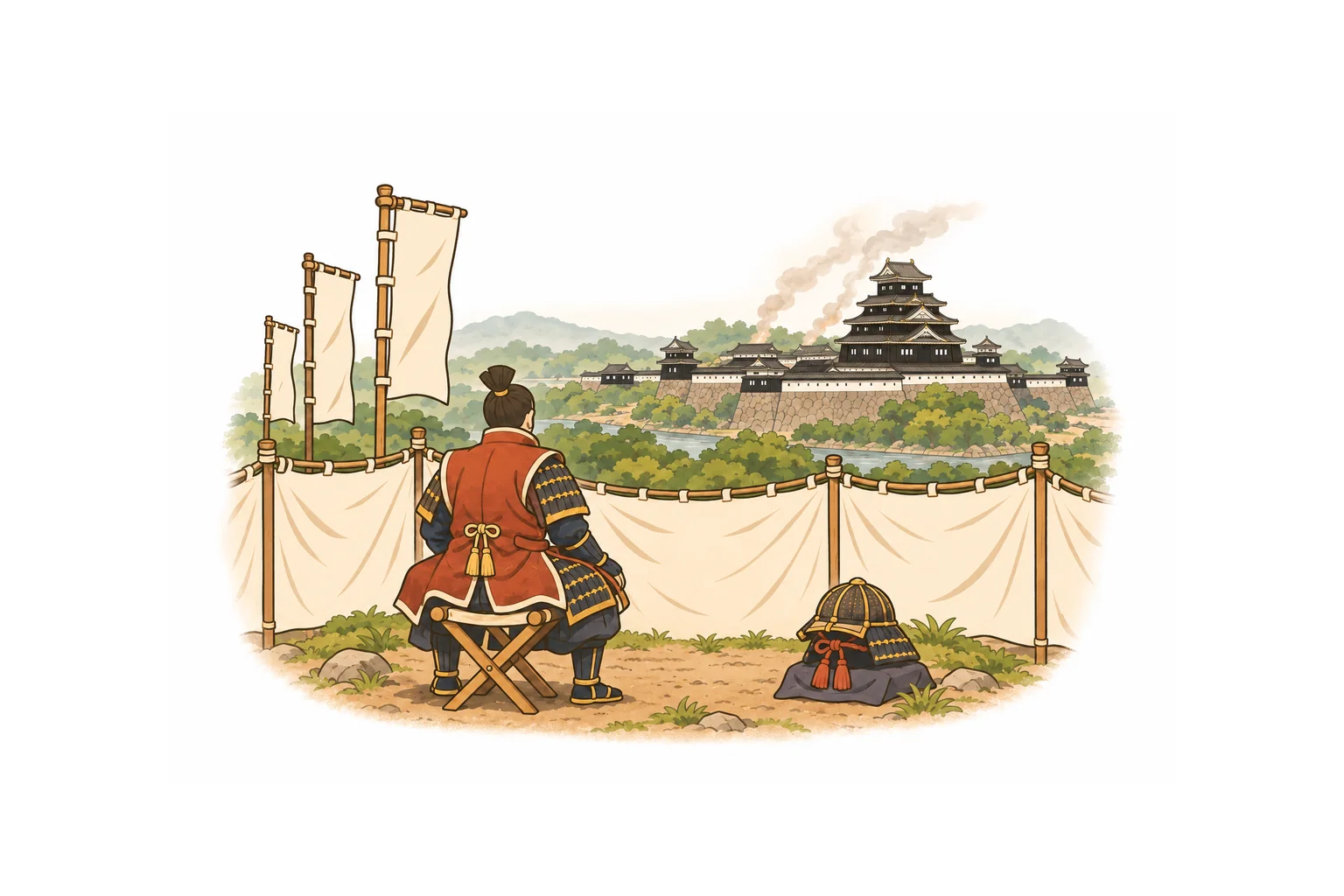
The best-remembered rivalry of the age is between Takeda Shingen of Kai, a mountain province west of modern Tokyo, and Uesugi Kenshin of Echigo, on the Sea of Japan coast. Shingen built flood-control embankments that still carry his name. Kenshin was a devout Buddhist who grew rich on the trade in a fiber used for cloth. They met five times on the plain of Kawanakajima, most bloodily in 1561. A well-loved story says Kenshin rode alone into the Takeda headquarters and slashed at Shingen, who parried with his iron war fan without rising from his stool. The scene comes from later war tales. What is certain is that neither man could beat the other.
That stalemate was typical. A daimyo could become very strong inside his own region and still find it almost impossible to expand beyond it, because every advance left his home exposed to the next rival.
04Guns and Missionaries
In 1543 a Chinese junk carrying a few Portuguese traders washed up on Tanegashima, a small island south of Kyūshū. The island’s young lord bought two of their matchlock muskets and had his swordsmiths copy them. Within a few decades, gunsmiths in the trading city of Sakai near Ōsaka and at Kunitomo on Lake Biwa were turning out firearms in quantity, and Japan had become one of the most heavily armed societies on earth.
Guns changed warfare. Mounted warriors with bows and swords mattered less; drilled ranks of ashigaru with muskets mattered more. A lord who could afford thousands of guns, along with the imported saltpeter needed for gunpowder, held a real advantage, which made ports and trade routes worth fighting over.
The Portuguese brought religion as well. In 1549 the Jesuit missionary Francis Xavier landed at Kagoshima in southern Kyūshū. Over the following decades tens of thousands of Japanese converted to Christianity, among them several Kyūshū daimyo. Faith played its part, and so did profit: Portuguese ships tended to call at ports where missionaries were welcome, bringing Chinese silk and gunpowder. One Christian lord, Ōmura Sumitada, went so far as to hand the port of Nagasaki over to the Jesuits.
05Oda Nobunaga
Out of this crowded field came the first of three men who would reunite Japan. Oda Nobunaga was born in 1534 into a minor branch of a family serving the governor of Owari, the province around present-day Nagoya. As a youth he dressed carelessly and behaved so strangely that people called him "the great fool of Owari."
In 1560 Imagawa Yoshimoto, a powerful lord from the east, marched through Owari at the head of an army usually put at more than twenty thousand men. Nobunaga had perhaps two or three thousand. While the Imagawa army rested among the low hills at Okehazama, Nobunaga attacked under cover of a thunderstorm and killed Yoshimoto. The victory made his name. It also freed a young hostage held by the Imagawa, Matsudaira Motoyasu, who went home to the neighboring province of Mikawa and allied himself with Nobunaga. He would later take the name Tokugawa Ieyasu.
Nobunaga conquered the province of Mino next, renamed its main castle town Gifu, and began using a seal that read tenka fubu, roughly "the realm under military rule." In 1568 he marched into Kyoto escorting Ashikaga Yoshiaki, a claimant to the shogunate, and installed him as shogun. Yoshiaki soon realized he was a puppet and began organizing a coalition of lords against his patron. For a while Nobunaga was in serious danger, especially when Takeda Shingen marched west in 1572. Then Shingen died the following spring, and Nobunaga drove Yoshiaki out of Kyoto. The Ashikaga shogunate, which had lasted since the 1330s, was finished.
Nobunaga was ruthless with those who opposed him. In 1571 he burned the great monastery complex on Mount Hiei, outside Kyoto, which had sheltered his enemies, and his troops killed monks and laypeople by the thousand. He fought the Ishiyama Hongan-ji for ten years and slaughtered Ikkō followers in their strongholds at Nagashima and in Echizen.
In 1575, at Nagashino in Mikawa, Nobunaga and Ieyasu faced Shingen’s son Takeda Katsuyori. Behind a line of wooden palisades, their musketeers shot down the charging Takeda cavalry. A famous account says Nobunaga had three thousand guns firing in rotating volleys of three ranks. Historians now trace the three-rank volleys to later retellings from the early 1600s, and copies of the main contemporary chronicle give the number of guns as either one thousand or three thousand, but there is no doubt the guns decided the day.
The next year Nobunaga began building Azuchi Castle on the shore of Lake Biwa. At its center rose a towering keep of many stories, its rooms decorated with gold-leaf paintings by Kanō Eitoku, the leading artist of the day. European visitors were dazzled. Below the castle Nobunaga declared free markets, abolishing the monopolies held by merchant guilds. He welcomed the Jesuits, partly from curiosity and partly because they were enemies of the Buddhist institutions that had fought him.
By 1582 Nobunaga controlled central Japan and was pushing west against the Mōri. In the summer of that year he stopped in Kyoto at a temple called Honnō-ji, with only a small bodyguard, on his way to reinforce his general Hashiba Hideyoshi. Before dawn on June 21, 1582 (the second day of the sixth lunar month), one of his other senior commanders, Akechi Mitsuhide, surrounded the temple with his army. Nobunaga died in the burning building at the age of forty-eight by Western reckoning. Why Mitsuhide turned on his lord has never been settled; personal grievance, ambition and a hidden conspiracy have all been proposed.
06Toyotomi Hideyoshi
Hideyoshi was born to a peasant or low-ranking foot-soldier family in Owari. He entered Nobunaga’s service as a menial and rose, through quick wits and hard work, to become one of his leading generals. A popular story has him warming Nobunaga’s sandals inside his shirt on cold mornings; it is a legend, but it captures how people remembered him.
When news of Honnō-ji reached him, Hideyoshi was besieging a Mōri castle far to the west. He made peace on the spot and force-marched his army back toward Kyoto in about ten days. At Yamazaki, just outside the capital, he crushed Mitsuhide, who was killed by villagers as he fled. Mitsuhide had held Kyoto for less than two weeks.
Having avenged his master, Hideyoshi dominated the Oda family’s councils. He pushed through the choice of Nobunaga’s three-year-old grandson as heir. The boy was placed in the care of Nobunaga’s third son, while Hideyoshi, as one of four senior retainers running the Oda house, became the strongest voice among them. In 1583 he defeated Nobunaga’s senior general Shibata Katsuie. In 1584 he fought Tokugawa Ieyasu at Komaki and Nagakute without gaining the upper hand, so he switched to diplomacy, eventually marrying his sister to Ieyasu and sending his own mother to him as a sort of hostage. Ieyasu came to Ōsaka and submitted.
Hideyoshi never became shogun. The usual explanation is that his birth was too humble for the title, though no record from the time supports it. Instead, in 1585 he had the imperial court appoint him kanpaku, imperial regent, a post that had always been reserved for the highest aristocratic families. The court gave him a brand-new surname, Toyotomi. He subdued the island of Shikoku in 1585 and Kyūshū in 1587. In 1590 he besieged Odawara with an enormous army and destroyed the Later Hōjō, and the lords of the far north hurried to submit. For the first time since the Ōnin War, all of Japan answered to one man.
Hideyoshi built a great castle at Ōsaka on the site of the old Ishiyama Hongan-ji, and he reshaped Kyoto as well. His most lasting work, though, was administrative. His officials surveyed land across the country using standard measures and rated every village by its expected rice yield, measured in koku, a unit of about 180 liters. A daimyo’s rank was now expressed by the size of his domain in koku. In 1588 he ordered the "sword hunt," confiscating weapons from farmers and temples. Soon afterward he forbade warriors to become farmers or merchants and forbade farmers to leave their fields. The line between samurai and commoner, which had been blurry throughout the Sengoku period, became fixed.
In his later years Hideyoshi grew unpredictable. In 1587 he suddenly ordered the missionaries expelled, and in 1597 he had twenty-six Christians crucified at Nagasaki. In 1591 he ordered his tea master, the great Sen no Rikyū, to commit suicide. That same year he handed the post of kanpaku to his nephew Hidetsugu and took the title taikō, retired regent. Then in 1593 his consort Yodo-dono bore him a son, Hideyori. Two years later Hidetsugu was forced to kill himself, and more than thirty of his wives, concubines and children were executed on a riverbank in Kyoto.
The worst of it happened overseas. Hideyoshi dreamed of conquering Ming China and demanded passage through Korea. When Korea refused, he sent an invasion force of well over a hundred thousand men in 1592. The Japanese took Seoul and Pyongyang within weeks, but the Korean admiral Yi Sun-sin repeatedly defeated their fleets, Ming armies arrived to help Korea, and the war bogged down. After peace talks collapsed, Hideyoshi invaded again in 1597. The invasions devastated Korea. Many Koreans were carried off to Japan, among them potters whose skills founded several famous Kyūshū ceramic traditions. When Hideyoshi died at Fushimi Castle in 1598, his armies came home.
07Sekigahara
On his deathbed Hideyoshi’s great worry was his five-year-old son. He appointed a council of five senior lords, the Five Elders, and five trusted administrators, the Five Commissioners, and made them swear to protect Hideyori until he came of age. The richest of the Elders was Tokugawa Ieyasu. Years earlier Hideyoshi had moved him to the Kantō plain in the east, where Ieyasu had made the small town of Edo, the future Tokyo, his base. His domain, at about 2.5 million koku, dwarfed everyone else’s.
Once Hideyoshi was dead, Ieyasu began acting as if he were already in charge, arranging marriages with other lords without permission and moving into Fushimi Castle. Ishida Mitsunari, one of the Commissioners and a fiercely loyal Toyotomi administrator, became convinced that Ieyasu meant to take the realm. But Mitsunari was widely disliked by the fighting generals, who had bled in Korea and resented desk-bound officials like him.
In 1600 Ieyasu marched east to punish the lord Uesugi Kagekatsu. Mitsunari seized the moment and raised an army in Ōsaka under the nominal command of Mōri Terumoto, another of the Elders. Ieyasu turned back west. The two armies, usually put at ninety to a hundred thousand men for the Eastern side and about eighty thousand for the Western, though the figures vary, met at Sekigahara, a narrow valley on the main road between eastern and western Japan.
The battle was fought on a foggy morning, October 21, 1600 (the fifteenth day of the ninth lunar month). At first the Western Army, Mitsunari’s side, held its own. The key was Kobayakawa Hideaki, a young nephew of Hideyoshi’s wife, who sat on a hill overlooking the field with more than ten thousand men. He had secretly promised to defect to Ieyasu but, in the traditional account, held back for hours. Around midday he finally attacked the Western Army’s flank. Other units followed his lead or refused to fight, and Mitsunari’s army collapsed. Some recent research argues that he changed sides soon after the fighting began. A well-known story says the impatient Ieyasu had his gunners fire toward Kobayakawa’s hill to force him to make up his mind; whether that really happened is debated.
Mitsunari was caught a few days later and beheaded in Kyoto. Ieyasu confiscated or shrank the domains of those who had opposed him and handed the land to his relatives and allies, placing lords he did not trust far from Edo. In 1603 the emperor appointed him shogun. Two years later he passed the title to his son Hidetada, making it plain to everyone that the office would stay in the Tokugawa family.
08The Fall of Ōsaka Castle
Hideyori and his mother Yodo-dono still lived in Ōsaka Castle. He held a modest domain, but he was Hideyoshi’s heir, the castle was the strongest in Japan, and its vaults held his father’s gold. Many lords still felt loyalty to the Toyotomi name. Ieyasu was in his seventies and wanted the problem settled before he died.
His pretext was a bronze bell. Hideyori had rebuilt the great Buddha hall of the Hōkō-ji temple in Kyoto, and the inscription on its new bell included the phrase kokka ankō, "peace and prosperity to the nation." Tokugawa advisers claimed that splitting the two characters of Ieyasu’s name across the phrase was a curse on him. The accusation was transparently contrived, and it served its purpose. In the winter of 1614 Tokugawa armies surrounded Ōsaka.
No daimyo came to Hideyori’s aid, so the defenders were mostly rōnin, masterless samurai who had lost their lords after Sekigahara. The most famous was Sanada Nobushige, better known by the later name Sanada Yukimura. He built an earthwork outpost on the castle’s southern side, the Sanada-maru, and inflicted heavy losses on the attackers. Unable to take the castle by storm, Ieyasu offered peace on condition that his men fill in the outermost moat. Once the treaty was signed, Tokugawa workers filled the moats of the second and third baileys as well, leaving only the central keep enclosure and the castle nearly defenseless.
In the summer of 1615 the war resumed. With no moats to protect them, the Toyotomi forces had to fight in the open. Sanada led a charge that broke through to Ieyasu’s own headquarters and, according to tradition, briefly drove Ieyasu to think of suicide before Sanada was killed. On June 3 (the seventh day of the fifth lunar month) the castle fell and burned. The next day Hideyori and Yodo-dono took their own lives inside it. Hideyori’s seven-year-old son, Kunimatsu, was hunted down and executed, and the Toyotomi line came to an end.
09Putting Down the Sword
The same year the shogunate changed the era name to Genna, and the moment came to be called the Genna Peace, the time when weapons were laid aside. New rules ordered every daimyo to keep only one castle in his domain and tear down the rest, and forbade lords to repair castles or arrange marriages without permission. Ieyasu died the following spring. The Tokugawa shogunate he founded would last more than 260 years.
The Japanese have long compared the three unifiers through a little verse about a cuckoo that will not sing. Nobunaga says: kill it. Hideyoshi says: make it want to sing. Ieyasu says: wait until it sings. It was composed long afterward, but it sums up how they have been remembered. A harsher saying runs that Nobunaga pounded the rice, Hideyoshi kneaded the dough, and Ieyasu sat down and ate the cake.
Behind the jokes lies a real sequence. Nobunaga smashed the old powers: the Ashikaga shoguns, the armed monasteries, the Ikkō leagues. Hideyoshi measured and registered the whole country and drew a hard line between samurai and farmer. Ieyasu built those pieces into a system designed to last.
Visitors to Japan meet this era everywhere. The keep of Ōsaka Castle is a 1931 reconstruction, but the great stone walls give a sense of Toyotomi ambition. Himeji and Hikone castles still have original keeps from the early 1600s. The site of Azuchi Castle, the battlefields of Sekigahara and Nagashino, Gifu Castle on its mountaintop, and Honnō-ji in Kyoto all belong to this story. Japanese television dramas, novels and video games return to the Sengoku period again and again, drawn by its ambition, betrayal and sudden reversals of fortune.