
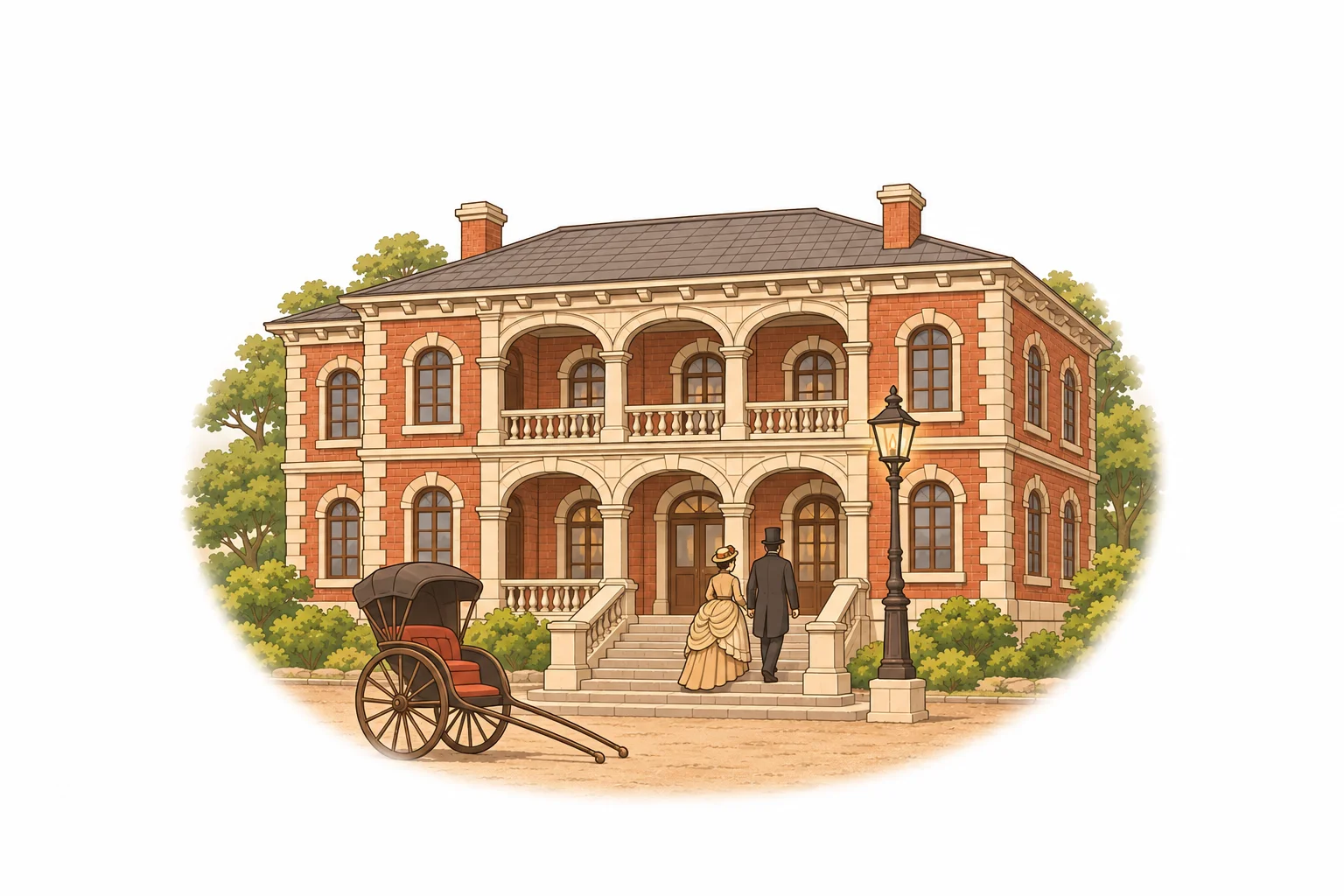
The Meiji reign lasted forty-five years, and in that time Japan’s government, industry, army and society were remade. Most accounts of the period start with institutions. This one starts with places: ten sites you can still stand in, each tied to one thing that happened there and to the people at its center. They include castles and battlefields, but also a factory, a railway terminus, a clock tower, an inn and a quiet road at the bottom of a slope.
The scenes run in order of time, from the siege of Aizu in 1868 to the crowds outside the palace in 1912. The first half crowds into Meiji’s opening decade, when the civil war ended, factories and railways opened, Hokkaidō was settled and the samurai made their last armed stand. The later scenes are spaced further apart: diplomacy, war and the emperor’s death each get one. At most of these places the stone walls, buildings or road lines of the time can still be traced.
01Tsuruga Castle: A Month under Siege
The story of Aizu from Fushimi to the siege of its castle begins in Kyoto. From 1862 the Aizu lord Matsudaira Katamori served as Kyoto Protector, suppressing the loyalist radicals and earning Chōshū’s lasting hatred. After defeat at Toba–Fushimi in early 1868 he withdrew to Edo with Tokugawa Yoshinobu and was branded an enemy of the court. Back in Aizu he offered apologies but refused to surrender his castle or hand over the men held responsible.
In the eighth month the new government’s army broke through and reached the castle town, and a squad of Byakkotai boys killed themselves on Mount Iimori. The gates of Tsuruga Castle closed in time, and several thousand defenders and refugees held out for about a month. The era name changed to Meiji during the siege. In the ninth month Aizu surrendered through Yonezawa. The battered keep was demolished in 1874; today’s is a 1965 reconstruction.
02Goryōkaku: The Last Stronghold
Goryōkaku is a Western-style star fort built by the shogunate for its Hakodate magistrate’s office and largely complete by 1864. Within a few years it became the final battlefield of the civil war. In the eighth month of 1868 Enomoto Takeaki, vice-commander of the shogunal navy, sailed north from Shinagawa with eight ships and in the tenth month landed in Ezo and occupied the fort.
What followed was the provisional Ezo government at Goryōkaku. In the middle of the twelfth month, officers voted Enomoto president, though most posts kept shogunal titles. Its aim was to have the court entrust Ezo to Tokugawa retainers, not to declare independence; the label "Republic of Ezo" came from foreign writers. Hijikata Toshizō, formerly of the Shinsengumi, was deputy army magistrate. He was killed in the government’s assault on Hakodate in the fifth month of 1869, and days later Enomoto surrendered, ending the Boshin War.
03Tomioka: Three Hundred Reels
Raw silk became Japan’s largest export after the ports opened, but hand-reeled thread was uneven. In 1870 the government decided to build its own model mill, with Shibusawa Eiichi among the planners. The hired Frenchman Paul Brunat and Shibusawa’s cousin Odaka Atsutada chose Tomioka in Kōzuke Province.
Construction of the Tomioka Silk Mill began in 1871, in timber frame with brick infill; the reeling hall, about 140 meters long, has no interior pillars. The mill opened in the tenth month of 1872, already November by the Western calendar, with 300 French-style reeling basins and Odaka as its first director. Recruits were scarce at first, because rumor said the French drank human blood, really red wine. Odaka sent his own daughter Yū in first, and by April 1873 there were reportedly 556 women workers, who carried the technique home. The mill passed to Mitsui in 1893 and ran until 1987, 115 years in all.
04Yokohama: The First Train Arrives
The Yokohama port-opening area was a farming and fishing village until the port opened in 1859; within decades it was one of Japan’s largest trading ports. In 1872 Japan’s first railway reached it, at a station near present-day Sakuragichō.
Before the Shinbashi–Yokohama railway opened, the new government refused a late-shogunate concession to an American and insisted on building and running the line itself; Ōkuma Shigenobu was one of its promoters. Service between Shinagawa and Yokohama began in the fifth month of 1872. At the opening ceremony in the ninth month, October by the Western calendar, Emperor Meiji rode a ten-car imperial train from Shinbashi and reached Yokohama about an hour later. The line ran about 29 kilometers, with nine round trips a day taking about 53 minutes.
05Sapporo: Clark and the Drill Hall
Kuroda Kiyotaka, who led the Hokkaidō colonization office, believed the island should follow the farming of the northern and western United States rather than wet-rice cultivation. Hence Sapporo Agricultural College: in March 1876 the office hired William S. Clark, president of Massachusetts Agricultural College, and the school opened in August, teaching science, agriculture and practical work in English. Most students were on government scholarships and owed five years of service afterward.
Clark stayed only about eight months and left in April 1877. The earliest written record of "Boys, be ambitious" dates from seventeen years later. The colonization the school served also cost the Ainu their land and way of life. The college drill hall was completed in 1878 and fitted with a four-faced Howard tower clock in 1881. It is now the Sapporo Clock Tower, building and clock both original.
06Tabaruzaka: Seventeen Days in the Rain
Saigō Takamori resigned and went home to Kagoshima in 1873. In mid-February 1877 his followers marched north to "question the government," and the Satsuma Rebellion began. They besieged Kumamoto Castle, whose garrison of mostly commoner conscripts held.
Government relief from the north had to come through Tabaruzaka, a winding old road about 1.5 kilometers long and the only route for artillery and supply carts. The Satsuma army dug in on both sides. From March 4 the government attacked again and again in steady spring rain, forming a "drawn-sword unit" of police swordsmen, and broke through on March 20 after seventeen days and nights. Kumamoto was relieved in mid-April. In late September, at Shiroyama, Saigō was shot and his comrade Beppu Shinsuke ended his life. The bullet-scarred storehouse in today’s memorial park is a reconstruction.
07Kioizaka: A Carriage in the Morning
After the war, Home Minister Ōkubo Toshimichi was the real center of the government and the main target of its critics. On the morning of May 14, 1878, as his carriage passed Shimizudani at the foot of Kioizaka on the way to the temporary palace in Akasaka, six men led by Shimada Ichirō, a former samurai of Ishikawa, attacked with swords. Ōkubo and his coachman Nakamura Tarō were killed. Ōkubo was 47.
After the assassination at Kioichō, the six did not flee but surrendered with a statement accusing Ōkubo of shutting out public debate, suppressing popular rights and wasting state funds. They were sentenced in late July and executed the same day. Itō Hirobumi succeeded him as home minister. The Kioizaka assassination site is now in Shimizudani Park, marked by a large memorial stone raised in 1888.
08The Rokumeikan: Dancing for Treaty Revision
In Tokyo, beside the Hibiya parade ground, stood a former Satsuma residence. Foreign Minister Inoue Kaoru believed treaty revision required showing the powers that Japan had reached the standard of a "civilized country," with a place for Western-style dinners, dances and conversation. Josiah Conder’s two-story brick building was finished in July 1883, and the Rokumeikan opened in late November, with some 1,200 invitations sent out.
When the cabinet system began in 1885, Itō became prime minister and Inoue foreign minister, opening about two years of "Rokumeikan diplomacy." But the draft treaty provided for foreign judges during a transition, and once it leaked, Inoue Kowashi and others protested. The conference was suspended in July 1887 and Inoue Kaoru resigned in September. The building was torn down in 1941 (some say 1940).
09Shunpanrō: Seven Meetings at Shimonoseki
The Shunpanrō is a pufferfish inn beside Akama Jingū, overlooking the Kanmon Strait. In March 1895 the Qing plenipotentiary Li Hongzhang, aged 72, came here with his son Li Jingfang to meet Itō and Mutsu Munemitsu seven times. On March 24 a young Japanese man, Koyama Toyotarō, shot and wounded Li on his way back to his lodgings, and Japan agreed to an armistice, Taiwan and the Pescadores excepted.
The Sino-Japanese War ended with the treaty signed on April 17. China recognized Korea’s independence, ceded southern Liaodong, Taiwan and the Pescadores, and agreed to an indemnity of 200 million taels. Six days later Russia, Germany and France intervened, and Japan returned Liaodong for a further 30 million taels. In China the treaty is widely remembered as a national humiliation; in Japan, as the moment it joined the powers. The original building burned in 1945; the memorial hall keeps the tables and chairs used in the talks.
10Nijūbashi: The End of Meiji
After the Restoration, Edo Castle became the emperor’s residence, today’s Imperial Palace; the Imperial Palace East Gardens are its public part. In July 1912 the Imperial Household Ministry announced that the emperor was gravely ill and began issuing bulletins several times a day. Crowds knelt in prayer before Nijūbashi, theaters closed or shortened performances, and the Ryōgoku fireworks were canceled.
Emperor Meiji’s death and the Taishō succession came at the end of July. The official time of death was 12:43 a.m., though diaries suggest he died late the previous evening. Prince Yoshihito succeeded, and Meiji 45 became Taishō 1. On the night of the funeral in September, General Nogi Maresuke and his wife Shizuko took their lives at their home in Akasaka. In his will he wrote that he had wished to atone with his death ever since losing his regiment’s colors in 1877.
11Closing
Three of these scenes are battlefields of civil war: Tsuruga Castle, Goryōkaku and Tabaruzaka. Tomioka and Yokohama stand for new industry and transport, Sapporo for northern colonization, Kioizaka and the Rokumeikan for political violence and diplomatic display, and the last two for a war’s peace table and an emperor’s death. Much of what visitors see today has been rebuilt: the Aizu keep, the Hakodate magistrate’s office, the Tabaruzaka storehouse, the Shunpanrō itself. What survives from the time includes the Tomioka mill buildings, the Sapporo clock and the Kioizaka memorial stone. At each place it is worth asking what year the thing in front of you comes from, and where people stood when it happened.