
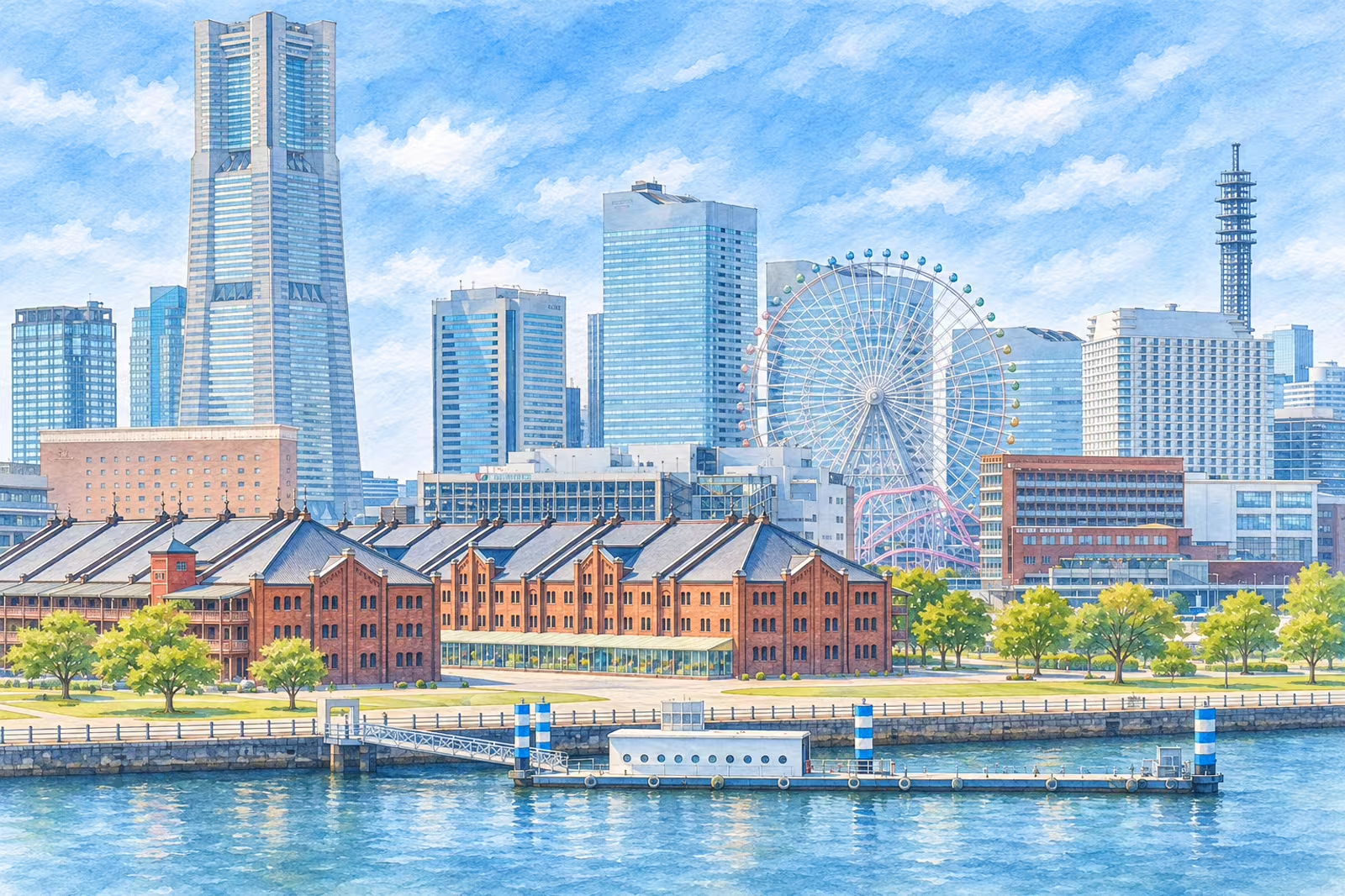
The Yokohama Port-Opening Historic Area covers Kannai, Yamashita-chō and Nihon Ōdōri in Naka Ward, Yokohama, Kanagawa Prefecture: the ground where the port and the foreign settlement were laid out when Yokohama opened to trade in 1859. A farming and fishing village became, within a few decades, one of Japan’s largest international ports. Its streets hold each stage from the end of national seclusion to the modern port city.
01From Treaty to Open Port
In 1854 the shogunate signed the Japan–US Treaty of Peace and Amity (the Treaty of Kanagawa) with Commodore Perry at Yokohama village, generally placed near today’s Yokohama Archives of History. The 1858 Treaty of Amity and Commerce named Kanagawa as a port to be opened, but the shogunate, wary of clashes between foreigners and traffic on the Tōkaidō highway, built the port instead at Yokohama, across the inlet and away from the road. Yokohama opened on July 1, 1859. The shogunate set up a waterfront customs office and divided the land into a foreign settlement and a district for Japanese merchants, and raw silk exports soon became the port’s mainstay.
02Fire, Earthquake and Rebuilding
A great fire in 1866 destroyed large parts of the Japanese town and the settlement. Nihon Ōdōri, built afterward as a firebreak dividing the two, is generally credited in part to the British engineer Richard Henry Brunton. In 1872 Japan’s first railway opened between Shinbashi and Yokohama; the Yokohama terminus stood near present-day Sakuragichō. The foreign settlement was abolished in 1899 with treaty revision. The Great Kantō Earthquake of 1923 nearly levelled the port district, and Yamashita Park was built on land reclaimed with the rubble. Many of the Western-style buildings seen today date from the rebuilding after the quake.
03What Can Be Seen Today
The Yokohama Archives of History, beside Kaikō Hiroba (Port-Opening Square), occupies the former British Consulate of 1931 and holds documents from before and after the opening. Nearby stand the "three towers" of the Kanagawa Prefectural Government Office, Yokohama Customs and the Yokohama Port Opening Memorial Hall, as well as the former head office of the Yokohama Specie Bank, now the Kanagawa Prefectural Museum of Cultural History. At Zō-no-hana, the curved breakwater near the first piers survives and was landscaped as a park for the port’s 150th anniversary in 2009. Bashamichi and Yokohama Chinatown both grew out of the post-opening town plan. The buildings are of many dates, mostly twentieth-century replacements, but the street lines and blocks largely follow the layout of the opening years.
Yokohama
01Where the City Began
Walk down from Nihon-ōdōri Station toward the water and you reach a small triangular square, Kaikō Hiroba, "Port Opening Square." On one side stands a cream-colored two-story building with a courtyard: the Yokohama Archives of History. Across the road is the waterfront, the curved breakwater called Zō-no-hana, and the long pier of Ōsanbashi. Within a few hundred meters rise two towers that every Yokohama resident knows, the Kanagawa Prefectural Government building and the Yokohama Customs house.
This patch of ground is where Yokohama began. In the early 1850s it was a village of perhaps a hundred households, Yokohama-mura, living from farming and fishing on a sandbar between Edo Bay and a marsh. Within a decade it had become Japan’s busiest port for foreign trade. Silk went out from here to Lyon and London; railways, gas lighting, newspapers and Western-style buildings came in.
There is no single fenced monument called "the port opening site." What visitors find is a district, centered on Kannai and running along the waterfront to Yamashita Park, made up of streets laid out in the 1860s, a handful of designated buildings, piers, parks and memorial stones. To read it, start with the American warships.
02Perry Comes Ashore
In 1853 Commodore Matthew C. Perry of the United States Navy brought four ships into the waters off Uraga at the mouth of Edo Bay and delivered a letter from President Millard Fillmore demanding that Japan open its ports. He said he would return for an answer. He came back early in 1854 with a larger squadron and anchored farther up the bay, uncomfortably close to Edo.
The shogunate, the military government of the Tokugawa family, wanted to talk at Uraga; Perry wanted to be nearer the capital. They settled on Yokohama village, and the Japanese side built a temporary reception hall near the shore. On March 8, 1854, Perry landed with several hundred sailors and marines, a band playing. The expedition’s artist, Wilhelm Heine, painted the scene, and in his picture a large tree stands beside the hall.
The chief Japanese negotiator was Hayashi Fukusai, head of the shogunate’s Confucian academy. After several sessions the two sides signed the Treaty of Peace and Amity, usually called the Treaty of Kanagawa, on March 31, 1854. It opened Shimoda and Hakodate to American ships for fuel, water and provisions, promised good treatment for shipwrecked sailors, and allowed the United States to station a consul at Shimoda. It said nothing about trade, but the policy of strict seclusion that had held for more than two centuries was over.
The treaty was signed roughly where the Archives of History and the prefectural offices now stand. In the Archives’ courtyard grows an evergreen known as the Tamakusu, a tabunoki or Japanese bay tree, traditionally regarded as a descendant of the tree in Heine’s painting and listed by the city as a local historic site. It burned in the 1923 earthquake and sprouted again; local tradition says it also survived a fire in the 1860s. A stone in Kaikō Hiroba marks the site of the treaty signing.
03Kanagawa on Paper, Yokohama in Practice
The Treaty of Kanagawa did not open Japan to commerce. That came four years later, through the efforts of Townsend Harris, the first American consul general, who had settled at Shimoda. On July 29, 1858, Japanese commissioners Inoue Kiyonao and Iwase Tadanari signed the Treaty of Amity and Commerce with Harris aboard the USS Powhatan, anchored off Kanagawa. The Netherlands, Russia, Britain and France soon followed with similar agreements, together known as the Ansei Treaties. They opened ports for trade, gave foreigners extraterritoriality, the right to be tried by their own consuls, and fixed Japan’s tariffs by treaty. Revising these "unequal treaties" would occupy Japanese diplomacy for the next forty years.
The treaty named Kanagawa as one of the ports. Kanagawa was a busy post town on the Tōkaidō, the great highway between Edo and Kyoto, full of travelers and samurai retinues. The shogunate’s leadership under the chief minister Ii Naosuke feared clashes between foreigners and anti-foreign samurai on the highway, and decided to build the port across the inlet at Yokohama instead, arguing that Yokohama lay within Kanagawa. Harris and the British consul general Rutherford Alcock insisted on Kanagawa, suspecting that the Japanese meant to confine foreigners in a second Dejima, the walled island at Nagasaki where the Dutch had been kept.
While they argued, the shogunate built. It moved the villagers of Yokohama to Honmura, at the foot of the Yamate hill (today’s Motomachi), and put up piers, a customs house, offices and shops at Yokohama, and pressed merchants from Edo and elsewhere to move there. The port opened on July 1, 1859, the same day as Nagasaki and Hakodate. The foreign consulates first set up in temples on the Kanagawa side, but the merchants found Yokohama’s deep water and open land more convenient, and trade went where they went. The consulates followed. Yokohama still celebrates June 2, the date of the opening in the old Japanese calendar, as Port Opening Day.
04Kannai and the Foreign Settlement
Early Yokohama was laid out to be controlled. The customs house, called the unjōsho, stood on the site of today’s prefectural government building, with two stone piers, the East and West Hatoba, running out into the bay in front of it. To the west lay the Japanese town, where silk and tea dealers from across the country opened shops along Honchō-dōri. To the east lay the foreign settlement.
The area was bounded by water on three sides, and on the landward side by rivers and newly dug canals. It could be entered only over a few bridges, and the shogunate set up guard posts, or sekisho, at the bridgeheads to check who came and went; the best known stood at Yoshida Bridge. The district inside the barriers became known as Kannai, "within the barrier," and the outside as Kangai. The guard posts are long gone, but Kannai remains the name of the neighborhood and of its railway station.
Inside the settlement, foreigners leased land from the Japanese government, built houses and offices, and traded. They could not travel freely; their movement was limited to about ten ri, roughly forty kilometers, from the port. Disputes involving them went before their own consuls. The British firm Jardine, Matheson & Co. took Lot No. 1 on the waterfront, and its building, "Ei-ichiban-kan," stood where the Silk Center is today.
Large numbers of Chinese arrived with the Western merchants. Some worked as compradors, go-betweens who handled dealings between the foreign firms and Japanese merchants, since they could communicate in written Chinese characters with the Japanese. Others worked as tailors, printers and barbers. They settled in a block of the settlement whose streets ran at an angle to the surrounding grid, and that block became Yokohama Chinatown.
05Silk
For its first decades, Yokohama’s trade was above all silk. A silkworm disease had devastated the industries of France and Italy in the 1850s, and Japanese raw silk filled the gap. Silk from Gunma, Nagano, Yamanashi and the hills west of Edo came down to Yokohama through markets like Hachiōji and was sold to foreign houses in the settlement. Japanese dealers such as Hara Zenzaburō and Mogi Sōbei became the city’s first great merchants. Tea and silkworm eggs were also important exports; cotton and woolen textiles were the main imports.
The opening of the port was not peaceful. Differences between the gold-silver ratio in Japan and abroad allowed foreign traders to export Japanese gold coins at a large profit, and the shogunate’s remedy, a debased recoinage, drove up prices. Anti-foreign feeling ran high. Ii Naosuke was assassinated outside the Sakurada Gate of Edo Castle in 1860. In 1862, at the village of Namamugi on the Tōkaidō near Yokohama, retainers of Shimazu Hisamitsu of Satsuma cut down the English merchant Charles Richardson when he and his companions failed to give way to the procession. The Namamugi Incident led to the British bombardment of Kagoshima the following year. British and French troops were stationed on the Bluff, the hill of Yamate above the settlement, from 1863 until 1875 to protect the foreign community.
06The Pork Butcher’s Fire and Nihon Ōdōri
On November 26, 1866, a fire broke out in a pork butcher’s shop and swept through Kannai, destroying much of the Japanese town and a large part of the foreign settlement. People called it the Butaya Kaji, the "pork shop fire." The licensed pleasure quarter of Miyozaki burned with it.
After the fire the shogunate and the representatives of Britain, the United States, France and the Netherlands signed an agreement, known as the Keiō Memorandum, to rebuild the district on fire-resistant lines, move the Miyozaki quarter and turn its site into a park. The work fell to the new Meiji government. At the request of the British minister Harry Parkes, the Scottish engineer Richard Henry Brunton, who had come to Japan to build lighthouses, designed the streets and the park. The centerpiece of his plan was a broad avenue, about thirty-six meters wide with sidewalks and a planted strip, between the Japanese town and the foreign settlement: Nihon Ōdōri, one of Japan’s first Western-style streets, designed in the early 1870s and complete by about 1877. It served both as a firebreak and as a boundary. At its southern end, on the site of the burned pleasure quarter, a park shared by foreigners and Japanese opened in 1876. It was called Higa Kōen, "the park of them and us"; it is today’s Yokohama Park.
The avenue, lined with ginkgo trees and the prefectural offices, keeps the width and line of that plan.
07Elephant’s Trunk and the Great Pier
The East Pier built in 1859, also called the English Pier, was at first a straight stone jetty. Over the following years, from the last days of the shogunate into early Meiji, it was lengthened and bent into a curve to shelter the lighters from wind and waves, and from above the shape looked like an elephant’s trunk, which is how it got the name Zō-no-hana.
As ships grew larger, the old piers could serve them only by lighter, with small boats shuttling cargo and passengers back and forth. From 1889 Yokohama began building a modern harbor to a plan by the British engineer Henry Spencer Palmer, and in 1894 an iron pier reaching far into the bay was completed. It was the ancestor of today’s Ōsanbashi. Palmer had already built Yokohama’s modern waterworks, which began supplying water in 1887, the first of their kind in Japan.
The pier was rebuilt several times and badly damaged in 1923. The present Osanbashi Yokohama International Passenger Terminal opened in 2002; its roof is a rolling wooden deck open to walkers, with views of Minato Mirai, the Red Brick Warehouses and Yamashita Park. The Zō-no-hana breakwater sank in the 1923 earthquake and was rebuilt in a straighter form. On June 2, 2009, the port’s 150th anniversary, the area opened as Zō-no-hana Park, with the breakwater restored to its curved mid-Meiji shape and relics of the old customs area found during construction on display.
08Firsts of the Meiji Era
Many novelties arrived in Japan by way of Yokohama. In 1872 the country’s first railway opened between Shinbashi in Tokyo and Yokohama; the Yokohama terminus stood where Sakuragichō Station is now. The same year, a company run by the entrepreneur Takashima Kaemon lit Japan’s first gas streetlamps here, and replica gas lamps line Bashamichi today. Japan’s first daily newspaper in Japanese, the Yokohama Mainichi Shinbun, was founded here in January 1871.
Bashamichi, "carriage road," took its name from the horse carriages foreign residents drove along it. Local tradition credits it with a string of other firsts, including Japan’s first ice cream shop; some of these claims are documented, others rest on local lore. At the end of the street stands the Kanagawa Prefectural Museum of Cultural History, built in 1904 as the head office of the Yokohama Specie Bank to a design by Tsumaki Yorinaka. The bank specialized in foreign exchange and became the center of Japan’s international finance. Its interior and dome burned in 1923; the bronze dome was not restored until 1967. The building is now an Important Cultural Property, a national designation.
In 1899 revised treaties took effect, extraterritoriality ended and the foreign settlements were abolished. Foreigners could now live anywhere in Japan, and the settlement’s streets became ordinary city blocks.
09Earthquake and Rebuilding
The Great Kantō Earthquake of September 1, 1923, struck Yokohama, in proportion to its size, even harder than Tokyo. Most of the brick buildings in Kannai collapsed, and the fires that followed burned nearly everything left. The townscape of the settlement era disappeared, and many foreign firms moved to Kōbe.
Rubble from the disaster was dumped into the sea off Yamashita-chō to create Yamashita Park, which opened in 1930 as Japan’s first waterfront park. Kannai was rebuilt in reinforced concrete, and most of the historic buildings visitors see today belong to this generation.
Only a few earlier buildings survived even as shells. One is the Yokohama Port Opening Memorial Hall. Built with citizens’ donations to mark the fiftieth anniversary of the port and finished in 1917, it is a public hall of red brick and white stone with a tall clock tower. The 1923 fire gutted it; it was repaired, and the dome roof of its tower was finally restored to its original form in the late 1980s. It was designated an Important Cultural Property in 1989. The Kanagawa Prefectural Government building was completed in 1928, its tower capped with a Japanese-style roof, an early example of mixing Western building with Japanese roof forms; it became an Important Cultural Property in 2019. The Yokohama Customs building followed in 1934, with a green, Islamic-looking dome.
Sailors are said to have nicknamed the three towers the King (the prefectural office), the Queen (the customs house) and the Jack (the memorial hall), and used them as landmarks when entering port. A later piece of local lore holds that anyone who can see all three from certain spots will have a wish granted; this belief spread only in the late twentieth century.
The British Consulate was rebuilt on its old site and completed in 1931. It closed in 1972; the city bought it and in 1981 opened it as the Yokohama Archives of History.
Moored off Yamashita Park is the Hikawa Maru, an ocean liner completed for the NYK Line in 1930 for the route between Yokohama and Seattle. She served as a hospital ship during the Pacific War and afterward carried repatriates and returned to transpacific service. Retired in 1960, she has been moored here since 1961 and was designated an Important Cultural Property in 2016.
10A Walk Through the District
Start at Kaikō Hiroba. Step into the courtyard of the Archives of History to see the Tamakusu tree, then cross to Zō-no-hana Park and look at the curved breakwater and the old stonework. Walk out along Ōsanbashi and climb onto the deck; looking back, you can pick out the King and Queen towers, with Minato Mirai beyond.
East along the shore lies Yamashita Park, with the Hikawa Maru and several memorials. Back at Nihon Ōdōri, follow the ginkgo-lined avenue south past the prefectural offices toward Yokohama Park. A short detour west brings you to the brick Port Opening Memorial Hall, and from there to Bashamichi, its gas lamps and the domed former Specie Bank.
Almost every building on this route postdates 1923. The streets themselves are older: their lines were drawn in 1859 and redrawn after the fire of 1866.