
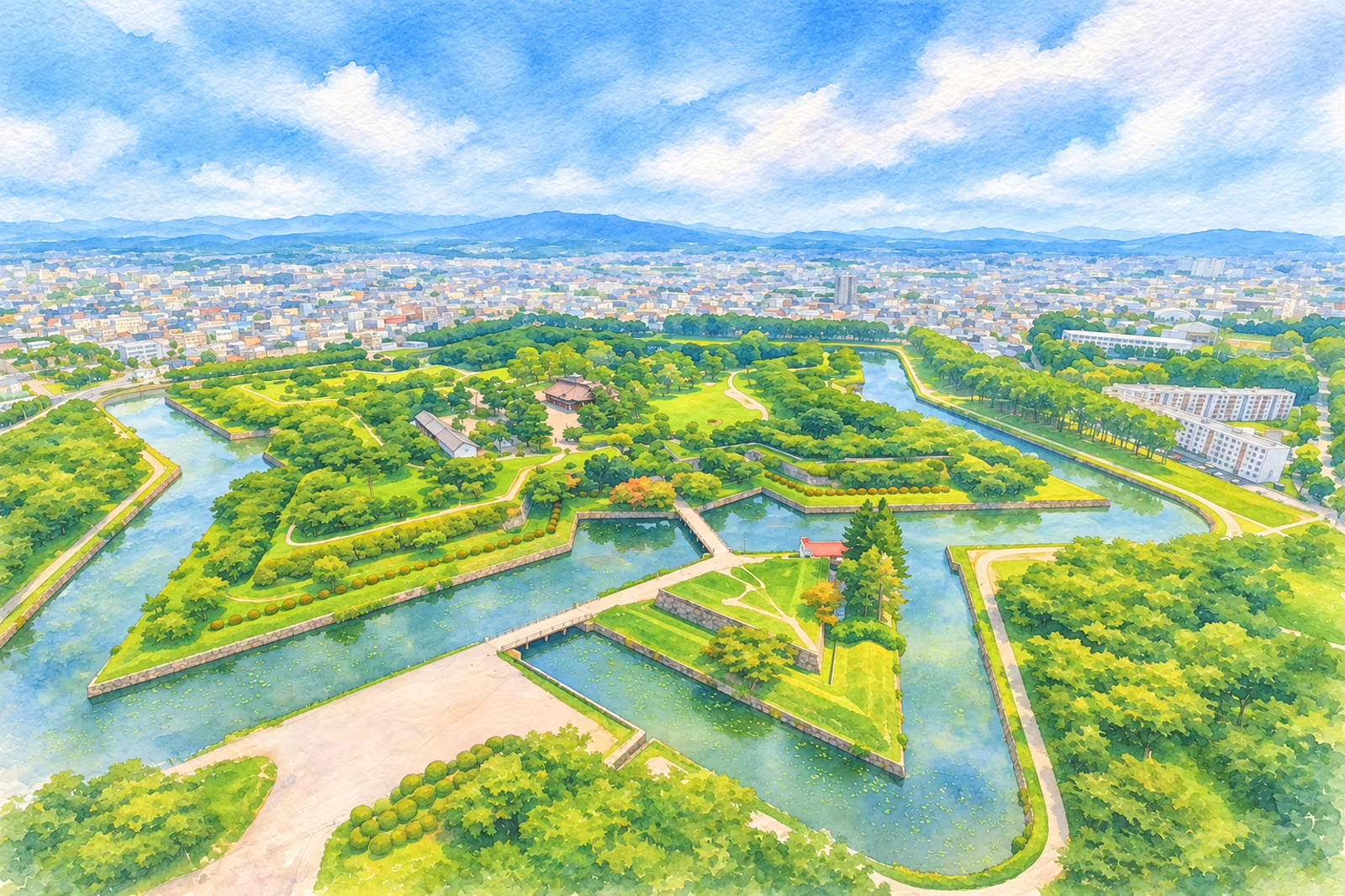
Goryōkaku is a star-shaped Western-style fort in Hakodate, Hokkaidō, built in the last years of the Tokugawa shogunate to house the Hakodate magistrate’s office. Its five projecting bastions give it the outline of a five-pointed star, a form almost unknown among Japanese castles. Only a few years after its completion it became the main stronghold in the final campaign of the Boshin War, and the surrender of the former shogunate forces here ended Japan’s civil war.
01A bastion fort for a treaty port
After the 1854 treaty with the United States, Hakodate (then written 箱館) was opened to foreign ships, and the shogunate appointed a Hakodate magistrate (bugyō) to handle foreign relations, northern defense and local administration. The original magistrate’s office stood at the foot of Mount Hakodate, close enough to the harbor to be within range of foreign warships, so a new inland site was chosen. The design was entrusted to Takeda Ayasaburō, a shogunal retainer trained in Dutch learning, who modeled it on European bastion fortresses. Instead of tall stone walls, the fort relied on earthen ramparts and a moat, with cannon placed on the projecting points so that each face could cover its neighbors. Construction is generally dated from 1857, and the fort was essentially complete in 1864, when the magistrate’s office moved in. More outworks were planned, but shortage of funds meant that only one ravelin, in front of the main gate, was built.
02The last battle of the Boshin War
In late 1868 Enomoto Takeaki led the former shogunate fleet north to Ezo, landed at Washinoki and occupied Goryōkaku, which became the seat of a short-lived regime; Enomoto was elected its president. In the spring of 1869 the new government’s army landed at Otobe and advanced on Hakodate. In the fifth month of 1869, Hijikata Toshizō, formerly of the Shinsengumi, was killed in fighting near the town, and a few days later Enomoto and his commanders surrendered the fort, bringing the Boshin War to an end.
03What survives
In the early Meiji years nearly all the buildings inside were dismantled; a single provisions storehouse is the only original structure still standing. The grounds later served as an army parade ground and were opened as a public park in 1914. The ramparts, moat, stone walls and ravelin survive largely intact, and the site was designated a national Special Historic Site in 1952. At the center, the Hakodate magistrate’s office was reconstructed from old photographs, plans and excavation results and opened in 2010; it is generally said to reproduce only part of the original complex. Goryōkaku Tower, just outside the fort, is a modern structure, and its observation deck is the easiest place to see the full star shape. The cherry trees along the moat are also well known.
Goryōkaku (Hakodate)
01A Star in a Northern Port
From the observation deck of Goryōkaku Tower, the shape is unmistakable: a five-pointed star outlined by a water-filled moat, its earthworks lined with trees, and in the middle a low, tiled-roof government building with a small drum tower on top. Goryōkaku means roughly "five-pointed enclosure." It was the first full-scale European-style fortress built in Japan, and within a few years of its completion it became the last stronghold of the Tokugawa shogunate’s supporters in the Boshin War, the civil war of 1868–69 that brought the Meiji government to power.
The fort was not built to fight Japanese armies. It was built because of foreign ships. To understand why a star-shaped fortress stands in a residential district of Hakodate, a port city at the southern tip of Hokkaidō, you have to start with the harbor.
02Hakodate Opens to the World
In the Edo period Hakodate was written with characters meaning "box residence" and was a fishing and trading town under the Matsumae domain, the small domain that controlled the Japanese foothold in Ezo, the old name for Hokkaidō. In 1854 the American commodore Matthew Perry concluded the Treaty of Kanagawa with the shogunate, opening two ports to American ships: Shimoda on the Izu Peninsula and Hakodate in the far north. Perry’s squadron sailed into Hakodate Bay that same year to survey it.
The shogunate responded by appointing a Hakodate magistrate (bugyō, a senior shogunal official with administrative and judicial powers) and, in 1855, taking most of Ezo under its direct control. The magistrate became responsible for diplomacy, coastal defense and colonization across the north. Hakodate opened to foreign ships in 1855 and became one of the treaty ports for trade in 1859.
The magistrate’s office first stood on the slope below Mount Hakodate, near today’s Motomachi district, overlooking the harbor. That was convenient for business but dangerous in war: a warship anchored in the bay could shell it directly. The shogunate therefore decided to move the office several kilometers inland onto open ground in Kameda village and to protect it with Western-style earthworks and a moat. During construction the new office was called the Kameda Goyakusho; once finished it was formally the Hakodate Goyakusho, and "Hakodate Magistrate’s Office" is the customary name.
03Takeda Ayasaburō and the Bastion Fort
The design was entrusted to Takeda Ayasaburō, an official of the magistrate’s office. Born in the Ōzu domain on the island of Shikoku, Takeda had studied Dutch learning (rangaku, Western knowledge acquired through Dutch books) under the physician Ogata Kōan in Ōsaka and Western gunnery under Sakuma Shōzan. He was one of a handful of Japanese technicians of his generation who had actually read European works on fortification.
What he built was a bastion fort, the type of fortress that developed in Europe after gunpowder artillery made tall medieval walls obsolete. Instead of high walls, a bastion fort has low, thick earthen ramparts that absorb cannon fire, and the walls project outward in angular points. Each point covers the faces of its neighbors, so an attacker approaching any stretch of rampart is caught in crossfire. Takeda worked from Dutch military texts and is generally thought to have drawn on information from French officers as well. Goryōkaku is often compared to the forts of Vauban, the seventeenth-century French military engineer.
Takeda also designed the Benten Daiba, a gun battery on the Hakodate waterfront. The battery and the inland fort were the two halves of the port’s defensive scheme. The Benten Daiba was demolished during harbor reclamation in the Meiji period and survives only as a place name and a marker.
04Seven Years of Building
Construction began in 1857 and was essentially finished in 1864, though the last associated works were completed only in 1866. Most of the labor went into digging the moat and piling up the earthen ramparts; stone walls were laid at key points. On some stretches the topmost course of stones projects outward like the eaves of a roof. This feature, called hanedashi, was meant to stop attackers from climbing the wall, and it is usually described as rare in Japanese castles. You can still see it on the walls today.
The fort as built was more modest than it might have been. Only one ravelin, a detached triangular outwork protecting the main approach, was constructed, at the front. It is usually said that tight shogunal finances forced cuts. The ramparts are also relatively low and the interior cramped, and in the war that followed Goryōkaku functioned more as a headquarters than as a fortress capable of withstanding a long siege.
The office building inside the fort was begun in 1862 and completed in 1864, and in the sixth month of that year the magistrate Koide Hidesane began conducting business at Goryōkaku. This was a thoroughly Japanese structure: a large timber complex with a formal entrance under a curved gable and a drum tower (taiko-yagura) rising from the roof, used as a lookout toward the harbor. Japan’s first European-style fortress thus enclosed a traditional samurai government office, and that combination is what gives Goryōkaku its distinct character.
05A Peaceful Handover
The magistrate worked at Goryōkaku for only about four years. In late 1867 the shogun Tokugawa Yoshinobu returned governing authority to the imperial court, and in early 1868 fighting broke out at Toba-Fushimi near Kyoto, beginning the Boshin War. In Hakodate the last magistrate, Sugiura Makoto, handed the office over to the new government without a fight. The new authorities set up a court-appointed administration, soon renamed Hakodate Prefecture, under the court noble Shimizudani Kinnaru, and Goryōkaku became the seat of the imperial government in the north.
The calm lasted only a few months. Over the autumn of 1868 the northern domains of the Ōu-Etsu alliance surrendered one after another, but the last organized force of the old shogunate was already at sea.
06Enomoto Takeaki Sails North
Enomoto Takeaki, born in 1836 to a family of shogunal retainers, had trained at the shogunate’s naval academy in Nagasaki and then studied in the Netherlands, returning home aboard the Kaiyō Maru, the powerful warship the shogunate had ordered from Dutch shipyards. After Edo Castle was surrendered to the new government in 1868, Enomoto, as vice-commander of the shogunal navy, refused to hand over the fleet. On the night of October 4, 1868, he slipped out of Shinagawa with eight ships: four warships, the Kaiyō Maru, the Kaiten, the Banryū and the Chiyodagata, and four transports. A storm off the Bōsō Peninsula scattered the fleet; two of the transports, the Kanrin Maru and the Mikaho Maru, were separated and eventually lost, and the rest gathered in Sendai Bay.
At Sendai Enomoto took on board soldiers retreating from the collapsing northern front, among them Ōtori Keisuke, a former shogunal infantry commander, and Hijikata Toshizō, vice-commander of the Shinsengumi, the shogunate’s notorious police unit in Kyoto. Hijikata had fought at Utsunomiya and in Aizu and chose to keep going north. Also with the fleet were several members of the French military mission to the shogunate, led by Jules Brunet, who had left the French army to stay with their Japanese students.
On December 4, 1868, about three thousand men landed at Washinoki, north of Hakodate, and marched south in two columns, Ōtori on the main road and Hijikata along the coast. They pushed aside the imperial garrison and Matsumae troops. Shimizudani abandoned Goryōkaku and fled across the strait to Aomori, and on December 9 the shogunal forces marched into the fort.
Hijikata then led an expedition against the Matsumae domain, taking Matsumae Castle in December and pursuing its forces toward Esashi on the Sea of Japan coast. Enomoto sailed to support him in the Kaiyō Maru, but the ship was driven onto rocks in a storm off Esashi and sank. It was the strongest warship in Japan, and its loss crippled Enomoto’s naval advantage before the decisive campaign had even begun.
07The "Republic of Ezo"
With Ezo in their hands, the shogunal forces organized a government at Hakodate. On January 27, 1869, its leaders were chosen by a vote among the officers. Enomoto became president (sōsai), Matsudaira Tarō vice-president, Arai Ikunosuke naval commissioner, Ōtori Keisuke army commissioner, and Hijikata Toshizō deputy army commissioner, also responsible for keeping order in Hakodate town, and the veteran shogunal official Nagai Naoyuki magistrate of Hakodate.
This regime is often called the Republic of Ezo. The name is a later label: the regime never called itself a republic in its own documents, but the British diplomat Francis Adams described it as one in a book published in 1874, and the phrase caught on. Enomoto and his colleagues did not see themselves as founding a separate country. Through the British and French naval captains at Hakodate they petitioned the new government to entrust Ezo to former shogunal retainers, who would develop it and defend Japan’s northern frontier. The new government refused, and everyone understood that the spring would bring war.
Goryōkaku was the regime’s headquarters. Its leaders worked in the magistrate’s office, and troops were quartered in and around the fort. A fortress built against foreign warships now waited for a Japanese army.
08Miyako Bay and the Imperial Landing
The new government held the advantage at sea, above all because it had acquired the ironclad Kōtetsu (originally the Stonewall, built for the Confederate navy). On May 6, 1869, Enomoto sent the Kaiten and other ships south to Miyako Bay in present-day Iwate Prefecture to board and capture the Kōtetsu at anchor. Bad weather separated the ships, the boarding attempt failed under heavy fire, and the Kaiten’s captain Kōga Gengo was killed. Hijikata took part in the raid at the head of a detachment of soldiers.
On May 20 imperial troops landed at Otobe, north of Esashi, and advanced on Hakodate by several routes. Hijikata held the mountain pass at Futamata-guchi behind field fortifications and repelled repeated assaults over many hours. But the other lines gave way, and to avoid being cut off he withdrew to Hakodate. By mid-June the imperial army was closing on the town, and in battles in Hakodate Bay the shogunal ships were run aground or destroyed one by one.
09The Death of Hijikata Toshizō
The final assault came on June 20, 1869. One imperial force landed behind Mount Hakodate, seized the heights and descended on the town, which fell quickly. The Benten Daiba battery, held by shogunal troops including men of the Shinsengumi, was cut off. Hijikata rode out from Goryōkaku with a small force to try to break through to it. Near the Ippongi checkpoint, a barrier on the road into town, he was shot from his horse and killed. He was thirty-four by Western reckoning.
Accounts disagree about exactly where and how he fell; the Ippongi checkpoint is the most widely accepted location, with other accounts placing it near the Ikoku-bashi bridge or in Tsuruoka-chō. Where his body was buried has never been established, and there are several traditions, including burial inside Goryōkaku itself. A monument marking the place of his death stands today in the Wakamatsu-chō district of Hakodate, and flowers are left there throughout the year. Novels, television dramas and manga have made Hijikata one of the best-loved figures of the period, and his last ride is the story most visitors bring with them to Goryōkaku.
After his death the end came quickly. The Benten Daiba surrendered, and Nakajima Saburōsuke, a former shogunal official from Uraga who had been among the first Japanese to board Perry’s ships in 1853, died with his two sons defending the Chiyogadai outpost.
10Surrender
Kuroda Kiyotaka, a staff officer of the imperial army from Satsuma, urged Enomoto to surrender. In a well-known episode, Enomoto sent Kuroda his copy of a Dutch-language treatise on maritime law that he had brought back from Europe, so that it would not be lost when the fort fell, and Kuroda replied with a gift of sake and food. On June 27, 1869, Enomoto and the other leaders came out of Goryōkaku and surrendered. The Battle of Hakodate, and with it the Boshin War, was over.
Enomoto was taken to Tokyo and imprisoned. Kuroda argued for clemency, reportedly going so far as to shave his head in support of the plea. Enomoto was released in 1872 and went straight into government service, first in the colonization of Hokkaidō and then as minister to Russia, where he negotiated the 1875 Treaty of Saint Petersburg exchanging Sakhalin for the Kuril Islands. He later served as navy minister and in several cabinet posts, including foreign minister. Ōtori Keisuke was also pardoned and served the Meiji state. The shogunal dead were gathered and buried by local people, among them the Hakodate townsman Yanagawa Kumakichi, and in 1875 a memorial called the Hekketsuhi was raised for them at the foot of Mount Hakodate.
11From Ruin to Park
After the war Goryōkaku passed to the Kaitakushi, the government’s Hokkaidō Colonization Office. In 1869 the characters used to write the town’s name were changed to the present form. Around 1871 the Kaitakushi tore down the magistrate’s office and most of the other buildings inside the fort, leaving a single storehouse standing.
In 1914 Goryōkaku opened to the public as a park, and cherry trees were planted along the ramparts and moat. It became one of Hokkaidō’s best-known cherry blossom spots. The site was designated a national Historic Site in 1922 and a Special Historic Site, the highest category, in 1952. To mark the fort’s centenary, a first Goryōkaku Tower, 60 meters tall, was built beside the moat in 1964; it was replaced in 2006 by the current tower, 107 meters tall, whose observation floors include historical displays and a bronze statue of Hijikata.
12The Reconstructed Magistrate’s Office
For more than a century the center of the star was empty ground. From 1985 the city excavated the site and located the foundations of the magistrate’s office. Using these findings together with photographs taken in the 1860s and surviving architectural drawings, the city began a reconstruction in 2006 and, after four years of work, opened it in July 2010.
The original complex covered about 3,000 square meters and combined a government section with the magistrate’s private residence. About one third was rebuilt, centered on the government section: the formal entrance, the reception rooms and the offices, crowned by the drum tower. One of the wooden storehouses that stood in front of the office was also reconstructed. Builders used traditional techniques and materials, with timber framing, clay walls and tiled roofs made as they would have been in the 1860s. The outline of the parts that were not rebuilt is marked on the ground. What you enter today is a reconstruction, but its position, scale and appearance rest on excavation and period images.
One original building does survive inside the fort: the provisions storehouse (hyōrōko), a plastered storehouse from the magistrate’s era that escaped the demolitions of the early Meiji years and was later repaired.
13Walking the Fort
Starting from Goryōkaku Tower, cross the road to the moat. The triangular earthwork standing out in the water in front of you is the ravelin. You enter by crossing the first bridge onto the ravelin and then a second bridge into the fort proper. Just inside the gates are screening mounds (mikakushi dorui), earthworks placed so that an enemy outside could not see straight in.
The reconstructed magistrate’s office stands ahead. Look up at the drum tower and compare it with the old photographs on display inside. Next to it is the original provisions storehouse. Elsewhere in the grounds is a memorial stone honoring the fort’s designer, Takeda Ayasaburō.
A path runs along the top of the ramparts, and walking it gives a sense of the five points from inside. Watch the stone walls for the projecting hanedashi coping stones. In spring the ramparts and moat banks fill with people under the cherry trees; in winter, snow sharpens the outline of the star seen from the tower.
If you have time, visit the monument at the place of Hijikata’s death in Wakamatsu-chō, the Hekketsuhi at the foot of Mount Hakodate, and the site of the first magistrate’s office in Motomachi. The ground between the harbor and the fort traces both the shogunate’s retreat inland in the 1860s and the last days of fighting in 1869.