
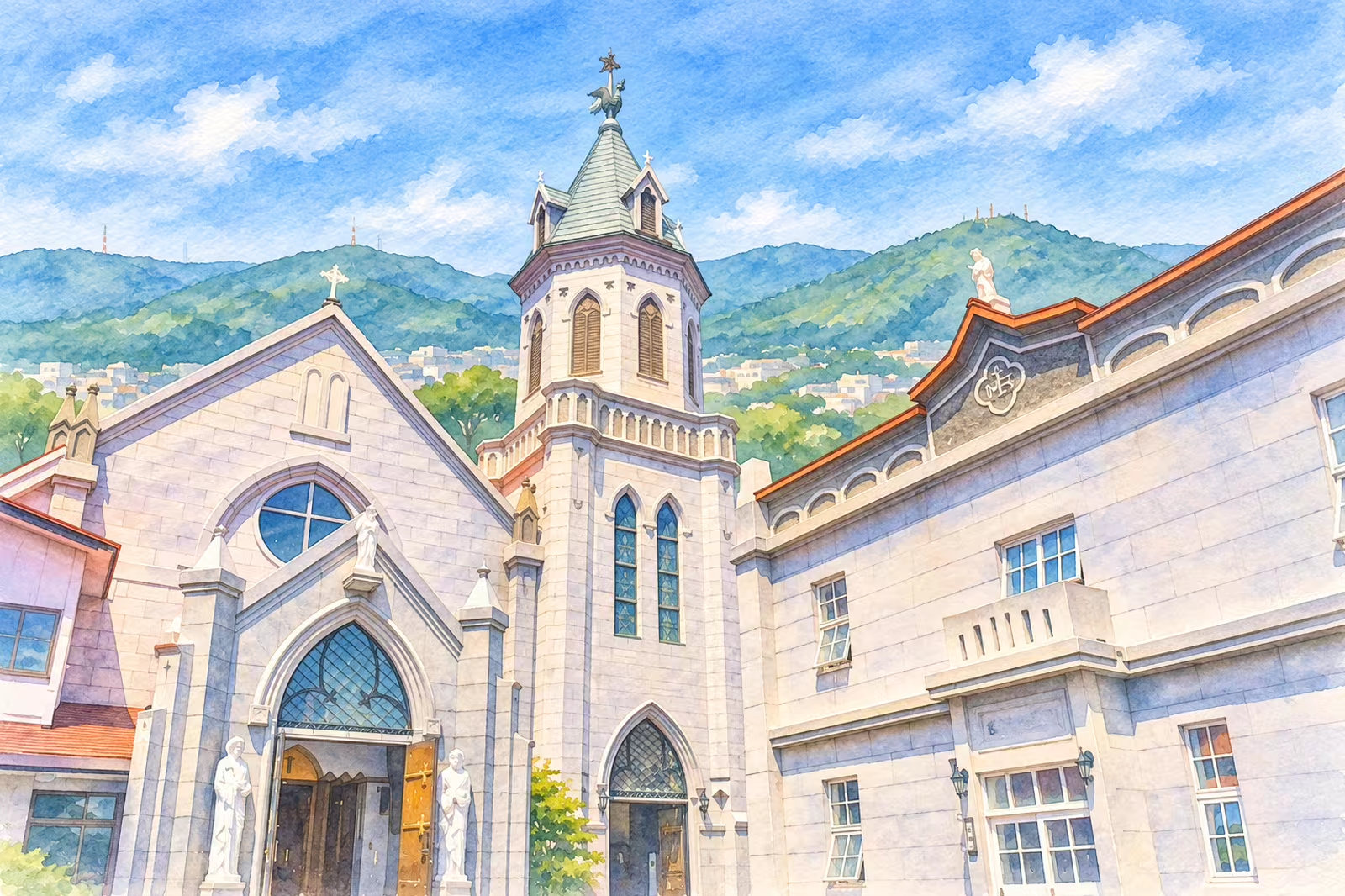
The Motomachi district, on the northern slopes of Mount Hakodate in Hakodate, Hokkaidō, is where foreign consulates and churches first gathered after the port was opened in the 1850s. An Orthodox, a Catholic and an Anglican church stand within a short walk of one another among the sloping streets, forming the city’s best-known treaty-port townscape. A little farther southeast along the foot of the mountain, in woods near Yachigashira, stands the Hekketsuhi, a memorial to the former shogunate soldiers who died in the Hakodate War.
01The port and its three churches
Hakodate was opened to foreign ships under the 1854 treaty with the United States and to foreign trade from 1859, and Russia, Britain, France and the United States set up consulates in Motomachi. The Russian consulate’s chapel was built around 1860, and Nikolai, who arrived as its priest in 1861, went on to spread Orthodox Christianity across Japan, so Hakodate is regarded as the starting point of the Japanese Orthodox Church. The French missionary Mermet de Cachon came to Hakodate soon after the port opened, laying the foundations of the Catholic mission, and Anglican work was begun by British missionaries in the early Meiji years.
Hakodate suffered repeated great fires, and the Motomachi churches were burned and rebuilt more than once. The present Hakodate Orthodox Church, formally the Church of the Resurrection, is a brick building completed in 1916, with white walls and green roofs; it was designated an Important Cultural Property in 1983. The Gothic Motomachi Catholic Church was rebuilt after the fire of 1921 and completed in 1924; its altar is said to have been a gift from the Pope. St. John’s Church, the Anglican church, dates from 1979 and is cross-shaped when seen from above, making it the newest of the three. Other Western-style buildings nearby, such as the Old Public Hall of Hakodate Ward, belong to the same historic district.
02The Hekketsuhi
After the Hakodate War ended in 1869, the bodies of the former shogunate dead were left where they fell, and few dared to collect them. Yanagawa Kumakichi, a local strongman and labor boss, defied the prohibition, gathered the remains with his men and buried them on the slopes of Mount Hakodate; he is said to have been arrested for it and later released. In 1875, with the support of former shogunate commanders including Enomoto Takeaki and Ōtori Keisuke, the Hekketsuhi was erected to commemorate about 800 men killed in the fighting, generally thought to include Hijikata Toshizō. The name, meaning "blue-green blood," comes from a story in the Zhuangzi about a loyal minister, Chang Hong, whose blood turned to green jade three years after his death. Accounts differ over who wrote the inscription. Beside it stands a monument to Yanagawa erected in 1913. A memorial service is still held here every year, and visitors should treat the site as a grave.
Hakodate Motomachi
01A Slope Facing the Harbor
Motomachi, literally "the original town," is the hillside neighborhood at the northern foot of Mount Hakodate, tilted toward the harbor. A ladder of steep streets runs down it to the water: Hachiman-zaka, Motoi-zaka, Daisan-zaka, Nijikken-zaka and others, each with its own name and view. Walk up any of them and within a few hundred meters you pass a Russian Orthodox church, a Catholic church, an Anglican church, a Buddhist temple built of concrete, and a blue-and-yellow Western-style public hall. Few places in Japan pack so many faiths and architectural styles into so small an area.
The reason is the treaty port. In the 1850s Hakodate became one of the first Japanese harbors opened to foreign ships, and the consuls, merchants and missionaries who arrived settled on this slope, close to the Japanese government offices that also stood here. A decade later the same town became the last battlefield of the Boshin War, the civil war that ended the Tokugawa shogunate. On the eastern shoulder of Mount Hakodate, a short walk from the churches, stands the Hekketsuhi, a stone monument to the shogunate soldiers who died here in 1869. This guide covers both stories.
02Perry Comes North
In the Edo period the town was written Hakodate with different characters (箱館, "box fort"), and it was a harbor of Ezo, the northern island now called Hokkaidō, under the oversight of the Matsumae domain. Herring, kelp and other northern products moved through it, and in the early nineteenth century the shipping magnate Takadaya Kahei made it his base.
In March 1854, at Kanagawa, the shogunate signed the Convention of Kanagawa with Commodore Matthew Perry of the United States Navy. It opened two harbors, Shimoda on the Izu Peninsula and Hakodate in the far north, where American ships could take on coal, water and provisions. Perry sailed north to inspect Hakodate in May 1854. The harbor, sheltered from the open sea by the bulk of Mount Hakodate, was deep and calm. While the squadron lay at anchor two sailors from the USS Vandalia died and were buried in the town, the beginning of what became Hakodate’s Foreign Cemetery.
The shogunate then took Hakodate and its surroundings out of Matsumae hands and placed them under a commissioner, the Hakodate bugyō, whose office stood at the top of Motoi-zaka, the slope that today climbs to Motomachi Park. Under the commercial treaties of 1858 with the United States, the Netherlands, Russia, Britain and France, Hakodate opened for trade in 1859, together with Yokohama and Nagasaki.
The commissioner’s office looked straight out over the harbor and was well within range of a warship’s guns. The shogunate therefore built a new, star-shaped fortress inland, designed by the Western-learning scholar Takeda Ayasaburō: Goryōkaku. The commissioner moved there in 1864. The old site on the slope later served as the Hakodate branch office of the Hokkaidō Colonization Office and then of the Hokkaidō prefectural government, and it is now Motomachi Park.
03Consuls, Traders and Sailors
The first foreign official to reside in Hakodate was the American commercial agent Elisha Rice, who arrived in 1857. Russia’s first consul, Iosif Goshkevich, arrived in 1858 and at first used the Buddhist temple Jitsugyō-ji as his consulate; the first British consul, Christopher Pemberton Hodgson, arrived in 1859. In 1860 the Russians completed a proper consulate on the site of today’s Orthodox church in Motomachi, a substantial establishment with a hospital and a chapel.
The foreign community was always small, far smaller than Yokohama’s: consular staff, a handful of British and other merchants dealing in kelp, dried abalone and sulfur, ship chandlers, missionaries, and the crews of whalers and Russian ships calling for supplies. Even so, Hakodate residents met Western ways early. Photography, Western medicine, bread and dairy all have Hakodate chapters in their Japanese histories.
The Foreign Cemetery lies on the western flank of Mount Hakodate at Funami-chō, looking out to sea. It has separate sections for Protestants, Russians, Catholics and Chinese, and its stones carry the names of consuls, traders, sailors and missionaries.
04Father Nikolai and the First Orthodox Church
Orthodox Christianity in Japan began in the Russian consulate. When the consulate was built in 1860, a wooden chapel was attached to it (some accounts date its beginnings to 1859), the first Orthodox church in the country.
In 1861 a young priest-monk named Nikolai, born Ivan Kasatkin, arrived as the consulate’s chaplain. He set himself to learn Japanese thoroughly, reading the Kojiki and Nihon shoki, the eighth-century chronicles of Japan’s origins, along with Buddhist and Confucian texts. Christianity was still banned for Japanese subjects.
A well-known story concerns Sawabe Takuma, a swordsman from Tosa who had married into the family of the chief priest of Hakodate’s Shinmei shrine and served there himself. According to the traditional account he came to the consulate intending to confront, or even kill, the foreigner he saw as a threat to Japan, and left as Nikolai’s student. In the spring of 1868 Nikolai secretly baptized Sawabe, a Hakodate physician named Sakai Tokurei, and Urano Daizō of the Nanbu domain in his own room, the first Japanese Orthodox converts. Sawabe became the first Japanese Orthodox priest in 1875. Nikolai moved to Tokyo in 1872, where he founded the mission center at Surugadai that is now the Holy Resurrection Cathedral, known to everyone as Nikorai-dō. He was canonized after his death as St. Nicholas of Japan, Equal-to-the-Apostles.
05Catholics and Anglicans
The Catholic presence was French. Eugène-Emmanuel Mermet de Cachon of the Paris Foreign Missions Society reached Hakodate in 1859, where he taught French as well as preaching and became friendly with shogunate officials, among them Kurimoto Joun, later a key figure in the shogunate’s ties with France. The Catholic mission survived his departure and after several moves settled on its present site.
The Anglican story began in 1874, when Walter Dening of the Church Missionary Society arrived from Britain. His work is counted as the start of Anglican missions in Hokkaidō, and St. John’s Church, the oldest Anglican congregation on the island, traces its origins to it.
So the three churches standing side by side correspond to the three powers most active in early Hakodate: Russia, France and Britain.
06Fire, and What You See Today
Hakodate burned often. The town is squeezed between mountain and sea, and wooden houses packed tightly together could not stop a fire driven by strong winds. The worst of many Meiji-era fires came on August 25, 1907, when close to nine thousand buildings were destroyed. The churches of Motomachi and the old town assembly hall all burned. Most of what stands in Motomachi today was built after that fire.
The Hakodate Orthodox Church of the Resurrection was completed in 1916 to a design by Kawamura Izō, a Japanese Orthodox believer. It is built of brick finished in white plaster, with green copper roofs and domes in a Russo-Byzantine style. Its bells ring out rhythmic melodies, which is why locals call it "Gangan-dera," the clanging temple. The church and its iconostasis, the icon screen before the altar, were designated an Important Cultural Property, Japan’s main national heritage category for buildings, in 1983.
Motomachi Catholic Church built a brick church in 1910 after the great fire, lost it to another fire in 1921, and rebuilt within the surviving walls, finishing in 1924 (some sources say 1923). It is Gothic, with a bell tower about 33 meters high. The high altar inside was a gift from Pope Benedict XV in sympathy after the fire, and is described as the only altar in Japan given by a pope.
St. John’s Church also burned more than once and moved to its present site in 1921. The current building, a modern one, dates from 1979. From above its roof forms a cross; from the street you see brown roofs, white walls and a large cross on each face.
Nearby stands the Hakodate branch temple of Higashi Hongan-ji, whose main hall of 1915 is usually described as the first Buddhist temple in Japan built of reinforced concrete. It was designated an Important Cultural Property in 2007, and it is a reminder that the temples of Motomachi, too, were rebuilt in fireproof materials.
07The Old Public Hall of Hakodate Ward
At the top of Motoi-zaka, above Motomachi Park, stands the Old Public Hall of Hakodate Ward. Hakodate Ward was the city’s administrative unit in the Meiji period. When the earlier ward assembly hall burned in 1907, the wealthy merchant Sōma Teppei donated 50,000 yen of the roughly 58,000-yen cost of a replacement, and the new hall opened in 1910.
It is a two-story wooden building in a colonial style, with verandas and columns, painted blue-gray with yellow trim, impossible to miss on the hilltop. It was used for meetings, banquets and the reception of guests. In 1911 the Crown Prince Yoshihito, later Emperor Taishō, stayed here during his tour of Hokkaidō. The visit was arranged while the hall was still under construction, and the building was hastily extended and some rooms refitted for him; the suite prepared for him on the second floor is preserved.
The hall was designated an Important Cultural Property in 1974. It has had two major conservation repairs, the most recent finished in 2021, which repainted it in blue-gray and yellow. From the second-floor balcony you look straight down Motoi-zaka to the harbor.
Below it, the former British Consulate, a building of 1913 designed by the British government’s Office of Works in Shanghai and used as a consulate until 1934, is now open as a museum of the port opening. Motomachi Park also holds the former Hakodate branch office of the Hokkaidō government, begun in 1909 and completed in 1910. Together these buildings preserve the old arrangement of government offices and consulates on the same slope.
08The Last Battle of the Shogunate
The second history of this place comes from the Boshin War of 1868–69. After the shogunate’s defeat at Toba-Fushimi in early 1868 and the surrender of Edo Castle, the shogunate’s naval commander Enomoto Takeaki refused to hand over the fleet. In the eighth month of 1868 he slipped out of Edo Bay with the flagship Kaiyō Maru and other ships, picking up defeated shogunate troops in the northeast, including Hijikata Toshizō, former vice-commander of the Shinsengumi, the shogunate’s police unit in Kyoto, and the army commander Ōtori Keisuke.
In the tenth month they landed at Washinoki, north of Hakodate, took Goryōkaku and the town, and then captured Matsumae Castle. They organized a government of their own and chose Enomoto as its president by ballot. Later writers called it the "Republic of Ezo," a name taken from foreign descriptions rather than an official title the regime used. Disaster struck early when the Kaiyō Maru ran aground and sank off Esashi in the eleventh month.
In spring 1869 the imperial government’s forces landed at Otobe and advanced along several routes. On the eleventh day of the fifth month they launched a general assault on Hakodate. Hijikata was shot and killed near the Ippongi checkpoint while leading a sortie; he was thirty-four by Western count. The town fell the same day. On the eighteenth day of the fifth month, June 27, 1869, Enomoto and the other leaders surrendered Goryōkaku, ending the Boshin War.
09Yanagawa Kumakichi and the Hekketsuhi
After the battle, the bodies of many shogunate dead lay where they had fallen. The victors regarded them as rebels and did not permit their burial. Yanagawa Kumakichi, a local boss of the kind Japanese call a kyōkaku, a chivalrous gang leader, would not leave them there. With Matsuo Nichiryū, head priest of Jitsugyō-ji temple, and the master carpenter Ōoka Sukeemon he gathered the bodies and buried them, at the risk of punishment. According to the story, the authorities came after Kumakichi and he escaped punishment only when Tajima Keizō, a Satsuma samurai on the government side, spoke up for him.
In 1871 Kumakichi bought land at Yachigashira on the eastern foot of Mount Hakodate and moved the remains there from Jitsugyō-ji. In 1874 the government permitted rites for the shogunate dead, and in 1875, the seventh anniversary of their deaths by Japanese count, a memorial was raised on the spot with the support of former shogunate men including Enomoto Takeaki and Ōtori Keisuke: the Hekketsuhi. The stone, from Izu, was shipped from Reiganjima in Tokyo; it stands about six meters high.
The name means "monument of jade-green blood." It comes from the Chinese classic Zhuangzi, which tells of Chang Hong, a loyal minister of the Zhou who was wrongly put to death; his blood, preserved by the people of Shu, turned into green jade after three years. The blood of men who die for a just cause, in other words, becomes something precious. At a time when the new government still regarded the shogunate’s last army as rebels, the monument names no one and states no cause on its face, only the three large characters. The back of the base carries sixteen characters of classical Chinese, roughly: "In the dragon and snake years of Meiji this truly happened; we raise a stone on the mountain to show our resolve." The dragon and snake years are 1868 and 1869.
About eight hundred dead are commemorated, among them Hijikata and Nakajima Saburōsuke, a former official of the Uraga magistracy who died with his two sons at the Chiyogadai battery. Kumakichi spent his last years beside the monument, looking after it until his death, and a stone honoring him stands nearby. A memorial service is held in front of the monument every year in late June.
10Walking Motomachi
A good route starts near the Kanemori red-brick warehouses on the waterfront and climbs Hachiman-zaka, a broad, tree-lined slope paved in stone. Turn around near the top for the classic view of the harbor, with the old Seikan ferry Mashū Maru moored at the bottom.
At the top, head east. Motomachi Catholic Church comes first, then the Orthodox Church of the Resurrection, with St. John’s Church beside it; they stand within a hundred meters or so of one another, and you can take in the white walls and onion domes, the gray Gothic spire and the brown cross-shaped roof in one view. Looking down Daisan-zaka you see the great roof of the Higashi Hongan-ji branch temple.
Westward along the hillside is the top of Motoi-zaka, where the Old Public Hall looks over the harbor, with Motomachi Park, the former Hokkaidō government branch office and, at the bottom of the slope, the former British Consulate. This is roughly where the bugyō’s office stood, facing the foreign ships as they came in.
For the Hekketsuhi, follow the foot of the mountain southeast toward the Yachigashira hot spring and Hakodate Hachimangū shrine, then climb the path into the trees. The monument stands in a quiet clearing that few tourists reach. From the port-opening churches to the shogunate grave is an easy walk, and it covers most of what happened to Hakodate in the fifteen years after Perry arrived.