
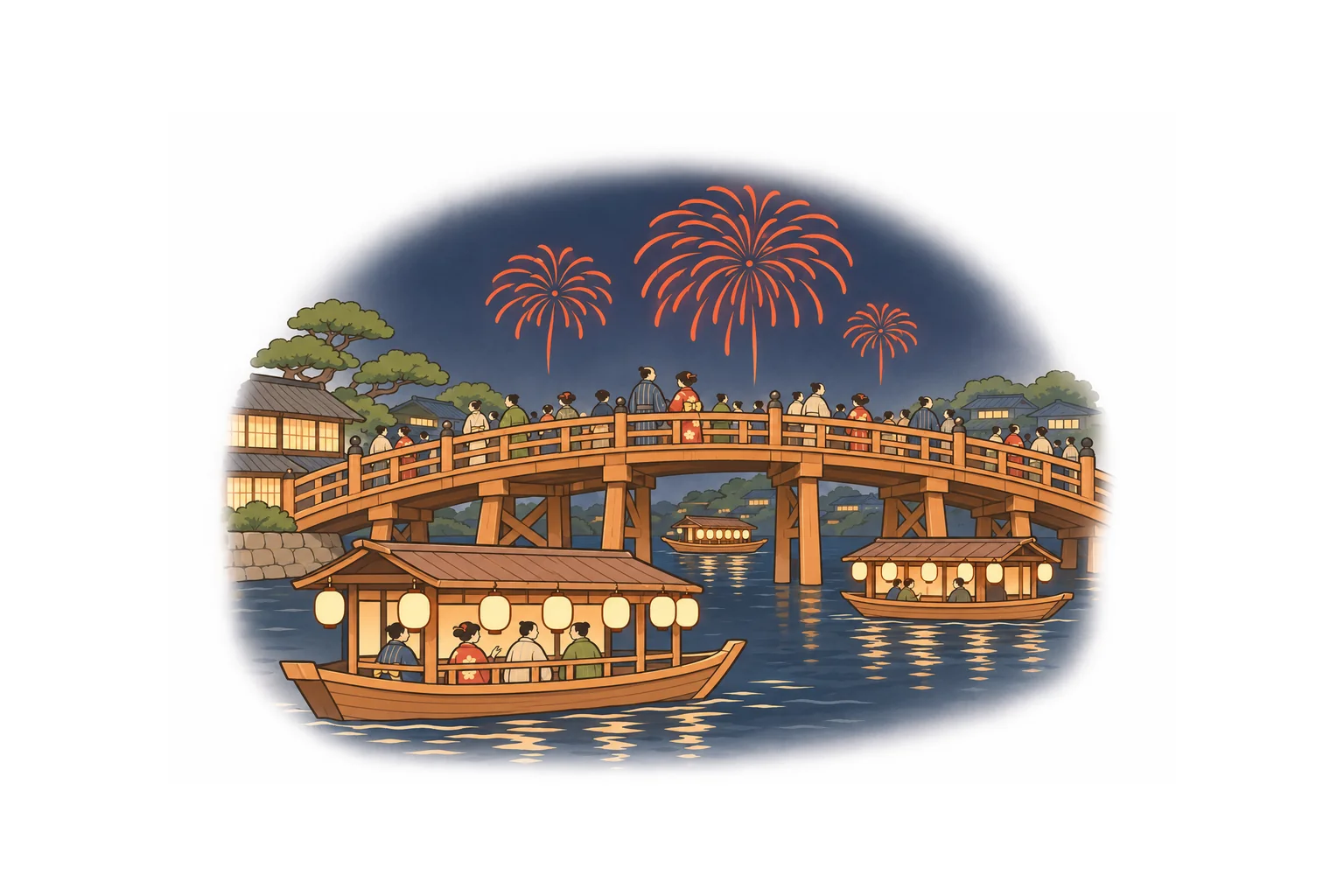
Get off the train at Ryōgoku station in Tokyo and the first thing you see is the great roof of the Kokugikan, the national sumo hall. In January, May and September, when the Tokyo tournaments are on, crowds stream toward it from early afternoon. The Sumida Hokusai Museum is close by, and a few minutes’ walk brings you to the Sumida River. Two hundred years ago this was the liveliest corner of Edo, as Tokyo was then called. Sumo bouts were staged in a temporary hall in the grounds of the temple Ekō-in, crowds packed Ryōgoku Bridge on summer nights to watch fireworks, and a stall-keeper nearby is often credited with pressing a ball of vinegared rice and a slice of fish together and handing it straight to the customer.
To understand why Edo was so busy having fun, start with who lived there. By the eighteenth century it was a city of around a million people, and a large share of them were men on their own: samurai serving their lords’ stints in the shogun’s capital, craftsmen, porters and shop hands who had come from the provinces to find work. Many lived in cramped row houses called nagaya and had no kitchen worth the name. They had a few copper coins in their pockets and no wish to spend the evening indoors. What a city like that wants is cheap, fast and always open: food you can eat standing up, a show that costs a few dozen coins, a picture you can carry home for about the price of a meal.
Food came first. Soba, sushi and tempura were later remembered as Edo’s three great fast foods. A bowl of nihachi soba, buckwheat noodles bound with a little wheat flour, cost 16 mon, and the Edo way was to dip only the ends of the cold noodles into a strong soy-based sauce and slurp them in one go. Hand-pressed nigiri sushi took shape around the Bunsei era (1818–1830), and Hanaya Yohei of Ryōgoku is the name most often attached to it. His sushi was two or three times the size of today’s, the rice tinted brown by red vinegar brewed from sake lees, and almost every topping had been salted, marinated or simmered first. Both foods were born at street stalls for people in a hurry. One is now what Japanese families eat on New Year’s Eve; the other is the most exacting meal in the country.
Then there was theater. Kabuki began around 1603 with the dances of a woman called Okuni on a Kyoto riverbank. By the late seventeenth century, Edo audiences had their own hero in the first Ichikawa Danjūrō and his aragoto, a rough, bravura style of superhuman warriors in red face paint who flatten whole gangs of villains. It suited a frontier city of laborers and bachelors perfectly. Ōsaka preferred puppets. In 1684 the chanter Takemoto Gidayū opened his theater in Dōtonbori, and the playwright Chikamatsu Monzaemon turned a real double suicide into The Love Suicides at Sonezaki, staged about a month after the event. The puppet theater, now called bunraku, and kabuki borrowed freely from each other, and several of kabuki’s greatest plays were first written for puppets. Cheaper still was the yose, the storytelling hall. In 1798 Sanshōtei Karaku began charging admission in Shitaya, and the rakugo performer, kneeling alone on a cushion with a fan and a hand towel, played every resident of a backstreet tenement. By the 1820s Edo was said to have more than 120 yose, with a ticket reputedly costing about the same as a bowl of soba.
Some pleasures you could take home. A full-color woodblock print, an ukiyo-e, is usually thought to have sold for around 20 mon, again close to the price of noodles. After the play you bought your favorite actor in his current role; after the sumo, a portrait of the champion Raiden; at summer’s end, a view of Ryōgoku Bridge under bursting fireworks. Ukiyo-e put the theater, the ring and the riverbank on paper, which is why it sits in the middle of this route: nearly everything on the cards around it turns up somewhere in the prints.
Sumo and fireworks were spectacles for the whole city. From 1833 Edo’s sumo tournaments settled at Ekō-in in Ryōgoku, twice a year, and the top wrestlers were celebrities on a level with kabuki actors. In 1733 the shogunate held a rite for the water deity on the Sumida at Ryōgoku, and fireworks are traditionally said to have gone up the same night. From then on they marked the river’s summer opening every year, and the crowd shouted the names of the two rival makers, "Tamaya!" and "Kagiya!", a cry Tokyo still half-jokingly repeats.
Read these eight cards together and a pattern appears. Almost all of Edo’s amusements were businesses: craftsmen in a huge city making things for ordinary people to watch and eat, keeping prices low, changing the program constantly, and more than once running into the shogunate’s bans. Most survived, changed shape, and are now called tradition. The makunouchi lunch box eaten between acts at the Kabukiza, the floor boxes at the Kokugikan, a dozen-odd storytellers taking turns at a yose, the Sumida River fireworks on the last Saturday of July, a bowl of soba finished in three minutes on a station platform: all are habits that city left behind.
The order starts in the theater, with kabuki and bunraku, two stages that traded plays. It moves to rakugo, where one person is enough. Ukiyo-e then puts all of it on paper, before the route crosses to Ryōgoku for sumo and fireworks and ends at the table with sushi and a bowl of soba.
01Reading order
- Kabuki
The great popular theater of Edo’s townspeople. Read the section on Edo’s aragoto and the softer Kamigata style to see what kind of hero a city of samurai and bachelors wanted, and the last section for how to buy a single-act ticket at the Kabukiza.
- Bunraku
Ōsaka’s puppet theater, the western counterpart to kabuki. The story of the Takemoto theater and Sonezaki explains why kabuki’s three great classics were first written for puppets.
- Rakugo
The cheapest theater of all, one performer with a fan and a towel. It tells how the yose spread through Edo, and the hapless tenants in the stories were the people in the audience.
- Ukiyo-e
The theater, the pleasure quarter and famous views, printed and sold for a few dozen coins. The actor prints link back to the stage; the Ryōgoku and Sumida scenes point ahead to sumo and fireworks.
- Sumo
From temple fundraising bouts to the Ryōgoku Kokugikan. Read how Edo’s wrestlers became stars of the color print, then how to spend a day at a tournament today.
- Hanabi
Summer fireworks that trace back to the 1733 river opening at Ryōgoku. The rivalry between Tamaya and Kagiya, and Tamaya’s abrupt end, show how much of Edo’s fun was commerce.
- Sushi
Nigiri was born at an Edo street stall. The Edo-mae section explains why early sushi was big, why the rice was brown, and why every fish was worked on first.
- Soba
Edo’s fast food at 16 mon a bowl. The two explanations of "nihachi" and the rakugo tale of the cheating customer bring the route back to a noodle stall at night.