
Every autumn the Mitsukoshi flagship store in Nihonbashi, Tokyo, gives a gallery floor over to a quiet exhibition: the Japan Traditional Kōgei Exhibition. A tea bowl, a length of hand-dyed kimono silk, a bamboo flower basket, a lacquer box flecked with gold. Beside each is a small card with the maker’s name, and on some of the cards one extra line: Holder of Important Intangible Cultural Property. That is the official title behind the popular phrase "Living National Treasure." The objects sit perfectly still in their cases. The question behind them does not: will the hands that made this have anyone to pass it on to?
That question is the thread of this route. Japanese craft is usually sold to foreigners as an aesthetic, all wabi-sabi and devoted artisans. These cards read more like a ledger. Where do the raw materials come from? Who makes the tools? How does an apprentice learn? Who buys the work, what happens when it breaks, and where does the state step in? Put swords, pottery, lacquer, paper, textiles and glass side by side and you find that each has survived in its own way.
Begin with the Living National Treasures card, which supplies the framework. In 1949 a fire in the Golden Hall of Hōryū-ji in Nara destroyed most of its ancient murals. The following year Japan passed its Law for the Protection of Cultural Properties, and for the first time wrote "intangible" cultural property into law. What gets designated is the skill; a person is recognized because they embody it. The logic is simple. A burned temple can be rebuilt from drawings. When the last woman who knows how to set up a particular loom dies, the knowledge goes with her. The card is frank about the system’s limits, too: the annual grant of ¥2 million is modest, most holders are only recognized in their sixties or seventies, and the real threat is often the disappearance of materials and tools.
The Japanese sword shows that threat most starkly. Swords are forged from tamahagane, steel smelted from iron sand over three days and nights in a clay furnace called a tatara. The method died out in the modern era and was revived only in 1977, in Okuizumo in Shimane Prefecture; today almost every swordsmith in the country depends on the handful of firings held there each winter. After the 1876 edict banning the wearing of swords, many smiths turned to farm tools and kitchen knives. After 1945 the occupation authorities ordered swords confiscated, and the craft was saved only by the argument that a sword is a work of art: blades with artistic value could be registered and kept. Becoming a smith today means years under a master, a three-year training course, and a cap of usually no more than two long blades a month. A craft boxed in tightly by law has survived because of the box.
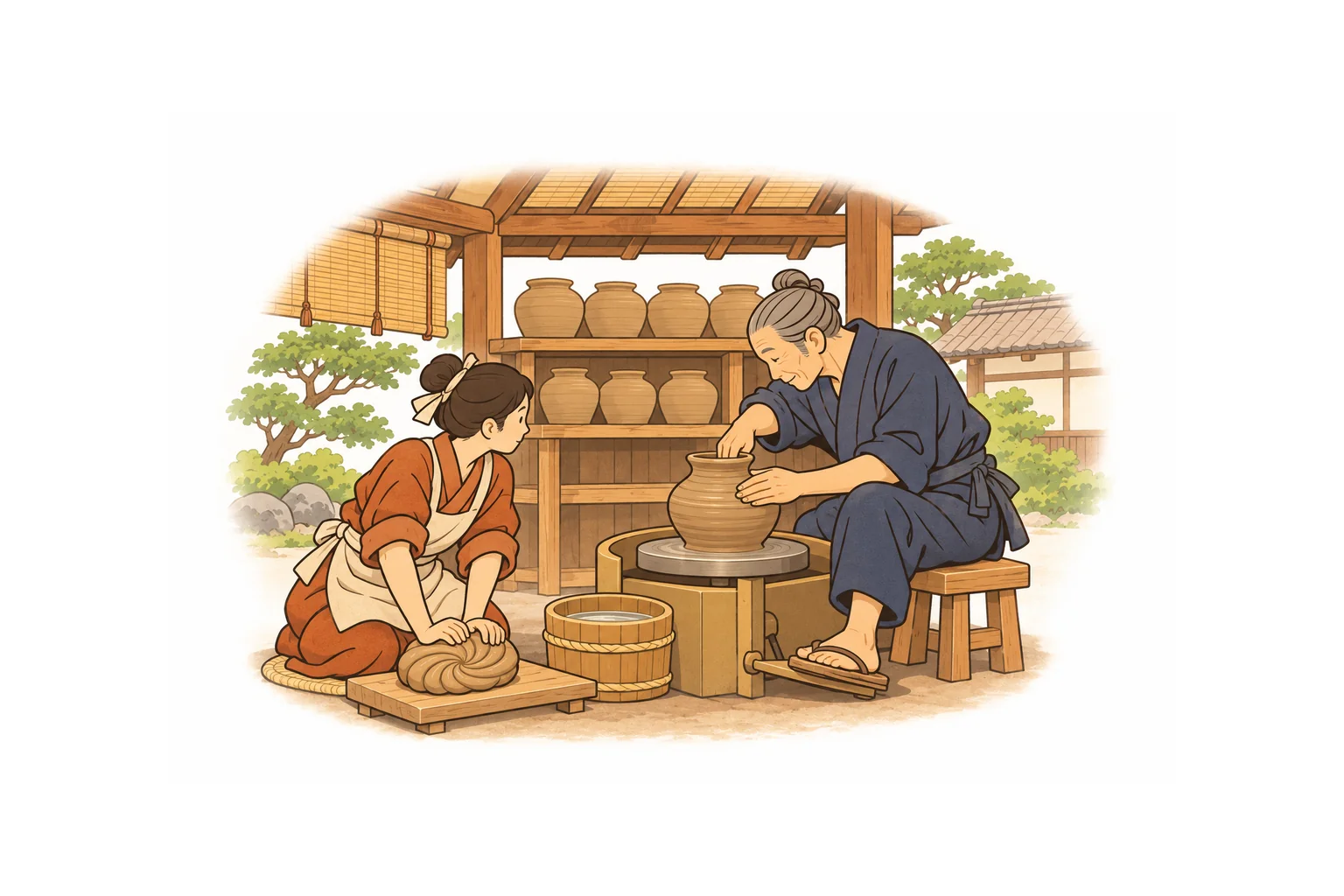
Pottery took the opposite road: it survived by being used. A Japanese table rarely holds a matching set; a stoneware rice bowl, a lacquer soup bowl and a blue-and-white porcelain dish sit side by side. In the early 20th century, as handmade kilns closed, the thinker Yanagi Sōetsu and the potters Kawai Kanjirō and Hamada Shōji coined the word mingei, folk craft, arguing that anonymous everyday wares had an honest beauty precisely because no one was trying to make them beautiful. Hamada settled in Mashiko and spent his life making platters, jars and tea bowls from local clay and glazes. In 1955 he was among the first Living National Treasures, and Mashiko turned from a kitchenware town into a magnet for potters.
Lacquer’s problem is supply. A lacquer tree needs about ten years before it can be tapped, gives perhaps 200 grams of sap in a season, and is then usually cut down so it can regrow from the root. Nearly all the urushi used in Japan now comes from China; domestic lacquer is a few percent. Since fiscal 2018, restoration of National Treasure and Important Cultural Property buildings has in principle required Japanese lacquer, and the near-vanished trade of sap-tapping around Jōbōji in Iwate has begun taking on young people again. Kintsugi belongs right here. It turns lacquer to repair: shards glued back with lacquer, seams dusted with gold, the crack becoming the most striking line on the bowl. It took shape among tea masters and has carried on for four or five centuries, kept alive by people who would rather mend a bowl they love than throw it away. The mended bowl goes back to holding rice; when the gold wears thin, it goes back for another coat.
Paper has the most sobering numbers. Around 1901 some 70,000 households made paper by hand; by the early 1980s fewer than 600 were left. The survivors found a new job for washi: paper made from paper-mulberry bark is long-fibered, strong, chemically stable and can be made extraordinarily thin, which is why museum conservators worldwide use it to repair old books and paintings. In 2014 three papers, Sekishū-banshi, Hon-minoshi and Hosokawa-shi, were inscribed together on UNESCO’s intangible heritage list. Kimono dyeing, meanwhile, survives through division of labor. A hand-painted yūzen furisode, the long-sleeved formal kimono, passes through more than a dozen stages and several specialist workshops. Since the Meiji era, stencil-printed yūzen has made the patterns affordable, and most reasonably priced yūzen kimono are made that way, leaving hand painting to a discerning few.
Last comes Edo kiriko, Tokyo’s cut glass, a far younger craft. In 1834 an Edo glass dealer, Kagaya Kyūbei, carved patterns into glass with emery. In 1881 the government-run Shinagawa Glass Works brought in a British glass cutter to teach wheel-cutting to Japanese apprentices, and the small workshops of the city’s east side have passed it down ever since. Today "Edo Kiriko" is a registered regional trademark, usable only for glass cut by hand in the designated area. Tradition, it turns out, need not be ancient: a foreign technique, if someone takes it up, can become a local craft in little over a century.
Read the cards in this order and then walk back into that department-store gallery. It is no longer just a handsome bowl. You think of the clay it was fired from, the lacquer, the paper it is wrapped in, and whether its maker has an apprentice yet.
01Reading order
- Living National Treasures
The framework for the route. Why Japan protects people, not only objects, and the real obstacles: modest grants, aging holders and vanishing materials.
- The Japanese Sword
From tamahagane and folding to the sword ban and postwar confiscation, a craft that nearly died and lives on through a revived furnace and strict licensing.
- Japanese Ceramics
The craft that survived by being used. It covers how tea transformed pottery and how the mingei movement revalued the anonymous rice bowl.
- Kintsugi
Repair as a craft in its own right. See how lacquer and gold make a crack part of the object, and how the real thing differs from quick-fix kits.
- Urushi
How tree sap becomes a soup bowl. Read the tapping, ground layers and top coats, and why domestic lacquer is scarce and how restoration work is reviving it.
- Washi
From 70,000 households to fewer than 600. See how a sheet is made, and how washi found a second life in conservation.
- Kimono Textiles
How many hands go into one kimono. Yūzen resist dyeing, Nishijin weaving and regional ikat show how fine division of labor keeps skills alive.
- Edo Kiriko
The youngest craft here. From an Edo merchant to a British instructor in Meiji Tokyo to a modern trademark, a foreign technique turned downtown tradition.