
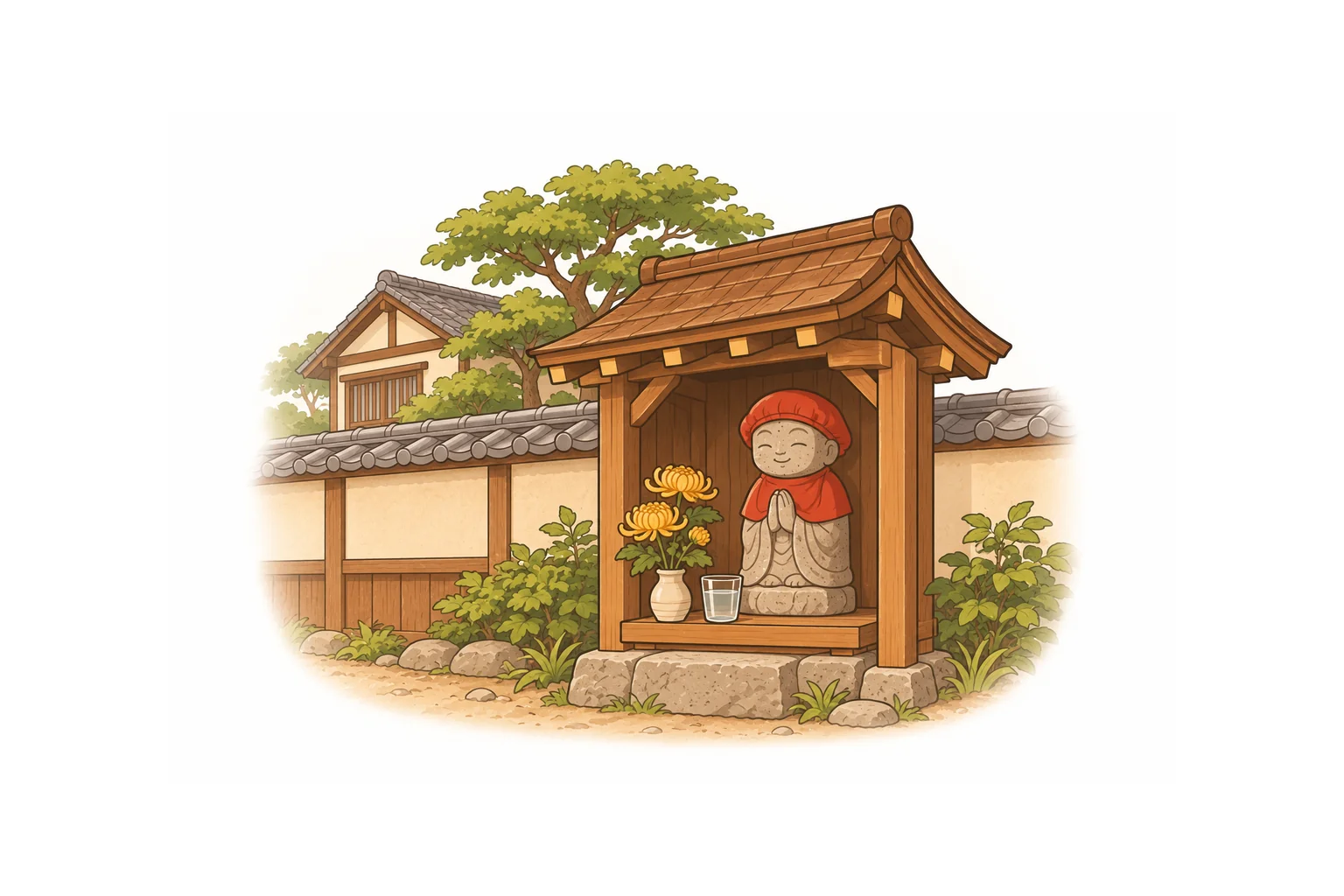
Seven in the morning on an ordinary residential street in Tokyo. Someone is buying coffee at the convenience store; parents cycle past with children perched on the back. At the foot of a utility pole stands a waist-high stone monk in a red bib, an unopened bottle of water at his feet. Two blocks on, wedged beside an office building, is a tiny shrine: a vermilion gate the height of a door, two stone foxes, a square of fried tofu laid out in front. At lunch, in a small izakaya, there is a shelf high above the counter holding a miniature wooden shrine hung with white paper and sprigs of green. Nobody points any of this out. Nobody explains it. But someone changes the water every day.
Ask most Japanese people what religion they follow and they will say "none." The same person will queue in the cold at New Year for hatsumōde, the year’s first shrine visit, carry a charm a classmate gave them before their entrance exams, travel home in August to clean the family grave, and call in a Buddhist priest when a parent dies. There is a saying for this: born at the shrine, buried by the temple. Babies are presented at Shinto shrines, weddings are often held before the kami, but death and the ancestors belong to Buddhism. This route gathers the things you keep bumping into on street corners, on bag straps and in people’s living rooms, and shows how they divide up a year and a lifetime between them.
Start with Shinto, because it is the most visible and the easiest to misread. It has no founder and no scripture everyone must know. What matters is less what you believe than what you do: bow at the torii gate, rinse your hands at the basin, bow twice, clap twice and bow once before the hall. A kami, a Shinto deity, can be a mountain, a boulder, or a scholar who died in disgrace and had to be appeased. Once that clicks, Inari makes sense. Inari began as a god of the rice harvest and ended up looking after almost everything: trade, fire prevention, the safety of the household. That is how Inari spread from a mountain on the edge of Kyoto into the back yards of Edo and onto the roofs of present-day office towers. The famous tunnel of red gates at Fushimi Inari is, in effect, centuries of merchants’ wishes and thank-yous, each gate signed by the business that paid for it.
Then come two Buddhist figures who could hardly be more different. Jizō is the little stone monk on the corner. In the sutras he descends into all six realms of rebirth to rescue suffering beings; in Japan he also became the guardian of children who die young, their stand-in parent in the afterlife. Many of those red bibs were tied on by mothers. Kannon, the bodhisattva of compassion, lives in the great temples, sometimes with eleven faces, sometimes with a thousand arms, every form making the same promise: call her name and she will hear. The crowds at Sensō-ji in Tokyo are paying respects to a statue no one has seen, a hidden image that is never put on display. Jizō by the road, Kannon in the hall: one homely, one grand, and people take their troubles to both.
Next are the things you can take home. An omamori is a charm in a brocade pouch, believed to hold a small share of the deity’s power. You don’t open it, and after a year you return it to be burned with the New Year decorations. An ema is a wooden plaque for writing a wish, and in exam season the racks at shrines to the god of learning are packed solid. A goshuin is a temple or shrine seal, brushed in ink and stamped in red. It began as the receipt pilgrims got for depositing copied sutras and only became a youth craze in the last decade or so. The vocabulary is telling: people don’t speak of buying these things, and the money is called hatsuhoryō, an offering of the first ears of rice.
The last two cards turn to death and the ancestors, the half of life handed over to Buddhism. Every mid-August tens of millions of people head back to their hometowns, light a small fire of hemp stalks at the door to guide the family dead home, give them a cucumber horse to ride in on and an eggplant ox to amble back on, then light another fire to send them off. This is Obon. Its frame comes from a sutra about a disciple rescuing his mother from torment; its flesh is a much older native cult of ancestral spirits. The funerals card follows a death from the overnight wake to cremation, where relatives lift the bones into the urn with chopsticks, and on through the household Buddhist altar to a final memorial service thirty-three years later. It explains why you never stand chopsticks upright in rice, and why nearly every family is tied to a particular temple: in the 17th century the shogunate, hunting out Christians, made everyone register as a temple parishioner.
Read together, these eight cards show a faith built on practice rather than doctrine. Kami and buddhas shared the same grounds for about a thousand years; only in 1868 did the new Meiji government order shrines and temples separated, so today’s tidy separation is barely 150 years old. Ordinary people still don’t fuss over the line. Many who go to Naritasan for New Year don’t much care that it is a temple, not a shrine. In a traditional house the god shelf sits high on one wall and the Buddhist altar lower down: one for good fortune, one for the family dead.
You don’t need to master any of this before you go. Pass a Jizō, pause, put your palms together. Walk to the side of a shrine’s approach path. If a friend invites you to light incense at the family altar, do it. That is about as far as most Japanese people go too. These cards fill in the generations of habit behind that small gesture.
01Reading order
- Shinto
The foundation for everything that follows. It explains a faith centered on ritual rather than belief, and what each part of a shrine means, from the torii to the god shelf.
- Inari Worship
The deity you will meet most often. See how a rice god became a god of business, and why red gates and stone foxes turn up on rooftops and field edges alike.
- Jizō
The step from shrine to temple, starting with the most approachable figure. The legend of the riverbank of the dead explains the red bibs, the stone piles and the pinwheels.
- Kannon
The great-temple bodhisattva. What the many faces and arms mean, and how hidden images and the thirty-three-temple pilgrimages brought her into everyday life.
- Omamori and Ema
Faith you can carry. The language of receiving rather than buying, and the yearly cycle of returning old charms to be burned.
- Goshuin
Where the ink-and-vermilion seals came from, why they boomed recently, and the simple rule of worshipping first and asking for the seal after.
- Obon
The summer days when the dead come home. See how welcoming fires, vegetable animals and sending-off fires fuse a Buddhist story with native ancestor worship.
- Funerals and Ancestors in Japan
The "buried by the temple" half. From bone-gathering and posthumous names to the home altar, and how the temple registration system bound every family to a temple.