
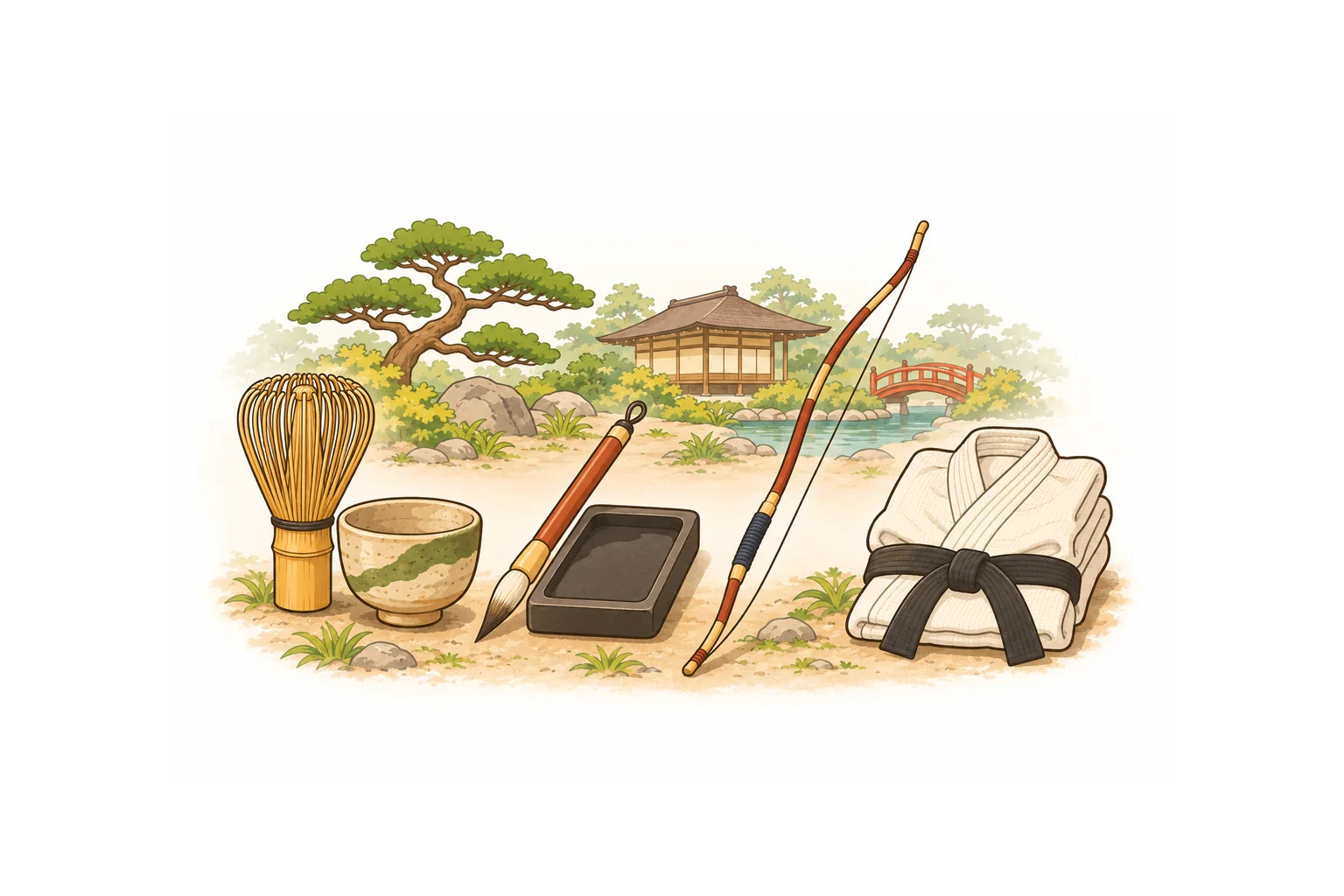
After classes end at a Japanese middle or high school, students in white tops and black hakama (wide pleated trousers) line up at the archery range in a corner of the grounds. One at a time they step forward, raise a bow taller than themselves, draw it, and then hold still, for so long that you start holding your breath too, until the string snaps. In the gym, another group in armor is shouting and cracking bamboo swords against each other’s face masks. Across town, a few people kneel in a teacher’s tatami room arranging flowers, and the teacher reaches over and snips off a branch that is too long. Archery, fencing, flower arranging: in Japan each of them is a dō, a "way." Kyudo, kendo, kadō, along with sadō (tea), shodō (calligraphy), judo and aikido.
Chinese calls calligraphy shufa, "the method of writing." Japanese calls it shodō, and the word suggests a road you walk for a lifetime. The term sounds ancient, but many of these names are surprisingly recent. Judo began in 1882, when Kanō Jigorō borrowed a few rooms in a Tokyo temple, laid down twelve tatami mats and started teaching. He deliberately swapped the jutsu of jūjutsu, "technique," for dō. A technique is how you win; a way is how you shape body and mind. He summed up its aims as "maximum efficiency" and "mutual welfare and benefit." "Kendo" replaced older words for swordsmanship around the 1910s and 1920s, "kyudo" replaced "kyūjutsu" in the early Shōwa years, and aikido only got its name around 1942. Once the samurai class was gone, battlefield skills needed a reason to exist in schools and training halls, and a new name gave them one.
So what is a "way" actually training? Read these cards side by side and a few things keep turning up.
The first is a fixed sequence of movements. In tea, the host’s procedure, temae, prescribes how each utensil is held and set down and the path the hand takes. Kyudo breaks a single shot into eight stages, the hassetsu; beginners learn them on day one, and people who have shot for decades still practice them daily. Judo keeps its principles alive in kata, set forms. Once the movements are fixed, you no longer have to think about what comes next, and your attention is free for the moment in front of you.
The second is that you only get one try. A calligraphy stroke cannot be corrected; the ink soaks into the paper and every hesitation stays visible. Tea people speak of ichigo ichie, "one time, one meeting": today’s guests, weather and hanging scroll will never come together in the same way again.
The third is that the person is judged, not just the result. In kendo, landing a hit is not enough. Spirit, sword and body must arrive together, and afterwards you must stay alert, a state called zanshin. Raise a fist in triumph and the referees can take the point back. Kyudo says "a correct shot always hits"; a hit made with sloppy form scores poorly. The pass rate for kendo’s eighth-dan examination stays below one percent, and most candidates are in their fifties and sixties. Aikido goes furthest of all: apart from one school, it has no competitions, and the two people training are partners, not opponents.
The fourth is a system designed to keep you learning for life. Flower arranging and tea are run by iemoto, hereditary heads of schools, who issue licenses as students progress. Judo’s grades and black belt, which Kanō adapted from the ranking system of the board game go, were later borrowed by kendo, aikido and many other martial arts. These systems keep the rules intact for centuries, and they also turn study into a long series of fees, something the cards are frank about.
Beneath all of it is an aesthetic. The flowers and scrolls in a tea room favor things that are plain, imperfect and marked by time, the taste known as wabi-sabi. It explains why a lopsided black raku tea bowl can be treasured, and why flowers for tea are meant to look as they would growing in a field.
One caution. Much of kyudo’s reputation in the West comes from Eugen Herrigel’s Zen in the Art of Archery, and a good deal of the Zen in that book is his own reading; the roots of Japanese archery lie in warrior etiquette and shooting technique. A "way" does not need to be mysterious. It is more like a method of practice: break one activity into fixed steps, repeat them until you no longer think about them, and then check every time whether you did it right.
The route opens with tea, because flower arranging and calligraphy both meet in the alcove of the tea room. Four martial arts follow, showing how jutsu became dō. Wabi-sabi closes the route, naming the outlook all these ways share.
01Reading order
- The Way of Tea (Chanoyu)
The model for every other "way." Read why each gesture of the host’s procedure is fixed, and what kind of hospitality ichigo ichie describes.
- Ikebana
Shares the tea room’s alcove and its sense of season. Follow its path from Buddhist altar offerings to tea flowers, and see how the iemoto and license system keeps the schools alive.
- Shodō
Start with the opening chapter on why writing became a "way": no stroke can be taken back. Then see how Zen monks’ calligraphy ended up hanging in tea rooms.
- Kendo and Iaido
Read what counts as a valid strike and the chapter on grades, to understand why referees look at more than contact and why eighty-year-olds still sit exams.
- Kyudo
Read the eight stages and the long stillness at full draw, then the section on Herrigel, to separate discipline from myth.
- Judo
The place where jutsu became dō. See how Kanō reorganized the techniques and invented the grades and black belt that other arts later borrowed.
- Aikido
The youngest and most radical of the group, with no winners at all. Read about Ueshiba Morihei and how a fighting art became a practice of harmony.
- Wabi-Sabi, Mono no Aware and Mujō
Back to aesthetics. The chapter on how tea masters turned the idea into objects and rooms shows the eye behind all of these ways.