
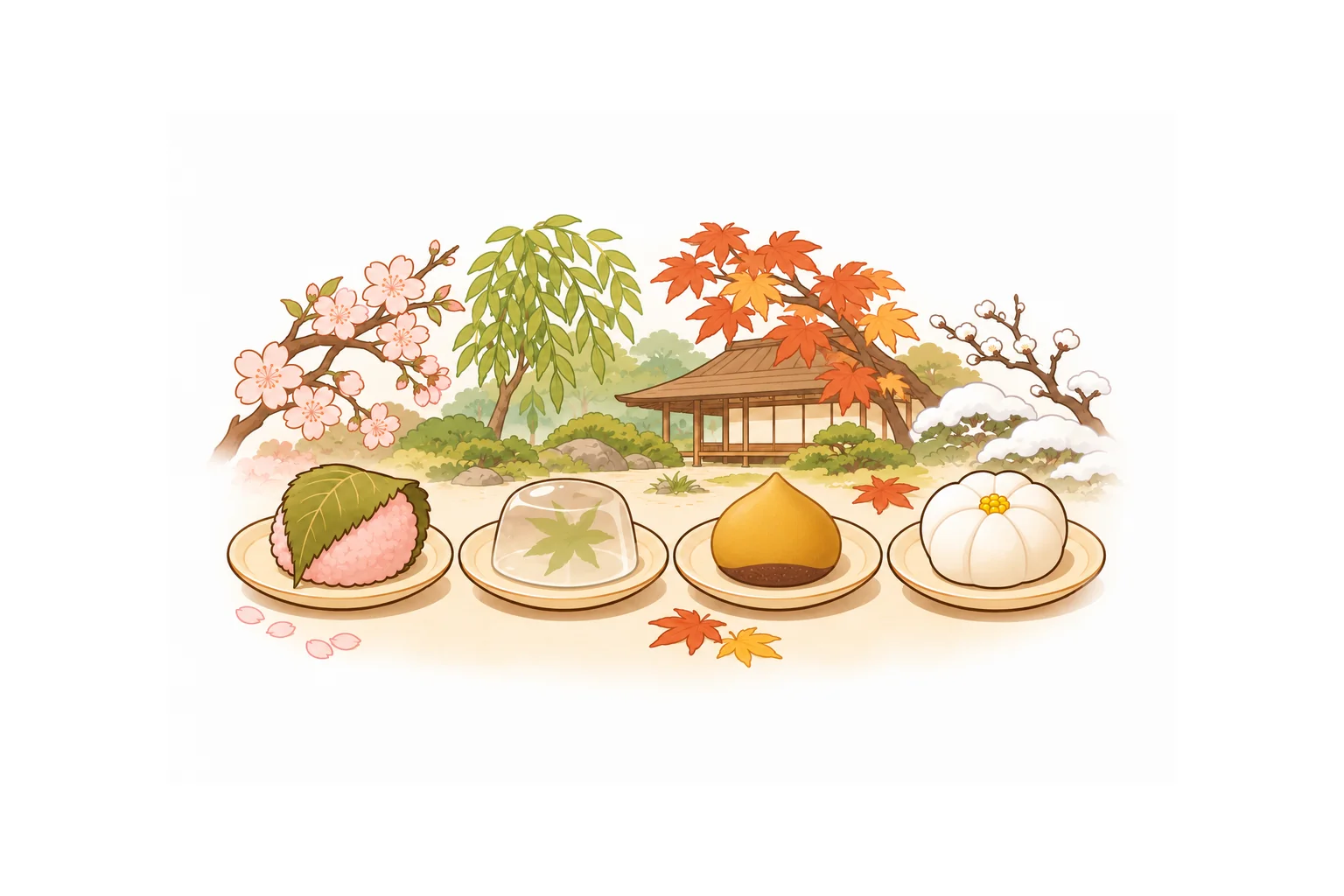
Walk into an old sweet shop in Kyoto in late September and the glass case has changed since August. The little red goldfish suspended in clear agar jelly are gone. In their place sit sweets shaped like chestnuts and a plate of plain white dumplings. Ask the shop assistant and each sweet has a name, and the name almost always carries a word for the time of year. Down the street, the supermarket has moon-viewing dumplings on the counter, and a fast-food chain is advertising its limited "tsukimi" (moon-viewing) burger. In two months the same street will be jammed with people who have come for the autumn leaves.
Japanese people like to say their country has four distinct seasons, and it sounds like a cliché until you spend a year there. Then you notice that the seasons are less a backdrop than a shared program, performed again every year. Underneath that program is a surprisingly fine calendar. The twenty-four solar terms, borrowed from China, cut the year into slices of about fifteen days by the sun’s position. Below those sit the seventy-two kō, or micro-seasons, each about five days long and each labeled with a short phrase about what nature is doing that week. Japan added its own markers too: Setsubun on the eve of spring, the equinox weeks called Higan, Hachijūhachiya (the eighty-eighth night, in early May), the official start of the rainy season, the midsummer doyō days when people eat eel. Those names are still printed on calendars. The climate helps. Across most of Honshū, winter and summer are sharply different, and between them come two long, wet transitions: the early-summer rains (tsuyu) and the autumn rains. When seasons change slowly, there is time to watch each stage.
The habit was learned in poetry. The Kokinshū, an imperial anthology compiled in the early tenth century, arranged its poems by spring, summer, autumn and winter, and for a thousand years Japanese verse kept to that order. By the time of haiku the season had become a rule. A seventeen-syllable poem normally contains a kigo, a season word: frog is spring, cicada is summer, and "moon" on its own means the autumn moon. One word sets the time and the air, and the reader fills in the rest. Poets keep a saijiki, a dictionary of season words sorted by time of year, close at hand.
From poetry the idea spread into food and clothing. Each fine confection, or jōnamagashi, has a poetic name called a kamei. At a tea gathering the guest asks for the name before eating, and reads the season, and the host’s intentions, in it. That works exactly like a season word in a poem. Kimono change with the calendar: lined garments (awase) from October to May, unlined hitoe in June and September, sheer gauze in high summer. Motifs are meant to run a little ahead of nature. You wear cherry blossoms before the trees bloom and put them away once the real flowers are out, because there is no point competing with them. Kaiseki cooks talk about shun, the moment an ingredient is at its best, and divide it further into hashiri, the first of the season, and nagori, the last. Put both on one plate and a single mouthful tastes of one season handing over to the next. A real maple leaf or a sprig of pine might be tucked under the food. Nobody eats it. It is there to tell you the season.
The big events come in spring and autumn. Cherry trees go from first bloom to full bloom in about a week and drop their petals a week after that, so the whole country stops to look. The Meteorological Agency announces the blossoming, and a "cherry blossom front" moves up the map day by day. In autumn the foliage front runs the other way, starting on the slopes of Daisetsuzan in Hokkaidō in mid-September and moving south and downhill; Kyoto’s temples usually peak in late November. Moon-viewing is the quietest of the three: a plate of dumplings and a few stalks of pampas grass under the eaves, once on the fifteenth night of the old eighth month, and again a month later on the thirteenth night, when people admire a moon that is still two days short of full.
Read these cards together and a pattern shows. What people watch is rarely the peak. They watch arrivals and departures: sweets that appear early, kimono motifs a step ahead, the last taste of a season saved for the end of a meal, a moon that isn’t quite round. The names of the micro-seasons often arrive before the weather does. It is still cold on the first day of spring, and the cherries may have barely opened when the calendar says they have. Nobody minds. Once the name arrives, people start looking out for the real thing.
The route begins with the card that explains the underlying calendar and the season words. Cherry blossoms and haiku follow, showing the season as a national festival and as a rule of verse. Then come three cards on sweets, kimono and kaiseki, where the season ends up on a plate or a sleeve. Autumn leaves and the autumn moon close out the year.
01Reading order
- The Seasons in Japan
The foundation for everything else. Read how the solar terms, micro-seasons and Japan’s own calendar markers divide the year, then see which small signs, from cicadas to ginkgo leaves, belong to which stretch.
- Hanami
The season at its most concentrated. Watch how a one-week bloom brings the country to a halt, and how blossom-viewing moved from Heian court banquets to Edo picnics.
- Haiku and Matsuo Bashō
Season words came from the opening verse of linked poetry. This is the grammar the other cards share: how a kigo and a cutting word fit a whole season into seventeen syllables.
- Wagashi
Focus on the chapters about seasonal sweets and the tea ceremony, where a sweet’s poetic name calls up a time of year just as a season word does.
- Kimono
Read the chapter on seasonal dressing. The rotation of lined, unlined and gauze garments, and the rule of wearing a motif slightly early, are how the season is worn.
- Kaiseki
Read the chapter on season, tableware and soup to see how first, peak and last ingredients are built into one meal, and how dishes and leaves announce the season.
- Momiji
Read it against Hanami. The foliage front runs opposite to the blossom front, and "leaf hunting" is another way of traveling to meet the season.
- Tsukimi
The year’s last act. Find out why both the fifteenth and the thirteenth night must be viewed, and how dumplings, pampas grass and taro turned court elegance into a harvest rite.