
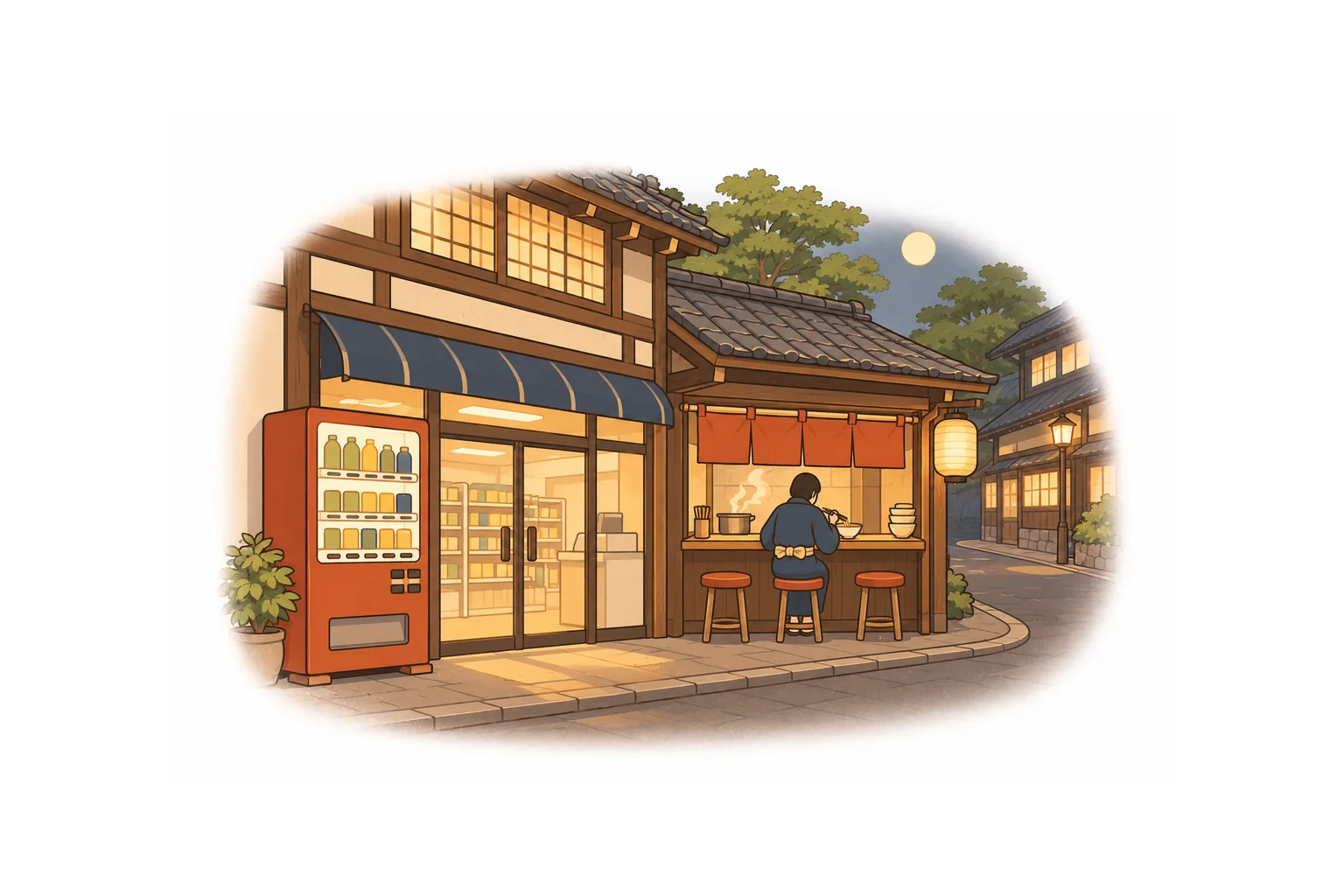
It is past eleven at night in Umeda, Ōsaka’s busiest hub, and you have just left a small bar with the last train nearly gone. The convenience store on the corner is still lit, and when the door chime sounds the clerk still calls out "irasshaimase," welcome. You buy a bottle of water and a rice ball, walk two blocks and find a capsule hotel. Shoes off and into a locker, bag into another, change into the house pajamas, have a bath, then climb into a pod about a meter wide and a meter high and pull the blind down. Dozens of strangers are sleeping within a few meters of you. Nobody says a word, and you sleep surprisingly well.
Spend a few days on your own in a Japanese city and a strange feeling creeps up: the place seems to have been designed for one person at a time. The capsule hotel appeared in Umeda in 1979, built for office workers who had drunk too late to get home to the suburbs. The konbini, or convenience store, is easiest of all on your own; people pop downstairs in slippers when they get hungry at midnight. The vending machine, or jihanki, needs no staff at all and takes up about a square meter of pavement; in winter a red label means hot and blue means cold. Each of these has its own history, but read side by side they answer one question. Japanese cities are full of people living alone in small apartments. Where do they go when they want to be somewhere other than home?
One answer is to buy a seat. A cup of coffee at a kissaten, the old-style independent coffee house, usually costs 500 to 800 yen, more than at a chain, but the price includes the chair and the time. You are brought a glass of water and a damp hand towel, there are newspapers and manga on the rack, and nobody minds if you stay all afternoon. People call the kissaten the city’s living room, study and meeting room, because their apartments have no space for any of those. The sentō, the neighborhood public bath, sells another kind of shared home. In Tokyo the adult price is capped at 600 yen. You push through the curtain marked ゆ ("yu," hot water), scrub down on a low stool first, then lower yourself into water at around 42°C beneath a painted Mount Fuji. Dozens of naked people share one pool without talking to each other, and everybody knows the rules.
At night the choices multiply. The izakaya, a Japanese pub built around drink and small plates, is usually pictured as a place for groups, but the long counter of an old red-lantern place is full of people who came by themselves. A few drinks and a few dishes come to 3,000 to 5,000 yen, and once you become a regular, the owner remembers your drink and the man on the next stool talks to you about baseball. If you would rather not talk, there is karaoke. Singing alone, hitokara, became ordinary in the late 2000s, and from 2011 there were even shops designed for solo singers, with booths of around two square meters. On a weekday afternoon a few hundred yen buys an hour or so, with nobody waiting for the microphone and nobody to hear you miss a note.
The last card on this route is the kōban, the neighborhood police box. It closes the list because everything before it rests on a layer you barely notice. Under the red lamp on the corner sits a police officer you can ask for directions or report a lost wallet to, and when people in Japan find a wallet or a phone, their first instinct is to take it to the nearest kōban. The all-night konbini, lit and staffed, also counts as a kind of safety post, and a vending machine full of coins can stand unattended by an empty road for more than a decade. The ease of walking a strange city alone at night is made of small things like these, stacked together.
Read the eight cards and you also see the cost. The night shift at a konbini is often one clerk running the whole store, and franchise owners frequently work those nights themselves. Tokyo had 2,687 public baths in 1968 and 417 in 2025. Many kissaten owners are elderly with no one to take over. The convenience of being alone in a Japanese city rests on a great many people working long hours, and some of these places grow fewer every year.
The order roughly follows a day. Check into a capsule late at night, get breakfast at a konbini, buy a can from a vending machine on the way, spend the afternoon in a kissaten, go to the sentō at dusk, have a drink at an izakaya, then shut yourself in a karaoke booth for a while. The kōban comes last because you can walk in whenever you need it.
01Reading order
- Capsule Hotels
The smallest unit of a night alone. Read why the first one opened in Umeda in 1979, then the first-stay section on moving between pod, locker and bath.
- Konbini
Where one person eats, pays bills, withdraws cash and sends parcels. The sections on the store as infrastructure and the price of keeping the lights on show who keeps it running.
- Japan’s Vending Machines
A shop with no shopkeeper. Why a machine can stand by an empty road for years, and what the red and blue labels mean.
- Kissaten
The price of a coffee buys a seat you can keep. Read how it became the city’s living room in the Shōwa era, and the last section on how long it is fine to stay.
- Sentō
Hot water for a few hundred yen and a neighborhood living room. The walk-through covers the rules, then the card turns to how the numbers fell and how young owners are taking over old baths.
- Izakaya
A counter with room for one. Read about red-lantern places and standing bars, then the first-visit section so you can push the door open without hesitating.
- Karaoke
From singing in front of a bar full of strangers to singing alone behind a closed door. The passage on hitokara explains why people want a small room where it is safe to let go.
- Kōban
The red lamp on the corner that underpins everything else on this route. Read the lost-property section and the advice for travelers before you need to ask directions or report a loss.