
On an early-July evening in a Tokyo station concourse, a clump of bamboo stands near the ticket gates, its branches hung with strips of colored paper: "Let me pass my first-choice exam," "Let Grandma stay healthy." A table beside it holds pens and blank strips, called tanzaku, and anyone may add one. This is Tanabata, the Star Festival, and it opens the Japanese summer. The story comes from the Chinese tale of the Weaver Girl and the Cowherd, two stars kept apart by the Milky Way, but in Japan the festival became a day for everyone’s wishes, a habit traced to Edo-period temple schools, where children wrote on five-colored paper, hung it on bamboo and prayed for better handwriting.
From that bamboo in early July to the last firework over a riverbank at the end of August, somebody in Japan is holding a festival almost every weekend. This route puts eight cards in the order a summer unfolds. Read in sequence, they show something the noise tends to hide: most of these festivals are, underneath, about sending something away.
Tanabata already is. The bamboo decorations were traditionally floated off on rivers or the sea to carry impurity away, and the old calendar treated the festival as preparation for Obon. Tanabata also explains a puzzle travelers run into. In 1873 the Meiji government adopted the solar calendar, and festivals of the old seventh month were moved straight into July, roughly a month early. So Tokyo celebrates Tanabata on July 7, while Sendai’s famous version runs August 6 to 8, and Obon likewise splits into July and August versions. When the same festival seems to happen a month apart in two places, the calendar change is usually why.
July in Kyoto belongs to the Gion Matsuri. Visitors know the procession of towering floats on July 17, but the festival fills the whole month, and its origin is usually dated to an epidemic in 869. The Kyoto basin was hot, humid and disease-prone in summer, so at the most dangerous time of year people invited the plague deity out, placated it and saw it off. The neighborhoods take their floats apart as soon as the procession ends, it is said so that the gathered spirits of disease do not linger. On the evenings before, children in yukata sing outside the neighborhood halls, selling chimaki: bundles of bamboo leaves that are not for eating but for hanging over the door as a year’s charm against illness.
By mid-August tens of millions of people are heading home. Obon is not a public holiday, yet it is the biggest family reunion of the year after New Year. On the evening of the 13th families light a small fire of hemp stalks at the gate to guide the ancestors home. On the altar stand a cucumber horse and an eggplant ox, so the spirits can arrive quickly and leave slowly. After a few days another fire, on the 16th, sends them back. Kyoto’s great mountain bonfires on the night of the 16th are that farewell performed by a whole city, which is why Kyoto people wince when outsiders call it Daimonji-yaki, as if it were a show.
Obon nights bring dancing. Bon odori began as a dance to keep the returning dead company and send them off in good spirits; today it is usually a neighborhood summer gathering. A wooden tower goes up in a shrine yard or school ground, lanterns are strung out from it, and people circle it slowly, repeating a sequence of about ten beats that anyone can pick up after a couple of rounds. Tokushima’s Awa Odori, August 12 to 15, is also an Obon dance, but instead of circling, hundreds of troupes parade down closed-off streets. Its song puts the whole idea in one line: the dancers are fools and the watchers are fools, so if you’re a fool either way, you might as well dance. Visitors can join a niwaka-ren, a pickup troupe that teaches the basic step on the spot.
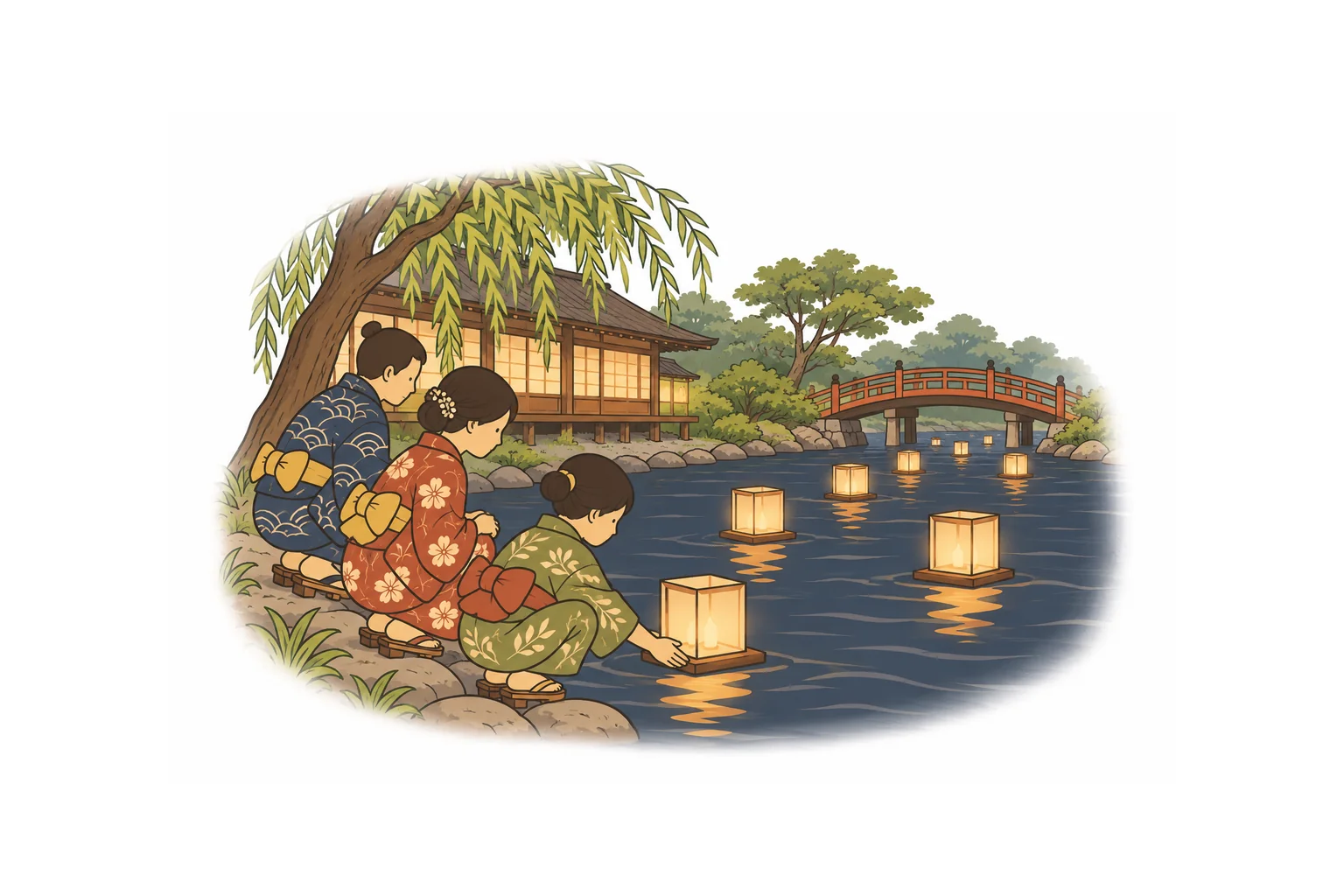
Farther north, Aomori Nebuta hands the city center to glowing giants from August 2 to 7. Its roots lie in nemuri-nagashi, "floating away sleep," the custom around Tanabata of setting lanterns adrift to wash away summer drowsiness and impurity. On the final night a few of the great lanterns go out on barges in the harbor under fireworks. Like Awa Odori, it has almost no barrier to entry: rent the costume of the haneto, the leaping dancers, and you can jump in alongside any group, chanting "rassera."
Fireworks carry the same memory. The Sumida River display is usually traced to 1733, when the shogunate held a water-god ritual for the victims of famine and epidemic, with fireworks said to have been set off at the same time. Nagaoka opens its show every year with pure-white shells called shiragiku, "white chrysanthemum," for those killed in the 1945 air raid. People watch for the few seconds of brilliance, and also for the darkness and quiet that follow.
The last card is the yukata, the light cotton robe, because you will want it at nearly every event above. Once something worn after the bath, it came back from the 1990s onward as the summer outfit for fireworks dates and festival nights. Left panel over right; a plaster between the toes before you set off in wooden geta; and wear it roughly from June to early September.
Laid end to end, the cards give a summer an itinerary: write a wish at a station in early July, see the floats in Kyoto in mid-July, head north to Aomori in early August, then to Tokushima or any small town’s dance circle in mid-August, and finish at the Ōmagari national fireworks competition on the last Saturday of the month. It is a loud season, and under the noise much of it is a farewell.
01Reading order
- Tanabata
Start with the star lovers and the temple-school wish strips, then see how the calendar reform split the festival into July and August, the date puzzle that runs through this whole route.
- Gion Matsuri
A city spends a month seeing off plague; read the schedule and the section on the festival eves, then pick a night to walk among the lanterns.
- Obon
It lays out the three or four days of welcoming fire, altar and sending-off fire; the dances and lanterns on the following cards all revolve around them.
- Bon Odori
Follow the dance from Buddhist chanting to the neighborhood summer party, and read the last section on how to step into the circle.
- Awa Odori
Read it against the previous card to see how Tokushima stretched the circle into a street parade, and how visitors join in.
- Aomori Nebuta
The origins in "floating away sleep" and a lantern maker’s year explain why these are pictures painted for the night.
- Hanabi
From the Sumida River’s memorial rite to Nagaoka’s white chrysanthemums, plus why a Japanese firework looks round from every angle.
- Yukata and Jinbei
You will wear it to everything above; read where it came from and the final section on how to wear it and walk in it.