
It is a little after eleven on the night of December 31. On television, NHK’s year-end song contest, Kōhaku Uta Gassen, has just finished, and the screen cuts to a mountain temple under snow, where a bell is being struck, slowly, one stroke at a time. Step outside and the street is quieter than on any other night of the year. The shopping arcade shutters came down hours ago. The only movement is on the road to the local shrine, where people are beginning to gather. This is how the Japanese New Year, shōgatsu, begins.
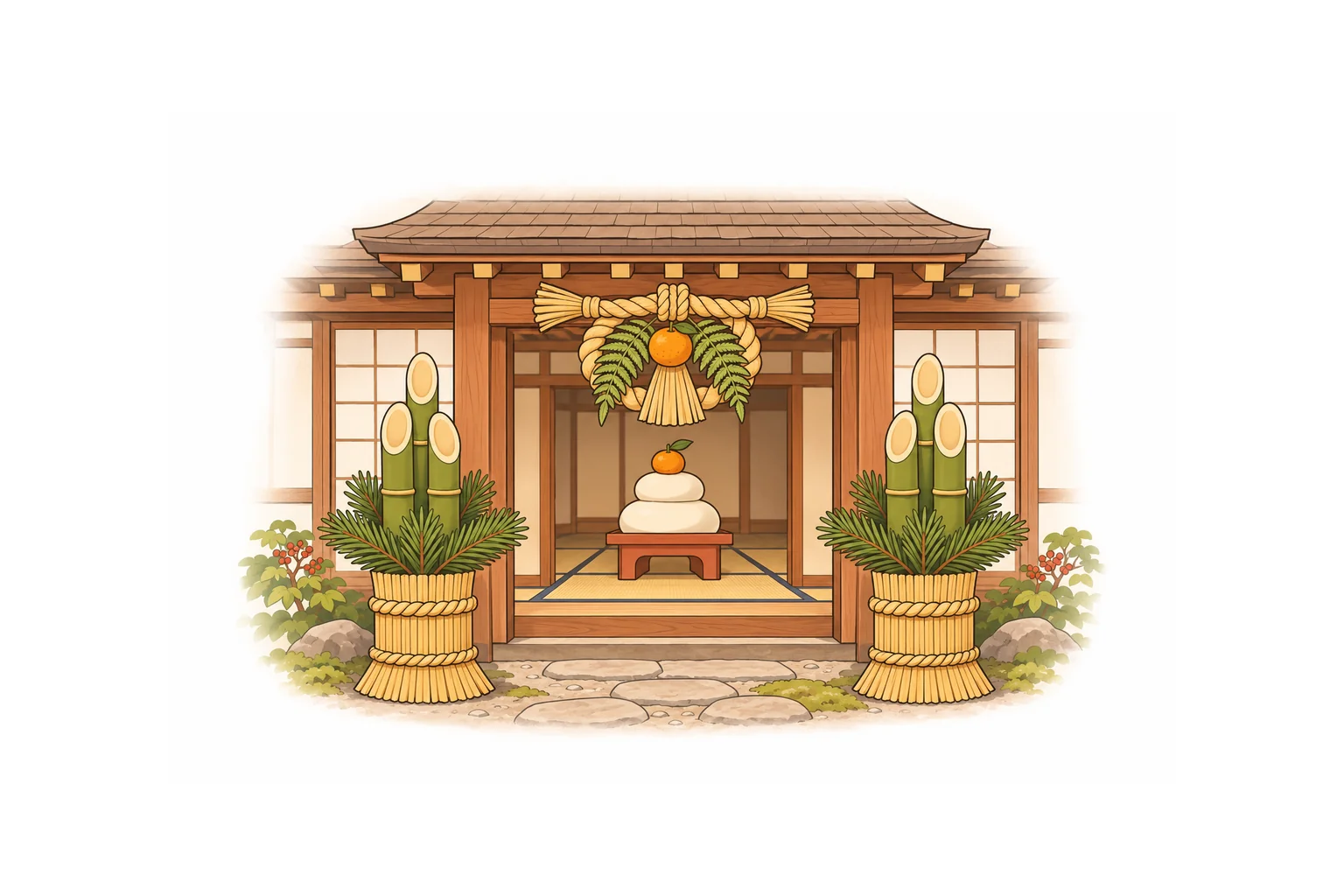
The first thing to know about winter in Japan is that New Year falls on January 1 of the Western calendar, and that underneath the decorations and the food it is a piece of hospitality. In folk belief, a deity called the toshigami, the god of the year, comes down from the mountains or from far away to visit every household. Families clean the house in mid-December. A pair of pine-and-bamboo kadomatsu stands at the gate to show the god the way; a rice-straw rope marks the entrance as purified; a stack of round rice cakes, kagami mochi, gives the god somewhere to stay. The New Year meal is food first offered to the god, and the envelopes of money children receive, otoshidama, began as a share of the god’s gift. Around January 15, the decorations are carried out and burned in a bonfire, and the god is said to ride the smoke back home. Hold on to that idea of a welcome and a send-off, and the scattered customs of a Japanese winter start to fit together.
Take the little brocade charms sold at shrine windows, omamori. Plenty of people barely set foot in a shrine all year, yet carry one on their bag, and the usual understanding is that a charm lasts a year. On the first shrine visit of January, hatsumōde, you take a new one and hand back the old, and the shrine burns the old charms along with the New Year decorations. The red, round-bodied Daruma doll from Takasaki follows the same path. You buy one at the Daruma market on January 6 and 7, paint in one eye when you make a wish, and a year later take it back to the temple to be burned, then buy one a size larger. In Japan, good luck is not a one-time purchase; it is renewed each year as the god comes and goes.
Or take the treasure ship. People in the Edo period slipped under the pillow a picture of the Seven Lucky Gods aboard their ship of riches on the first or second night of the year, hoping for an auspicious first dream, hatsuyume. Only one of the seven, Ebisu, is native to Japan; the rest came from India and China and were assembled into a set in medieval Kyoto. In the first days of January, people in Tokyo and Kyoto walk routes linking seven temples and shrines, one for each god, collecting a stamp at each. Most routes are under ten kilometers, a pilgrimage and a neighborhood stroll at once.
New Year also has its television hours and its floor-mat hours. On January 2 and 3, university runners race from central Tokyo to Lake Ashi in the Hakone mountains and back, ten legs and about 217 kilometers in all. This is the Hakone Ekiden, and many families leave it on all morning after the holiday soup. What holds them is less the speed than the cloth sash, the tasuki, passed from runner to runner. In the evening, someone reads the opening of a classical poem aloud while everyone else kneels over cards scattered on the tatami, racing to slap the card bearing its ending. The poems are the Hyakunin isshu, a hundred verses chosen by the courtier-poet Fujiwara no Teika in the early 13th century. Each January the top competitive matches are held at Ōmi Jingū, the shrine to Emperor Tenji, author of poem number one.
Winter brings another kind of visitor, too, one with a demon’s face. On New Year’s Eve on the Oga Peninsula in Akita, men in red and blue masks and straw capes stomp into village homes as namahage, roaring for crying children and lazy people. To an outsider they look like demons; locally they are gods down from the mountain, seated in the place of honor, served sake, and thanked for their blessing on the coming year. They originally came on the fifteenth night of the old lunar New Year and moved to December 31 only after Japan changed calendars in the Meiji era.
A month later the treatment of demons is reversed. Setsubun, in early February, is the day before the traditional start of spring, which under the old calendar counted as the real beginning of the year. That makes it a kind of second New Year’s Eve. Families open the windows, throw roasted soybeans, and shout "Demons out, fortune in!", then each eat as many beans as their age. In a single winter, one demon is invited in and fed while another is chased out the door, and nowhere is Japan’s easy ambiguity about gods and monsters plainer.
The reading order below is simply a winter calendar: the welcoming of the year god, then the charms, lucky gods, races and card games of the holiday, then the visiting demon-gods of New Year’s Eve, ending with the beans of Setsubun. After these eight cards, the pine at a bank entrance, the one-eyed Daruma on a shop shelf, the students running across the television, and the sushi-roll posters in a convenience store window all have a place on the same page.
01Reading order
- Japanese New Year
The backbone of the route. Read how the year god is welcomed and sent off; every later card hangs on that structure of hosting a guest.
- Omamori and Ema
See how a charm’s one-year lifespan ties into the first shrine visit and the January bonfires, and read the startlingly frank wishes exam candidates hang at shrines to the god of learning.
- The Seven Lucky Gods
Start with the treasure ship and the first dream, then learn to tell the seven apart, useful if you plan to walk a New Year pilgrimage route.
- Daruma and Maneki-neko
Place Daruma’s eye-painting, temple burning and yearly upgrade inside the New Year cycle; the beckoning cat, which nobody replaces annually, makes a useful contrast.
- Ekiden
The Hakone course, its ten legs and the dreaded staggered-start rule explain why a student relay sits beside the song contest and the shrine visit as a fixture of the holiday.
- Hyakunin Isshu and Karuta
Follow a medieval anthology from Teika’s selection to a family card game to the hushed, lightning-fast matches at Ōmi Jingū.
- Namahage
The demon-faced gods of New Year’s Eve. Read where the name comes from and what happens between host and visitor inside one farmhouse.
- Setsubun
Winter’s last word. Read it against Namahage to watch the demon go from honored guest to evicted pest, and to see how convenience stores turned a regional sushi roll into a national habit.