
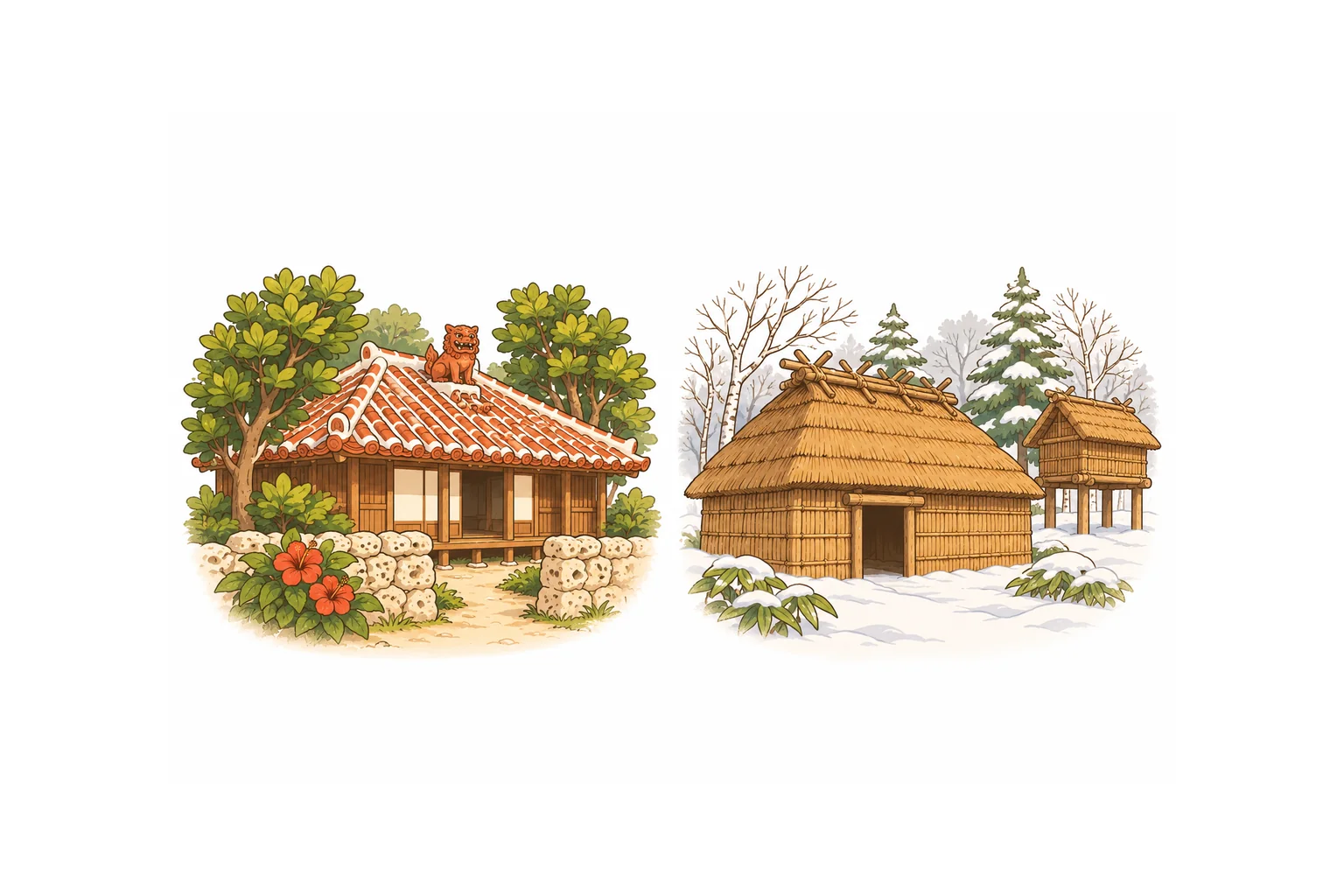
Ten o’clock at night in a folk-song bar in Naha. The singer on the little stage finishes a slow number, and then her picking hand speeds up. Customers set down their cups of awamori, the local rice spirit, get to their feet, raise both hands above their heads and sway side to side in the dance called kachāshī. The instrument is a sanshin, a three-stringed lute with a body covered in python skin, and half the lyrics would be lost on a visitor from Tokyo. At the other end of the archipelago, beside Lake Poroto in Shiraoi, Hokkaidō, a guide lifts a thin strip of bamboo to her lips and tugs a cord. The reed hums and buzzes like wind moving through trees. This is the mukkuri, the Ainu mouth harp.
Both sounds belong to Japan, and neither fits the picture most people have of Japan. This route reads the two ends of the country side by side, because their stories turn out to rhyme.
Start in the south. For some 450 years Okinawa was a kingdom. In 1429 a ruler named Shō Hashi unified the main island, and the Ryūkyū Kingdom, governed from Shuri, sent tribute to Ming China while its ships traded between Fujian, Korea, Japan, Siam and Malacca. A bell cast for Shuri Castle carried the phrase "a bridge between all nations." In 1609 the Satsuma domain invaded, and for more than two centuries Ryūkyū answered quietly to Japan while still presenting itself to China as a tributary. In 1879 the Meiji government abolished the kingdom, made it Okinawa Prefecture and moved the last king, Shō Tai, to Tokyo.
Now the north. Hokkaidō, southern Sakhalin and the Kuril Islands were home to the Ainu. Ainu means "human," and the word takes its meaning from its opposite, kamuy, the gods: the bear, the owl, the orca, the hearth fire, even a wooden bowl that has seen long use. In 1869 the Meiji government set up a colonization office and gave the land the name Hokkaidō. Settlers from the main islands poured in, and Ainu deer hunting and salmon fishing were banned or restricted.
Both regions were folded into modern Japan within a decade of each other, and both went through forced assimilation. Okinawan schoolchildren caught speaking their own language were made to wear a punishment placard. In Hokkaidō, a law officially titled the Hokkaidō Former Aborigines Protection Act stayed on the books from 1899 until 1997. Okinawa then carried a further weight: the Battle of Okinawa in 1945 killed more than 200,000 people, and the islands stayed under US rule for 27 years before returning to Japan in 1972.
Still, this route is less about wounds than about what survived, and survived loudly. The sanshin came from the Chinese sanxian, probably in the late 14th or 15th century, became an accomplishment of the Shuri aristocracy, followed displaced aristocrats into the countryside after the kingdom fell, turned into village folk music and traveled north to become the mainland shamisen. In the 1990s, hit songs carried its sound back across all of Japan. Eisa began as a dance young men performed house to house during the three days of the lunar Obon festival, chanting to send the ancestors back. After the war, an island-wide contest in Koza, a town pressed against a US air base, multiplied the drums until Eisa became Okinawa’s signature spectacle. Karate traveled furthest of all: a fighting method taught privately among Ryūkyū’s gentry entered Okinawan schools in the early 1900s, was demonstrated in Tokyo by Funakoshi Gichin in 1922, swapped the characters of its name from "Chinese hand" to "empty hand," and eventually reached the Olympics.
Belief in the two regions throws light both ways. On Miyako Island, mud-caked visiting gods called pāntu were inscribed in 2018 on UNESCO’s intangible heritage list together with Akita’s namahage. Okinawa’s sacred sites, utaki, are often just a grove and a stone, with no shrine building at all. The Ainu, for their part, held that the bear god comes into the human world wearing a bear’s skin and bringing its meat as a gift, and that people must return the favor with sake and inau, wooden wands shaved into curls, before sending the god’s spirit home. A god arrives from elsewhere, is hosted, and goes back: the pattern holds at both ends of the country.
The last card turns to the land itself. Shiretoko takes its name from an Ainu word meaning "the land’s protruding tip," and in winter drift ice packs the Sea of Okhotsk off its coast. In the Kushiro Marsh, red-crowned cranes, once thought extinct, were rediscovered in 1924, just over a dozen of them. Far to the south, the Kerama Islands of Okinawa Prefecture became a national park in 2014. Hokkaidō’s place names and Okinawa’s seas were both shaped by people who lived there long before the modern state arrived.
Read from south to north, and the word "Japan" turns out to be wider than it looks: a lost kingdom, an Indigenous people, settlers and military bases all fit inside it.
01Reading order
- Ryūkyū and Okinawan Culture
The gateway to the south. Follow the story from unification in 1429 through annexation, war and reversion, then the sacred groves, court theater and a bowl of noodles; the three Okinawan cards after it grow from here.
- Sanshin
Where the sound of Okinawa comes from, and how it moved from palace to village to national pop charts. It also tells you where in Naha to go and listen.
- Eisa
Read the three days of lunar Obon first, then how a postwar contest in Koza turned a village memorial dance into Okinawa’s emblem. Most useful for summer visitors.
- Karate
From the gentry’s "hand" to Funakoshi’s Tokyo demonstration and the settling of the name, watch an Okinawan art turn into a global martial art.
- Ainu Culture
The gateway to the north. Begin with the mutual hospitality of humans and kamuy, go through colonization and assimilation, end at Upopoy and Nibutani, and read it against the Ryūkyū card.
- Japan’s National Parks
The close. Read the sections on Shiretoko and the Kushiro cranes to see how Japan protects a landscape people still live in, and spot the Ainu words still embedded in the map.