
The credits of Spirited Away roll, and the questions start. Who are all those gods arriving by ferry to soak in the bathhouse? Why would a river have a god at all? And the great gray creature that Mei finds asleep under the camphor tree in My Neighbor Totoro: what, to a Japanese viewer, is he supposed to be? Ghibli’s films are fantasies, but very little in them is invented from nothing. Miyazaki Hayao and Takahata Isao got into the habit of going to look before they drew, back when they were making Heidi for television in the 1970s, and the forests, rice fields, farmhouses and spirits on screen all have relatives you can visit in Japan.
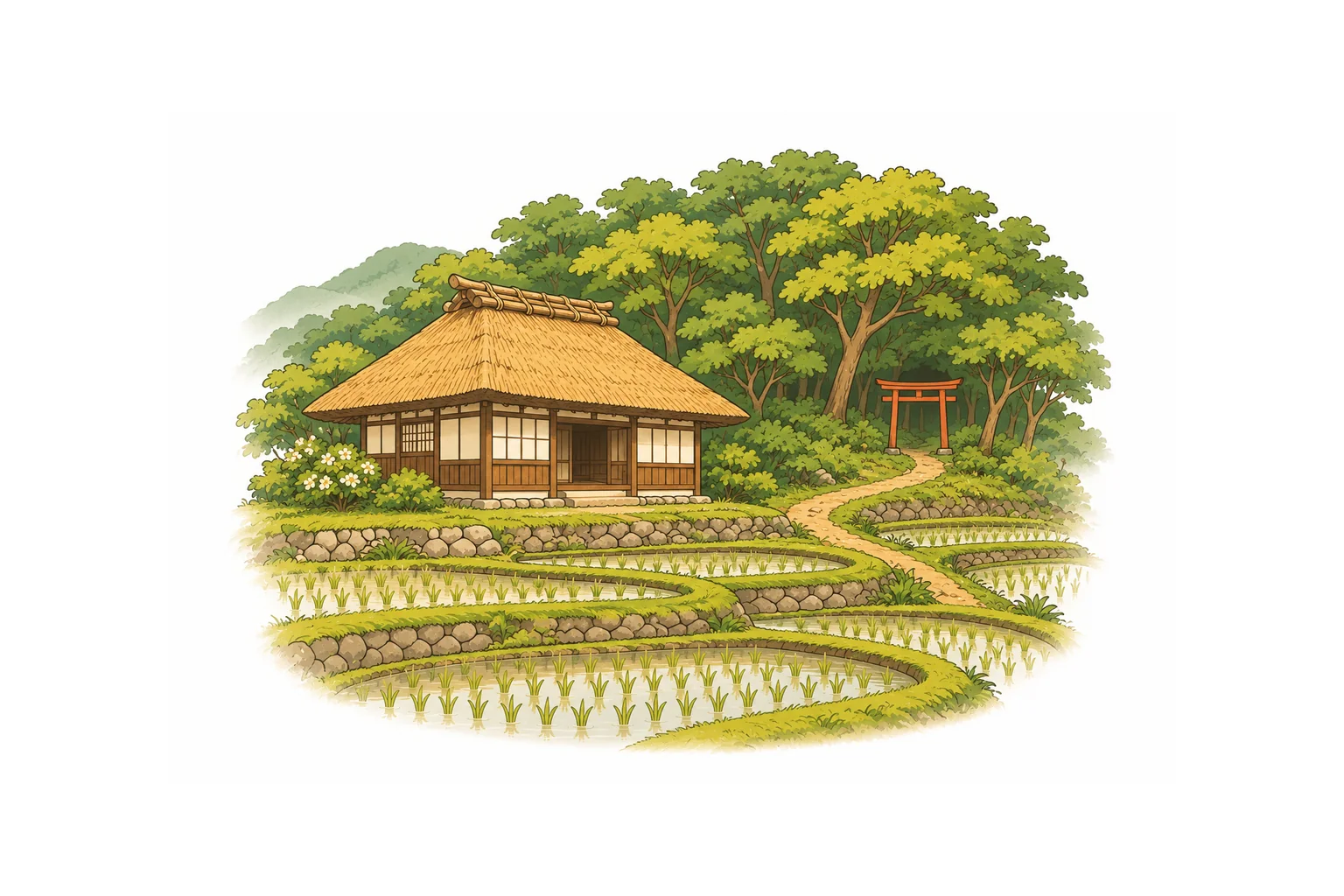
Start with the ground. The countryside where Satsuki and Mei move is a patchwork of coppice woods, paddies, ponds and streams. The Japanese call this kind of landscape satoyama, the hills and fields behind a village that people have worked for centuries. It is not wilderness. It exists because generations cut firewood, mowed grass and raked leaves for compost, and when people stop, the woods grow dark and the spring flowers and summer fireflies disappear. One of the models for Totoro is generally said to be the Sayama Hills on the Tokyo–Saitama border, where residents began raising money in 1990 to buy up woodland plot by plot as "Totoro’s Forest." Once you understand satoyama, you understand why so many Japanese viewers watch Totoro as a kind of homecoming.
Then step inside a house. The minka, the ordinary farmhouse, is built around a large earthen-floored work area, a cooking stove, a sunken hearth in the middle of a raised wooden floor, and a steep, thick thatched roof. The hearth had no chimney; its smoke drifted up and blackened the beams, which is exactly what preserved them. At Ghibli Park in Aichi Prefecture, Satsuki and Mei’s house has been built at full scale, and you can take off your shoes, walk in, and open the drawers. After reading about minka, the sliding doors, stoves and deep eaves in the films stop looking like scenery and start looking like a way of living.
Next come the gods. Ghibli’s gods are rarely remote. The mud-caked guest at the bathhouse turns out to be the god of a polluted river; Haku has forgotten his own name because his river was filled in and built over. Gods in these films get sick, get hurt, get forgotten. That is a very Shinto idea of a god. The Japanese word kami covers anything extraordinary and awe-inspiring, as the eighteenth-century scholar Motoori Norinaga put it: a mountain, a great rock, an old tree, a waterfall, a fox. Hence the stock phrase "eight million kami." Shinto has no founder and no essential scripture; it is mostly a matter of doing things, washing your hands, bowing, offering food and sake, and clearing away impurity. When Chihiro hauls a mountain of junk out of that river god and the whole bathhouse cheers, you are watching, among other things, a purification.
Behind Shinto lies an older layer of story, the myths written down in the eighth-century chronicles Kojiki and Nihon shoki. The god Izanagi follows his dead wife Izanami into the underworld, only to be told she has already eaten its food and cannot return. The sun goddess Amaterasu shuts herself in a cave and the world goes dark. The idea that eating in the other world binds you to it is there, faintly, when Chihiro’s parents gorge themselves and turn into pigs. Miyazaki was not necessarily illustrating the myths, but these stories have been retold for some thirteen hundred years and form the common stock Japanese storytellers draw on whenever they cross into another world.
The great myth-gods are far from daily life. The sacred figures people actually pass every day are smaller and friendlier. Inari began as a god of the rice harvest and ended up looking after business, households and fire prevention; there are said to be about 30,000 Inari shrines, guarded by pairs of stone foxes holding a key or a jewel. The foxes are the god’s messengers, not the god. Jizō, a Buddhist bodhisattva, stands at village edges, crossroads and cemetery gates as a shaven-headed little monk in a red bib, protecting children and travelers; in winter people knit him hats. When Satsuki and Mei take shelter from the rain in Totoro, they first put their hands together before a roadside Jizō.
Last come the yōkai, the creatures Japan invented to give shape to things it could not explain: the river-dwelling kappa, the mountain tengu, shape-shifting foxes and raccoon dogs, household objects that come to life after a hundred years. Folklorists often describe yōkai as gods who were not properly worshipped, and the line between the two is porous, which is why the traditional response is to placate a yōkai or strike a bargain with it rather than destroy it. The mononoke in the Japanese title of Princess Mononoke is an old word for a spirit that possesses people, and the bathhouse in Spirited Away is, after all, a resort for the eight million kami and assorted spirits.
The route moves from landscape to house, from gods to monsters, which is to say from what you can see to what you cannot. Rewatch the films afterwards and the strange creatures turn out to have been living in Japan’s villages, crossroads and old houses all along. On your next trip, a pair of stone foxes by a paddy or a Jizō in a knitted cap may feel like running into an old friend from the screen.
01Reading order
- Studio Ghibli and Miyazaki Hayao
Begin with the films themselves, what Totoro, Princess Mononoke and Spirited Away are about, and the studio’s habit of studying real places before drawing them.
- Satoyama and Satoumi
The real landscape behind Totoro’s forest and fields; read how it was kept alive by human work, how it nearly vanished, and how "Totoro’s Forest" came to be protected.
- Minka and Gasshō-zukuri
Walk into a farmhouse like Satsuki and Mei’s and see what the earthen floor, stove, hearth and thatch were each for.
- Shinto
Learn what "eight million kami" means, why a river or a tree can be a god, and why purity and purification matter so much.
- Japanese Mythology
Read the underworld and the sun-goddess-in-the-cave stories, the old common ground for Japanese tales of other worlds and broken taboos.
- Inari Worship
Meet Japan’s most familiar god through red gates and white foxes, and watch a rice god move from the fields to city rooftops and back alleys.
- Jizō
Get to know the little stone monk in the red bib, why he watches over children, travelers and the dead, and the folktale of the six snow-covered Jizō.
- Yōkai
Finish with kappa, tengu and haunted household objects, the blurry border between gods and monsters, and think back to the bathhouse guests and soot sprites.