
The most familiar scene in Japanese animation is probably not a giant robot or a magical transformation. It is a morning. A student pulls on shoes in the entryway, runs up a hill strung with utility poles, swaps outdoor shoes for white indoor slippers at a wall of shoe lockers, and slides into the classroom just as the bell goes, while the student on duty calls out "Stand, bow, sit." Watch enough anime and this routine feels as familiar as your own school days. Look closer and it gets strange. Why does the school year always start under cherry blossoms? Why are the students mopping the floors? Why does nobody go home when classes end? This route strings together seven pieces that explain the ordinary world anime keeps returning to, moving from the classroom to the station, from the lunchbox to the shopping street, and finally out to the real streets the animators drew.
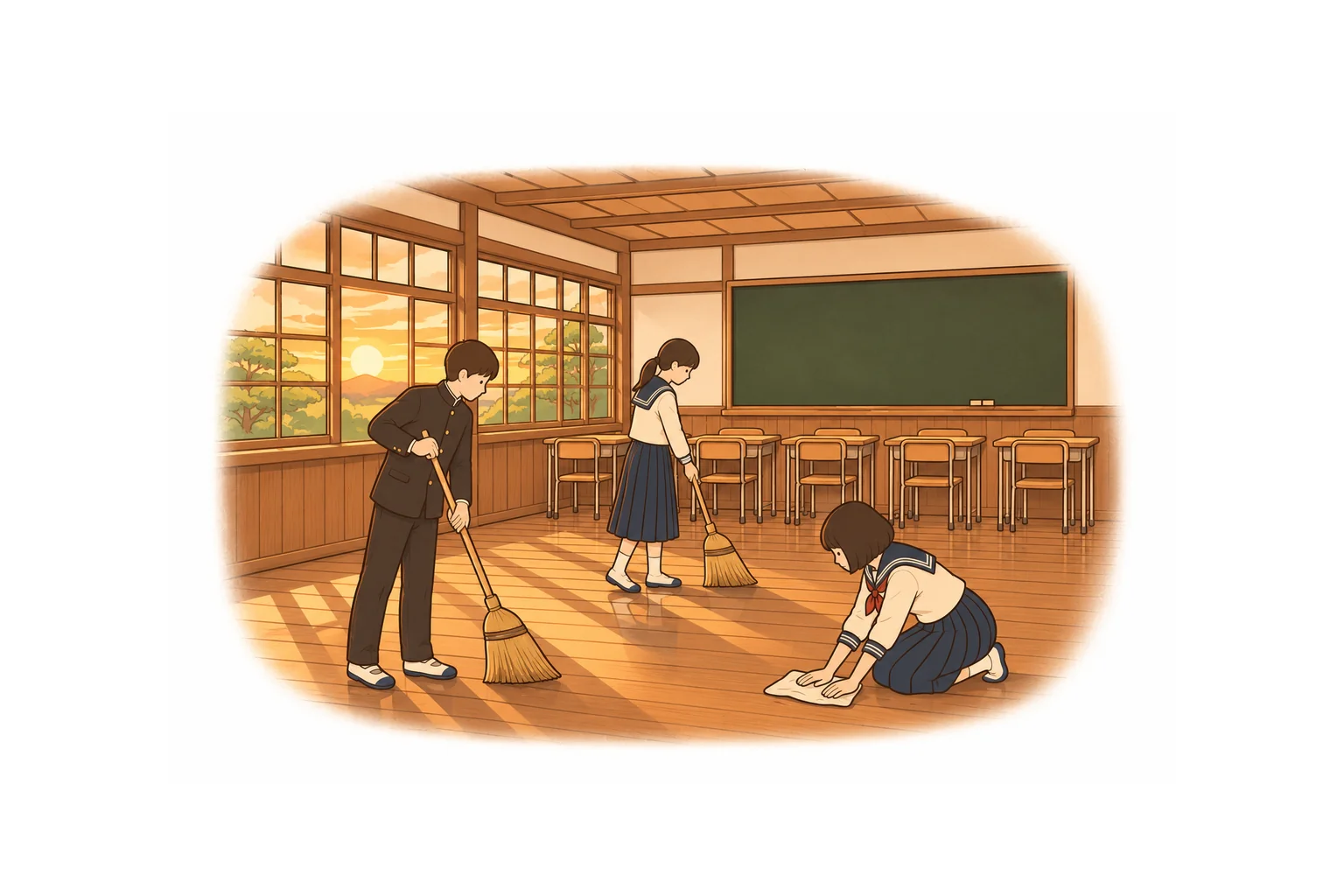
Start at school. The Japanese school year begins in April, right as the cherry trees bloom, which is why so many school series open with a new student under pink petals. Pupils clean their own classrooms, corridors and toilets every day, kneeling to wipe the floors. At lunch, students on rotation put on white smocks and caps, wheel the big pots of school lunch, kyūshoku, back to the classroom and serve their classmates, and everyone says itadakimasu together before eating. When lessons finish mid-afternoon, the school only gets louder: this is bukatsu, club activities, often five or six days a week, with a strict line between senior senpai and junior kōhai. The stand-up-collar jacket for boys and the sailor-collar outfit for girls both descend from military and naval uniforms. The second button begged from a boy’s jacket at graduation, the red-versus-white teams of sports day, the haunted houses and cafés of the autumn culture festival, the school trip to Kyoto and Nara: these are not anime inventions but fixtures of the real Japanese school calendar.
The other half of school life is exams. Behind the anime trope of the final-year student suddenly studying through the night lies a whole way of living called juken. The national university entrance test is held over a weekend in mid-January and seems to coincide with snow every year; schools then hold their own exams and post results through February and March. Passing is "the cherry blossoms bloom," failing is "the cherry blossoms fall." Many children attend juku, private cram schools, from primary school onward and leave at nine or ten at night, buying a rice ball at a convenience store for dinner. Candidates hang prayer plaques at shrines to the god of learning and receive KitKats from friends, because the name sounds like a Kyūshū-dialect phrase for "you’ll surely win."
Then there is lunch. Public primary schools and most middle schools serve kyūshoku, but many high schoolers bring a bentō, a packed lunch, which is why rooftop lunch scenes come with a box for everyone. A good bento has to taste fine cold and look good: rolled omelet sweet or savory depending on the family, red sausages cut so they curl into little octopuses, a single pickled plum on white rice. Some mothers turn rice, nori and ham into pandas or Totoros, a style called kyaraben, character bento. Classmates see what is inside when the lid comes off, so a lunchbox often carries messages a family would never say aloud.
On the way home, characters drift into a konbini. Japan has roughly 56,000 convenience stores, almost all open around the clock. Rice balls in clever pull-tab wrappers sit in the middle of the store, the hot case holds Lawson’s Karaage-kun and FamilyMart’s Famichiki fried chicken, and in winter a pot of oden simmers by the register. Eating fried chicken outside the store after school is close to a universal Japanese adolescent memory.
A little further into the old part of town is the shōtengai, the covered neighborhood shopping street: butcher, greengrocer, sweet shop, bookshop, side by side. At the butcher’s, croquettes come out of the fryer and are handed over wrapped in thin paper to students on their way home. Families often live upstairs and run the shop below, and anime likes to put its characters there: the heroine of Tamako Market comes from a family that runs a rice-cake shop on just such an arcade. Many of these streets declined after suburban malls arrived, and the rows of pulled-down shutters, shattā-dōri, are as real a part of provincial Japan as the lively arcades in the shows.
Along the way you notice how much of this everyday world is drawn as cute. Kawaii is a public language in Japan: round mascots outside police boxes, a black bear serving as a prefecture’s "sales manager." In the 1970s, schoolgirls developed a rounded handwriting their teachers tried to ban, and the huge, highlighted eyes painted by the illustrator Nakahara Jun’ichi from the 1930s are often cited as an ancestor of the big eyes of girls’ manga. The soft look of so much anime grew from that soil.
The last stop is seichi junrei, "pilgrimage to sacred sites," the fan practice of visiting real locations from anime. Background artists often work from photographs, so the utility poles, station signs and shrine steps match reality, especially in slice-of-life series where viewers spend twelve or twenty-four episodes walking the same route to school. In 2007, Lucky Star filled Washimiya Shrine in Saitama with fan-drawn prayer plaques; in 2016, the year of Shinkai Makoto’s Your Name, "seichi junrei" made the top ten of Japan’s buzzword of the year awards. Read the first six pieces before you go, and standing on that familiar street you will recognize the shoe lockers, the lunchboxes, the croquettes and the walk home for what they are.
01Reading order
- School Life in Japan
The source of nearly every school-anime scene, from entrance ceremonies and cleaning duty to school lunch, clubs, uniforms, festivals and trips; read it with your favorite scenes in mind.
- Entrance Exams and Juku
The other half of student life; the January test, cram schools and falling cherry blossoms explain the pressure behind every exam-season episode.
- Bento
Where the rooftop lunchbox comes from, what goes in a family bento, and how character bento turned lunch into a message.
- Konbini
The bright store on every walk home; read the stories behind the rice-ball wrapper, the hot-case fried chicken and winter oden.
- Shōtengai
The kind of covered street where the heroine’s family in Tamako Market runs a rice-cake shop; how it boomed, how it became a street of shutters, and where it still thrives.
- Kawaii
The aesthetic behind anime’s soft look, from girls’ magazine illustration to mascots and photo-sticker booths.
- Anime Pilgrimage
Step into the real streets behind the frames, with the stories of Washimiya and Ōarai and the manners every pilgrim should keep.