
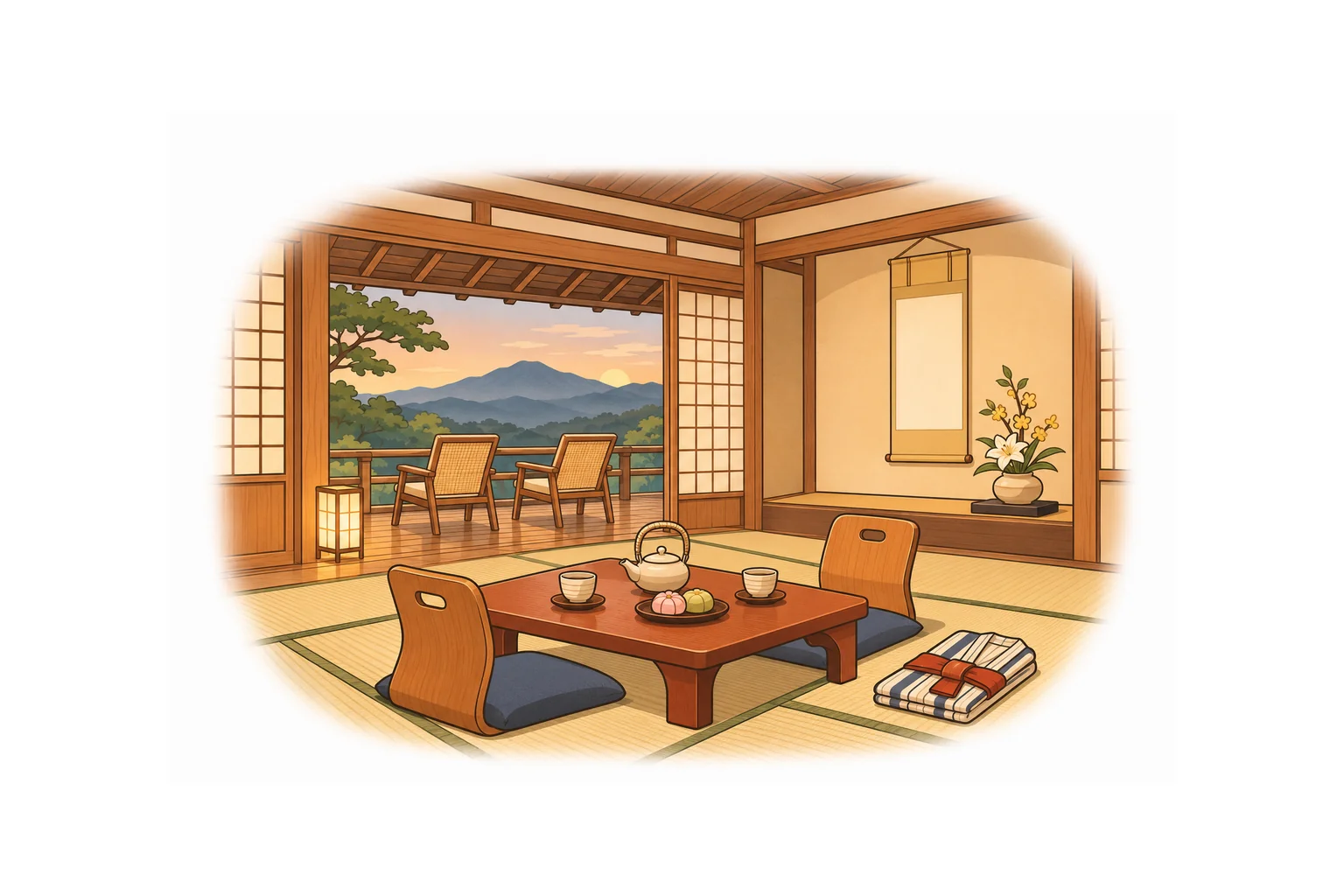
It is a little after three in the afternoon when the car pulls up at the last inn on the hot-spring street. In the stone-floored entrance someone takes your shoes, and you step up onto the raised wooden floor in your socks. That small step is the real threshold of a Japanese house: below it is the outside world, above it the floor you will sit, eat and sleep on. A room attendant, the nakai, leads you down a quiet corridor and slides open the door: eight tatami mats, a low table, and an alcove, the tokonoma, with a hanging scroll and a single seasonal flower. She kneels by the table, pours green tea, sets out a local sweet, tells you when dinner is served and where the baths are, and leaves. From now until about ten the next morning, very little is up to you.
That is what a ryokan sells: not a room so much as a stretch of time. Hotels charge by the room; ryokan charge per person, usually as ippaku nishoku, "one night, two meals." The formula is old. Inns on the Edo-period highways already served supper and breakfast, while hot-spring towns took in farmers who came for three weeks of therapeutic bathing, a practice called tōji, carrying their own rice and cooking for themselves. The modern hot-spring ryokan joins the two traditions. It also explains the house rules. Dinner is booked for a set time because the kitchen prepares course after course for a known number of guests; arrive too late and you may get a bed but no meal.
The six cards on this route follow the evening in the order you meet it.
First, the room. What surprises most visitors about a washitsu, a tatami room, is that it is not the same room at night as by day. When you come back from dinner, the table has been pushed aside and the futon bedding taken out of the closet and laid on the mats; the dining room has become a bedroom. The side with the tokonoma is the place of honor, and nothing, luggage included, goes inside the alcove. By the window there is often a narrow wooden strip with two armchairs, the hiroen, which puzzles foreigners and has been jokingly called a "mystery space" by Japanese guests too. It descends from the veranda of the traditional house, a zone between inside and outside, and it is exactly where you want to sit after a bath.
Second, the clothes. Folded in the closet is the inn’s yukata, a light cotton robe, often white with a fine blue pattern. The yukata began as something worn in and after the bath, and it has never quite lost that informality, which is why nobody blinks at guests wearing it to the bath, the dining room or a stroll down the hot-spring street. One rule matters above all: left panel over right. The reverse is how the dead are dressed. In cold weather a padded tanzen jacket goes on top.
Third, the bath. Japan sits on a chain of volcanoes, and under Japanese law water that emerges at 25°C or warmer counts as an onsen. What a first-timer really needs is the sequence. Check the curtains, usually blue for men and red for women; some inns swap the two baths overnight. Wash thoroughly at the seated showers before you get in. Keep the small towel out of the water, folded on your head or on the edge. Lower yourself in slowly, soak to the shoulders, climb out every five or ten minutes, and skip the bath after drinking. On the way back, the corridor fridge will often have bottled milk.
Fourth, dinner. A ryokan supper is almost always kaiseki in its banquet form: an appetizer, sashimi, something grilled, something simmered, often a small pot bubbling over a fuel tablet, and only at the very end rice, miso soup and pickles. The word kaiseki is written with two different sets of characters that sound the same. One is the meal served before tea at a tea gathering, where rice and soup arrive first; the other is the drinking banquet, where rice closes the meal. Knowing that explains why dinner can last an hour and a half or two, and why there should be something to drink on the table.
That drink is the last card. Sake is ordered by the gō, 180 milliliters. Fragrant ginjō is best chilled; fuller junmai sake often opens up when warmed. When drinking with others, pour for each other rather than for yourself, and keep a glass of water alongside, which the Japanese call yawaragi-mizu, "softening water," to make the morning easier.
Early the next day the bath is nearly empty, the view has changed, and many guests go once more before breakfast: rice, miso soup, grilled fish, a soft onsen egg, a sheet of nori. When you come back the futon is gone and the table is where it was. Fold the yukata roughly, leave it on the bedding, and check out around ten; the okami, the proprietress, or your nakai will usually see you off at the door and keep watching until the car turns the corner. By then omotenashi, the Japanese word for hospitality, has stopped being abstract. It is a room, a robe, a bath and a meal, each ready before you thought to ask.
01Reading order
- Ryokan
Start here for the whole sequence from 3 p.m. check-in to 10 a.m. departure, and for how "one night, two meals" grew out of Edo highway inns and hot-spring cures.
- The Japanese Room
Read for the story behind tatami, the tokonoma, paper doors and futon, and why one room serves as dining room by day and bedroom by night.
- Onsen
The first half explains where the water comes from and what the spring types mean; the walk-through from changing room to stepping out of the water is the part to read before your first bath.
- Yukata and Jinbei
See how the robe left the bathhouse, and pick up the practical rules: left over right, geta, and how to wear the inn’s own yukata.
- Kaiseki
Sort out the tea meal from the banquet, then use the course-by-course outline to follow dinner as it arrives.
- Sake
Focus on the sections on serving temperature and vessels, from chilled to warmed, gō to tokkuri, before you order a flask with dinner.