
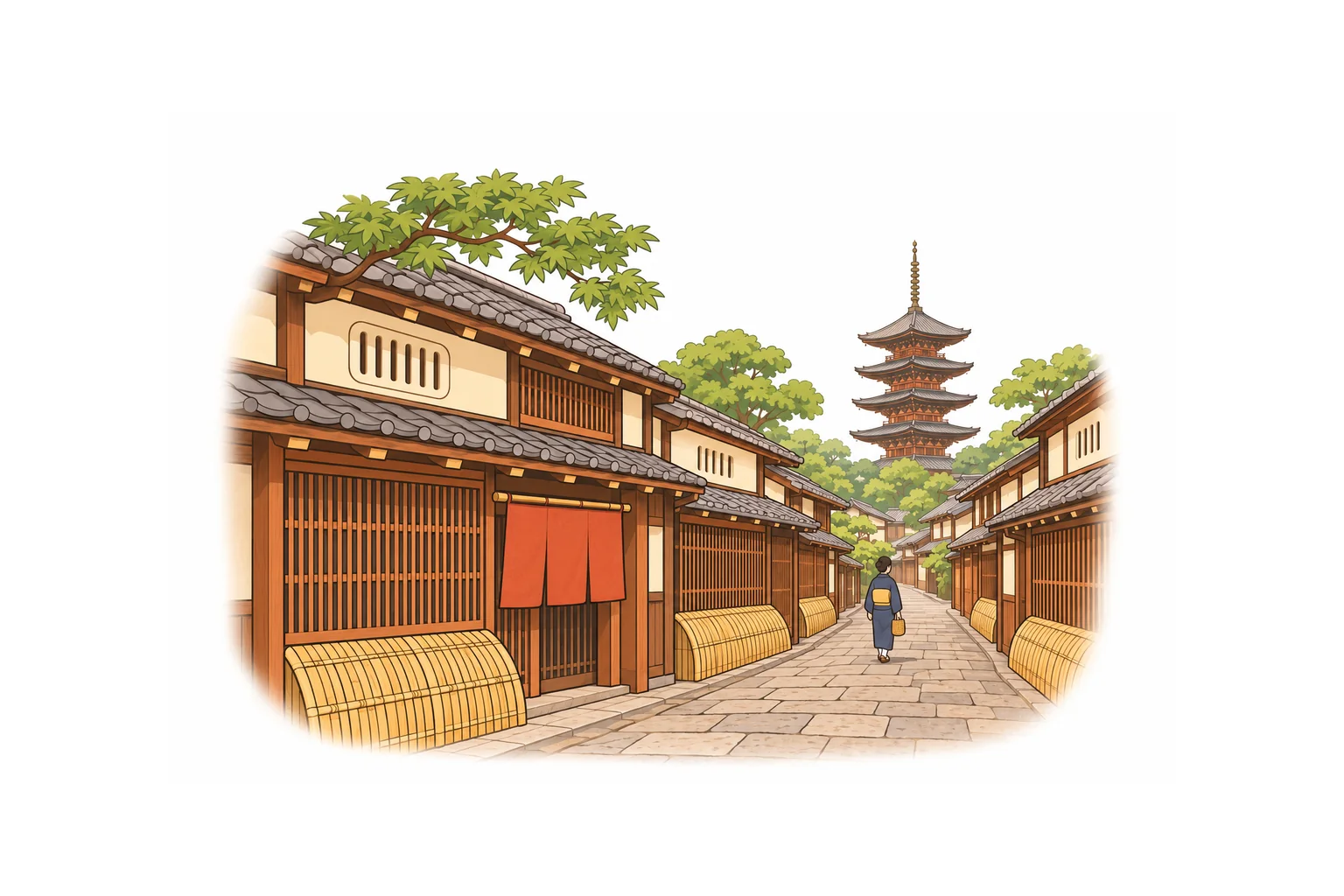
A little after eight in the morning, turn north off Shijō Street onto Muromachi-dōri, and the city is still quiet. Low wooden houses line both sides: dark lattice fronts, a squat second floor with narrow vertical slits in the plaster, a curved fence of split bamboo hugging the base of the wall. You can’t see through the lattice, but whoever is inside can see you perfectly well. These are kyō-machiya, Kyoto’s merchant townhouses, and they are the best place to begin three days in the city.
A machiya is only two or three bays wide at the front, four or five meters, but it can run twenty or thirty meters back from the street. Kyoto people call it "the eel’s bed." The shape goes back to the late sixteenth century, when Toyotomi Hideyoshi rebuilt the city and sliced its big square blocks into long strips so that every household could have a shopfront. The shop sat at the front, the family lived behind it, and in between was a tsuboniwa, a pocket garden a few square meters in size. Sprinkle it with water on a summer afternoon and a breeze is pulled through the lattice and down the length of the house. Just as important, no machiya stood alone. The houses on both sides of a street formed a chō, a neighborhood that shared responsibility for fire watch, security and festivals. The chō comes back on day three.
Day two is for temples. Almost every large Zen temple in Kyoto is the head of its own branch. Kennin-ji is the oldest of them, founded for Eisai, the monk who also brought powdered tea back from Song China. Across town at Ryōan-ji, visitors sit in a row on the veranda and look for a long time at a rectangle of white gravel and fifteen stones set in five groups. Nobody knows for certain who made it or when, and the temple offers no official interpretation. A Zen garden is meant to be looked at while sitting still, and if you sit long enough it quiets you down.
The cleverest trick in the Japanese garden is shakkei, "borrowed scenery." At Entsū-ji in the northern suburb of Iwakura, a moss lawn scattered with forty-odd low stones ends at a neatly clipped hedge; beyond it a row of tree trunks forms a frame, and inside the frame floats Mount Hiei. The whole garden exists for that one mountain, and the city now protects the view by law. Tenryū-ji in Arashiyama does the same, with the Arashiyama hills rising behind its pond.
After the temples and gardens comes a bowl of tea. Chanoyu, the tea ceremony, took its classic form in the sixteenth century under Sen no Rikyū, whose surviving tearoom, Taian, is just two tatami mats, so host and guest sit a tea bowl’s width apart. Rikyū’s descendants split into three houses; two of them, Omotesenke and Urasenke, still live next door to each other in Kyoto. For visitors, the easiest way in is an hour-long tea experience in the Gion or Higashiyama area, where you learn to lift the bowl, turn it, drink, and look at it. Tea people like to say ichigo ichie, "one time, one meeting": these guests, this weather, this scroll will never come together in quite the same way again.
A formal tea gathering includes a meal, and that meal is kaiseki. Two different words are pronounced kaiseki. One is the light meal served in the tearoom so guests don’t drink strong tea on an empty stomach, which is why the rice arrives at the start. The other is the banquet meal built around sake, where the rice comes last. What Kyoto’s ryōtei, its traditional restaurants, serve today is mostly the banquet kind touched by the spirit of the tea meal. Hyōtei, near Nanzen-ji, is said to have started as a teahouse for temple visitors. For a first kaiseki, lunch is the easiest way in.
As the light goes, walk to Gion. Lanterns come on along Hanami-kōji, and now and then a maiko in tall wooden clogs hurries past and disappears through a lattice door. Geisha (in Kyoto, geiko) are not hostesses; they are professional performers of dance, shamisen and conversation, and maiko are the young women still training. Gion itself grew out of the teahouses that served worshippers outside Yasaka Shrine. Watch from a distance: the stone lanes off the main street are mostly private, and photographing there without permission can bring a 10,000-yen fine. If you want to see them dance, buy tickets to the spring performances; Gion Kōbu’s Miyako Odori runs every April.
On the third morning, take the JR train to Inari Station, and the great gate of Fushimi Inari Taisha is right outside. The famous tunnels of red torii are quiet early. The higher you climb, the older the gates and the fewer the people, and the slopes fill with small stone markers set up by private worshippers. Inari began as a god of the rice harvest and ended up looking after business, households and nearly everything else, which is why so many little shrines sit behind Kyoto shops and on office roofs. The loop to the summit is about four kilometers and takes two or three hours; the Yotsutsuji crossroads halfway up looks out over the whole city.
If you happen to come in July, Muromachi-dōri, where you started on day one, becomes the heart of the Gion Matsuri. The festival began in 869 as a rite to calm an epidemic, and it belongs to Yasaka Shrine, but every one of its towering floats belongs to a chō, which stores it, assembles it and hauls it through the streets year after year. On the evenings of July 14 to 16, old merchant families take down their lattice fronts and display heirloom folding screens in the shop rooms, the one time of year a machiya opens itself to passers-by. On the morning of the 17th, teams of men drag floats weighing up to nearly twelve tons into the intersections and wrench them around ninety degrees.
Seen this way, three days in Kyoto trace a single line: merchants and their neighborhoods, stones and tea in the Zen temples, the meal that goes with the tea, the dance in the teahouse, the god on the mountain, and back to the festival the neighborhoods have kept running for generations. Kyoto’s beauty isn’t in any one famous sight. It’s in how well all these things know each other.
01Reading order
- Kyoto Machiya
Read before walking Muromachi-dōri and Shinmachi-dōri on day one. It shows how to spot the lattices, slit windows and pocket gardens, and explains the chō, the neighborhood unit the festival card depends on.
- Zen
Read before the temples on day two. It sorts out the Five Mountains, Daitoku-ji and Myōshin-ji, and its last two sections connect dry gardens, tea and Zen and tell you where to try sitting meditation.
- Japanese Gardens
Read alongside Zen. Focus on the sections on dry landscape gardens and borrowed scenery, then visit Ryōan-ji, Tenryū-ji and Entsū-ji knowing where to sit and what to look at.
- The Way of Tea (Chanoyu)
Picks up from the bowl of tea in the Zen temple. Follow wabi tea from Jukō and Jōō to Rikyū, then use the last section to be a good guest at a tea experience.
- Kaiseki
The meal that comes with the tea. Read it to tell the two kinds of kaiseki apart, follow the history of Kyoto’s ryōtei, and see how to book and eat at one.
- Geisha and Maiko
Read before your evening in Gion. It covers the five geisha districts, how a maiko trains and what happens at a banquet, plus the rules visitors should follow and the proper ways to see them.
- Inari Worship
Read before climbing Inari-san on day three. It explains where the foxes and red gates come from and how to dodge the crowds.
- Gion Matsuri
Read last; it ties the whole route together. See how each neighborhood keeps its float and how the eve nights and processions are scheduled, and use the final section if you are in Kyoto in July.