
It is close to ten at night when you finally drag your suitcase out of the station. Across the street a sign glows, and you push through the door into a convenience store. A chime sounds, someone behind the counter calls out "irasshaimase" (welcome), and a minute later you are paying for a rice ball and a bottle of tea. The clerk asks you something you don’t understand. You nod. The rice ball goes into a bag, a pair of chopsticks goes in after it, and you walk back to the hotel with the odd feeling that the country had already thought this through on your behalf.
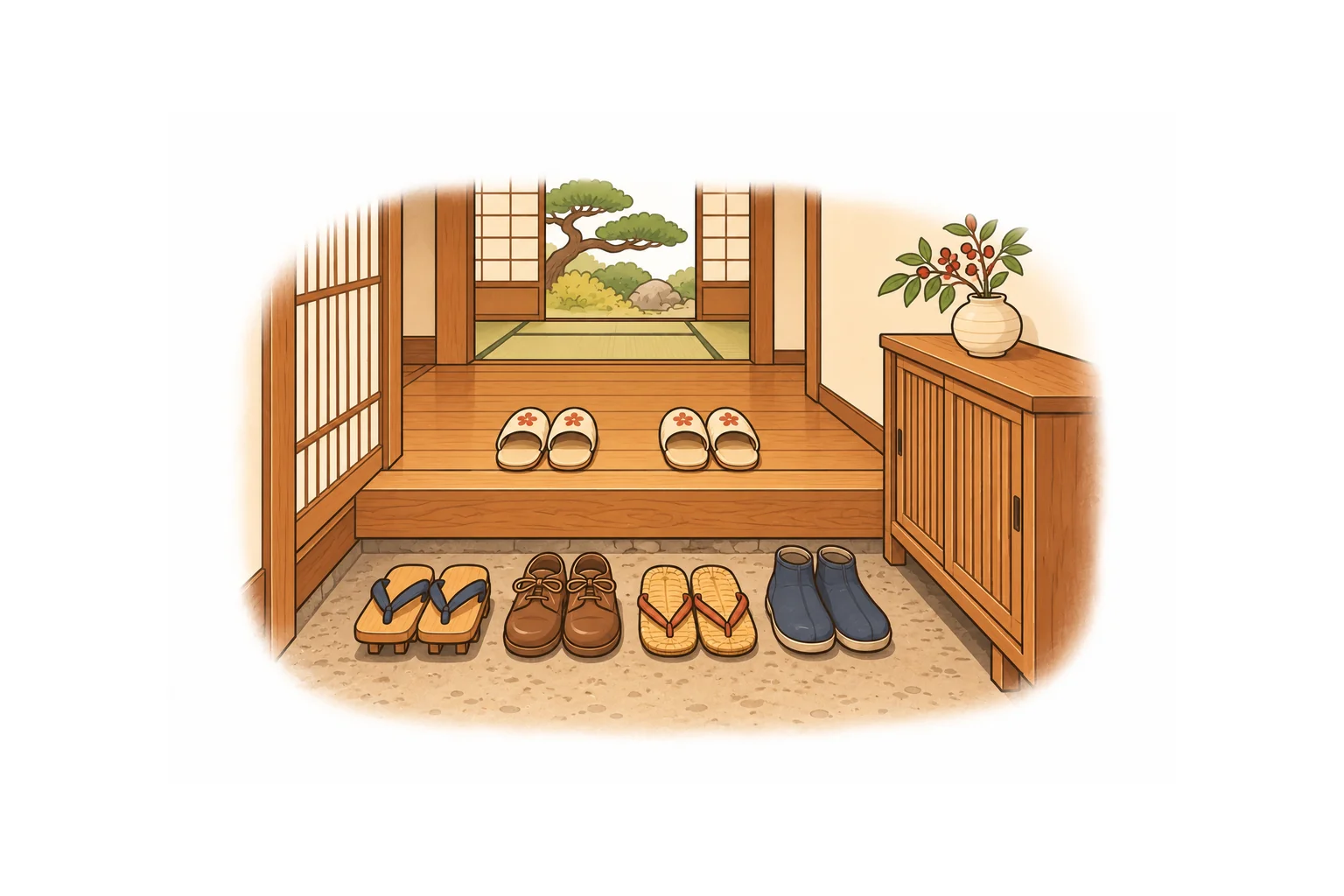
For the first few days in Japan, most visitors run into the same short list of things: the convenience store, the train, the bowing and the shoes left at the door, a pair of chopsticks, a pool of hot water, an inn with straw-mat floors, a little book held out at a shrine window, and a box of sweets bought at the station on the way home. They look unrelated. Read together, they turn out to be built on the same handful of ideas, and once you see those ideas the whole trip gets easier to read.
Start with the konbini, the convenience store. Japan has around 56,000 of them, nearly all open around the clock, each with only about 100 square meters of floor space. In that space you can withdraw cash, ship a parcel, print a document and buy a concert ticket. It works because of a system the customer never sees: since 1982, 7-Eleven Japan has been using checkout data to decide how many salmon rice balls each store should order for tomorrow. The railways run on the same principle. At rush hour on Tokyo’s Yamanote Line a train comes every two or three minutes. Painted marks on the platform show where the doors will open, people queue in two lines on either side, and everyone lets passengers off before getting on. A rechargeable IC card takes you through the ticket gate with a beep, and since 2013 the card you bought in Tokyo also works in Ōsaka or Fukuoka. You don’t have to ask anyone anything. You just follow the lines on the floor.
That is the starting point of Japanese etiquette. The word you hear most is meiwaku: being a bother to other people. Children are taught "don’t trouble others" before they are taught much else. No phone calls on the train, neat queues, taking your trash home: all of it comes back to meiwaku. Two other ideas sit beside it. One is the line between uchi and soto, insiders and outsiders. The other is kata, set forms: how deep to bow, how to place your shoes, how to hand over a business card. Because the forms are fixed, nobody has to guess what the other person wants. Japanese people are generally forgiving of foreign visitors who get things wrong, but knowing why the forms exist makes sense of a lot of seemingly fussy behavior.
The dinner table shows where the forms come from. A home meal is served one portion per person, usually without a spoon; you lift the soup bowl to your lips and hold the rice bowl in your hand. There are dozens of named chopstick taboos, most of them common sense. Two are worth remembering. Don’t stand your chopsticks upright in rice, because that is how a bowl is offered to the dead. Don’t pass food from your chopsticks to someone else’s, because that echoes the moment after a cremation when family members lift the bones together with long chopsticks. The rules look trivial, but they draw the line between the living and the dead into every meal.
At an onsen, a hot spring, "don’t be a bother" becomes a precise routine. Japan has more than 27,000 registered hot-spring sources, and the routine is the same at all of them: sit on a stool at the washing station and scrub yourself clean before you get in, keep your small towel out of the water (folded on your head is the classic spot), and lower yourself slowly into water that is usually 40 to 42°C. The bath is shared, so you arrive clean. A ryokan, a traditional inn, takes this kind of care to its limit. A hotel sells you a room; a ryokan sells you the time from 3 p.m. to 10 the next morning. You take off your shoes at the entrance, the room attendant pours green tea and leaves a small sweet, you change into a yukata, a light cotton robe, and go to soak. When you come back dinner is on the table, and when you come back from dinner the futon is laid out. Wear the yukata left side over right; the reverse is how the dead are dressed, the same boundary you met at the table.
At a shrine or temple you will see people waiting at a window while someone inside brushes a few lines of ink into a folding book and stamps it in red. This is goshuin. It looks like a souvenir stamp, but it is treated as proof of a visit to the gods or buddhas, which is why you pray first and ask second. It began as a receipt that temples gave pilgrims who donated hand-copied sutras, and only took off among young Japanese in the 2010s. The fee used to be 300 yen; 500 is now common.
And then you head home. On a Sunday evening in the passages under Tokyo Station, office workers stand at the sweet counters counting colleagues in their heads before buying a box of individually wrapped biscuits. Coming back from a trip empty-handed is barely acceptable. The habit goes back to Edo-period pilgrimages to Ise, when a village would pool money to send a few people and expect the shrine’s amulets in return. The box of biscuits on the office counter still says the same thing: I was away, I caused you some trouble, I’m back.
Taken together, these eight cards sketch everyday Japan as a web of settled ways of doing things that let strangers look after one another without much talk. Once you see the web, nodding at the konbini counter, lining up your shoes in the entryway and rinsing off by the bath stop feeling like rules and start feeling like part of the conversation.
01Reading order
- Konbini
The first place you walk into on your first night. Read it for the invisible system behind a tiny store, and use its last section as a practical guide to shopping in one.
- The Shinkansen and Japan’s Railways
The trains you will ride every day. Read it to see where the punctuality and platform order come from, and how IC cards and shinkansen tickets work.
- Japanese Etiquette
The explanation for the smoothness of the first two cards. Focus on the opening section on meiwaku, uchi and soto, and kata, and on the closing advice for guests.
- Chopsticks and Table Manners in Japan
Etiquette at the scale of a single meal. Read it for why you lift the soup bowl and why chopsticks never stand in rice or pass food.
- Onsen
Read before your first soak. It explains the analysis sign on the wall, and its fifth section walks step by step from changing room to bath.
- Ryokan
Bath, table and shoe rules combined into one night. Read it for how the evening unfolds and what to watch for when booking, arriving and checking out.
- Goshuin
The little book you will see at shrine and temple windows. Read it for what the ink and seals mean and how to ask for one politely.
- Omiyage and Gift-Giving in Japan
Read before you buy sweets at the station on the way home. It explains the individually wrapped boxes and the ledger of obligation behind them.