
Walk north up Ogawa-dōri in Kyoto, a narrow street lined with old townhouses, and you pass two quiet gates a few dozen metres apart. One belongs to Omotesenke, the other to Urasenke. A short walk south, on Mushanokōji-dōri, is a third, the home of Mushanokōjisenke. Between them, these three households, the San-Senke or "Three Sen Houses", teach most of the people who study tea in Japan today. But they are not the whole story. Samurai who learned from Sen no Rikyū founded schools of their own, and so did feudal lords of the Edo period and merchants in Kyoto and Edo. Some of those lines are still alive. This guide sorts out who is who, what you can actually see that tells one school from another, and how the system of hereditary grand masters has kept a bowl of whisked tea recognisably the same for four hundred years.
01Why tea has schools at all
The basic gestures of tea, warming the bowl, measuring powdered green tea (matcha) with a bamboo scoop, whisking it with hot water, are shared by everyone. A school, or ryūha, is a particular way of doing those things, handed down through a particular family or line of teachers. Differences lie in the exact sequence of movements, the way a cloth is folded, the preferred shape of a utensil, the amount of foam on the tea, and the aesthetic emphasis behind all of it.
By the seventeenth century there were three broad currents. The first was the Sen family itself, descended from Rikyū, rooted in Kyoto, and supported by stipends from great lords. The second was warrior tea. Many of Rikyū’s best pupils were daimyo, and they carried tea back to their domains, where it became part of the education of a ruling class; the shogunate appointed official tea instructors. The third was townsman tea: merchants and artisans in Kyoto, Osaka and Edo who studied under a particular master and kept his teaching going in their own families.
These streams overlapped constantly. Warrior tea men had often studied with Rikyū or his successor Furuta Oribe. Merchant schools often branched off from the Sen houses. The Sen houses themselves lived on warrior patronage. It is better to picture one tree with many branches than a set of rival sects.
What made the branches stable was the iemoto system: each school is headed by a hereditary grand master who controls the school’s procedures, grants licences, and confers tea names. Section 7 looks at how that works.
For a traveller, the school matters in a practical way. When you join a tea session at a temple, a garden teahouse or a hotel, the host belongs to one school or another, and the small courtesies you are taught, which hand lifts the bowl, how far to turn it, what to say before drinking, follow that school’s rules. Ask a different teacher in a different city and you may be shown a slightly different version. Neither is wrong. Japanese students accept this without fuss: you learn the forms of your own teacher’s school and politely follow the host’s lead when you are a guest elsewhere.
02The Three Sen Houses
How Sōtan’s three sons became Omotesenke (Fushin-an), Urasenke (Konnichi-an) and Mushanokōjisenke (Kankyū-an), and why "front" and "back" are only street geography, is told in the main tea article. Here the focus is on the houses themselves and what you can recognise of them.
Each tearoom name carries a story. Fushin-an is usually traced to a line by Rikyū’s Zen teacher Kokei Sōchin of Daitoku-ji, "Fushin hana hiraku konnichi no haru", roughly "Doubting, the flowers open: today’s spring". Konnichi-an, "Today Hut", comes with a well-known anecdote: Sōtan invited the Zen priest Seigan to the first gathering in his new tearoom but was delayed, and the priest left a note on the wall saying that a lazy monk like himself could not count on tomorrow. Sōtan took the point and named the room for the present day. The tale is told in later sources with variations, but Urasenke has kept the idea of "only today" close to its identity. Kankyū-an, "resting from office", is said to date from 1667, when Ichiō resigned as tea master to the Takamatsu domain.
The houses’ service to the Kii Tokugawa, the Kaga Maeda and the Takamatsu Matsudaira left traces in local crafts. Ōhi ware, the amber-glazed pottery of Kanazawa, is traditionally traced to a potter who travelled there with Sensō. In Wakayama, the Kairakuen ware fired in the garden of the tenth Kii lord, Tokugawa Harutomi, belongs to the years when Omotesenke’s ninth head served him.
Each house has a hereditary name that every head takes on. The head of Omotesenke is always Sōsa, of Urasenke Sōshitsu, of Mushanokōjisenke Sōshu, after Sōtan’s three sons. Because the names repeat, each head is also given a Buddhist art name ending in -sai by the priests of Daitoku-ji, and tea people refer to past heads by these: Joshinsai, the seventh head of Omotesenke; Gengensai, the eleventh head of Urasenke. Heirs carry a separate name before succession, and when a head retires he takes yet another. That is why Urasenke’s fifteenth head, Hōunsai, whose overseas work is described in the main article, is better known as Sen Genshitsu, the name he took after handing over to his son Zabōsai, the sixteenth Sōshitsu, in 2002. At Omotesenke the fifteenth head, Yūyūsai Sōsa, has succeeded Jimyōsai; Mushanokōjisenke is led by its fourteenth head, Futessai Sōshu.
Urasenke is by far the largest of the three, with branches across the world. Omotesenke is the second largest and has a reputation for conservatism, for changing as little as possible. Mushanokōjisenke is the smallest, though its designated heir, Sen Sōoku, has been active in exhibitions and writing about tea.
On Ogawa-dōri the gates themselves are worth a look: Omotesenke’s street gate, a samurai-residence gate received from the Kii Tokugawa in 1822, and Urasenke’s small roofed kabuto-mon. Behind them are some of the most copied rooms in tea. Omotesenke’s Zangetsu-tei, a reception room said to copy the one at Rikyū’s residence beside Hideyoshi’s Jurakudai palace, has been reproduced by tea people all over Japan. Urasenke’s Konnichi-an is just one full mat plus a three-quarter daime mat and a board in place of an alcove, about as small as a room for making tea can be, a measure of how far Sōtan pushed wabi in his old age.
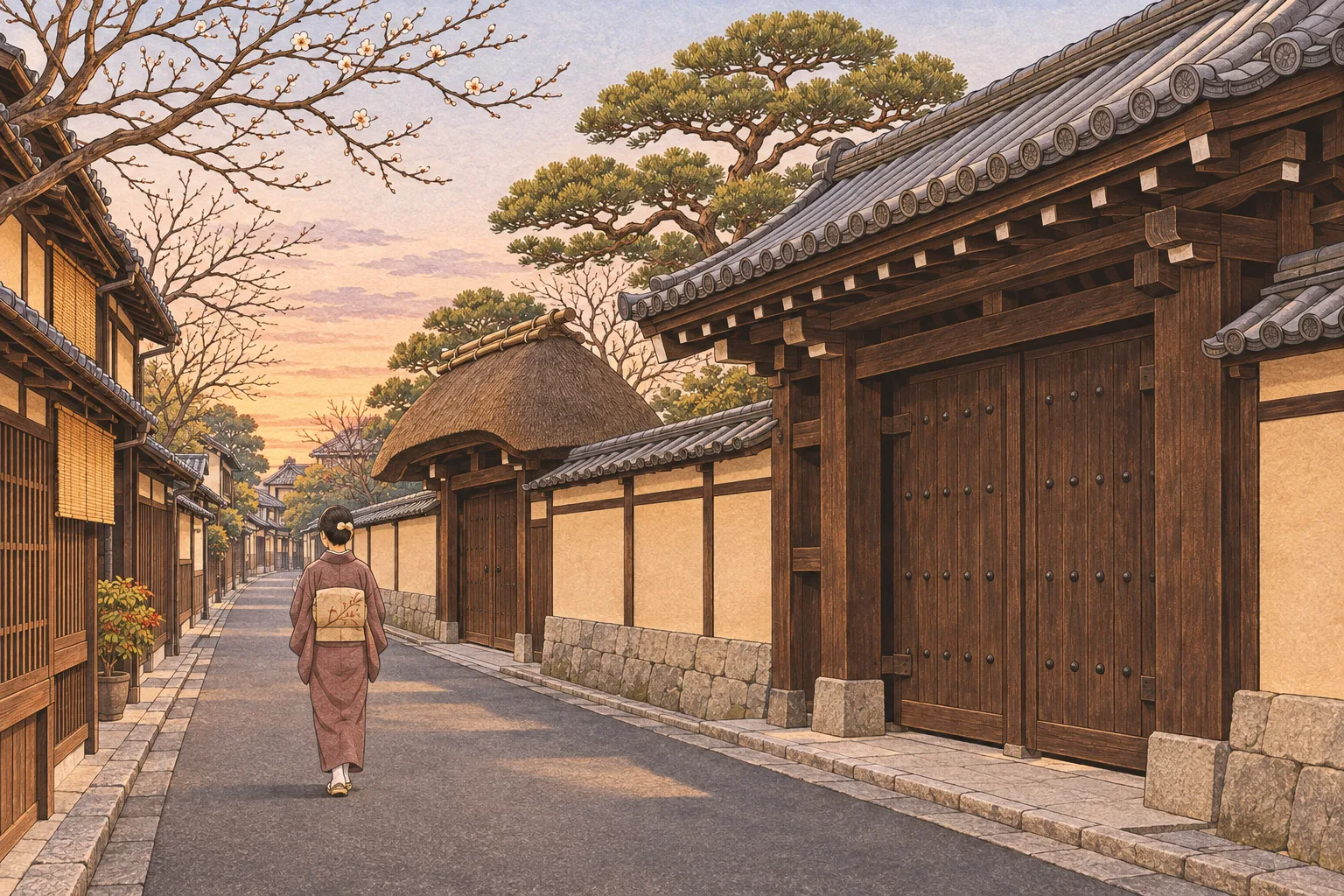
Ogawa-dōri in Kyoto. In the foreground is Omotesenke’s street gate, a samurai-residence gate received from the Kii Tokugawa in 1822; a few steps beyond is Urasenke’s small roofed kabuto-mon.
03Side by side: telling the Sen schools apart
Ask a Japanese tea student how to tell Omotesenke from Urasenke and you will usually get a list of small things. None of them is absolute, and individual teachers vary, but these are the comparisons people make most often, and several are visible from a guest’s seat.
The foam. This is the easiest. Urasenke whisks thin tea (usucha) briskly until a fine, pale-green foam covers the whole surface, often rising slightly in the middle. Omotesenke whisks more gently and leaves a lighter layer of foam, with a patch of dark green tea showing through, sometimes described as a "moon". Mushanokōjisenke aims for even less foam. If your bowl arrives looking like a cappuccino, the odds are good you are at an Urasenke gathering.
The whisk. Tea whisks (chasen) come mostly from Takayama in Ikoma, Nara Prefecture, where workshops cut different whisks for different schools. Urasenke uses pale "white bamboo", Omotesenke uses susudake, smoked bamboo with mottled dark-brown streaks, and Mushanokōjisenke uses purple-black bamboo. The whisk sits in the bowl when it is brought out, so its colour is easy to spot.
The silk cloth. The host wears a square silk cloth, the fukusa, at the left side of the obi and uses it to purify the tea caddy and scoop. All three Sen houses wear it on the left, so the position tells you nothing here. What is generally said to differ visibly is how it is handled, the small flourish of opening and refolding it. For thick tea (koicha), Urasenke guests are generally said to use a smaller cloth, the kobukusa, to support the bowl; Omotesenke and Mushanokōjisenke use a dashibukusa of full size. That affects what students carry in their kimono.
Feet at the threshold. No one steps on the threshold or on the cloth borders of the tatami. Which foot crosses first is fixed by each school, and Omotesenke and Urasenke are generally said to prescribe opposite feet, switching again on the way out. A visitor only needs the shared rule: do not step on borders.
Bows and walking. The placement of the hands in a bow, the number of steps per tatami mat, where the hands rest when sitting: all differ slightly. These are details insiders notice after sitting at several schools’ gatherings.
Taste in utensils. Every head of a school has his konomi, preferred or designed utensils, and a host will often say a piece is "the preference of" a particular head. Gengensai of Urasenke, for example, devised ryūrei, a style of tea made at a table with chairs, in the early Meiji years for foreign guests at an exhibition. You will meet ryūrei today at tea demonstrations in hotels and gardens.
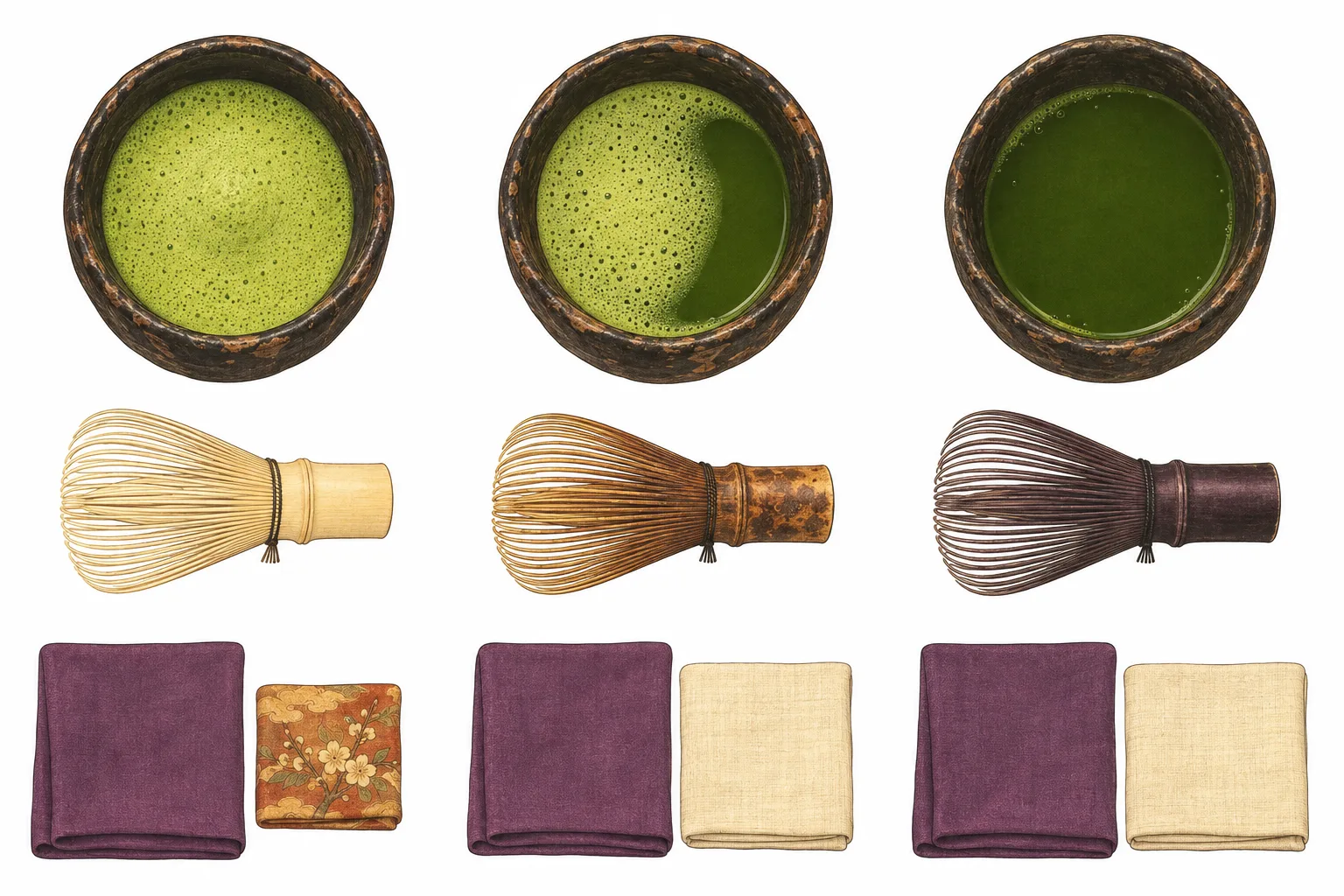
Three tells for the three Sen houses, from left: Urasenke, Omotesenke, Mushanokōjisenke. Top: the foam on thin tea, from a full cover, to a "moon" of dark tea showing through, to less still. Middle: whisks of white bamboo, susudake and purple-black bamboo. Bottom: the fukusa, with the small kobukusa (left) or full-size dashibukusa (centre and right) used for thick tea.
As a rough key for visitors: lots of foam, pale whisk, small cloth suggests Urasenke; light foam with a "moon", smoked whisk, full-size cloth suggests Omotesenke; less foam still and a dark purple whisk suggests Mushanokōjisenke. The schools themselves stress other things: Omotesenke its fidelity to inherited forms, Urasenke the four principles of harmony, respect, purity and tranquillity, while Mushanokōjisenke is often described as spare and economical in movement. None claims to be the "real" tea at the others’ expense.
Why should three brothers’ households drift apart at all? Partly it is simply time. Each house has passed through more than a dozen heads, and each head has adjusted something, introduced a utensil, simplified a gesture, written down a rule that had been oral. Partly it is patronage: serving different lords in Wakayama, Kanazawa and Takamatsu exposed each house to different local crafts and different expectations. And partly the differences became useful in themselves. Once students were organised by school, a whisk of a particular bamboo or a particular way of folding the fukusa was a quiet badge of belonging, in the same way that two martial-arts schools may share a technique but hold the sword a little differently.
04The ten craft families
Tea depends on objects, and for the Sen houses many of those objects come from ten hereditary craft families in Kyoto, the Senke Jusshoku. They are: the Raku family (tea bowls), Ōnishi (iron kettles), Nakamura Sōtetsu (lacquer), Komazawa Risai (wooden cabinetry and boxes), Nakagawa Jōeki (metalwork), Tsuchida Yūko (silk pouches for tea caddies), Okumura Kichibei (scroll mounting), Hiki Ikkan (ikkanbari, lacquered paper over a wooden or clay form), Kuroda Shōgen (bamboo ladles and wares), and Eiraku Zengorō (clay braziers and Kyoto ceramics). Most heads of these families take the same name each generation; the Raku family’s present head is the sixteenth Kichizaemon.
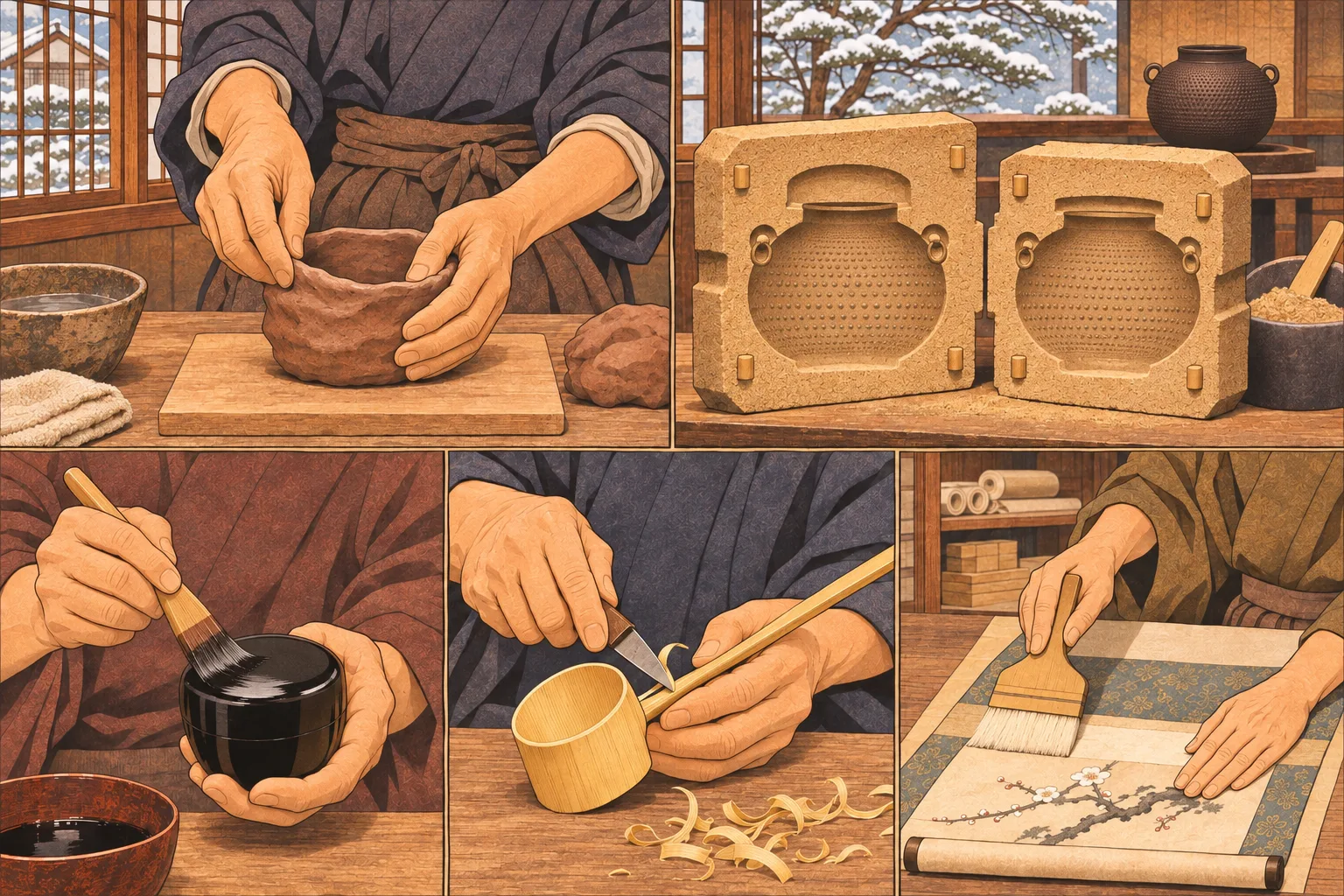
Some of the crafts behind the Senke Jusshoku. Upper row, from left: shaping a Raku bowl by hand; a sand mould for an iron kettle. Lower row, from left: lacquering a natsume, carving a bamboo ladle, mounting a scroll.
The label "Senke Jusshoku" was first used for department-store exhibitions in the Taishō era, when demand for tea utensils was booming; within the tea world the families are still usually called shokke, "craft houses". Before that, each grand master simply worked one to one with craftsmen, ordering pieces to his taste and signing the boxes, and in the mid-eighteenth century more than ten households made pieces for the Sen heads. In Kyoto you can see their work at the Raku Museum and at department-store galleries, where a jusshoku piece with a grand master’s box inscription sits in a different league from ordinary utensils.
The box matters as much as the object. A tea utensil normally lives in a plain paulownia-wood box, and when a grand master approves a piece he writes its name, his own name and his seal on the lid, a practice called hakogaki. At a formal gathering the host may set out the box for guests to see. The system ties maker, master and pupil together: the craft family makes, the iemoto names and approves, and the student, licensed to a certain level, is entitled to use certain kinds of utensils. Through the objects, a school’s taste becomes visible on the tatami.
05Rikyū’s warrior disciples: Oribe, Uraku, Sansai
The "Seven Sages of Rikyū" is a later grouping of his leading pupils. The most cited list, from notes written in 1663 by Omotesenke’s fourth head, names Gamō Ujisato, Hosokawa Tadaoki (Sansai), Furuta Oribe, Shibayama Kenmotsu, Seta Kamon, Takayama Ukon and Makimura Hyōbu. A slightly earlier list has Maeda Toshinaga (or, on another reading, his father Toshiie) in place of Seta Kamon, and later tea books bring in Oda Uraku, Sen Dōan or Araki Murashige. Only Gamō and Hosokawa appear in every version. Nearly all were warlords, a reminder that in Rikyū’s day tea was a political arena where Nobunaga and Hideyoshi rewarded and tested their men. Takayama Ukon, a Christian daimyo, ended his life in exile in Manila. Three of the circle left schools whose names you still meet on utensils and in museums.
Furuta Oribe (1543/44–1615) became the leading tea master after Rikyū and taught the second shogun, Tokugawa Hidetada. Where Rikyū sought stillness, Oribe liked movement. He favoured bowls deliberately pushed out of shape, with wavy rims and lopsided bodies; the "shoe-shaped" kutsugata bowl is the classic Oribe form. The green-glazed Oribe ware of the Mino kilns, named after him, is covered in the ceramics article. After the Osaka summer campaign of 1615 he was accused of collusion with the Toyotomi side and ordered to commit suicide; his house was extinguished. His pupils carried on the Oribe school, and his tearoom design survives in the Ennan at the Yabunouchi house in Kyoto.
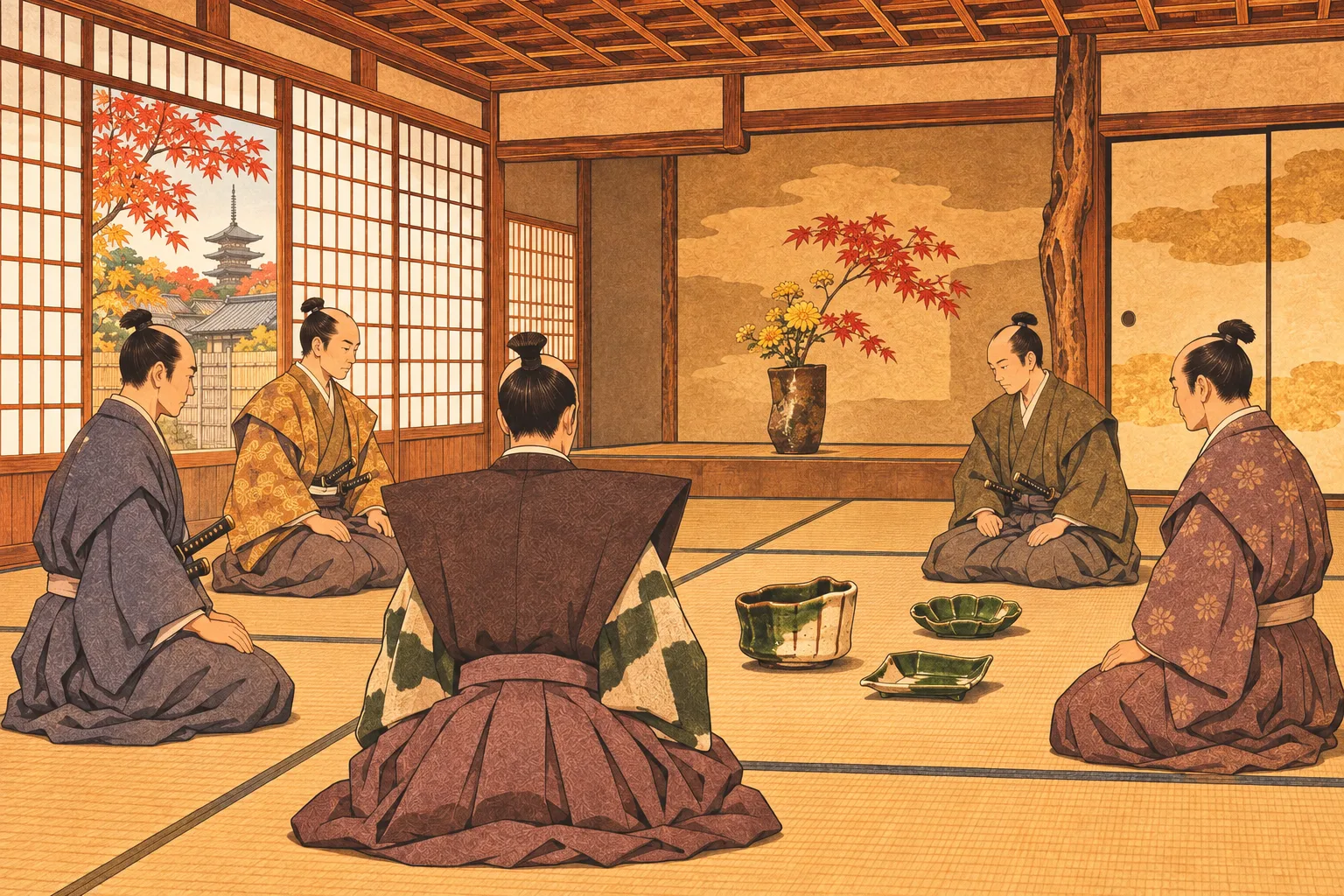
A warrior tea gathering in Oribe’s day, with a lopsided bowl and green-glazed dishes on the mat: brighter and livelier than Rikyū’s tea (artist’s impression).
Oda Uraku (1547–1622), born Nagamasu, was Nobunaga’s younger brother. At the Honnō-ji Incident he was in the Nijō palace with Nobunaga’s heir Nobutada, who died there; Uraku got out, which people have commented on ever since. He served Hideyoshi and then Ieyasu and retired to the Shōden-in, a subtemple of Kennin-ji in Kyoto, where he built the tearoom Jo-an. It is tiny, two and a half mats plus a short daime mat, but full of ideas: a window of tightly packed bamboo slats that casts striped light, the "Uraku window"; walls lined at the base with old calendar paper; a diagonal wall that makes the room feel deeper than it is. After moves to Mitsui family properties in Tokyo and Ōiso, Jo-an has stood since the early 1970s in the Urakuen garden in Inuyama, Aichi, and is one of only three tearooms designated National Treasures. Tokyo’s Yūrakuchō is sometimes said to be named after his residence, though the link is doubtful. His line is called the Uraku or Oda school.
Hosokawa Sansai (1563–1646), the warlord Hosokawa Tadaoki, was the most faithful of the disciples to Rikyū’s own manner. A frequently repeated story says that when Rikyū was banished from Kyoto in 1591 and left by boat from Yodo, only Sansai and Oribe came to see him off. The Hosokawa were moved to Kumamoto in 1632 under Sansai’s son Tadatoshi, and Sansai’s style was transmitted through retainers as the Sansai school; a shogunal retainer, Ichio Iori, who learned from one of them, started a branch in Edo. The Eisei Bunko museum in Tokyo holds the Hosokawa family’s tea utensils.
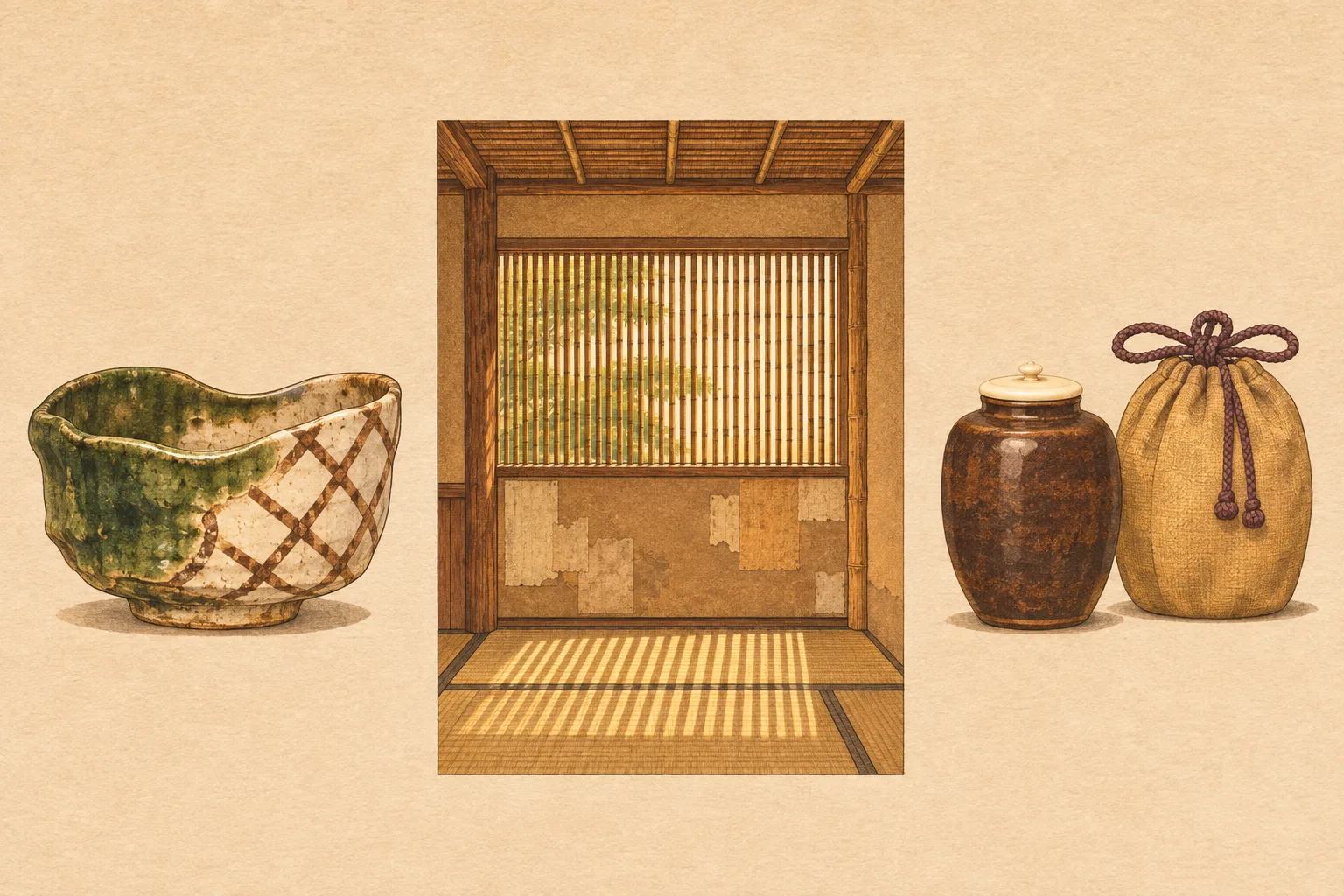
Three warrior disciples, three tastes. Left: Oribe, a lopsided clog-shaped bowl with copper-green glaze. Centre: Uraku, the striped light inside Jo-an. Right: Sansai, a caddy and its pouch that sit square and quiet, close to Rikyū.
In a museum case, the quickest way to sort their things is symmetry: Oribe’s pieces lean and bulge, Sansai’s sit square and quiet, and Uraku’s legacy is less an object than a room, best seen in photographs of the light inside Jo-an.
06Tea of the lords: Enshū, Sekishū, Sōko, Fumai
Once the Tokugawa peace settled in, tea became part of a daimyo’s education. The leading tea men of the seventeenth and eighteenth centuries were often not professional teachers but lords with land and office.
Kobori Enshū (1579–1647) was lord of the small Komuro domain and, more importantly, the shogunate’s commissioner of works, in charge of building palaces, castles and gardens. He studied under Oribe but steered tea toward a brighter, more courtly elegance later called kirei sabi, "beautiful patina". He selected and named a body of old tea caddies and bowls after poems and classical literature, now known as chūkō meibutsu, the "revival masterpieces", and a later grouping, the "Seven Kilns of Enshū", links him to kilns such as Shidoro, Zeze, Asahi and Takatori, though the list was fixed only in the mid-nineteenth century, varies by source, and includes kilns that started after his time. His retreat Kohō-an at Daitoku-ji, rebuilt under Matsudaira Fumai after a fire in 1793, has the tearoom Bōsen, where the lower half of the garden-facing screens is left open so the garden appears as a low horizontal picture. The Enshū school is still headed by the Kobori family and is based in Tokyo; there is also a separate Kobori Enshū line.
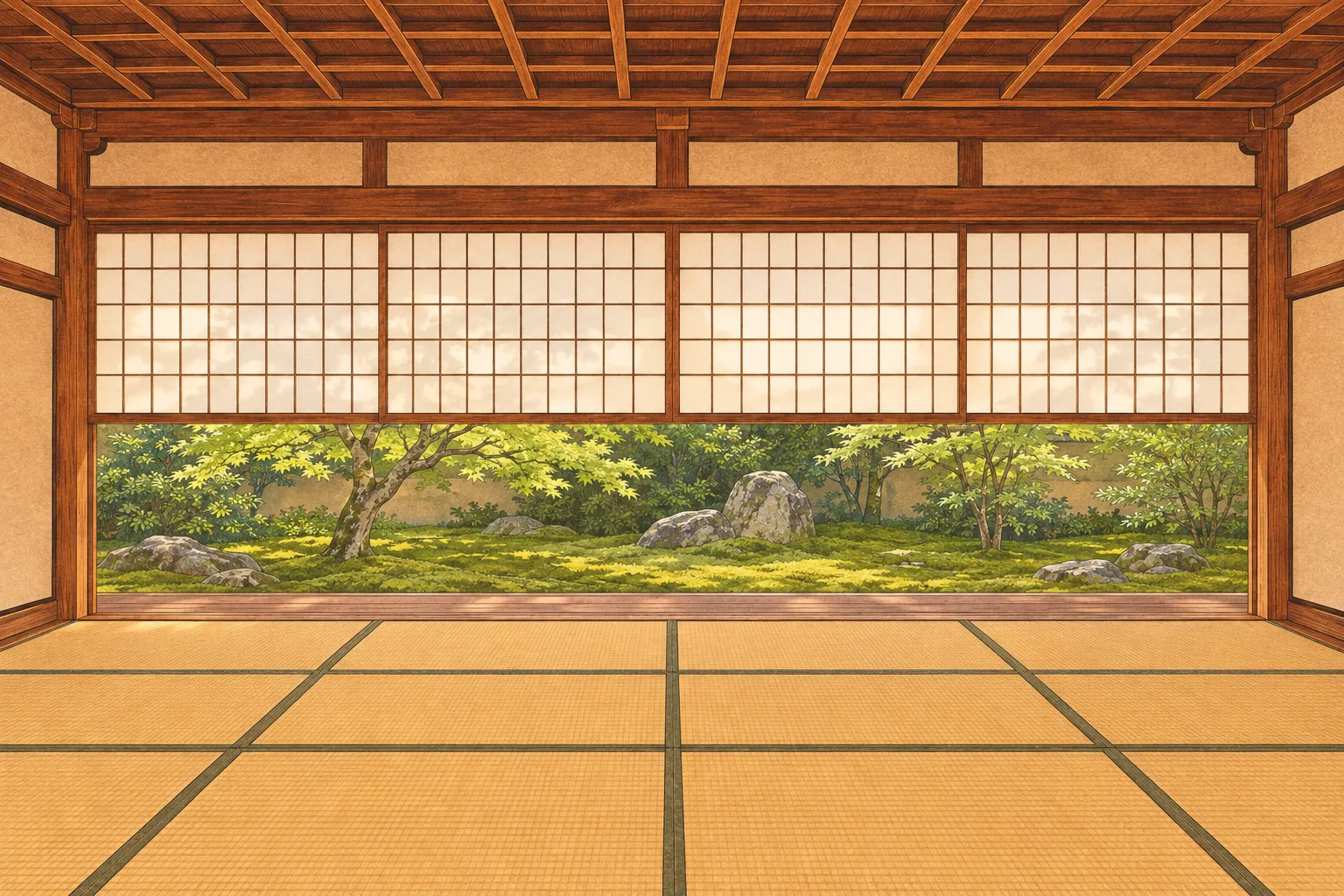
Bōsen, the tearoom at Kohō-an in Daitoku-ji. The screens cover only the upper half of the opening, so the garden appears below them as a low horizontal picture.
Katagiri Sekishū (1605–1673), lord of Koizumi in Yamato, made tea for the fourth shogun, Ietsuna, at Edo Castle in 1665 and became the shogun’s tea instructor. His rules became the model for the shogunate and for many domains. No single headship ever held the whole Sekishū school together, and his pupils taught independently, so the Sekishū school split into many branches spread across provincial domains. Jikō-in, the temple he built in 1663 in Yamato-Kōriyama near Nara for his father’s memory, survives with its study hall and tearoom; from the veranda you look over clipped hedges toward the Yamato plain.
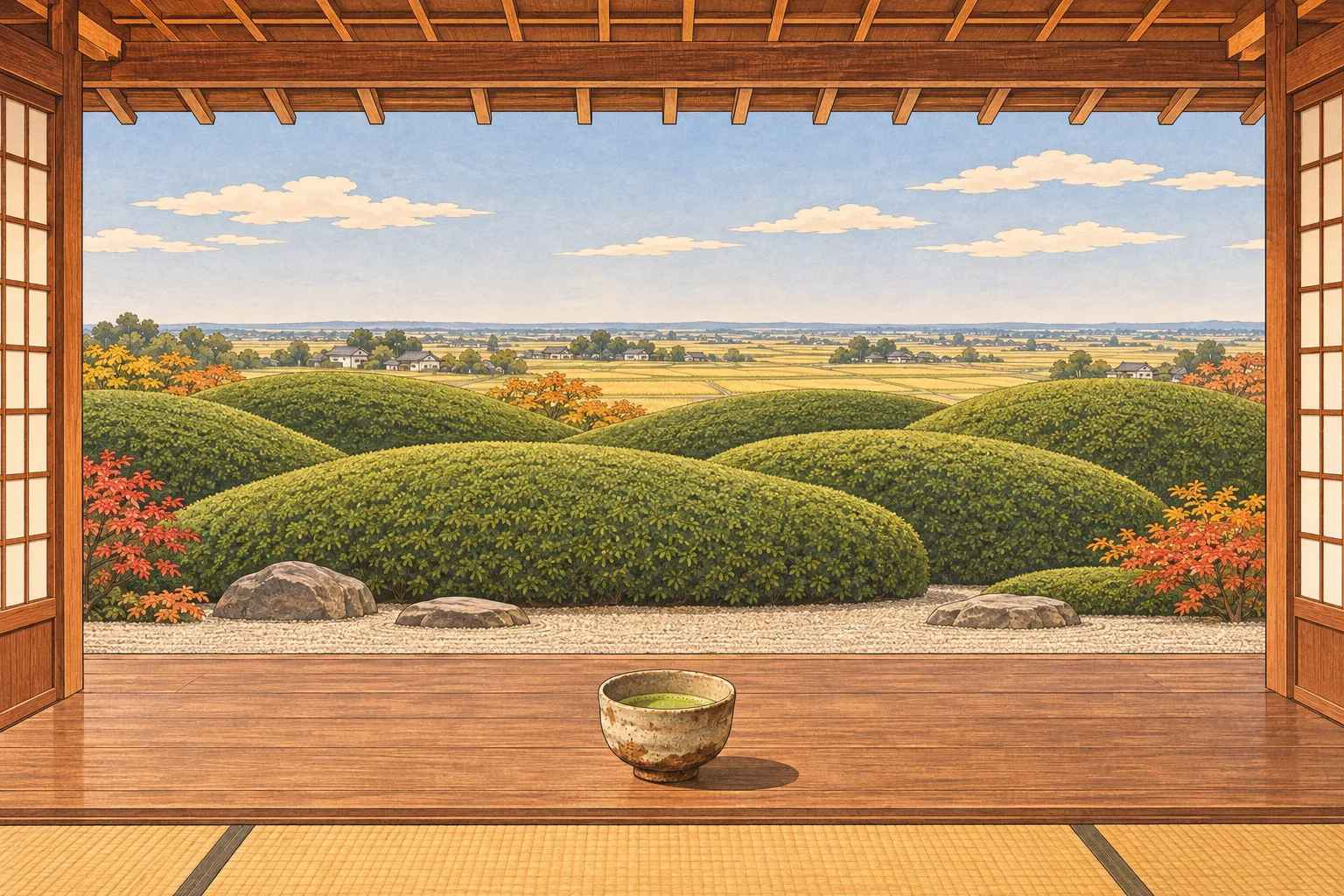
Jikō-in at Yamato-Kōriyama, built by Katagiri Sekishū. From the veranda you look over clipped hedges toward the Yamato plain.
Ueda Sōko (1563–1650) was a battle-hardened general who served Niwa Nagahide and Hideyoshi. In the Sekigahara campaign he marched to help his old lord Niwa Nagashige, turned back on hearing that Nagashige’s castle had fallen, and shaved his head afterwards. He later served the Asano, following them to Hiroshima in 1619 as a senior retainer. He studied with Rikyū and was close to Oribe. In Hiroshima he helped lay out the Asano garden Shukkeien, and his family’s residence had a tea retreat called Wafūdō; today Wafūdō and a study hall have been recreated in Hiroshima’s Nishi ward on the plan of an Edo-period samurai house. His descendants still lead the Ueda Sōko school, whose procedures are straight-lined and outward-reaching, with some differences between men’s and women’s forms. The school itself explains that it wears the fukusa on the right hip as a legacy of the days when the left hip carried a sword. The Enshū and Sekishū schools, and the Yabunouchi school, which has no warrior origin, also wear it on the right, while the Sen houses and other schools descended from Sōtan wear it on the left. Why is disputed: one story makes Sōtan left-handed, another says he moved it to the left for his most austere gatherings and that the right is the older custom. Either way, if you see a host take the cloth from the right, you are not at a Sen-school gathering.
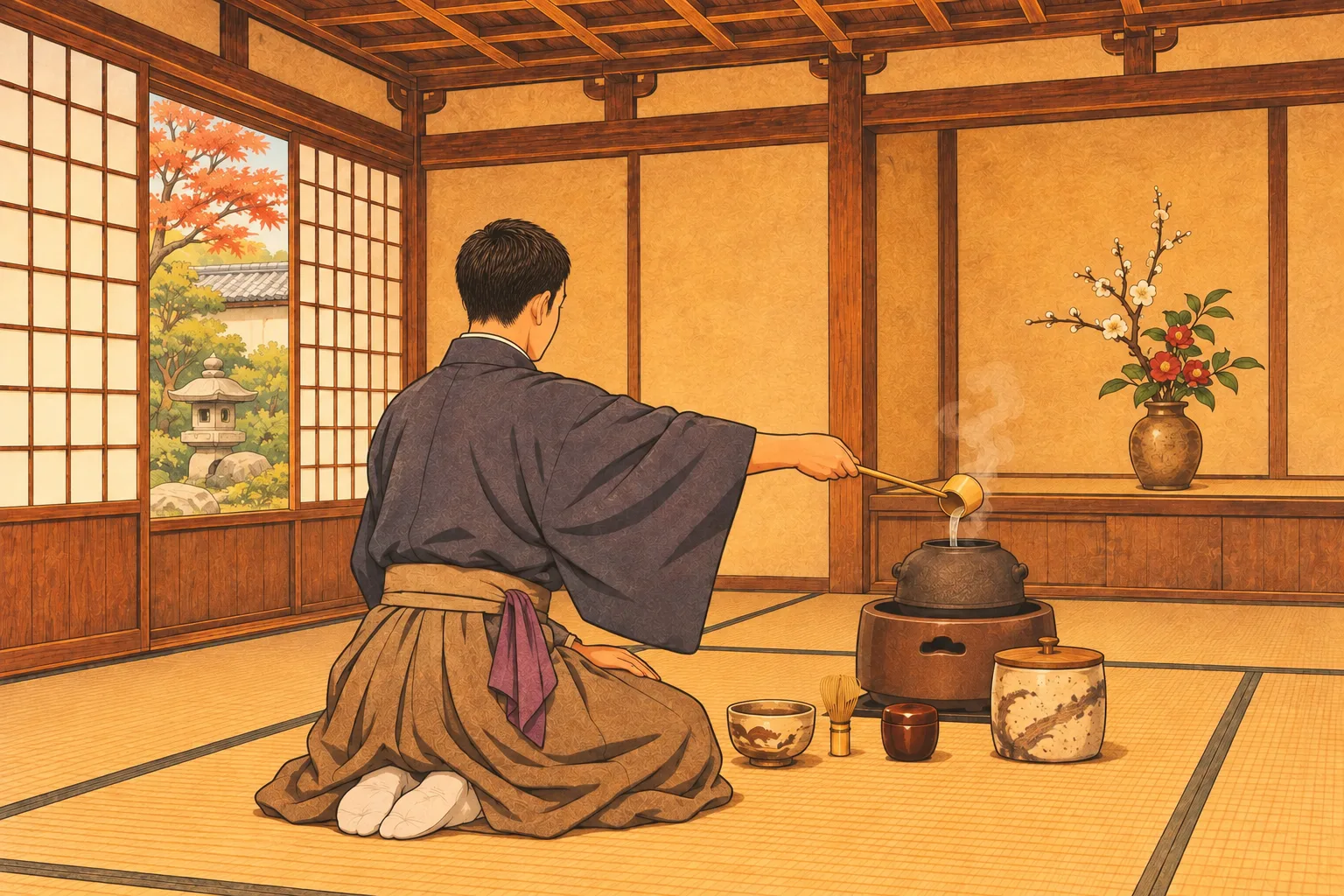
A host of the Ueda Sōko school. The movements are straight-lined and outward-reaching, and the fukusa hangs at the right hip, not the left as in the Sen houses.
Matsudaira Fumai (1751–1818), lord of Matsue in Izumo, inherited a near-bankrupt domain as a teenager. After its finances were repaired, he poured energy and money into tea and into collecting famous utensils, which he catalogued in a multi-volume classification of meibutsu. He trained in the Sekishū school and developed his own line, the Fumai school. Matsue still lives off his reputation: its tea culture is strong, and local confectioners trace sweets such as Wakakusa and Yamakawa to his gatherings. The tearooms Kanden-an and Meimei-an, associated with his taste, still stand.
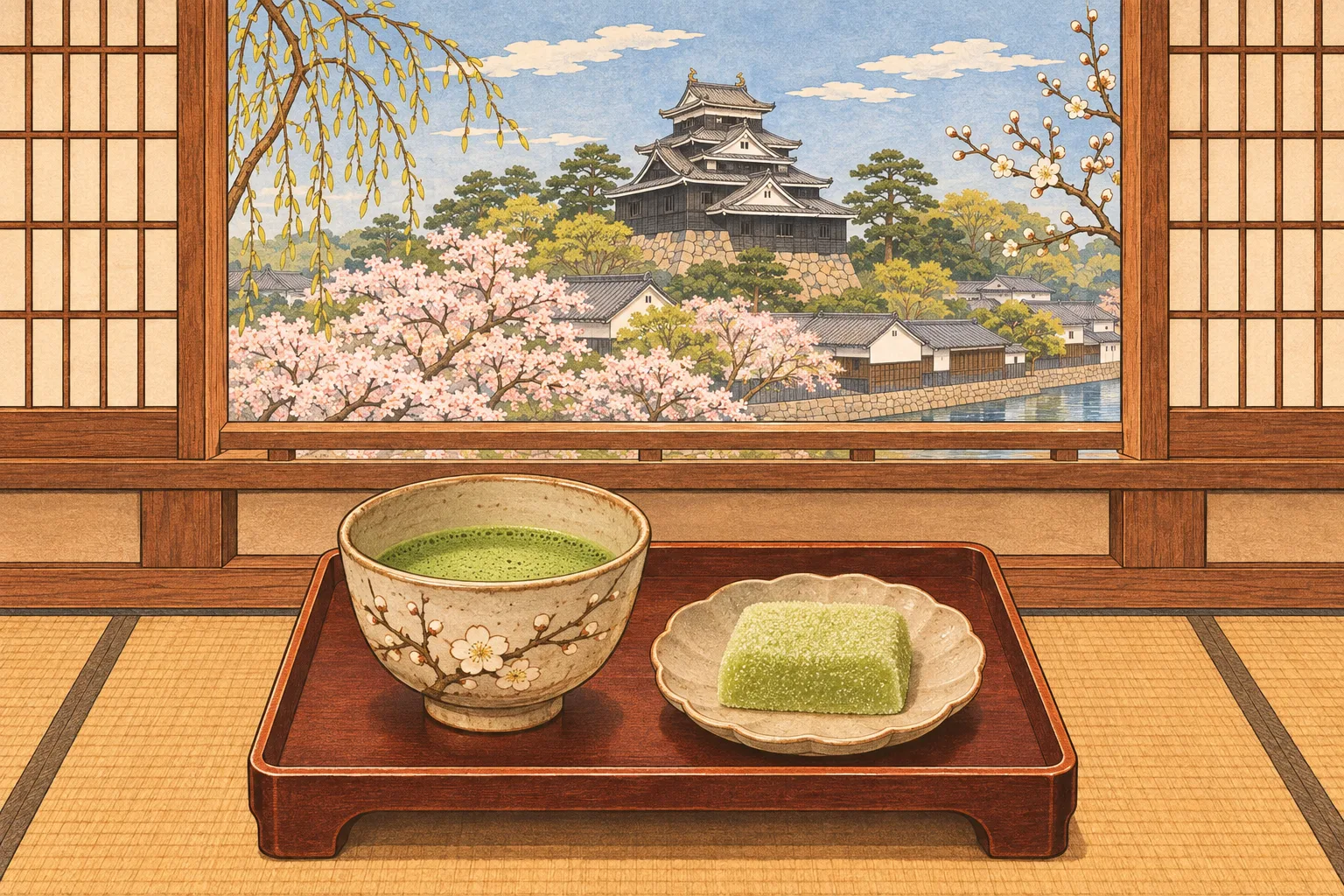
A bowl of thin tea and the green sweet Wakakusa in Matsue, with the castle outside the window. The town’s tea culture goes back to its lord Matsudaira Fumai.
When the domains were abolished in 1871, these schools lost their economic base. Some carried on through the old lords’ families or retainers’ descendants, some survived locally among pupils, some faded. You can still find their gatherings in Tokyo, Hiroshima, Matsue and Kumamoto.
07Townsmen’s schools and the iemoto system
In Kyoto, the Yabunouchi house is as old as the Sen line. Its founder, Yabunouchi Kenchū Jōchi (1536–1627), studied under Takeno Jōō like Rikyū, later learned from Rikyū himself, and was linked by marriage to Oribe, who is said to have passed him the Ennan tearoom before leaving for the Osaka campaign. From the second generation the family served as tea masters to Nishi Hongan-ji and moved beside it. The original Ennan burned in 1864; the present room is a faithful copy moved from Arima in 1867. Its style keeps more of the formal shoin tea of the generation before Rikyū.
Among Sōtan’s late pupils, four were called his "Four Heavenly Kings", most often listed as Yamada Sōhen, Fujimura Yōken, Sugiki Fusai and Kusumi Soan. Yamada Sōhen (1627–1708), born at a Kyoto temple, served the Ogasawara lords of Yoshida in Mikawa from 1655 and after 1697 taught in Edo, founding the Sōhen school; he wrote one of the earliest tea primers for a general readership. Fujimura Yōken’s line continues as the Yōken school around Kyoto.
The Edo Senke school came later. Kawakami Fuhaku (1719–1807), a retainer of the Mizuno family of Shingū in Kii, trained in Kyoto under Joshinsai of Omotesenke and went to Edo in 1750 as the Mizuno family’s tea master to spread Sen tea there. He gathered a huge following among Edo’s samurai and merchants. Edo Senke follows Omotesenke procedures, adjusted to Edo habits.
The iemoto system took shape in the eighteenth century as the number of students exploded. Joshinsai of Omotesenke and his brother Yūgensai of Urasenke, with help from Daitoku-ji priests and pupils including Fuhaku, devised the shichijishiki, seven group exercises such as kagetsu, in which participants draw lots to decide who makes or drinks the tea. They allowed many students to practise in one room and gave the curriculum structure.
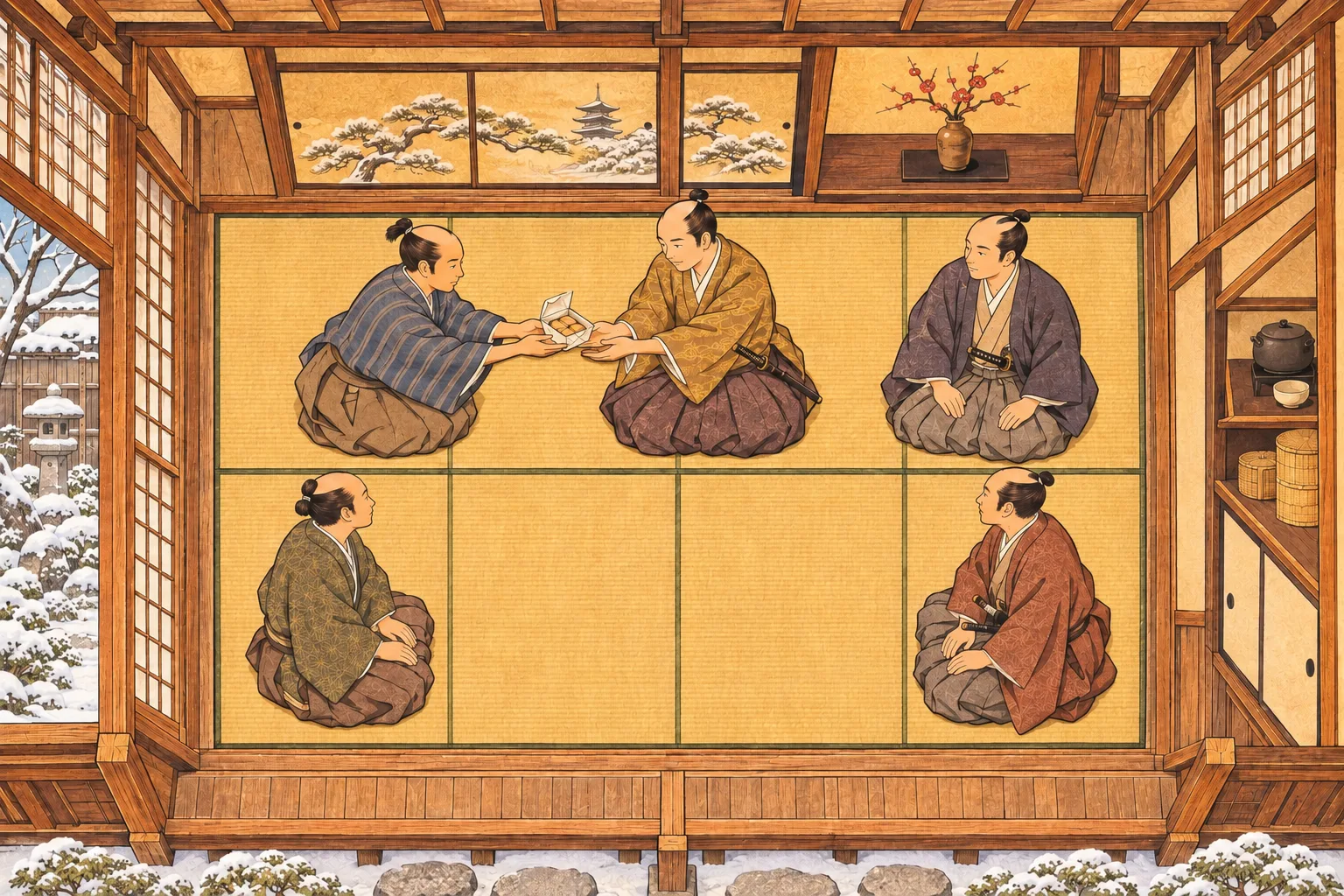
Kagetsu, one of the seven group exercises. Five people sit in an eight-mat room and pass round a folded paper box of lots to decide who makes the tea and who drinks it (artist’s impression).
Structure meant licences, kyojō. A licence is not a pass certificate but permission from the iemoto to learn a further set of procedures, from beginner forms up to rarefied ones using a formal daisu stand, Chinese tea caddies or tenmoku bowls. Each is issued in the grand master’s name through one’s teacher. Advanced students receive a tea name and the right to teach, but only what they have been licensed for; the full transmission stays with the iemoto. Critics argue this concentrates authority and stifles change from below. Defenders point out that the same structure kept tea intact through upheavals like the Meiji Restoration. Both views are held today.
08The modern collectors
After 1868 the Sen houses lost their warrior patrons and struggled. In 1872 Urasenke’s Gengensai submitted a statement to the authorities arguing that tea was a discipline of self-cultivation rather than a mere pastime, and tea later entered girls’ school curricula, becoming part of women’s education.
Alongside the schools, a new kind of tea man appeared: the industrialist-collectors known as kindai sukisha, "modern men of taste". With new fortunes they bought utensils and art scattered from daimyo houses and temples, and held lavish gatherings at their villas. Most had studied some school’s procedures but were not bound by any iemoto; their focus was connoisseurship and the art of combining objects.
Their leader was Masuda Don’ō (1848–1938), a founder of the Mitsui trading company. In 1895 he held a tea gathering at his Shinagawa house to show a newly acquired calligraphy attributed to the monk Kūkai; it became the Daishi-kai, an annual gathering hosted in turn by leading businessmen, where an invitation marked one’s standing. In 1919 he oversaw one of the most talked-about episodes in Japanese collecting: a famous scroll of the Thirty-Six Immortal Poets, too expensive for any single buyer, was cut into 37 sheets, one for each poet plus an image of the god Sumiyoshi, and distributed among collectors by lottery.
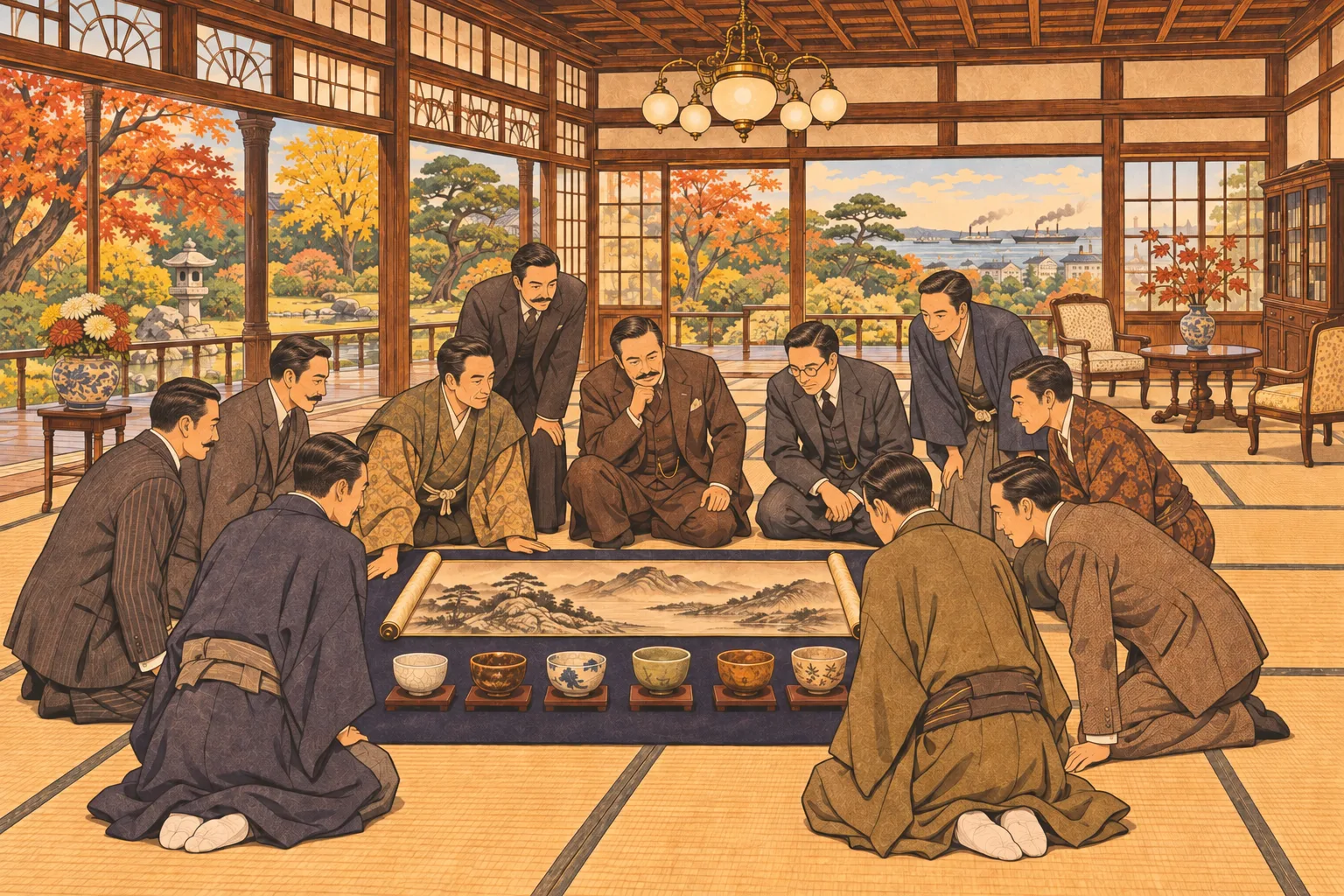
A gathering of the modern industrialist-collectors: men in suits and in kimono crowd round an unrolled old scroll and a row of tea bowls (artist’s impression).
Matsunaga Jian (1875–1971), the "king of electric power", came to tea seriously only around the age of sixty, then built a major collection. In 1948 he gave his Yanase villa in Saitama and his prewar collection to the Tokyo National Museum; much of what he collected after the war went to the Fukuoka Art Museum after his death. Others in the same circle included Hara Sankei, whose Sankeien garden in Yokohama gathers historic buildings and tearooms; Takahashi Sōan, who catalogued famous utensils; Nezu Kaichirō, whose collection became the Nezu Museum in Tokyo; and Hatakeyama Sokuō and Kobayashi Ichizō, each of whom left a museum. When you look at tea bowls and caddies in Tokyo’s or Osaka’s private museums today, you are very often looking at what these men assembled.
After the war the great business combines were dissolved and the era of grand collectors’ gatherings faded; their collections went to museums, while the Three Sen Houses kept growing through school programmes and overseas branches.
More deep dives on this topic
 ChawanAt the end of a tea ceremony, after the last sip, guests do something that puzzles first-time visitors.
 Tea UtensilsMost of what sits on a tea-room mat is small enough to hold in one hand.
 The Tea RoomA small Japanese tea room can look almost artless: a box of earth walls and straw mats, a few odd little windows, a recess with a single scroll.
 The AlcoveWhen guests enter a tea room, they do not sit down straight away.
 TemaeSit as a guest in a Japanese tea room and you will watch someone spend a quarter of an hour on a task that takes a minute in a kitchen, and it is natural to wonder what all the…
 The ChajiMost visitors to Japan meet the tea ceremony as a bowl of whisked matcha and a sweet, served in a temple garden or a tea school in Kyoto, over in fifteen minutes.
 The Tea YearWalk into the same tea room in January and in August and you might think you had come to two different houses.
 Schools of TeaWalk north up Ogawa-dōri in Kyoto, a narrow street lined with old townhouses, and you pass two quiet gates a few dozen metres apart.
- Back to the main article: The Way of Tea (Chanoyu) →