
Most visitors to Japan meet the tea ceremony as a bowl of whisked matcha and a sweet, served in a temple garden or a tea school in Kyoto, over in fifteen minutes. That is real tea, but it is the short form. The full form is the chaji, a gathering for a host and a handful of guests that lasts around four hours. It begins with the laying of a charcoal fire, moves through a meal, a break in the garden and the sound of a gong, and ends with two kinds of tea: a thick one shared from a single bowl, and a thin one served bowl by bowl. A host may spend months getting ready for those four hours. And there is not one chaji but seven, each pinned to a particular time of day, from a summer dawn to a candlelit winter night. This piece walks through a chaji from invitation to thank-you note, explains who does what, and shows why each of the seven kinds happens when it does.
01Tea Gathering or Tea Event?
HO’s main article on chanoyu explains the difference between a chakai, a tea gathering of any size, often a big public event serving thin tea in shifts, and a chaji. A chaji is a complete, private event for a small number of guests, typically three to five in a four-and-a-half-mat room. It has a fixed architecture. The first half, the shoza, is about fire and food: charcoal is laid, a meal called kaiseki is served, a main sweet follows. Then the guests step out. The second half, the goza, is about tea: thick tea, a second charcoal laying, thin tea. Between the two halves the room is changed, the light is changed, and the guests come back through the same small door to see it with fresh eyes.
Tea people often say that a chaji is the real thing and a chakai a digest of it. Everything a visitor sees in a short ceremony, the bow, the turning of the bowl, the wiping of the rim, comes from the full event and makes more sense inside it.
02Months Before: What the Host Does
A chaji starts with a reason. It might be a guest arriving from abroad, a seventieth birthday, the anniversary of a teacher’s death, the first snowfall, or simply friends who have not met in a while. Once the reason is set, the host chooses the principal guest, the shōkyaku, and traditionally consults that person about who else to invite, so that the party fits together.
Then comes the toriawase, the "assembly" of objects. The host picks a hanging scroll, a flower container, tea bowls, a caddy for thick tea, a tea scoop, a water jar, an incense container and a kettle, and makes them speak to each other and to the occasion. A chaji for a longevity celebration might pair a scroll reading "pines stay green for a thousand years" with a tea scoop whose poetic name, its mei, is "Thousand Autumns." A snowy-day chaji might use a white-glazed bowl named "First Snow." Hosts describe the toriawase as their composition; guests read it during the event by looking and asking.
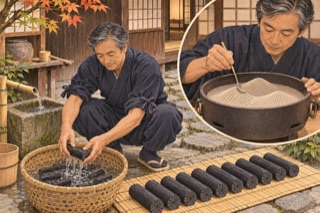
The unseen labour is larger. Charcoal must be sawn to set lengths, washed of dust and left to dry for several days. The practice is said to date back to Furuta Oribe’s time: washed charcoal does not dirty the hands, has no musty smell and burns more steadily. Ash takes longer still. For the winter sunken hearth, the host prepares damp ash to sprinkle around the fire. For the summer brazier, fine dry ash is shaped inside the brazier into a sculpted landscape of slopes and raked lines, the haigata, which takes a long time even for an experienced host and must be redone if spoiled. The garden path is swept, stones washed, moss tidied; bamboo fittings such as the gate, the fence ties and the spout over the stone basin may be replaced with freshly cut green bamboo. Paper on the sliding screens is renewed. The menu is planned and the fish ordered. The host rehearses the procedures for the day. On the morning itself, a careful host draws the first water from the well before dawn for the kettle.
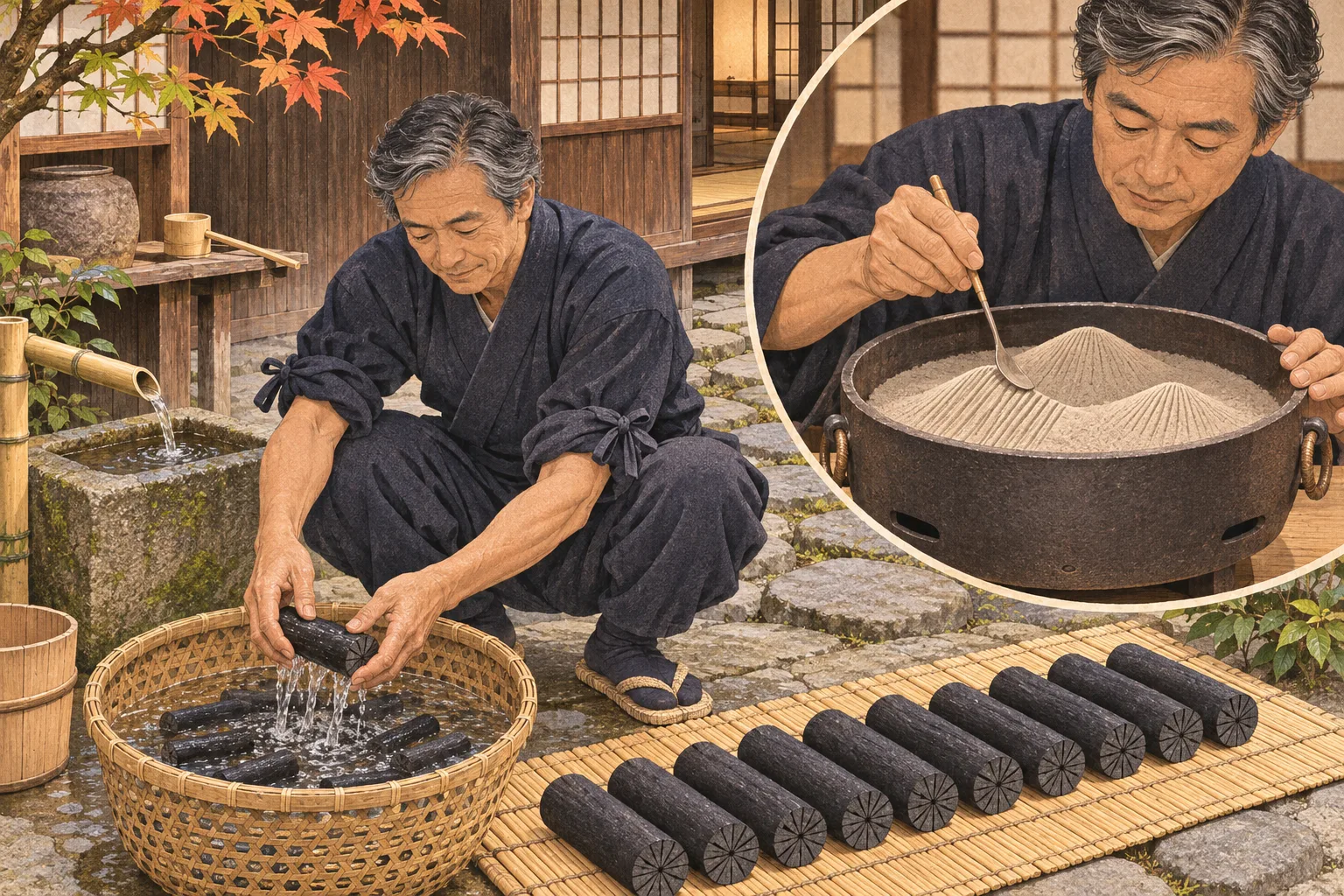
Work the guests never see: the host rinses charcoal sawn to equal lengths and lays it out to dry. Inset: shaping the haigata, the sculpted ash inside a summer brazier.
The invitation used to be a handwritten letter sent weeks ahead, naming the date, the hour and the other guests. Guests replied promptly, and in the formal manner a representative of the guests, usually the shōkyaku, calls on the host the day before to give thanks in advance, a courtesy called zenrei; a letter or phone call can stand in for the visit. Today a phone call or email often does the inviting, and the zenrei may shrink to a postcard, but in formal tea circles it still marks the opening bracket of the event.
03The Guests: First, Middle and Last
Guests in a tea room do not sit as equals. They kneel in a line beginning near the tokonoma, the alcove, in an order they settle among themselves in the waiting room, each politely urging the others to go first.
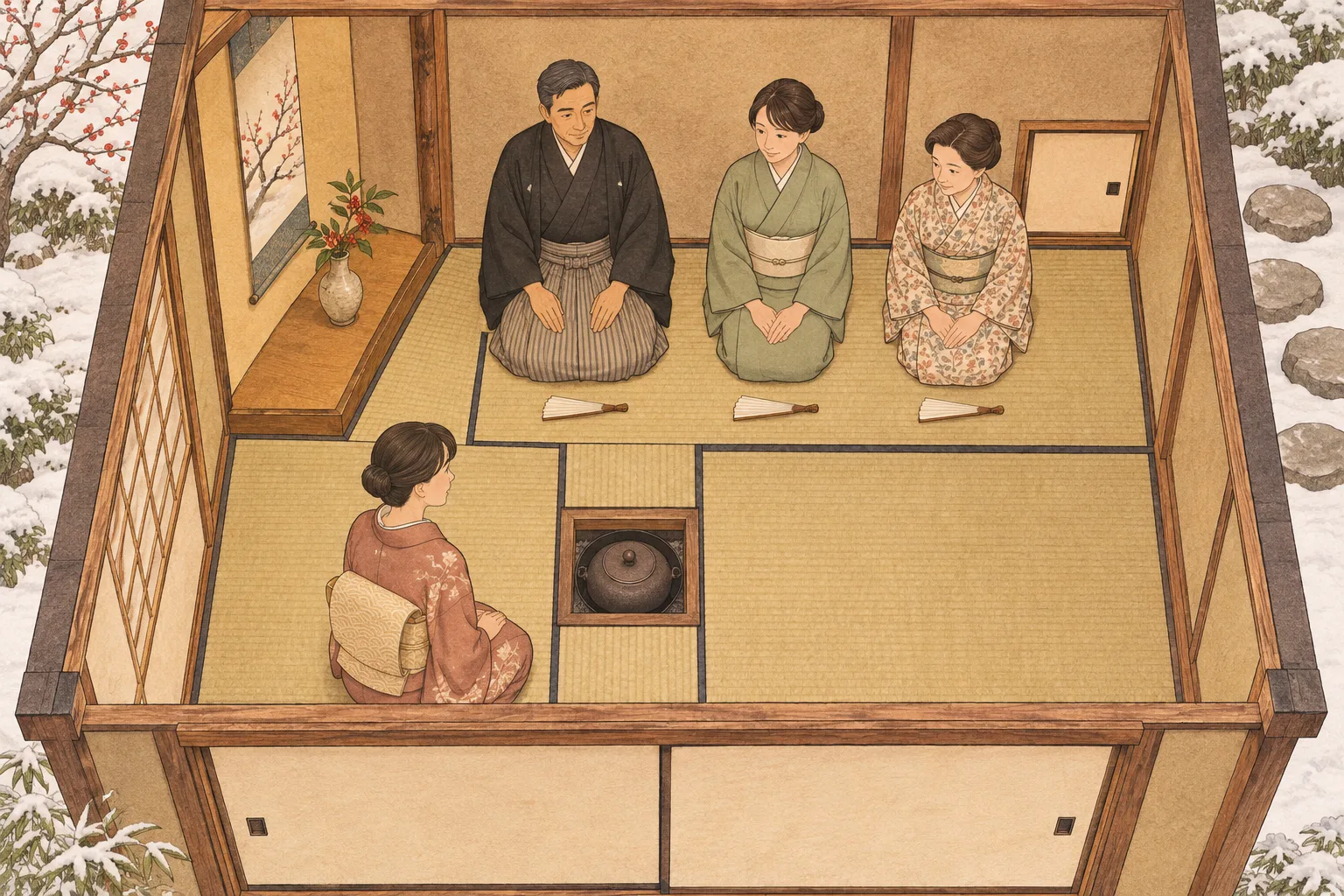
Where the three guests sit: the shōkyaku nearest the alcove, the jikyaku in the middle, the tsume at the end by the crawl-in entrance. The host sits across the hearth.
The shōkyaku, the principal guest, speaks for everyone. When the host talks, the shōkyaku answers. When the guests want to know something, the shōkyaku asks. He or she enters first, views the alcove first, takes the sweet and the tea first, and every movement serves as a model for those behind. The shōkyaku also carries the conversation about objects: who wrote the scroll, which kiln made the incense container, what the thick tea is called and which merchant blended it, what name the tea scoop bears. These questions give the host a chance to reveal the thinking behind the day. Ask too much and you seem to show off; ask the wrong thing and the host’s careful choices go unremarked. So hosts invite their most experienced friend as shōkyaku, and that friend, by custom, declines once or twice before accepting.
The second guest, the jikyaku, supports the first: listening to the exchange with the host, picking up the thread when needed, receiving each object after the shōkyaku and passing it on.
The last guest is the tsume, literally "the one at the end." The role is practical. The tsume enters the tea room last and slides the small entry door shut with a soft, deliberate click, which tells the host in the preparation room that all guests are seated. Sweet trays and inspected utensils that travel down the line end with the tsume, who returns them to the host’s door. The tsume leaves last at the break and re-enters last afterwards. Because the job demands anticipation, it also goes to an experienced guest. A common arrangement puts veterans at both ends of the line and beginners in the middle.
Larger chaji have an assistant host, the hantō, who serves the guests hot water in the waiting room, helps during the meal and the tea, and runs the preparation room.
04Arrival: Hot Water, a Silent Bow, and a Low Door
The following describes a winter midday chaji, the standard model.
Guests arrive around midday. The entrance has been sprinkled with water, a sign that the host is ready. In the machiai, the waiting room (formally the yoritsuki), guests change into fresh white tabi socks and tuck their kit into the fronts of their kimono: a folding fan, a pad of kaishi paper, a small silk cloth and a pick for sweets.
The hantō brings each guest a small cup of hot water, the kumidashi. Often it is plain water, sayu, which warms the throat and, it is often said, gives a first taste of the water the host will use for tea. Some hosts add a salted cherry blossom for a celebration, or a pinch of kelp tea or roasted rice in other seasons. Never matcha, which is saved for the tea room.
From there, guests move to the koshikake machiai, a roofed bench in the outer garden. The host comes out with a bucket of water, refreshes the stone basin, then walks to the middle gate dividing the outer and inner garden and opens it. Seeing this, the guests rise from the bench and come forward; in the Omotesenke manner they advance in order to the gate and crouch there. Host and guests bow to each other. No one speaks. This is the mukaetsuke, the "greeting." The host withdraws, and the guests, one by one, rinse their hands and mouths at the basin and approach the tea house.
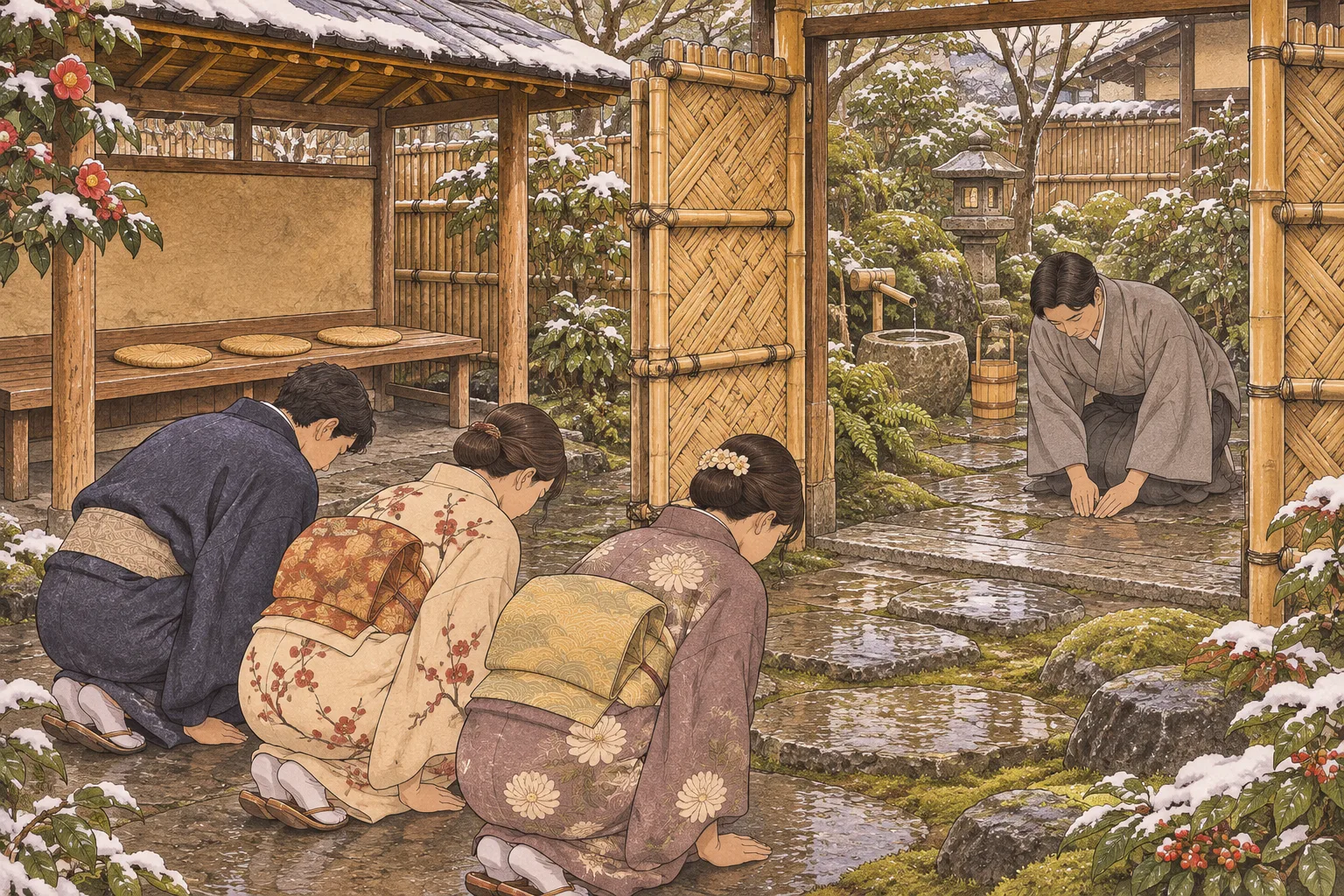
The mukaetsuke. The guests have left the bench and crouch before the middle gate; the host bows back from inside. No one speaks. Behind the host are the freshly filled stone basin and the bucket.
The low crawl-in entrance, the nijiriguchi, is described in the main article. The order matters here: the shōkyaku goes first, leaves sandals on the stepping stone, kneels, slides the fan in, glances inside, and shuffles through; each guest waits until the one ahead is fully inside.
Inside, guests do not sit at once. The shōkyaku shuffles on knees to the alcove, sets down the fan, bows and studies the scroll. In the first half of a chaji the alcove holds only a scroll. Next comes the hearth, where the kettle sits over a bed of glowing embers that is not yet a real fire, and only then the guest’s own place. Each guest follows. When the tsume’s click sounds, the host opens the service door, bows, and exchanges greetings with the shōkyaku, who thanks the host on behalf of all.
05The Charcoal Ceremony
In winter, the first act is shozumi, the laying of the first charcoal, performed in front of the guests.
It can seem strange to make a ceremony of adding fuel. The reason is practical. For the next several hours the water in the kettle has to stay just short of a rolling boil, with the fire at its strongest when thick tea is made. All of that depends on this one laying. Charcoal arranged badly will either sulk or flare and burn out. Guests watch the way diners at a counter watch a chef, and the experienced ones can judge a host’s skill from the arrangement.
The host brings in the sumitori, a finely woven basket or a gourd-shaped container in which pieces of charcoal cut to set sizes sit in set positions. Most is oak charcoal whose cut ends crack in a radiating pattern like a chrysanthemum. The thickest, the dōzumi, is a long cylindrical log that forms the core of the fire. Short, stout gitchō pieces and long, slim kudazumi, each also used split in half, come next. Thin twig charcoal, edazumi, made from charred azalea or oak twigs, is often painted white with powdered shell, so it looks like snow-covered branches. The tenzumi is a small final piece, named after the dot a calligrapher adds to finish a character. Names and sizes vary by school. In the basket also lie metal rings for lifting the kettle, a pair of fire chopsticks, a paper mat for the kettle, a feather brush, and the incense container. A separate vessel holds damp ash and a spoon.
The host lifts the kettle off with the rings and sets it aside on a paper pad, sweeps the hearth rim with the feather, and spoons the damp ash in an even ring around the embers, which is thought to help the fire draw. In the hearth season the shōkyaku now shuffles forward to the hearth’s edge with a word to the host, and the other guests follow to watch. Then, piece by piece with the chopsticks, the charcoal goes in, roughly the core log first, then the stout and slim pieces, then the twigs, and the small tenzumi last, though the exact order differs by school. Gaps are left for air so that the thin pieces catch and the thick ones burn slowly beneath. When the charcoal is laid, the guests return to their places, the last guest first, leaving only the shōkyaku nearby.
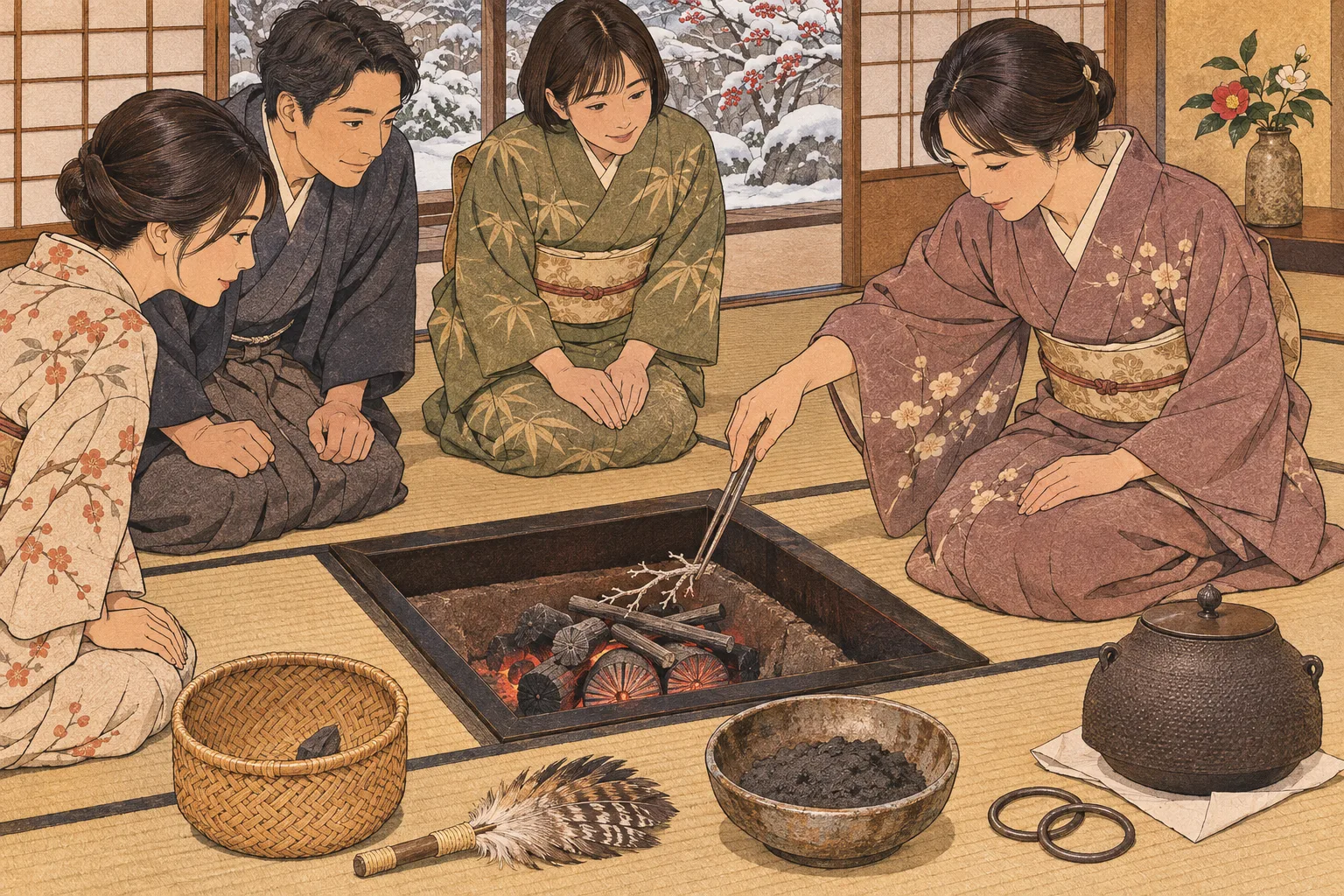
Shozumi, the first charcoal. The host adds a whitened twig with the chopsticks while the guests gather at the hearth’s edge. In front are the sumitori basket, the feather and the ash bowl; the kettle waits on its paper pad beside the two rings.
Last comes incense. The host opens the kōgō, the incense container, and places a few pieces near the fire. In the hearth season this is nerikō, a kneaded incense of powdered aromatics such as aloeswood and musk, bound with honey, plum flesh and other binders into small dark pellets, kept in a ceramic container. In the brazier season it is thin chips of sandalwood or similar wood, kept in a container of lacquer, plain wood, bamboo or gourd. By the time the scent reaches the guests, the fire has caught. The kettle goes back on with the rings.
The shōkyaku then asks to see the kōgō. It passes down the line and back. Incense containers are often the smallest and most playful pieces at a chaji: ceramic persimmons, lucky gods, shells and birds, or lacquer boxes painted with autumn grasses. The shōkyaku asks about its maker and name, the host answers, and withdraws with the basket.
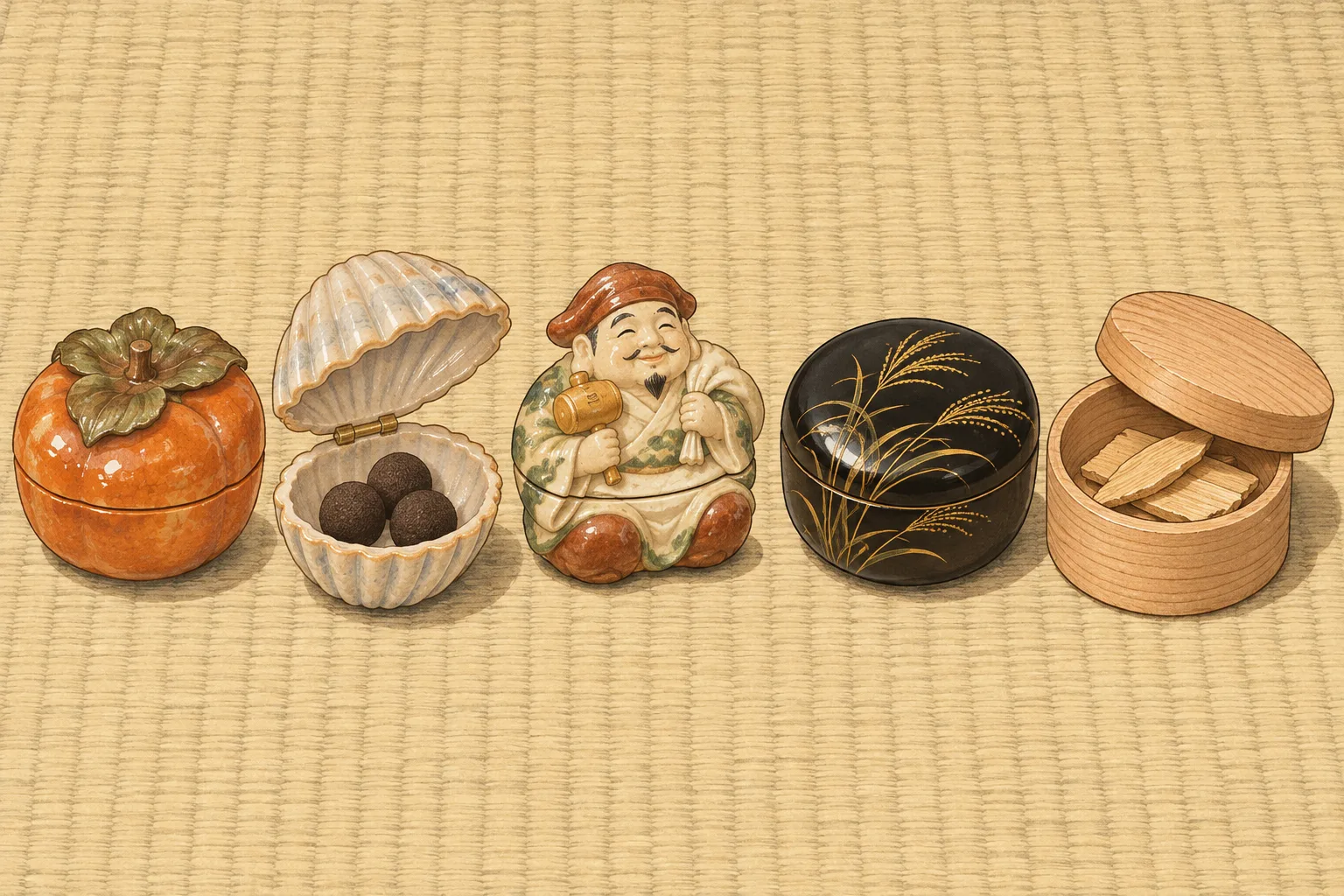
Five kōgō. The three on the left are ceramic, for the hearth season: a persimmon, a shell opened to show dark pellets of nerikō, and a lucky god. The two on the right are for the brazier season: a lacquer box with autumn grasses, and a plain wooden box holding sandalwood chips.
The order changes with the season. From roughly November to April the host uses the ro, a square hearth sunk into the floor near the guests, and the charcoal comes straight after the greetings, before the meal. From roughly May to October the host uses the furo, a brazier standing on the mat on the host’s side, and the meal comes first, with the first charcoal slotted in between the kaiseki and the main sweet. This is the standard order in the Senke schools and most others. The usual explanation is comfort: in winter the fire warms the room and kettle before guests eat; in summer it spares them sitting beside fresh charcoal through the meal. The switch between hearth and brazier, and the November opening of the hearth, belong to the tea calendar and are not covered here.
06Meal, Sweet, Break and Gong
After the charcoal (or, in summer, right after the greetings) the host serves kaiseki, the light meal that keeps thick tea from striking an empty stomach. Its courses, the exchange of sake cups between host and guests, and the closing pot of rice-scorch broth are covered in HO’s article on kaiseki. In the shape of the chaji it is the longest single stretch, about an hour, and the busiest for the host, who shuttles between kitchen and room.
Next comes the omogashi, the main sweet: a moist confection of bean paste, rice flour or kudzu, shaped and coloured for the season, perhaps a camellia dusted with "snow" in winter, a translucent kudzu dumpling in summer. In a formal chaji the sweets arrive in fuchidaka, a stack of five black lacquer boxes, one sweet per tier, with one fresh wooden pick per guest laid on the lid. The shōkyaku takes the top tier and passes the rest down. Guests lift the sweet onto their kaishi paper and cut it with their own pick. The sweetness prepares the palate for the bitterness of thick tea.
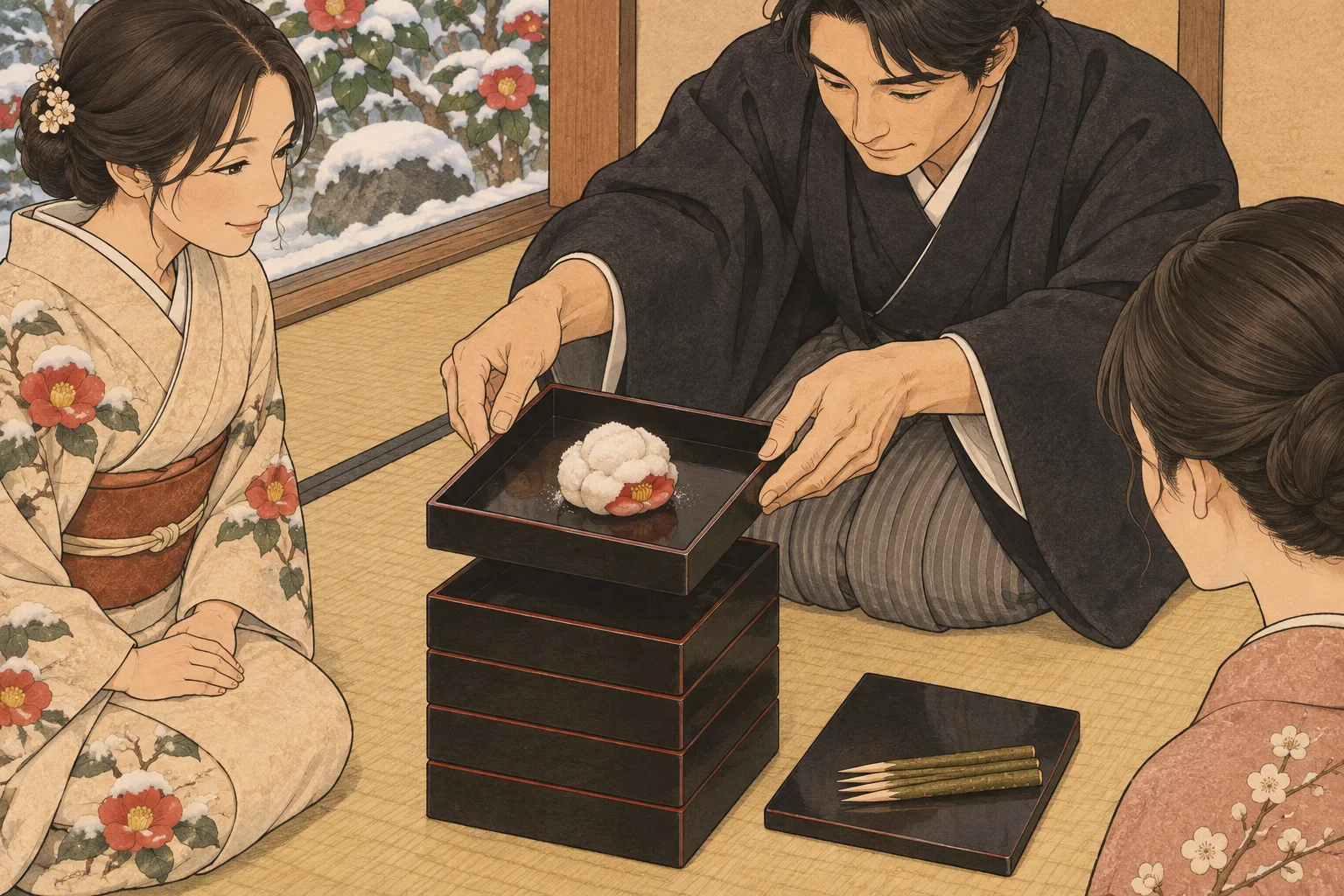
The omogashi arrives in fuchidaka, five stacked black lacquer boxes with one sweet in each. The shōkyaku lifts off the top tier, which holds a winter camellia dusted with "snow"; the wooden picks lie on the lid beside it.
The guests then crawl out and go to the bench in the inner garden, the uchi-koshikake, for the nakadachi, the break, which usually lasts fifteen to twenty minutes. In the tea room the host rolls up the scroll and puts flowers in the alcove, sweeps, sets out the water jar and caddy for thick tea, and checks fire and kettle. During the first half bamboo blinds hang outside the paper windows; in the Omotesenke manner the hantō takes them down once guests have re-entered, and the room suddenly brightens.
When all is ready, the host strikes the dora, a bronze gong with a raised centre, hung from a frame or the ceiling, using a mallet with a padded ball head. A common pattern is seven strokes, large-small-large-small-medium-medium-large, sometimes shortened to five, large-small-medium-medium-large; the count varies with the school, the size of the room and the number of guests, some schools using five in a small room and seven in a larger one. The guests usually crouch with heads bowed, listening until the last reverberation fades. Then they wash at the basin again and re-enter. Some occasions, including the night chaji in many schools, use a small hanging bell, the kanshō, instead.
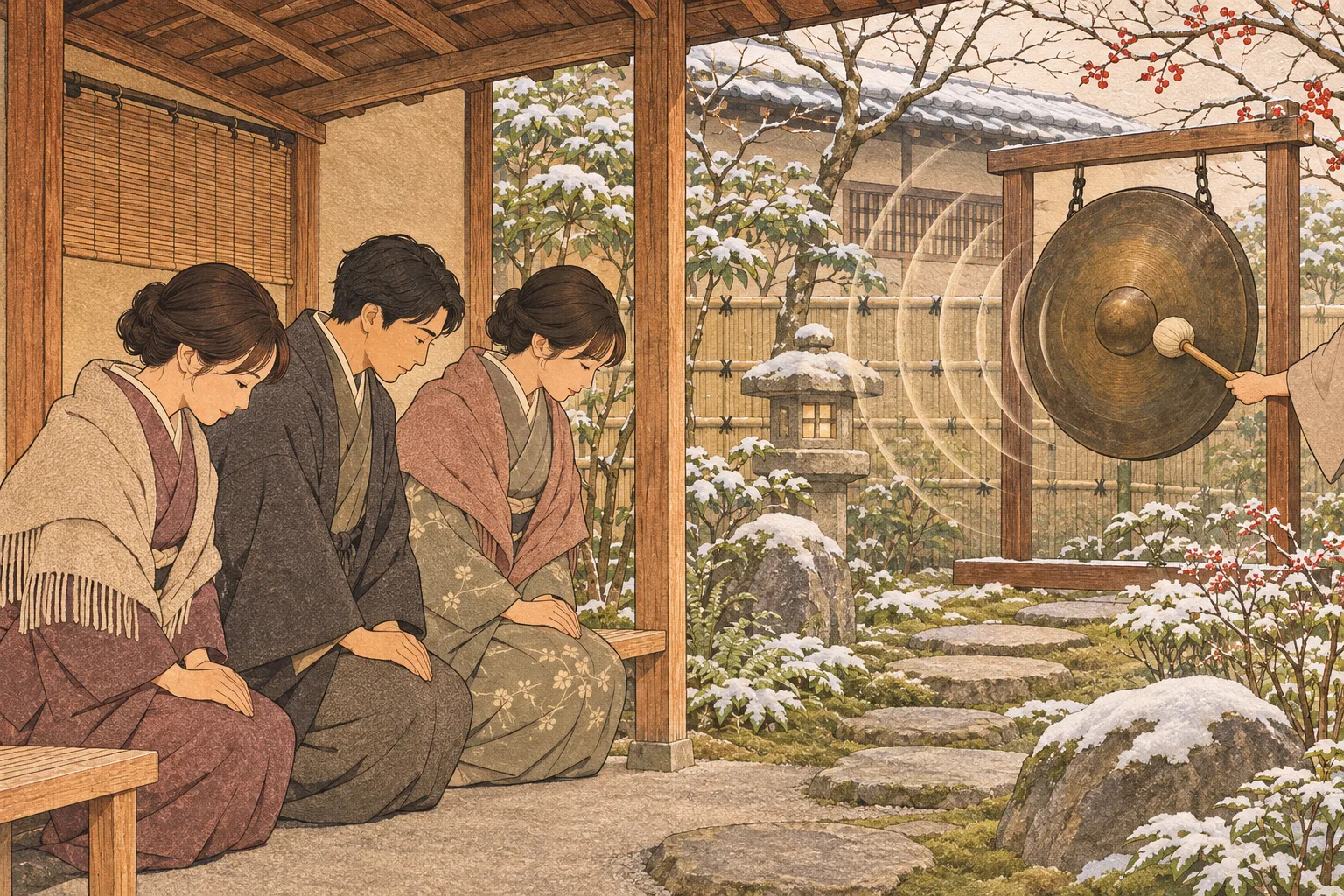
The break is over. The host strikes the dora on its frame with a ball-headed mallet, and the guests at the bench bow their heads and listen until the sound dies away.
The gong divides the event cleanly in two: the first half dim behind blinds, with a scroll, devoted to fire and food; the second half brighter, with flowers, devoted to tea.
07Thick Tea, Second Charcoal, Thin Tea
Back inside, the guests view the alcove again, now holding a flower or two in a bamboo or bronze vase, then the kettle, then sit.
The host makes koicha, thick tea. Its texture and the amount of tea used are covered in the main article. The details of the host’s movements belong to the article on temae. What matters here is that thick tea is shared. One bowl goes to the shōkyaku, who excuses himself to the next guest, turns the bowl away from its front, drinks about three and a half sips, wipes the rim with kaishi paper and passes it on. It travels down to the tsume. The shared bowl is said to have taken its settled form in Rikyū’s time, and is read as a sign that the people in the room are, for this moment, one company.
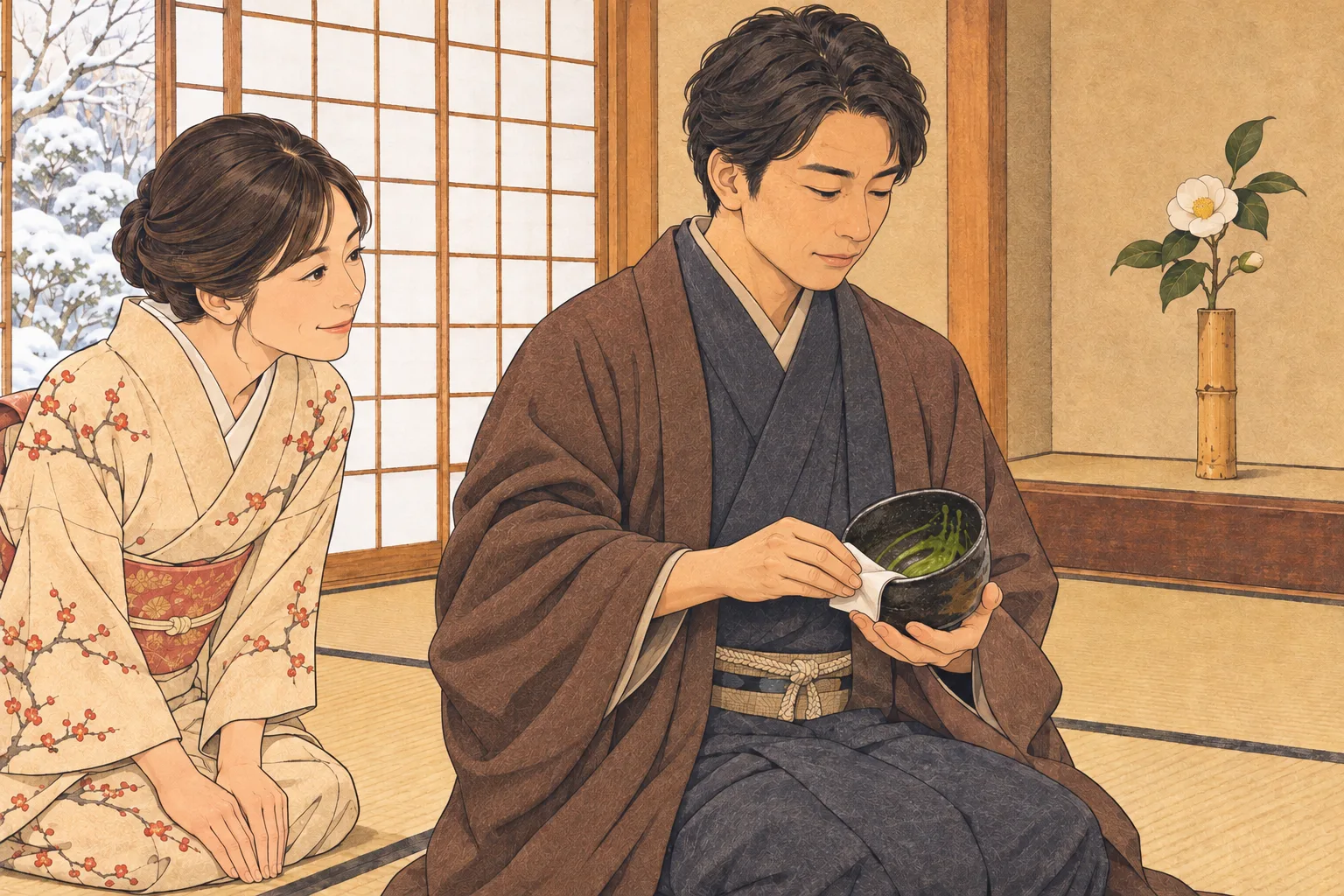
Koicha in the second half. After his sips, the shōkyaku wipes the rim with kaishi paper before passing the bowl to the next guest. In the alcove, a flower has replaced the scroll.
After the first sip, the host asks how the tea tastes; the shōkyaku says it is very good, and at a suitable moment, which varies by school, asks the tea’s name, its blender, and who made the main sweet. Thick teas carry poetic names given by the merchant or the head of a school. When the bowl returns, the shōkyaku asks to see the caddy, the scoop and the silk pouch, the shifuku, that holds the caddy. These are often the most valuable objects of the day, and the questions about their origins and names are the high point of the conversation.
By now the fire has burned two or three hours and is flagging, so the host lays charcoal again, the gozumi. It follows the pattern of the first laying but adapts to how the fire actually looks, with small differences: in the Omotesenke hearth version, for example, the incense goes in before the charcoal. The remains of the first charcoal, burned down to shapely grey-red forms, show a knowing guest how well the first laying was done. Some chaji skip the second charcoal, such as the summer morning chaji, where thin tea follows thick tea directly.
Then thin tea, usucha. First come dry sweets, higashi, such as pressed sugar shapes or small crackers, on a tray from which guests help themselves. Each guest gets an individual bowl, frothy and lighter green. The atmosphere loosens; a tobacco tray may be set out (now largely symbolic), and conversation wanders. The shōkyaku may invite the host to have a bowl too. At the end, the shōkyaku asks to see the thin-tea container and scoop.
08Leaving, and the Day After
The host bows at the service door and closes it. The guests crawl out one by one. In the garden the shōkyaku turns back; the host has reopened the door and is kneeling in the doorway, watching them go. Another silent bow from each side. After they have left, the host does not rush to clear up but returns alone to sit facing the kettle, going back over the day, and may make a bowl for himself. Ii Naosuke, the nineteenth-century statesman, stressed this "sitting alone in contemplation," dokuza kannen, in his tea treatise Chanoyu Ichie-shū.
Later that day or the next, a representative of the guests sends thanks, the gorei. Once this meant a visit; now a letter or phone call is usual. A good gorei mentions a particular object, a dish, or a detail the host clearly planned. With the zenrei before and the gorei after, the chaji is closed at both ends.
From the waiting room to the garden gate, a midday chaji runs about four hours.
09Seven Kinds of Chaji
Tea people group chaji into seven forms, the chaji shichishiki. Tea records from the mid-sixteenth century already mention morning, midday, night, dawn, after-meal, atomi and unscheduled gatherings, but the collective name is modern; in the Edo period people spoke of the "five times." Lists also differ: one standard Japanese encyclopedia drops the after-meal chaji and counts kuchikiri, the November opening of the tea jar, instead. What separates them first is the hour, and the hour follows from season, light and the rhythm of a day without electricity.
The shōgo chaji, the midday chaji, starts around noon and is the base form, held in any season. In Rikyū’s day, when people ate two meals a day, the "midday" chaji was held around 10 a.m. Its meal falls naturally at lunchtime and its light moves from bright noon into afternoon. Students learn it first; the other six add or subtract from it.
The asacha, morning tea, is a summer event. Kyoto afternoons in July and August are too hot to sit through, so the chaji moves to about 6 a.m., while dew still lies on the moss and before the cicadas get loud. Morning glories, which open at dawn and fade by midday, are a favourite flower for the second half. Everything is quicker. Although it falls in brazier season, the first charcoal comes before the meal. The meal is usually one soup and two dishes, with no raw fish and no grilled fish, and the second charcoal is dropped, so thin tea follows thick tea straight away, tsuzuki-usu. It ends well before the heat arrives.
The yobanashi, "night talk," is a winter event held from around the winter solstice until the start of spring in early February. It begins after sunset, around 5 or 6 p.m., in the season of the longest nights. Its subject is lamplight. Stone lanterns burn in the garden, paper lamps stand along the path, and inside the room is lit by a tall stand lamp and by teshoku, hand-held candlesticks. At the greeting, host and principal guest each carry a teshoku and exchange them at the middle gate, the best-known moment of the form. Hosts choose objects with candlelight in mind: gold lacquer glints, a black raku bowl deepens. Flowers lose their colour by lamplight, so Omotesenke displays a priest’s whisk or a ceremonial sceptre in the alcove instead; hosts who do use flowers favour white ones. After the greetings comes a bowl of thin tea, called zencha in Omotesenke usage, to warm guests coming in from the cold. In the Omotesenke sequence, first charcoal, meal, break, thick tea, second charcoal and thin tea follow; some hosts drop the second charcoal and serve thin tea straight after thick. Many schools call guests back with the kanshō bell. Sōtan, Rikyū’s grandson, is said to have taught that a tea person’s training is complete only with yobanashi, and it is counted the hardest form to host.
The akatsuki, "dawn" chaji, is the coldest and earliest, held from the year’s end through February, with guests entering around 4 or 5 a.m. Guests enter in darkness and see day break during the event. It is also called the zantō, "lingering lamp," chaji, after the lamps left burning from the night, so guests first see the tail end of night. At first the room is lit only by lamps and the hearth. In the Omotesenke custom, when the meal reaches the hassun course, the host opens the skylight in the small room’s ceiling to let in the first light of dawn. Some hosts are said to take the kettle out after the first charcoal, pour off half, refill it with water freshly drawn at dawn and return it, a practice called nuregama. It is rarely held today, yet many tea people consider it the most evocative form of all.
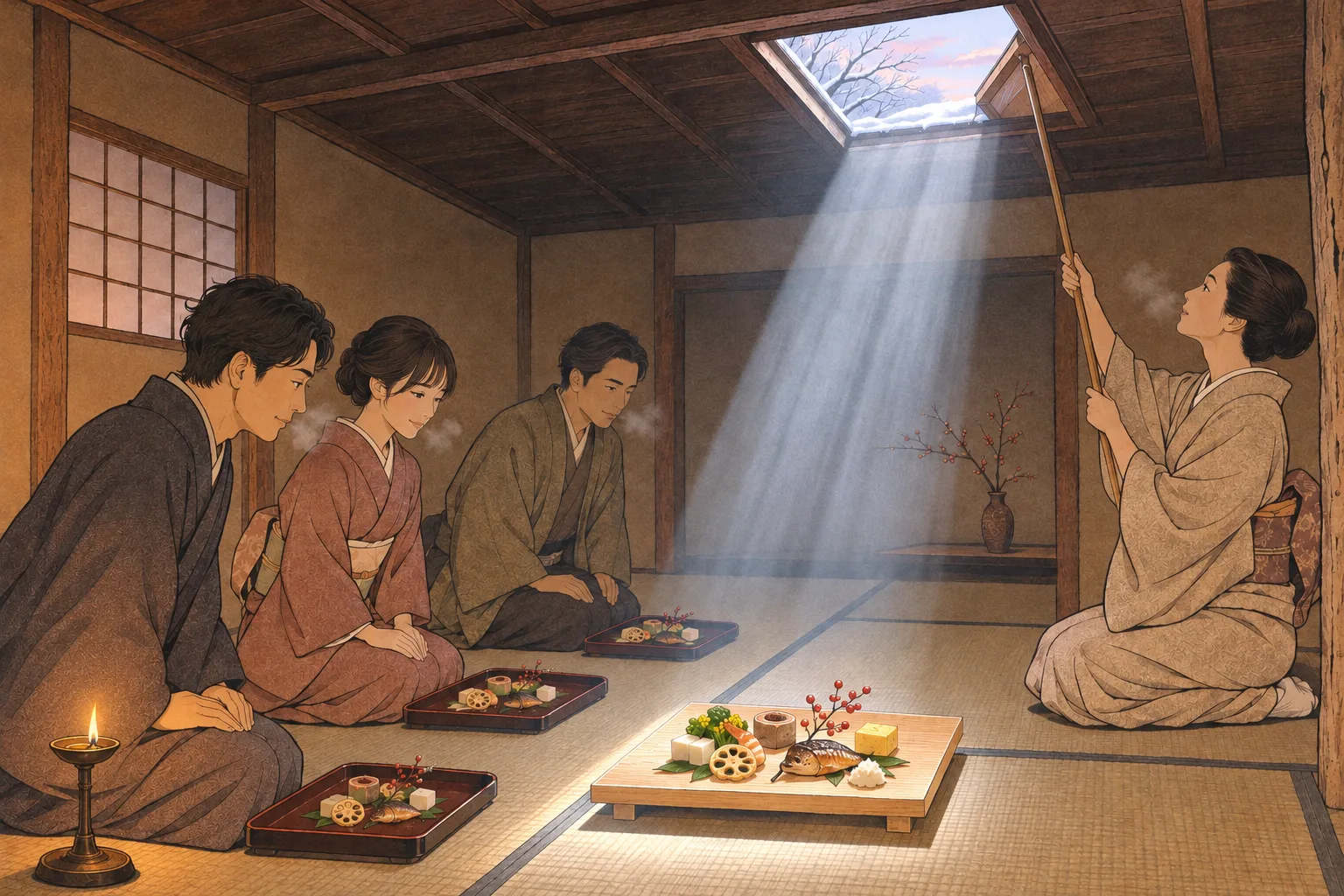
The akatsuki chaji. As the meal reaches the hassun course, the host pushes open the skylight with a pole and the first light of dawn falls into a room still lit by a lingering lamp.
The hango, "after a meal," deliberately avoids mealtimes and omits the full kaiseki. Held after breakfast or after lunch, it centres on sweets with thick and thin tea, and is also called the kashi chaji, sweets chaji. Its form is loose: sometimes only sweets, sometimes a little soup, a hassun tray and sake, with or without a break. It is shorter than a midday chaji and suits a host who wants a proper event without the labour of a full meal.
The atomi, "seeing the traces," is for people who missed out. When a host holds a chaji with celebrated objects, someone who was not invited may ask to come afterwards. It follows straight after a morning or midday chaji (an Edo-period tea manual says there is no atomi after a night chaji), keeping the flowers and utensils in place so that latecomers can see the arrangement, and then serves a simple tea. Today it is rarely held and survives mainly as a category in books.
The fuji, "unscheduled," is the impromptu chaji for a visitor who turns up unannounced. The host improvises a chaji with whatever utensils and food are at hand. Another reading takes fuji to mean a chaji held outside mealtimes. It looks the most casual and is the truest test: it shows at once whether the host’s utensils are in order, whether there is anything in the kitchen and whether charcoal and ash are ready.
Outside these seven are occasions defined by season or purpose, such as nagori in October, a farewell to the old year’s tea and the brazier, and kuchikiri in early November, when the jar of new tea is opened. Those belong to the tea calendar.
10Side by Side
On a clock face, the seven fall into place. Akatsuki: around 4 or 5 a.m., dark turning to dawn, deep winter, lamps. Asacha: around 6 a.m., early light and dew, high summer. Hango: after breakfast or lunch, no full meal. Shōgo: from about noon into the afternoon, the brightest hours, any season. Atomi: straight after a morning or midday chaji. Yobanashi: from about 5 or 6 p.m., full dark, winter, candles. Fuji: whenever the guest arrives.
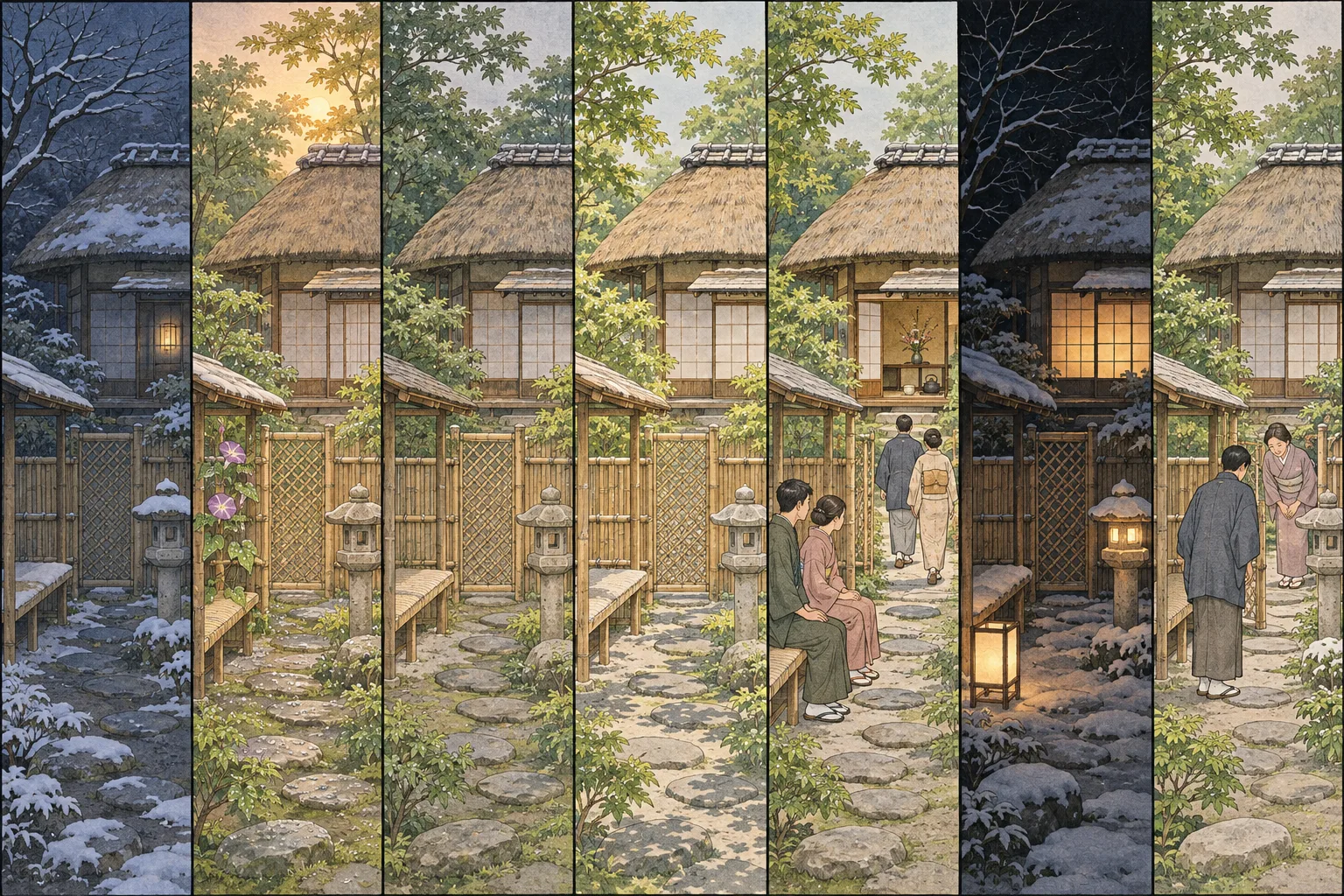
The same tea house at seven moments, from left: akatsuki (a winter night with one lamp), asacha (a summer dawn with morning glories), hango, shōgo, atomi (earlier guests leaving as new ones wait on the bench), yobanashi (winter dark, lanterns lit) and fuji (a visitor who simply turns up).
Seen as light, they form a loop: dawn chaji go from night into day, morning tea sits in thin early light, midday sits at the brightest point, night talk goes from dusk into darkness. A tea room is already a deliberately dim space lit through paper, so the same room looks like a different place in each.
Hearth and brazier are the other key comparison, taking the standard midday chaji. Winter, hearth: greeting, viewing, first charcoal, kaiseki, main sweet, break, gong, thick tea, second charcoal, thin tea. Summer, brazier: greeting, viewing, kaiseki, first charcoal, main sweet, break, gong, thick tea, second charcoal, thin tea. Charcoal before food in winter, food before charcoal in summer, with the summer morning chaji as the exception that follows the winter order. The quickest tell is what the host brings first after the greetings: a charcoal basket or a meal tray. The incense is another: dark kneaded pellets in a ceramic box in winter, pale sandalwood chips in a lacquer or wooden box in summer. And the fire itself: sunk into the floor in front of the guests in winter, raised in a brazier on the host’s side in summer.
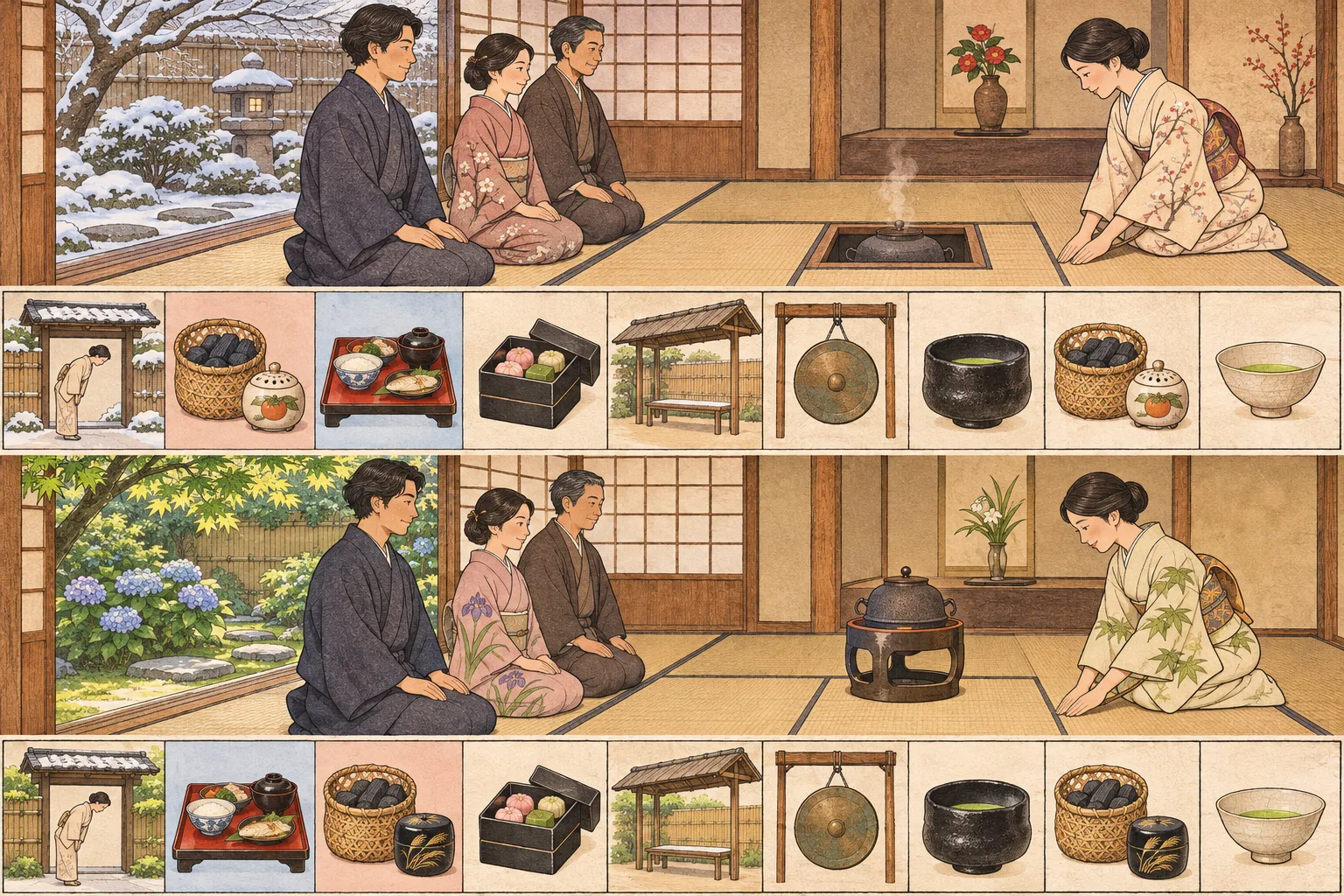
The order of a midday chaji. Upper row, winter hearth: greeting, first charcoal, kaiseki, main sweet, break, gong, thick tea, second charcoal, thin tea. Lower row, summer brazier: greeting, kaiseki, first charcoal, main sweet, break, gong, thick tea, second charcoal, thin tea. Charcoal before food in winter, food before charcoal in summer; the kōgō beside the basket changes from ceramic to lacquer.
More deep dives on this topic
 ChawanAt the end of a tea ceremony, after the last sip, guests do something that puzzles first-time visitors.
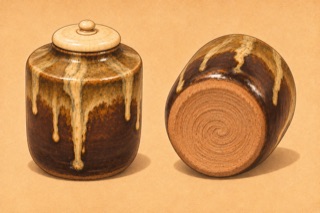 Tea UtensilsMost of what sits on a tea-room mat is small enough to hold in one hand.
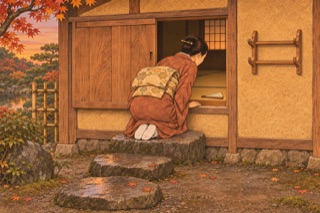 The Tea RoomA small Japanese tea room can look almost artless: a box of earth walls and straw mats, a few odd little windows, a recess with a single scroll.
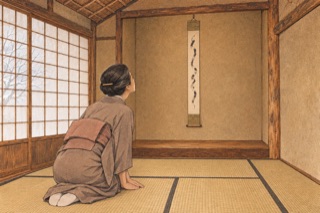 The AlcoveWhen guests enter a tea room, they do not sit down straight away.
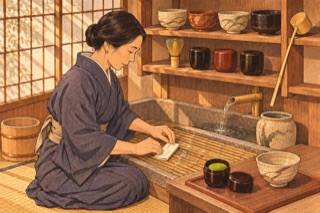 TemaeSit as a guest in a Japanese tea room and you will watch someone spend a quarter of an hour on a task that takes a minute in a kitchen, and it is natural to wonder what all the…
 The ChajiMost visitors to Japan meet the tea ceremony as a bowl of whisked matcha and a sweet, served in a temple garden or a tea school in Kyoto, over in fifteen minutes.
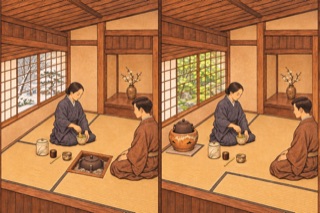 The Tea YearWalk into the same tea room in January and in August and you might think you had come to two different houses.
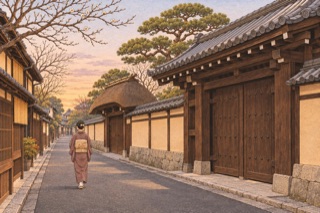 Schools of TeaWalk north up Ogawa-dōri in Kyoto, a narrow street lined with old townhouses, and you pass two quiet gates a few dozen metres apart.
- Back to the main article: The Way of Tea (Chanoyu) →