
At the end of a tea ceremony, after the last sip, guests do something that puzzles first-time visitors. They set the bowl down on the tatami, lean forward on their elbows, and look at it: the rim, the inside, the glaze running down the side. Then they tip it gently to inspect the foot underneath. This is not politeness for its own sake. Japanese tea people have a whole vocabulary for a tea bowl (chawan), with a name for the dip at the bottom of the inside, for the crawling beads of glaze around the foot, and for the marks left by iron tongs. The most famous bowls have personal names, wooden boxes inscribed by tea masters, and recorded lists of owners going back four centuries. This guide walks through a bowl the way a tea person reads one: parts first, then shapes, then where it came from, and finally the accidents, front side and box that turn an object into a story.
01Holding the Bowl: A Map from Rim to Foot
A typical matcha bowl is about 12–13 cm across and 7–8 cm tall, a little larger than a rice bowl. It is made to fill two hands: the left palm under the base, the right hand steadying the side. Reading it follows the same path as handling it, from the lip down and from the inside out.
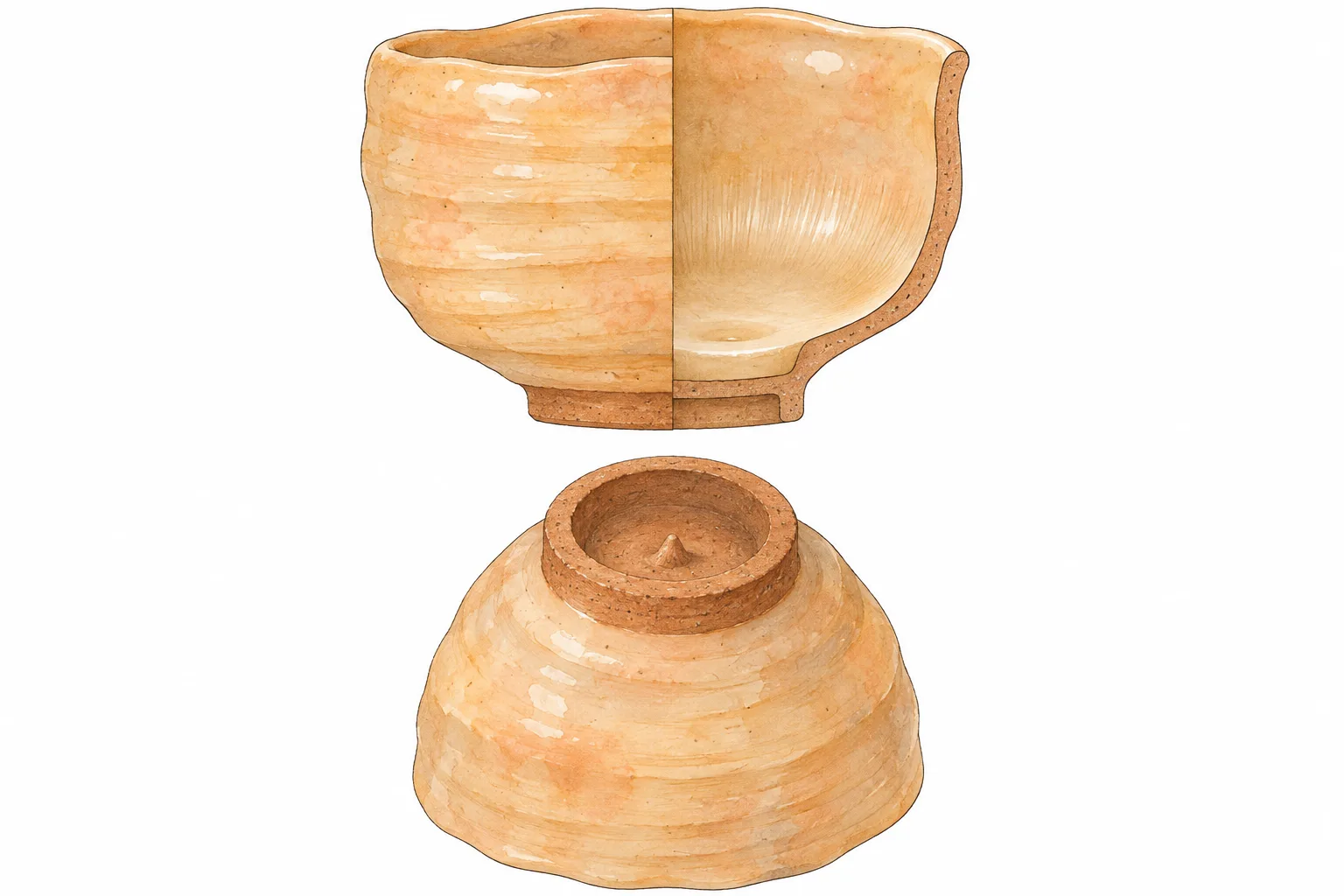
The parts of a tea bowl. Above: the outside on the left, a cross-section on the right, from rim through body and hip to the interior and the foot ring. Below: the bowl upturned to show the kōdai, with the small tokin point at its centre and the bare clay exposed.
The rim is called the kuchizukuri, literally "how the mouth is made." It may be thick and rounded (tamabuchi, a rolled lip), flared outward (hazori), turned slightly inward, or undulating in low hills and dips. That last type is called yamamichi, "mountain path," and it is common on Shino bowls and found on some Raku bowls too. As the bowl is turned during drinking, a mountain-path rim shows a different profile from every angle.
Below the rim is the body (dō), and where the body curves in toward the base is the waist (koshi). The waist is where your palms sit, so its thickness and texture matter. On wheel-thrown bowls, especially Korean and Karatsu ones, you can see horizontal throwing rings (rokuro-me) left by the potter’s fingers.
Looking inside, the whole interior is the mikomi, "the part you look into." The walls scraped by the bamboo whisk have their own name, and at the very bottom there is usually a shallow well called the chadamari, the "tea pool." When the guest tips the bowl for the final sip, the last of the tea gathers there. A good bowl has a pool that collects the tea neatly rather than leaving it scattered in a film across the bottom. Some Korean bowls show a ring of small scars inside: these are me-ato, marks from the clay spacers used to stack bowls in the kiln, and tea people treat them as features, not flaws.
Turn the bowl over and you see the foot ring (kōdai). The potter carves it with a blade when the bowl is leather-hard and upside down, so it carries the most direct trace of the maker’s hand. The edge that touches the floor is the tatami-tsuki, "the part that meets the tatami." The circle enclosed by the foot is the kōdai-uchi, and in many bowls the potter leaves a small raised point in the centre called a tokin, after the little black cap worn by mountain ascetics. The foot is often unglazed, exposing the raw clay. Tea people call this tsuchi-mise, "showing the clay," and they look closely at it, because colour, grit and texture reveal where the clay was dug.
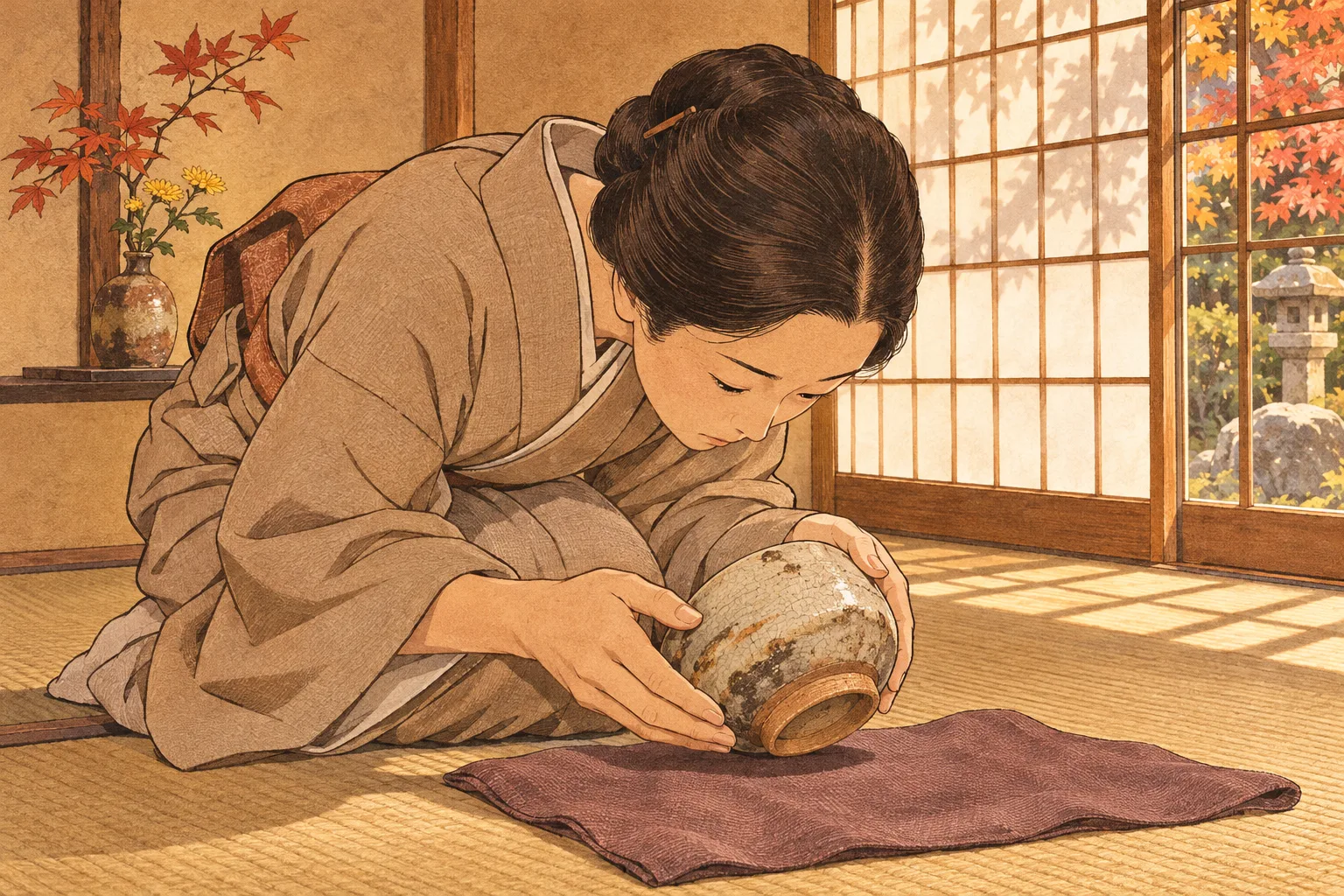
Looking at the foot after drinking. The guest bends low, keeps the bowl close to the mat and tips it sideways to see the unglazed ring of clay underneath.
The foot is also the fastest way to classify a bowl. Ido bowls have a tall, chunky foot carved in ridges like a bamboo node. Hagi bowls often have one or more notches cut into the foot (wari-kōdai). Tenmoku bowls have a small, crisp, low foot. Raku feet are low and round, sometimes barely raised at all.
02Shapes: Silhouettes With Names
From across a tea room, before you can see glaze, you see outline. Tea people name bowl shapes the way gardeners name leaf shapes, mostly by comparison with everyday things.
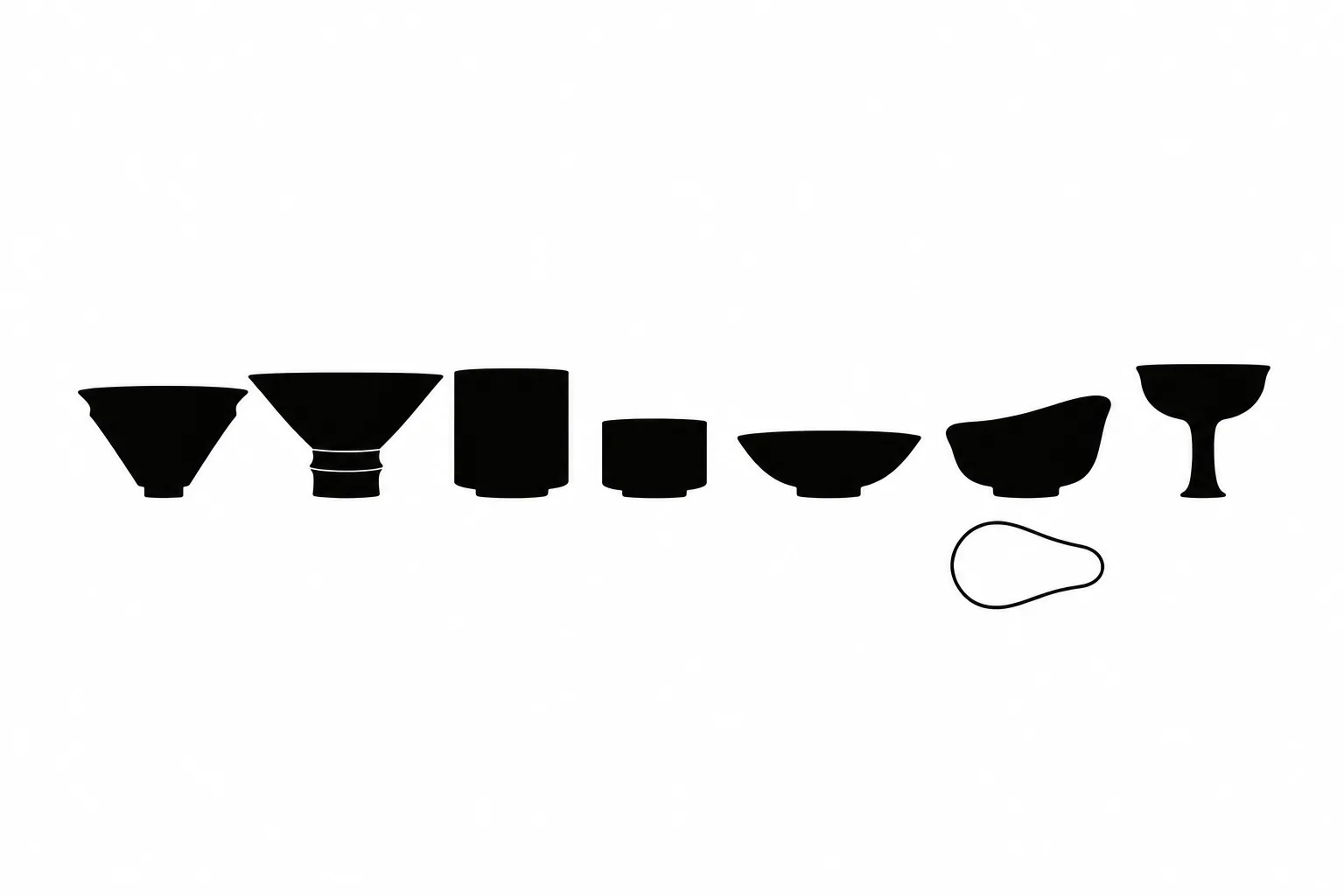
Seven bowl silhouettes, from left: tenmoku, ido, tsutsu, hanzutsu, hira, kutsu (with the outline of its rim seen from above) and bajōhai.
The tenmoku shape is the oldest, inherited from Song-dynasty China. The body rises in a straight, steep cone from a small foot, like an upturned funnel, and just below the lip there is a slight inward pinch before the rim flares out again. This pinch is called suppon-guchi, "snapping-turtle mouth," after the way a turtle’s neck emerges from its shell. Set on a black lacquer stand, the tenmoku shape is still the most formal bowl in tea and is used when tea is offered to a deity or an honoured guest.
The ido shape is deep and generous, opening in a wide V from a tall foot, with clear throwing rings on the outside. It looks loose and unfussy, and it has weight in the hand.
The tsutsu or cylinder bowl is straight-sided and deep, roughly as tall as it is wide, around 10 cm. The deep, narrow body holds heat, so it is a winter bowl. Whisking inside it takes a tighter wrist. A slightly shorter version with nearly straight walls is the hanzutsu, "half-cylinder," the most common proportion for Raku and Shino bowls and a common choice in spring and autumn.
The hira or flat bowl is the opposite: shallow and wide, often 15 cm or more across and only 5–6 cm high. The tea spreads out and cools quickly, and the broad green surface looks fresh, which makes it a summer bowl. The pairing of flat bowls for summer and cylinders for winter is one of the first seasonal rules a student learns.
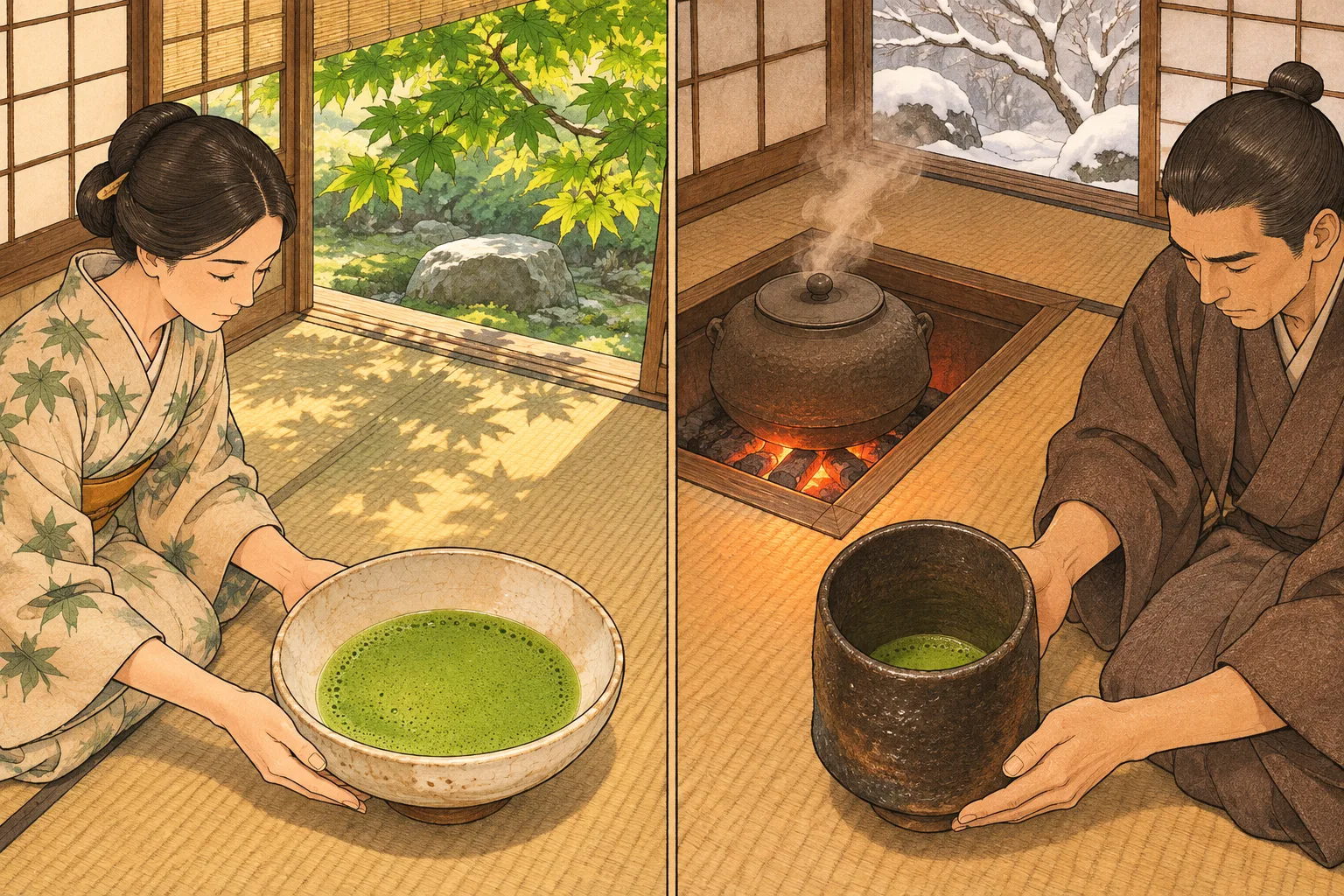
Left: a hira bowl for summer, shallow and wide, so the tea spreads out and cools quickly. Right: a tsutsu bowl for winter, straight-sided and deep, keeping the small surface of tea hot.
The kutsu or "clog" shape has a rim deliberately squashed out of round, so that from above it looks like an old wooden shoe, wide at one end and narrow at the other, often with a dent pushed into the side. This is the classic Oribe shape of the early 1600s. People seeing one for the first time sometimes assume it warped in the kiln. It did not.
The bajōhai, "horseback cup," has a small bowl set on a tall, narrow foot, like a stemmed cup. It began as a sake cup, held by the stem; the usual story is that the shape suited drinking on horseback, though how far that is true is hard to say. Tea bowls made in this form tend to be small and are used now and then as a playful change.
Other names you may see on museum labels include sugi-nari ("cedar shape," an inverted cone), wan-nari (a rounded, soup-bowl shape), and hazori-nari (flared rim). These are not a strict taxonomy. One bowl can be a half-cylinder with a touch of clog about it, and tea people will happily say so.
03Bowls From Abroad: Chinese Tenmoku and Korean Bowls
Japan’s first tea bowls were imports. From the 13th to the 15th century, Chinese goods (karamono) set the standard, and the most prized tea bowls were Chinese black-glazed wares.
The best known is Jian ware, made at the Jian kilns in Fujian province in the Song dynasty. The body is dark, gritty iron-rich clay, thick and heavy. The black glaze runs in the firing: it thins at the rim to a brown edge and pools outside near the foot in a thick roll, like candle drips that stopped just short of the base. Iron crystallising on the surface creates patterns. Fine streaks running down from the rim are called "hare’s fur" in Chinese and nogime, "grain-awn marks," in Japanese. Floating silver spots are "oil spot" (yuteki). Iridescent spots with a halo of blue and purple are yōhen, and only three complete yōhen bowls survive, all in Japan. The name tenmoku is usually traced to Mount Tianmu in Zhejiang, where Japanese monks studying in China are said to have used such bowls in the monasteries.
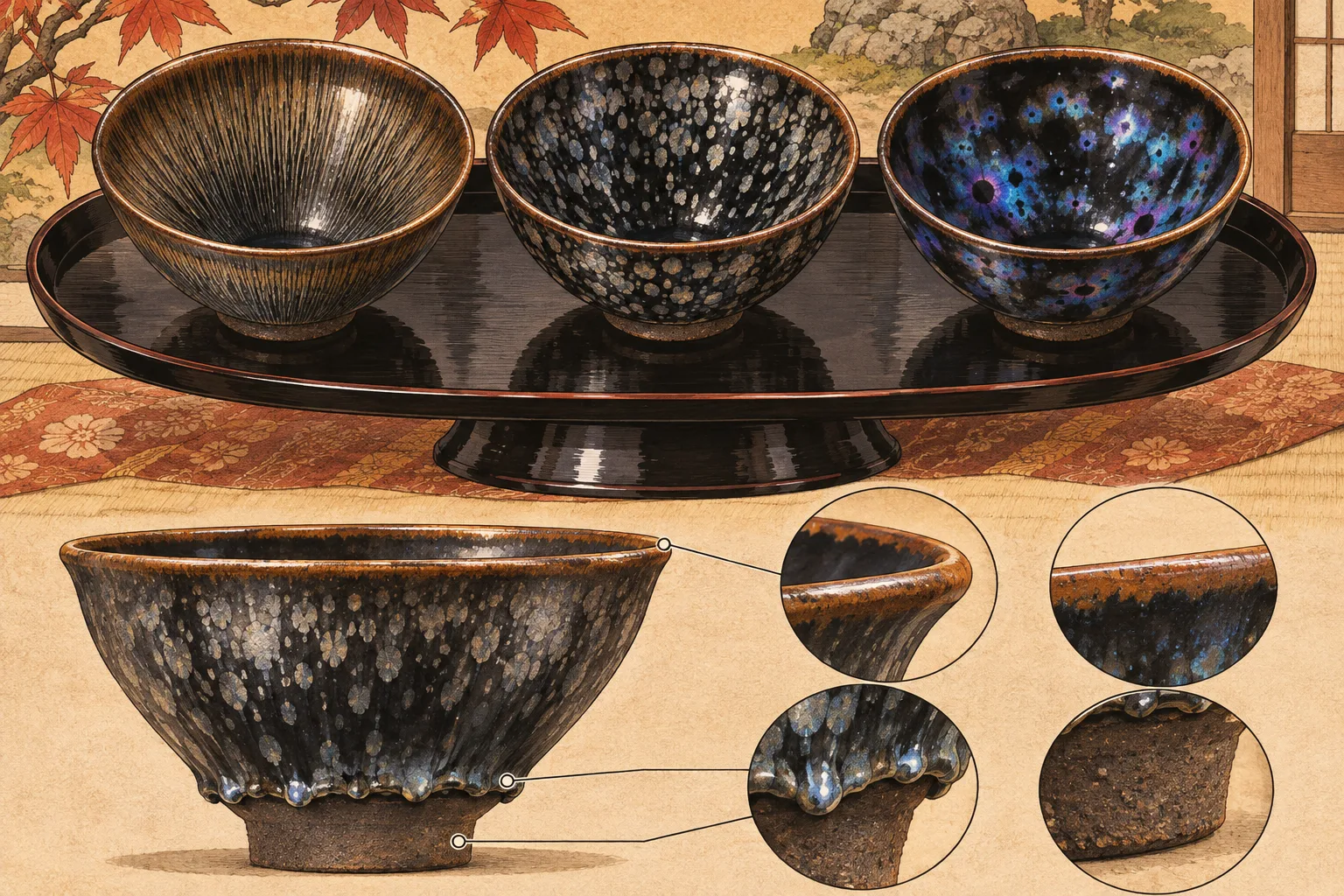
Three Jian-ware glazes, from left in the upper row: hare’s fur, oil spot and yōhen. Below, a Jian bowl from the side: the glaze thins to a brown edge at the rim, stops in a thick roll of drips just above the foot, and leaves the dark, gritty clay bare.
In the 15th century the Ashikaga shoguns’ connoisseurs ranked tenmoku types, with yōhen at the top. But Japanese taste was already drifting from Chinese values. Haikatsugi tenmoku, "ash-covered tenmoku," has a muddy yellow-brown to grey-black glaze that looks as if it has been dusted with ash. It is later than Jian ware, usually attributed to various Fujian kilns of the Yuan and Ming periods, and the Ashikaga shoguns’ collection treated it as hardly worth using. Yet by the late 16th century warlords and tea masters treasured it, because its subdued colour suited the quieter wabi style of tea.
Then the taste shifted to Korea. Japanese tea people call these bowls Kōrai chawan, "Goryeo bowls," but nearly all were made in the Joseon period, from the 15th to the 17th centuries. What they were originally made for varies by type and is partly debated. The early Mishima and Ido bowls are generally thought to have been everyday rice and soup bowls that Japanese buyers picked out for tea. Some, including the Korean potter Shin Han-gyun, argue that Ido bowls were household ritual vessels, and certain goki bowls (another Korean type) are also thought to have been ritual wares, but these views rest largely on inference. Others suggest some Ido bowls were made to Japanese order. What is certain is that from the late 16th century onward more and more bowls were made to Japanese specifications. The kilns are mostly unidentified beyond "southern Korea."
Ido bowls are considered the finest. Their glaze is a pale, warm yellow-brown that tea people compare to a loquat. Around the foot the glaze crawls into lumpy beads called kairagi, and this is the feature collectors look for first. Spacer scars often show inside. Subtypes include the large ō-ido, the smaller ko-ido, and the greyish ao-ido. Where the name "ido" comes from is unknown. Suggestions include a person named Ido who brought them to Japan, a Korean place name, and the simple idea that the deep bowl looks like a well (ido) when you peer into it.
Mishima bowls are covered in fine white patterns. The potter stamped or incised the grey clay, brushed white slip over it, then scraped the surface so the white stayed only in the grooves. In Korea this family is called buncheong. The usual Japanese explanation of "Mishima" is that the dense rows of pattern resembled the small kana on the Mishima almanac printed in Izu.
Kohiki, "powdered," bowls are dipped entirely in white slip under a clear glaze, giving a soft, chalky white. The slip is porous, so with use tea seeps under the glaze and forms pale brown blotches called amamori, "rain leaks," which tea people value as the bowl’s record of being used.
Komogai bowls are named after the port of Ungcheon (Komogai in Japanese), from which they are thought to have been shipped. They are round-bodied with a rim that turns strongly outward, and in the centre of the inside there is a small circular depression called the "mirror" (kagami). The foot is broad but not as tall as an Ido foot.
Irabo bowls are coarse, sandy and rough to the touch. The name is usually linked to ira-ira, "prickly." Glazes are yellow or grey-brown, sometimes with each half of the bowl dipped in a different glaze (katami-gawari). They are later than Ido, from around 1600 into the early Edo period, and many are thought to have been ordered by Japanese tea men from kilns near Busan.
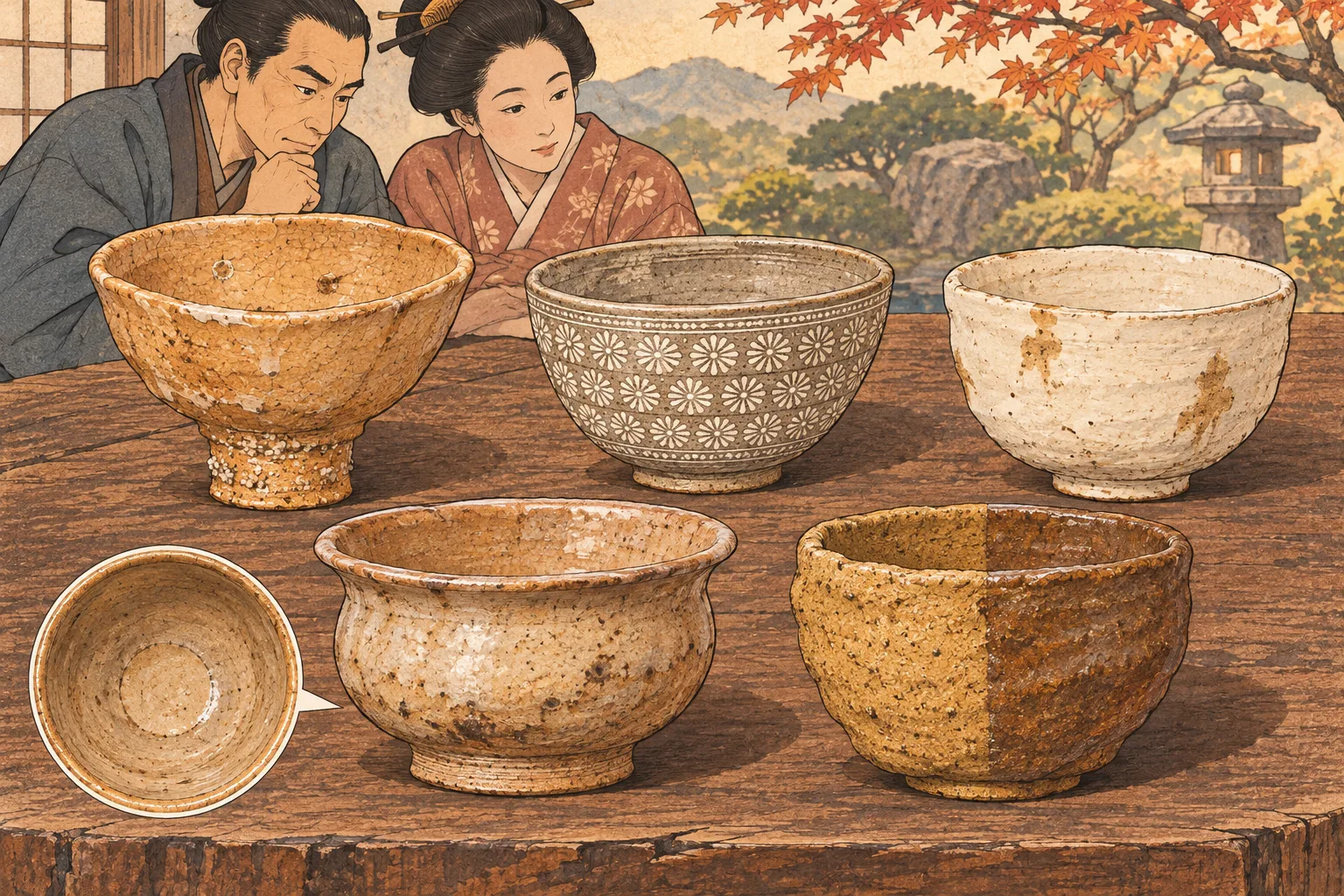
Five Korean bowls. Upper row, from left: Ido, Mishima and kohiki, with its pale brown amamori blotches. Lower row, from left: Komogai, shown with a view from above of the "mirror" in its centre, and irabo.
From the 17th century the story flips. Japanese clients sent designs to a kiln at the Japanese trading post in Busan and had Korean potters make bowls to order. These gohon ("model") bowls, often with soft pink spots, are Korean bowls made to Japanese taste, which shows how much the "discovery" of Korean bowls had always been a matter of Japanese eyes choosing.
04Japan’s Own Bowls: Raku, Shino and Oribe
In the late 16th century Japanese potters began making tea bowls on their own terms. The purest example is Raku, made in Kyoto by a tile maker named Chōjirō, working (as is generally accepted) under the guidance of Sen no Rikyū. Raku bowls are hand-built rather than thrown, carved, and fired at low temperature; black Raku is pulled from the kiln red-hot with tongs. (The ceramics guide covers the process.) Chōjirō’s bowls are close to half-cylinders, with rims turned slightly inward and walls carved into soft facets. The result is thick, light and porous. The clay insulates, so a bowl full of hot tea feels only warm in the hands. Nothing about it has the regularity of a wheel.
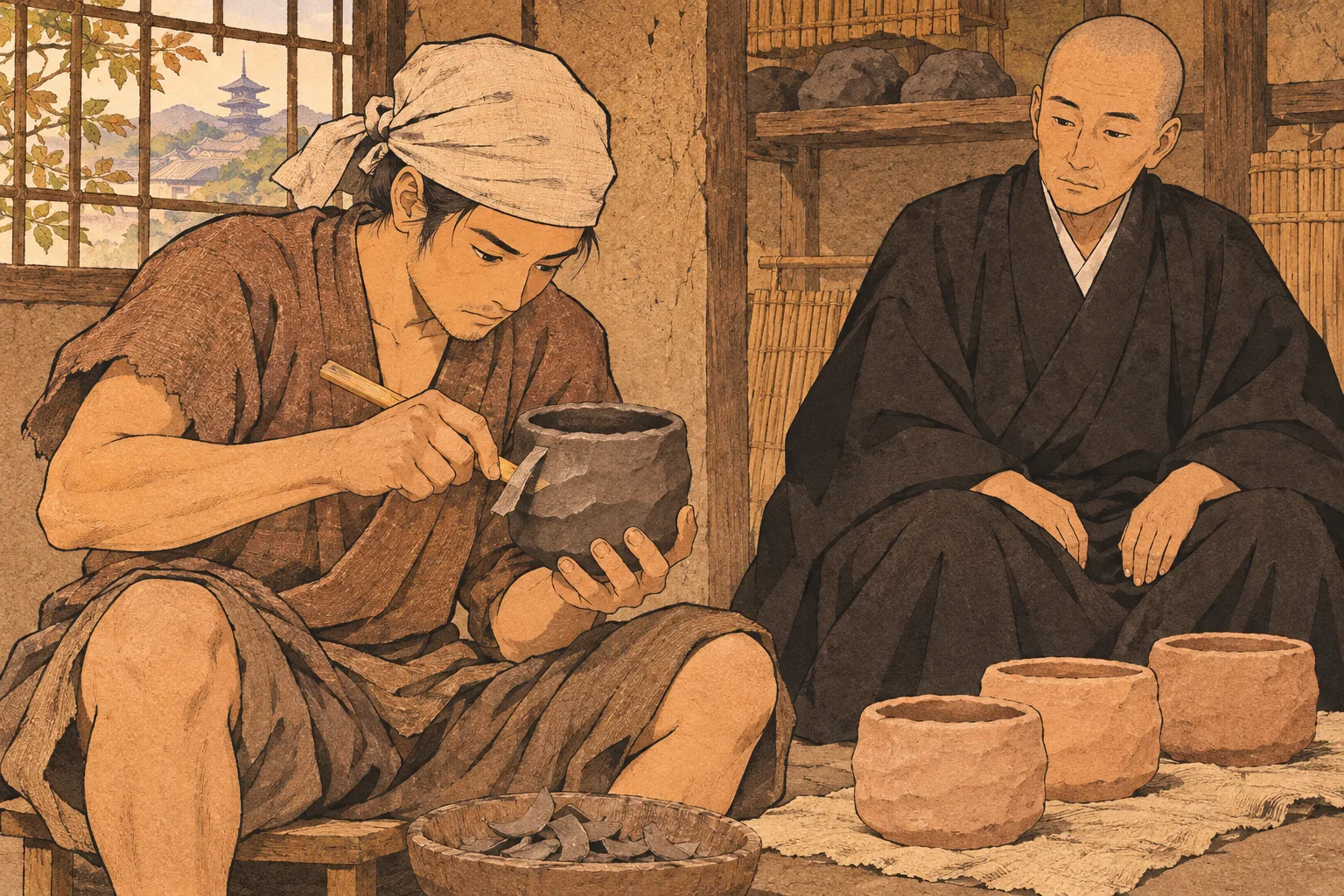
Chōjirō carving a bowl. Raku is built by hand, not thrown on a wheel, and then cut to shape with a blade. Sen no Rikyū looks on (artist’s impression).
Black Raku has a matt, deep black glaze, more like wet stone than glass, against which matcha looks dark and intense. Red Raku uses iron-bearing clay under a clear glaze, firing to an orange-red with grey smoke clouds. Early bowls carry stories. One black bowl is named Shunkan: Rikyū reputedly sent three bowls to a patron in Satsuma, who kept one and returned two, and the one left behind was named after the monk Shunkan of The Tale of the Heike, abandoned alone on an island when his companions were pardoned. A red bowl called Hayafune, "fast boat," is said to have been fetched by express boat for a particular tea gathering. The Raku family continues today, each head taking the name Kichizaemon, and the bowls of successive generations differ noticeably. The third head, Dōnyū, made glossier bowls with thinner rims.
At the same time, kilns in Mino (today’s Gifu Prefecture) produced a burst of new styles. Shino was among the first white-bodied tea bowls made in Japan. It has a thick, milky glaze of feldspar, white like snow, pitted with tiny pinholes that tea people compare to citrus peel. Where the glaze is thin, at the rim and edges, the clay blushes through in pale orange. Painted Shino (e-shino) has simple iron brushwork, grasses, fences, a bridge, showing faintly brown under the white. Grey Shino (nezumi-shino) has a coat of iron slip with designs scratched through it, so white lines show on grey; red Shino (beni-shino) uses ochre instead and fires reddish. Shino bowls tend to be half-cylinders with uneven walls and a mountain-path rim.
Oribe is named after Furuta Oribe, Rikyū’s most prominent student and the leading tea master after his death. Where Rikyū’s bowls are still, Oribe’s move. They are deliberately distorted, often clog-shaped, with dented sides and a tilted foot. Copper green glaze is splashed over part of the bowl, and the rest is painted in iron with bold geometric patterns: checks, plum blossoms, fans, stripes. Black Oribe has black glaze with painted windows. To modern eyes Oribe can look almost cartoonish, and that exuberance belongs to the same age as gilded screens and grand castles.
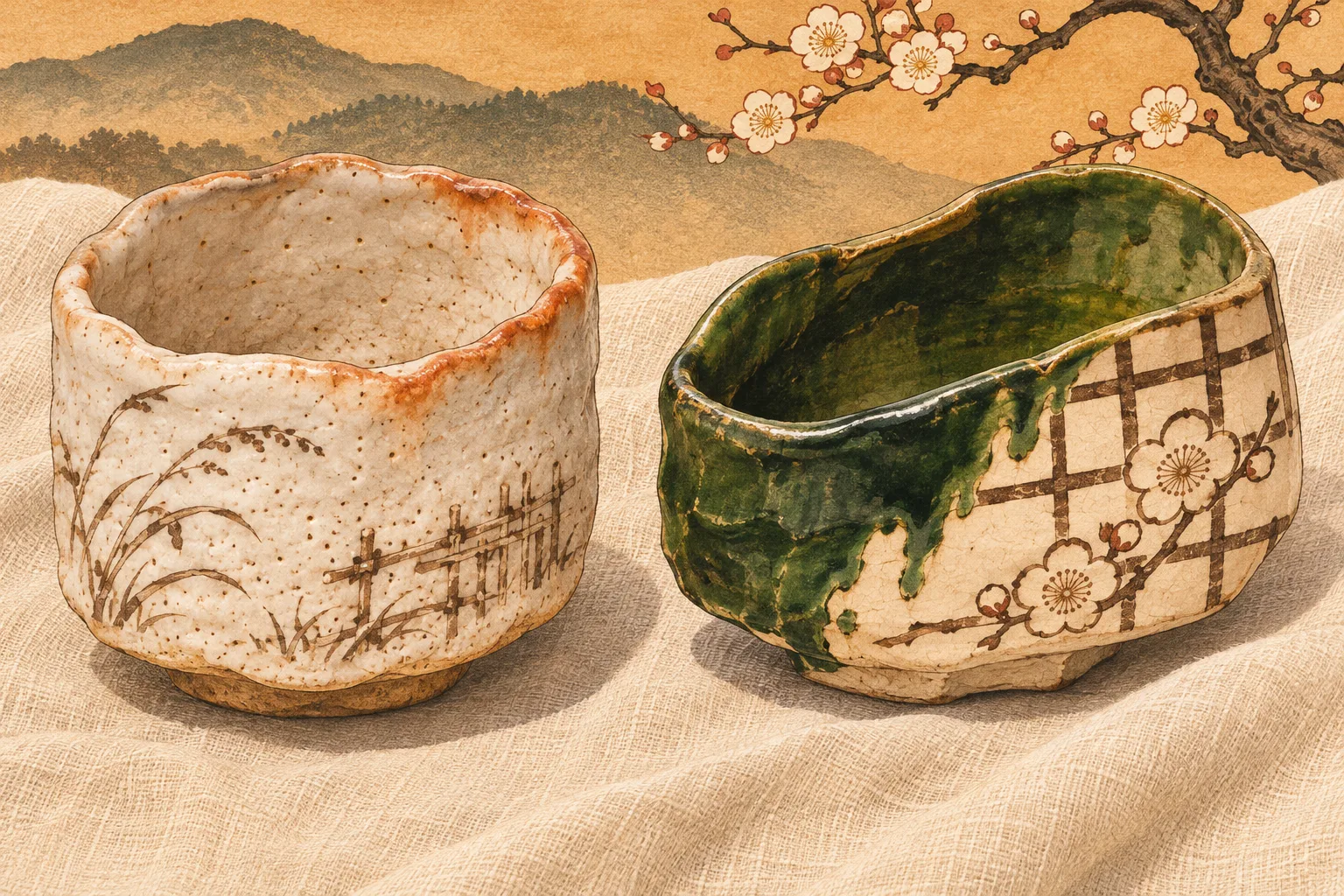
Left: Shino, with a thick, pitted white glaze over iron-painted grasses and a fence, and a blush of fire colour at the rim. Right: Oribe, pushed into a clog shape, with copper green on one side and iron-painted checks and plum blossoms on the other.
Also from Mino is Seto-guro, "Seto black," a jet-black bowl made by pulling the bowl out of the kiln with tongs at peak temperature and letting it cool suddenly in the air. The tongs leave a mark, which we will come back to.
05Hagi, Karatsu, and "First Raku, Second Hagi, Third Karatsu"
The two other bowls most often named alongside Raku both grew out of Korean craftsmanship. After Toyotomi Hideyoshi’s invasions of Korea in the 1590s, western Japanese lords brought Korean potters home with them.
In Hagi, in today’s Yamaguchi Prefecture, the Mōri family set up an official kiln with the Korean brothers Yi Jak-gwang and Yi Kyeong in the early 17th century (sources differ on the exact year); Yi Kyeong’s line later received the name Saka Kōraizaemon, which its heads still carry. Early Hagi bowls look very much like Korean Ido and Komogai bowls. The clay is soft and porous and fired relatively low, and the glaze is covered in fine crazing. With use, tea soaks into the crazing and the bowl gradually darkens and warms in colour, a change Hagi lovers enjoy watching over years. Typical colours are loquat-beige and a soft white made with straw-ash glaze. Hagi bowls often have a notched foot. A popular story says that Hagi ware was reserved for the Mōri domain, so potters cut the foot to make each bowl technically "flawed" and therefore allowed for sale to commoners. The story’s origin is unclear and it is probably later folklore; notched feet already appear on Korean bowls.
Karatsu ware comes from the old province of Hizen (today’s Saga and Nagasaki prefectures). Pottery was already being made there in the later 16th century, and it boomed when Korean potters arrived around the time Hideyoshi’s forces gathered at Nagoya Castle on the Hizen coast. Karatsu is the port the wares were shipped from, and in parts of western Japan "Karatsu-mono" is said to have come to mean pottery in general. Karatsu clay is grey-brown and gritty. Painted Karatsu (e-garatsu) has quick iron brushwork of grasses, reeds or birds. Mottled Karatsu (madara-garatsu) has a milky straw-ash glaze speckled with blue-black. Korean Karatsu (chōsen-garatsu) pairs a dark iron glaze with a milky straw-ash one, applied in upper and lower zones that overlap and run where they meet. Oku-gōrai bowls copy the broad shape and ridged foot of Korean bowls. Karatsu bowls are plain and sturdy, and tea people have long used them as everyday bowls.
The saying ichi Raku, ni Hagi, san Karatsu, "first Raku, second Hagi, third Karatsu," ranks these three as the top Japanese-made tea bowls. It is not a ranking of price or age but of how well a bowl suits drinking matcha and how much tea people love it. Raku comes first because it was designed for the tea room: hand-shaped to fit the palm, insulating, and coloured to set off the green of the tea. Hagi is second for its softness and the way it changes with use. Karatsu is third for its unpretentious, natural look.
No master laid it down, and when it arose is not known. An older version is better documented: ichi Ido, ni Raku, san Karatsu, which puts the Korean Ido bowl first, appears in a tea poetry collection of 1729 that already calls it a saying handed down from the past. Other variants also keep Ido at the top. The Raku–Hagi–Karatsu version is usually treated as a later, Japan-only ranking, and one historian argues it was promoted by Hagi interests through ties with the Omotesenke school in the Meiji period. Both are still heard, and neither is a serious league table.
06Keshiki: Reading the Accidents
Tea people call the visual features of a bowl its keshiki, "scenery," as if it were a landscape. Most scenery comes from things the potter could not fully control: how the glaze ran, how the flame licked the bowl, where it sat in the kiln. What a factory would reject, a tea master may treasure.
Yōhen or kiln change is the broadest term: unexpected colour shifts caused by flame, temperature and atmosphere. Two bowls from one firing can come out completely different depending on whether they faced the fire.
Chijire or crawling is when glaze pulls back during firing and breaks into islands, exposing the clay between. In everyday pottery this is a defect. On a tea bowl, especially around the foot, it is a feature.
At its most extreme, crawling becomes kairagi, dense beads of glaze bubbling up around the foot like the textured ray skin once used to wrap sword handles, which is where the word comes from. Kairagi is the defining feature of Ido bowls, and when a tea person tilts a bowl to look underneath, this is often what they are hoping to see.
Hasami-ato are tong marks: one or two small paired dents or bare patches where iron tongs gripped the molten glaze as the bowl was pulled from the kiln. Seto-guro and black Raku bowls show them, usually near the waist or rim. They are a birth certificate of sorts, proof the bowl came straight out of the fire.
Hiiro, "fire colour," is the blush of red or orange where iron in thin-glazed or bare clay oxidised in the flame. The pinkish glow at the edges of white Shino glaze is the classic example; Hagi and Karatsu show it too.
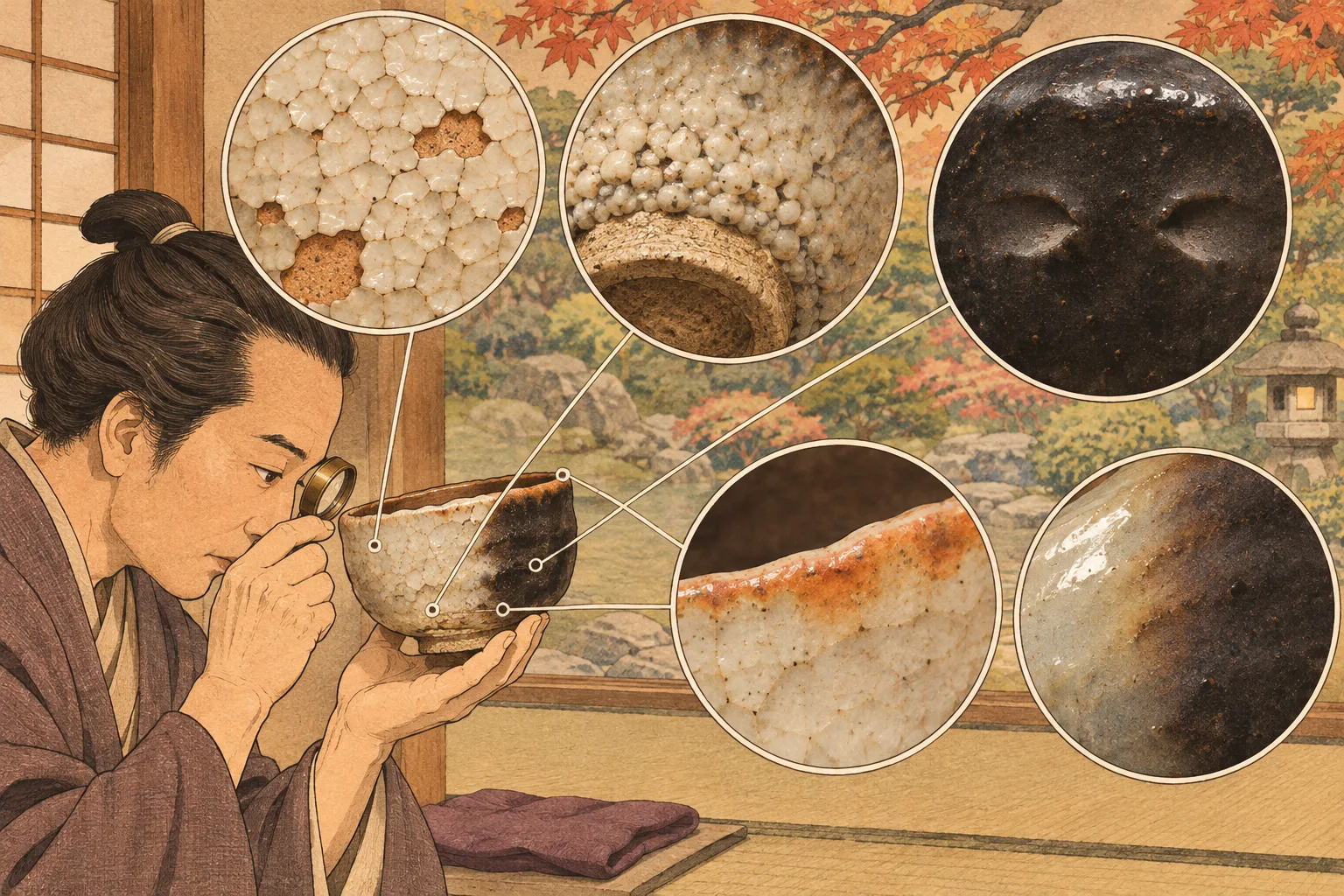
Five kinds of keshiki, enlarged. Upper row, from left: chijire, kairagi around the foot, and hasami-ato in black glaze. Lower row, from left: hiiro at the edge of a white glaze, and yōhen.
Other scenery includes glaze runs (nadare), small unglazed gaps where a finger or tongs held the bowl during dipping (hima), little craters where a stone in the clay burst in the fire (ishi-haze), crazing (kannyū), and the "rain leaks" of kohiki. Even repairs become scenery. Broken bowls rejoined with lacquer and dusted with gold, kintsugi, wear their seams openly. A famous mended bowl is the Ido bowl Tsutsui-zutsu, named after its owner Tsutsui Junkei and later owned by Hideyoshi. The story goes that a page dropped it and it broke into five pieces; Hosokawa Yūsai, who was present, calmed Hideyoshi with a comic verse playing on a poem from The Tales of Ise, taking the blame on himself. The story exists in several versions, and historians find it a little too neat.
07Front, Name, Box and Pedigree
A tea bowl has a front (shōmen). The potter places the best scenery or painting on one side. On a painted Shino or Karatsu bowl the painted side is the front; on an unpainted bowl it is usually the side with the finest glaze effects or carving, and sometimes the box inscription or tradition settles it.
The host sets the bowl down with the front facing the guest, offering the best side. The guest bows, picks it up, and turns it clockwise about two times so the front faces away, then drinks from the side. Afterwards the guest wipes the rim with the fingers, turns the bowl back so the front faces the host, and sets it down. The usual explanation is modesty: you avoid putting your lips to the side that was offered to you. Exact turns vary by school. Knowing this makes those small rotations in a tea demonstration suddenly legible.
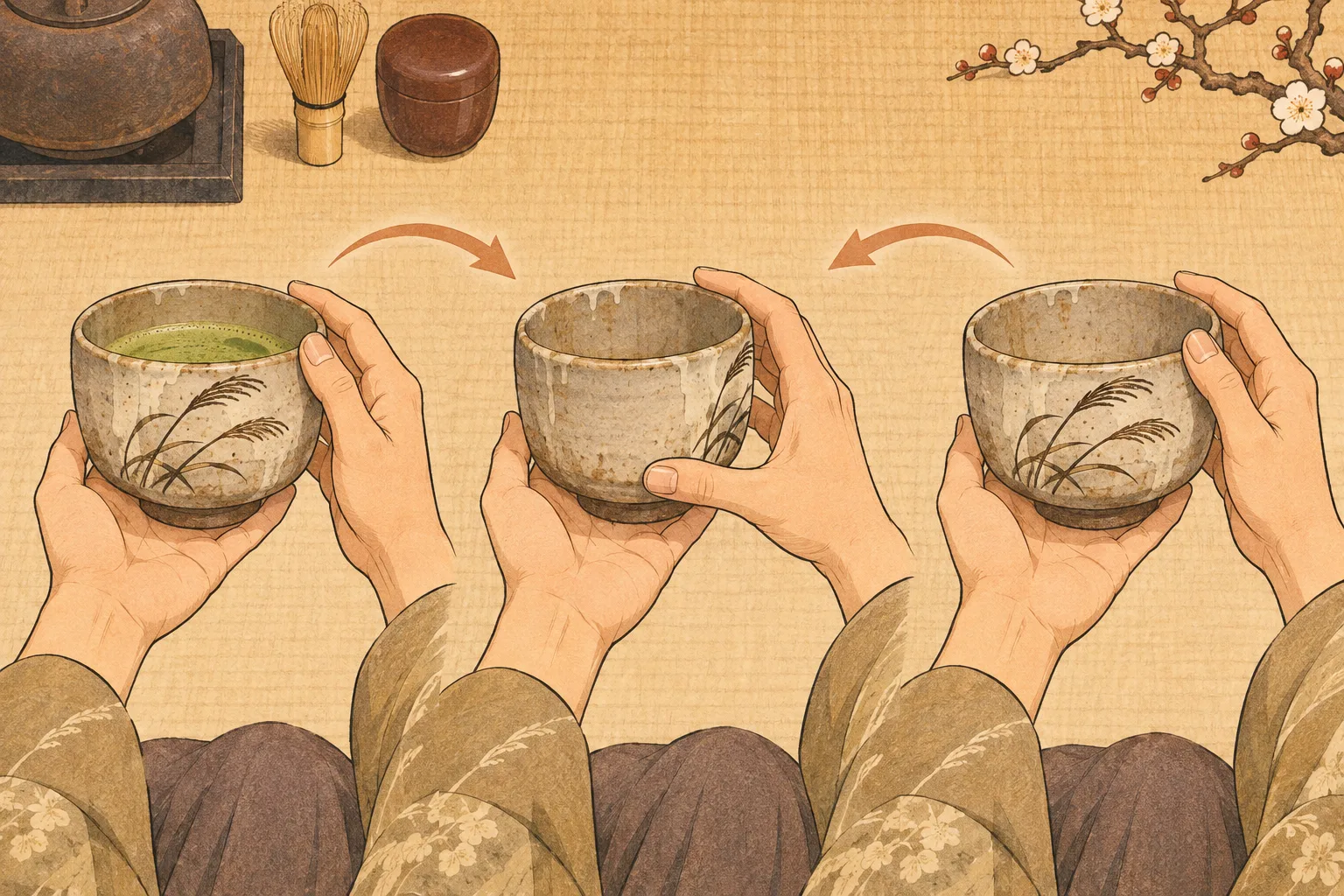
Turning the bowl. Left: as received, the painted front faces the guest. Centre: the bowl is turned so the front moves away before drinking. Right: afterwards it is turned back.
Famous bowls have names, mei. Tea masters and owners gave them, drawing on poetry, on the bowl’s look, on an incident in its history, or on a former owner. The Ido bowl Tsutsui-zutsu is named after Tsutsui Junkei, and the Ido bowl Shibata is said to have belonged to Shibata Katsuie; another, Uraku, takes its name from Oda Uraku, a tea master and younger brother of Oda Nobunaga. The Shino bowl Unohanagaki, "fence of deutzia flowers," takes its name from a waka poem that likened its painted fence and white glaze to a hedge of deutzia in bloom. A name turns a bowl into a character with a biography.
The name is written on the box. Good tea bowls live in paulownia boxes, and the lid carries the type of bowl, its name, and the signature and personal cipher of whoever wrote it. That writing is the hakogaki. If the potter signed it, it is a tomobako, "matching box." If a later tea master, such as the head of one of the Sen family schools, examined the bowl and inscribed the box, that inscription functions as appraisal and endorsement. Old bowls often sit in nested boxes, inner, middle and outer, with a new layer and new inscription added as important owners came and went. The bowl itself is wrapped in a small silk pouch called a shifuku, and a famous bowl may have several.
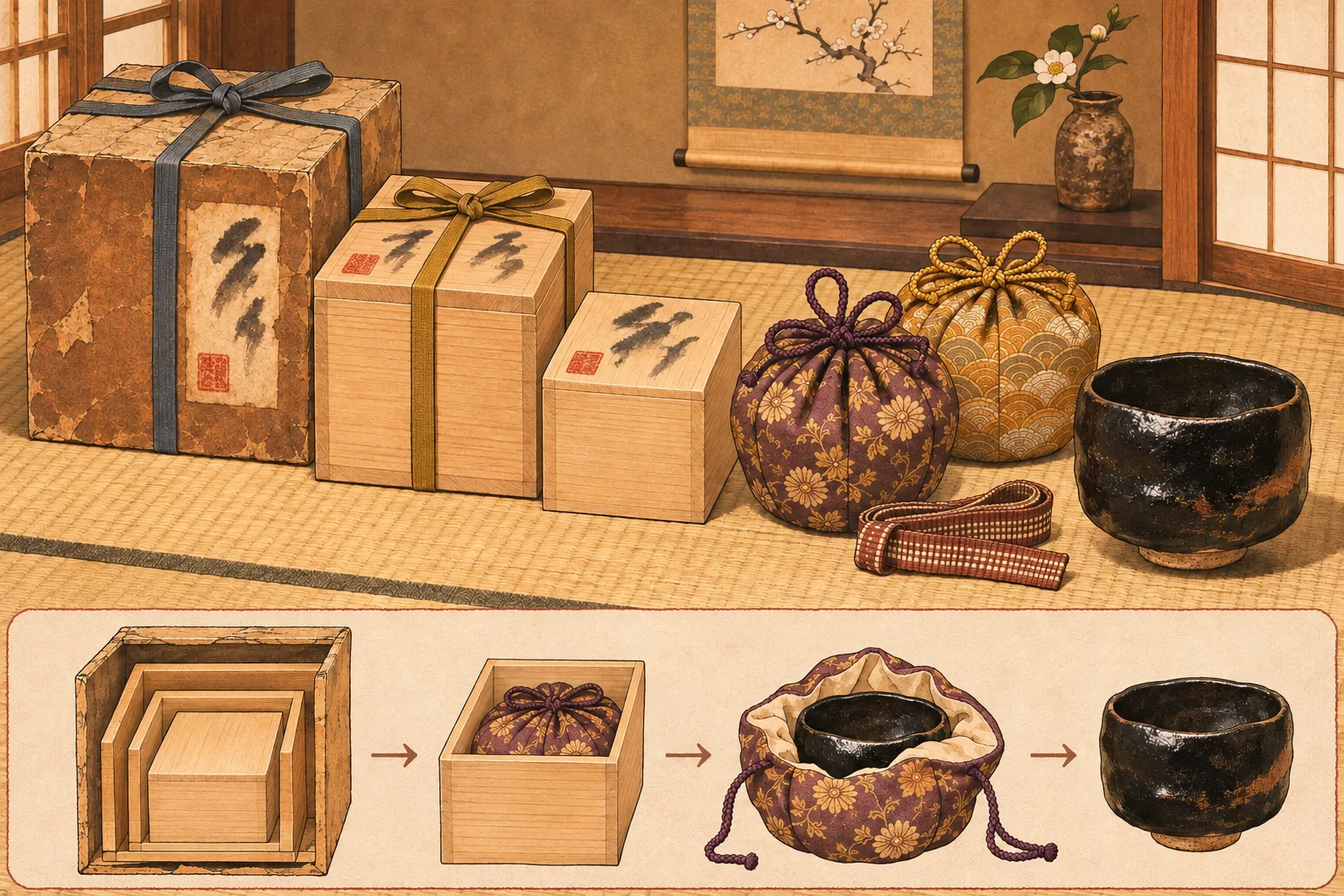
A famous bowl and its wrappings. Upper row, from left: outer, middle and inner boxes with their inscriptions and seals, two shifuku pouches, and the bowl itself. Lower row: unpacking, from the nested boxes to the pouch to the bowl.
Beyond the box, famous bowls often carry a written provenance listing their owners: from a tea master to a lord to a merchant house, sometimes with letters attached. Tea people judge the bowl, its name, its box, its pouches and its pedigree together. That is why museum exhibitions of tea bowls often display a stack of boxes and pouches beside the bowl, sometimes taking up more room than the bowl does.
08Side by Side: Telling Look-Alikes Apart
A few pairs trip up almost everyone.
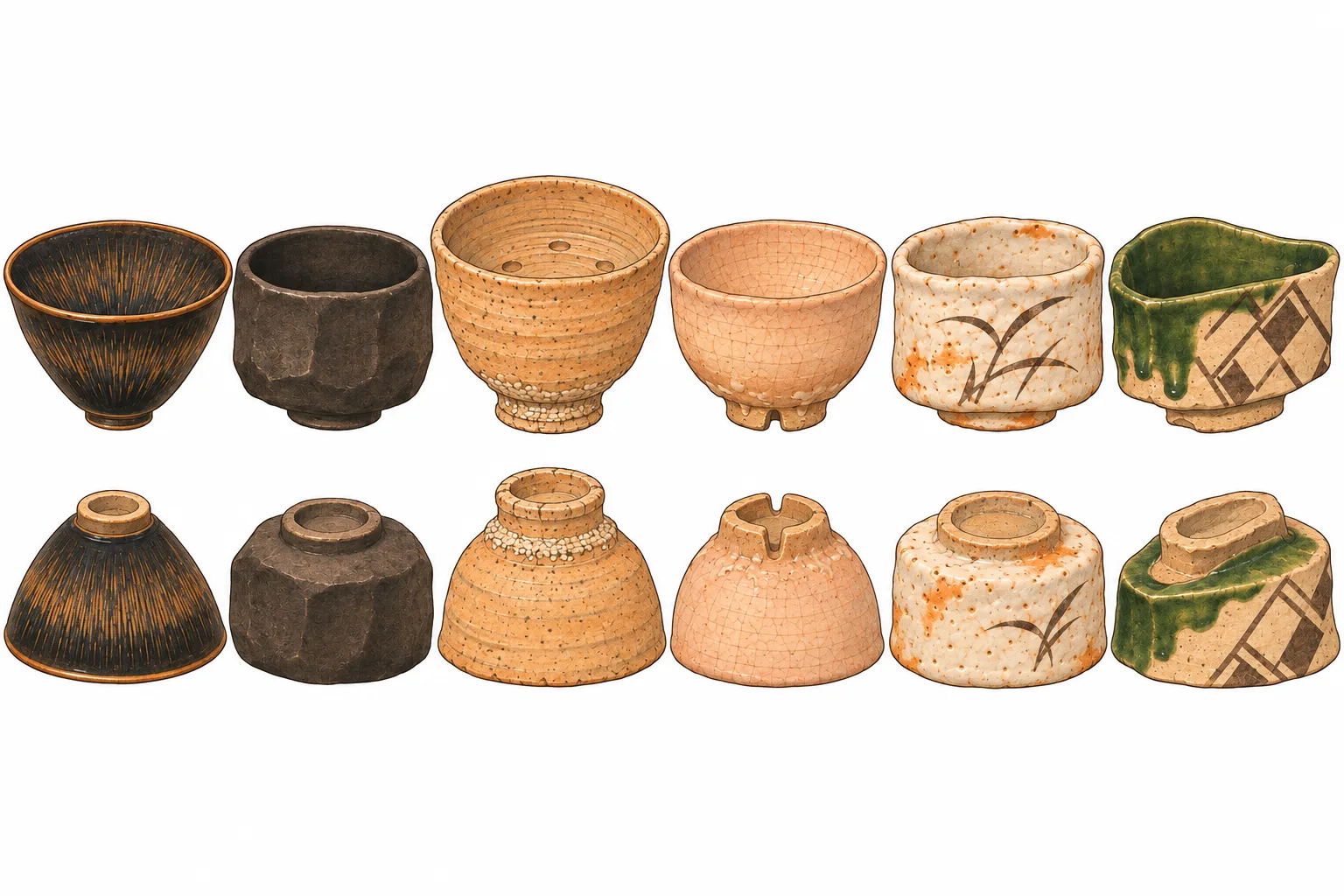
Six easily confused bowls, from left: Jian tenmoku, black Raku, Ido, Hagi, Shino and Oribe. The lower row shows each one upturned, with its foot.
Tenmoku versus black Raku. Both are black. Tenmoku is glossy like glass, often streaked or spotted, with a pinched rim, a steep funnel-shaped body, a neat small foot, perfect wheel-thrown symmetry, and real weight. Black Raku is matt like wet stone, plain, with straight, softly faceted walls, a rim turned slightly inward, a low round foot, and surprising lightness.
Ido versus Hagi. Both are loquat-coloured with wide mouths and tall-ish feet. Ido is larger, with strong throwing rings, a ridged bamboo-node foot ringed with kairagi, and spacer scars inside. Hagi is softer clay with fine crazing that darkens with use, often a notched foot, and less kairagi. Since early Hagi imitated Ido, clay and crazing are the real tells.
Shino versus kohiki. Both are white. Shino’s white is a thick, pitted glaze with orange blush and often iron painting, on a half-cylinder with uneven walls. Kohiki’s white is slip under a thinner, smoother glaze, often with brown "rain leak" stains, on a plain rounded shape without painting.
Oribe versus painted Karatsu. Both can have iron painting. Oribe has big splashes of copper green, a distorted clog shape and bold geometric motifs. Painted Karatsu has no green, a grey-brown clay, an even shape, and a few quick strokes of grass or reed.
Komogai versus Ido. Both Korean. Komogai is round with a flared rim and a "mirror" in the centre, on a broad but not tall foot. Ido opens in a V, has no flared lip, and stands on a tall ridged foot with spacer scars inside.
If you remember one trick, look at the foot. Bamboo-node ridges with beaded glaze suggest Ido. A notch suggests Hagi. Small and crisp suggests tenmoku. Low and round suggests Raku. A tilted foot under a squashed rim suggests Oribe.
More deep dives on this topic
 ChawanAt the end of a tea ceremony, after the last sip, guests do something that puzzles first-time visitors.
 Tea UtensilsMost of what sits on a tea-room mat is small enough to hold in one hand.
 The Tea RoomA small Japanese tea room can look almost artless: a box of earth walls and straw mats, a few odd little windows, a recess with a single scroll.
 The AlcoveWhen guests enter a tea room, they do not sit down straight away.
 TemaeSit as a guest in a Japanese tea room and you will watch someone spend a quarter of an hour on a task that takes a minute in a kitchen, and it is natural to wonder what all the…
 The ChajiMost visitors to Japan meet the tea ceremony as a bowl of whisked matcha and a sweet, served in a temple garden or a tea school in Kyoto, over in fifteen minutes.
 The Tea YearWalk into the same tea room in January and in August and you might think you had come to two different houses.
 Schools of TeaWalk north up Ogawa-dōri in Kyoto, a narrow street lined with old townhouses, and you pass two quiet gates a few dozen metres apart.
- Back to the main article: The Way of Tea (Chanoyu) →