
When guests enter a tea room, they do not sit down straight away. Each one shuffles on their knees to the alcove, the tokonoma, bows, and looks up at the scroll hanging there. In that recess there is usually just one hanging scroll, perhaps a small lidded box beside it, and nothing else. An hour or so later, after a meal and a short break in the garden, the guests return to find the scroll rolled away and a single vase in its place, holding one or two flowering stems.
For a Western visitor this can look like minimalism for its own sake. It is closer to a language. Who wrote the scroll, how it is mounted, whether the flowers stand in an old Chinese bronze or a cut length of bamboo, whether the incense box is lacquer or ceramic: each choice tells the guest the season, the reason for the gathering, and what the host wants to say. This guide walks through the three things that appear in the alcove at a tea gathering and how to read them. The architecture of the alcove itself, and the full sequence of a formal tea event, are covered elsewhere; here the focus is on what goes inside.
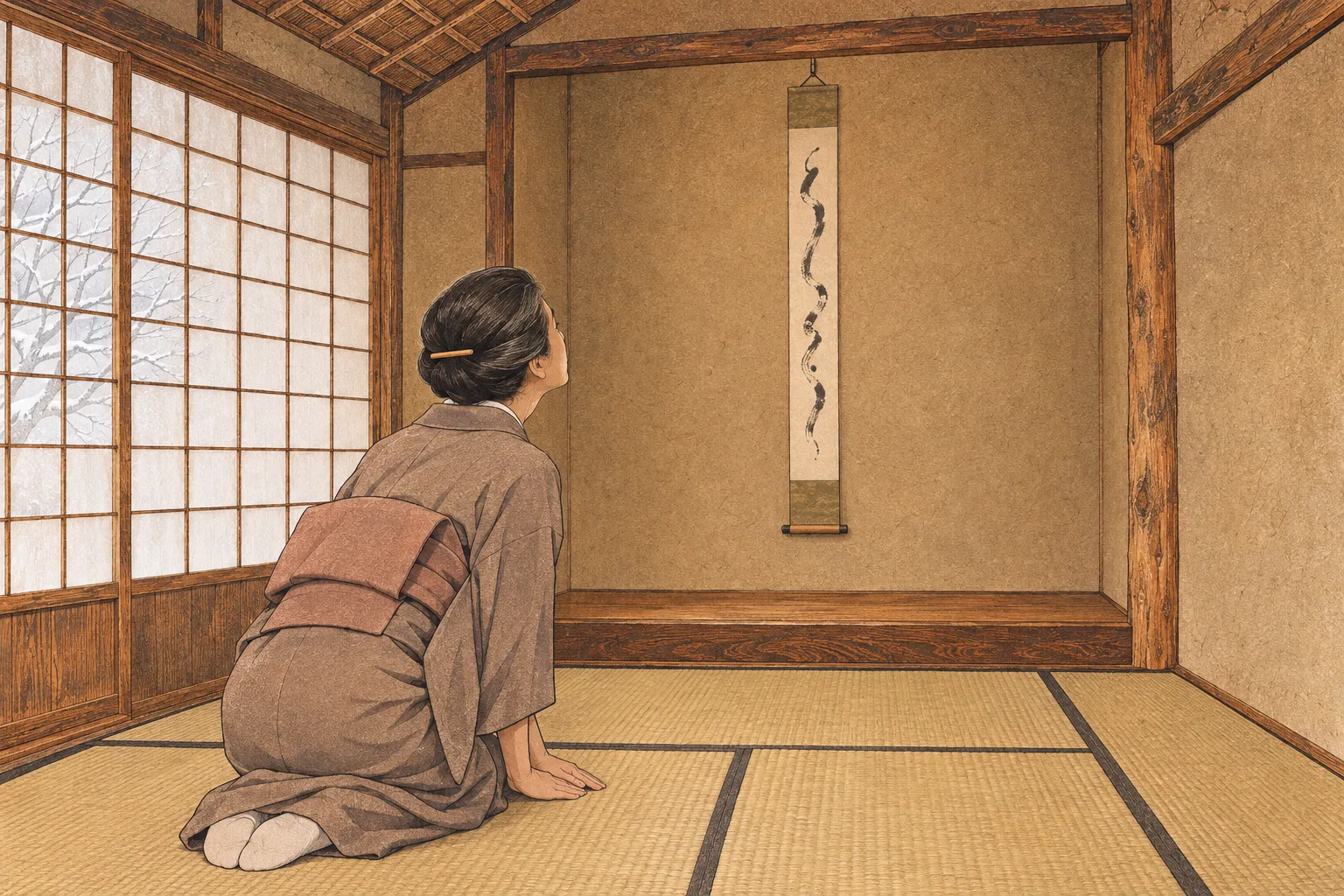
First the alcove. A guest kneels before the tokonoma, bows and looks up at the scroll. In the first half of a tea event it hangs alone, with no flowers.
01Why the Scroll Comes First
Tea people repeat an old saying: no utensil matters more than the hanging scroll. The line is usually quoted from the Nanpōroku, a text that claims to record the teachings of Sen no Rikyū (1522–1591). The book surfaced only in the late seventeenth century and most historians now treat it as a later compilation, but it captures an attitude that tea practitioners have held for at least four hundred years. It also ranks Zen calligraphy, bokuseki, at the very top.
You can see the attitude in old tea diaries. When a host or guest recorded a gathering, the scroll went on the first line, before the tea caddy, the bowl or the kettle. It functioned like the title of the event.
Part of the reason is history. Tea was first served in formal reception rooms in the fifteenth century, where Chinese paintings, calligraphy and bronzes were displayed as statements of wealth and taste. As Murata Jukō, Takeno Jōō and Rikyū developed the pared-down style known as wabi tea, most of that display disappeared, but the place for a single scroll remained, and as everything else fell away, the scroll mattered more. The main article tells the story of Jukō and the calligraphy of the Chinese monk Yuanwu Keqin; the later reverence for Zen writing grows from that root.
The other reason is practical. A host chooses a theme, and the scroll states it most directly: a New Year phrase for the first gathering of the year, a parting verse for someone going away, a letter written by a departed teacher at a memorial. The guests’ bow before the alcove acknowledges both the writing and the host’s thought in choosing it. Flowers and incense play supporting roles. They should echo the scroll, never compete with it.
02Six Kinds of Scroll
Experienced guests first ask which category a scroll belongs to, because each has a different history and standing.
Bokuseki ("ink traces") in the strict sense means calligraphy by Zen monks. The most prized pieces are by Chinese monks of the Song and Yuan dynasties; next come Japanese monks of the Kamakura and Muromachi periods, especially those connected with Daitokuji in Kyoto. The text can be a certificate of enlightenment given by a master to a disciple, a sermon, a verse, or a farewell poem, often several lines of dense characters with a date and signature. These monks were not professional calligraphers, and their brushwork can look rough or uneven. That unpolished force is what tea people value. The best known example, a fragment by Yuanwu Keqin in the Tokyo National Museum, is nicknamed "Nagare Engo" (the drifting Yuanwu) because, according to tradition, it once washed up on the Satsuma coast inside a paulownia tube.
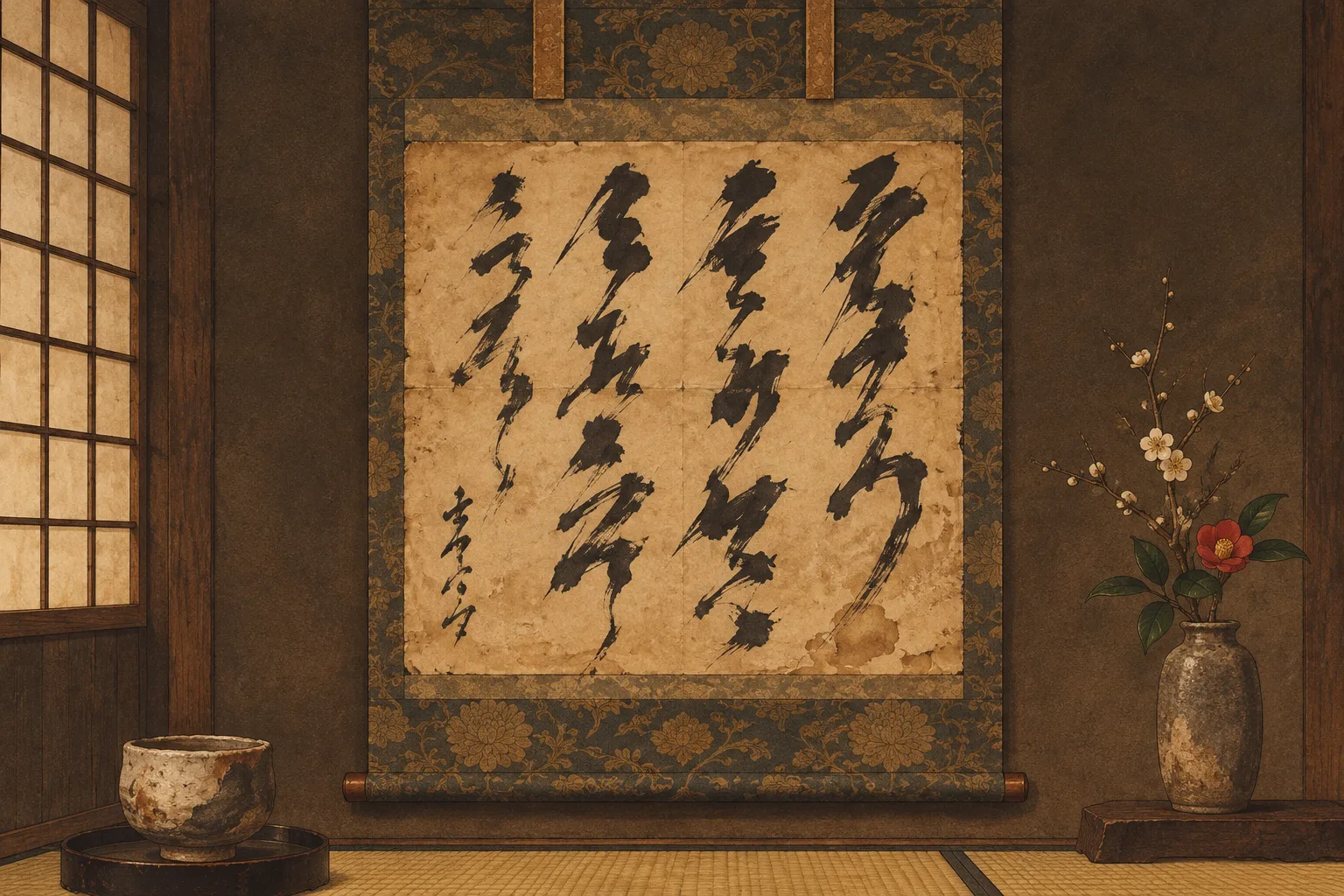
Bokuseki: several lines of dense, forceful characters by a Zen monk, uneven and unpolished, with a signature at the end, in a sober mounting of dark old textile.
Ichigyōmono ("one-line pieces") are the scrolls you will see most often today. A tall, narrow sheet carries a single vertical line, usually five to seven characters, sometimes only one or two, such as 無 (mu, nothingness) or 関 (kan, barrier). The form became popular from the Edo period on, written by abbots of Daitokuji and other Zen temples and by the heads of tea schools. They are affordable compared with medieval calligraphy and can be chosen to match a season or theme. To recognise one: tall, one line, large characters, a seal at the top right and a signature with two seals at the bottom left.
Yokomono ("horizontal pieces") turn the sheet sideways. Two to four characters run across, such as 和敬清寂 or 清風 ("fresh breeze"). They suit low, narrow alcoves in small tea rooms where a tall scroll would feel cramped, and wide alcoves in larger rooms where they fill the space sideways.
Gasan are paintings with an inscription. In the tea room these are often Zen ink paintings, perhaps a simple figure or an ensō, a circle drawn in one stroke, with a verse above; or Edo-period haiga, a few strokes of a frog or a willow paired with a haiku. Pure paintings have traditionally ranked below calligraphy in wabi tea, since a picture invites the eye to rest on prettiness. The inscription gives it something to say.
Kohitsu and kaishi take you away from Chinese characters altogether. Kohitsu ("old brush") are fragments of Japanese poetry anthologies written by Heian- and Kamakura-period courtiers, later cut from the original scrolls and albums and mounted one by one. The "Kōya-gire," among the oldest copies of the Kokinshū anthology, is the most famous. Kaishi are sheets on which participants at a poetry gathering wrote their own verses in a set format. Both are recognisable at a glance: flowing cursive kana across the page, often on paper decorated with faint patterns or flecks of gold and silver. Takeno Jōō is traditionally credited with first hanging poetry by Fujiwara no Teika in a tea room, opening a Japanese literary lane alongside the Zen one.
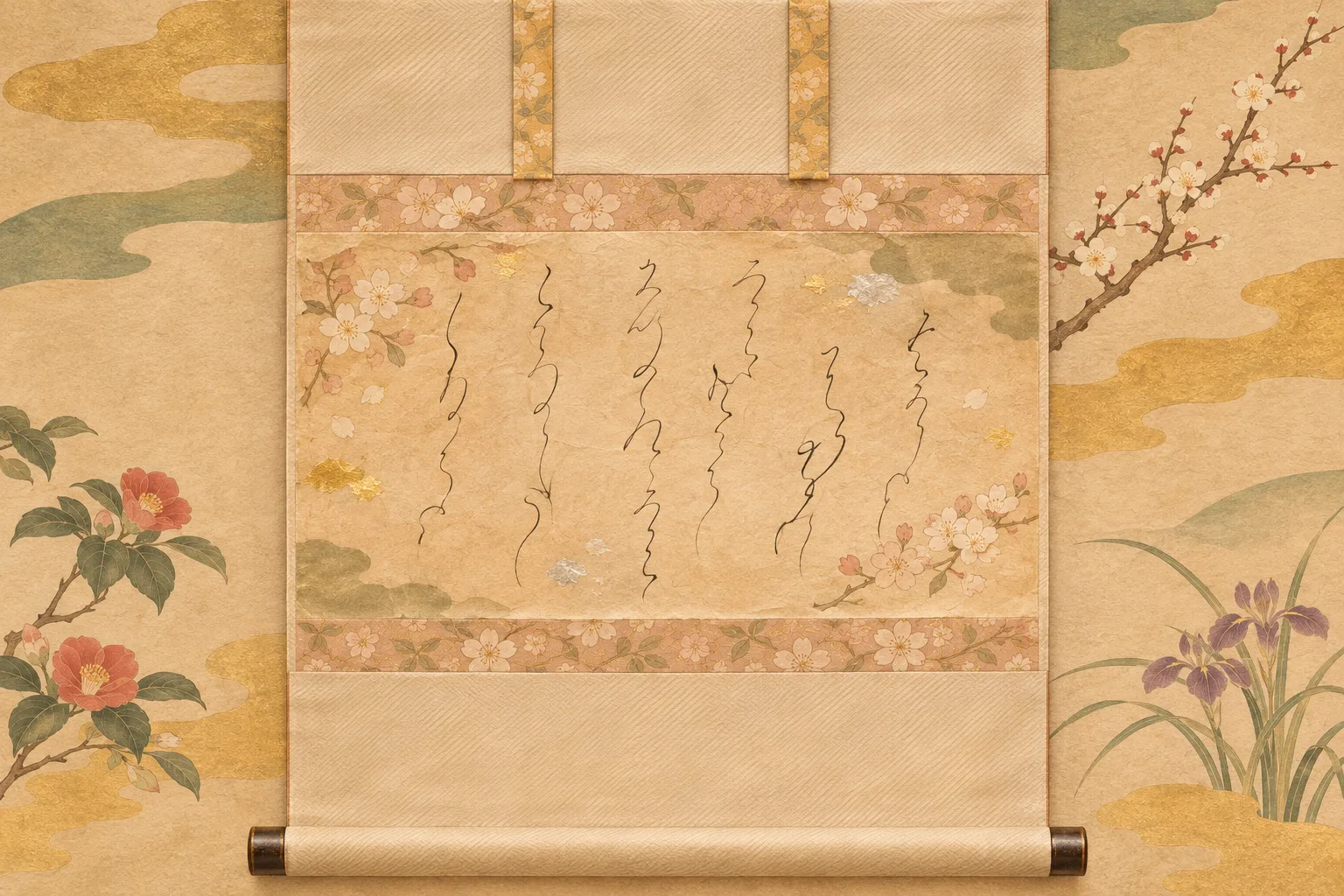
Kohitsu: flowing cursive kana on paper decorated with faint patterns and flecks of gold and silver, a different world from the bold ink of the Zen monks.
Shōsoku are letters. Correspondence from tea masters, warlords and monks is mounted and hung, with letters by Rikyū and his successors especially prized. The contents are often mundane: arranging a date, thanking someone for a gift, discussing a utensil. What matters is the writer and the human warmth of the exchange. A memorial gathering will often hang a letter from the person being remembered. Look for a few lines of running script, a date and signature, and fold creases.
03Reading the Common One-Line Phrases
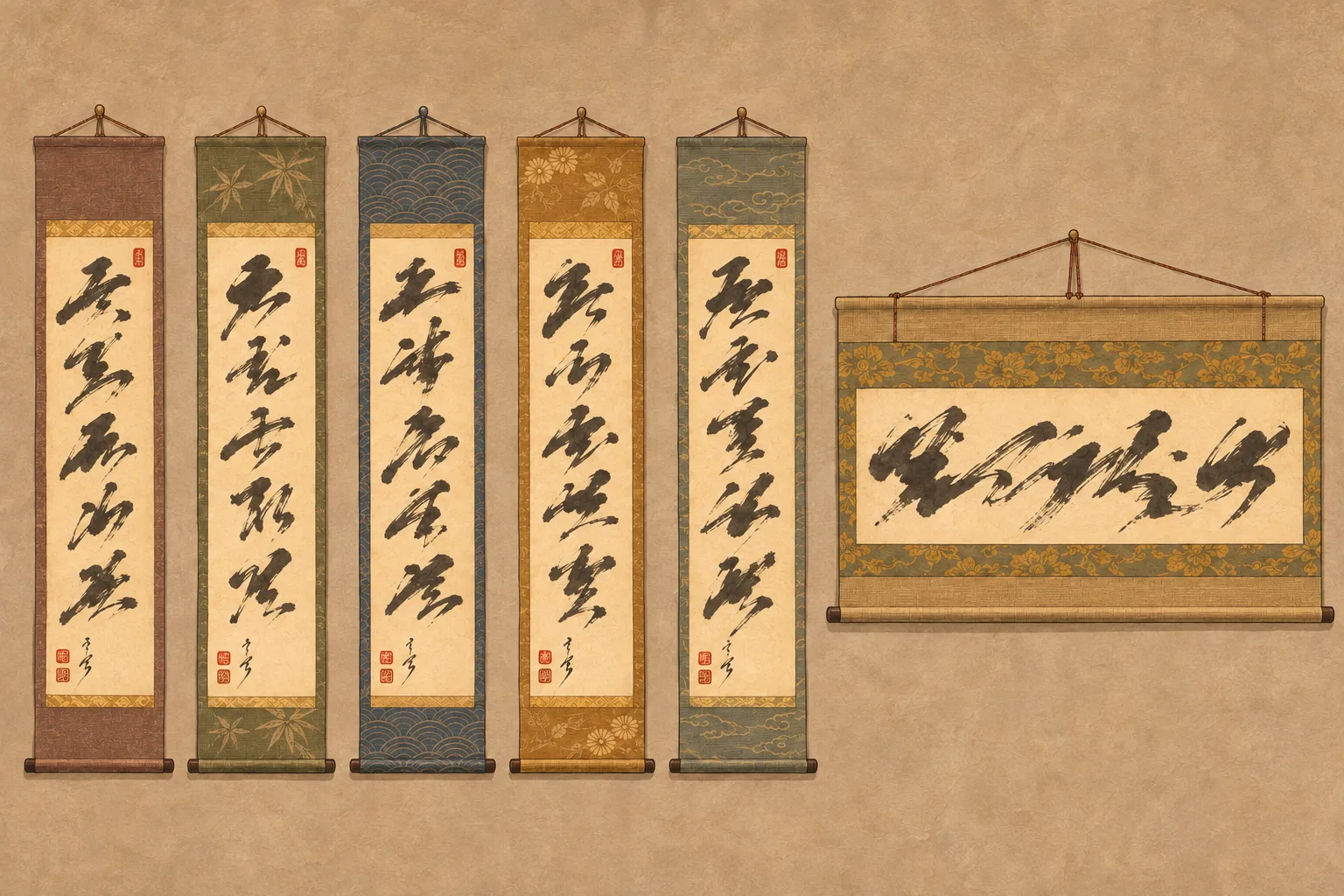
The five on the left are ichigyōmono, a single line of characters on a tall sheet. The one on the right is a yokomono, with the sheet turned sideways.
Most one-line scrolls come from Zen literature, and a few dozen phrases turn up again and again. Knowing the usual reading of these helps a visitor see more than a row of characters.
日日是好日 (nichinichi kore kōjitsu, "Every day is a good day"). Attributed to the Chan master Yunmen Wenyan, who lived at the end of the Tang and into the Five Dynasties, and recorded in the Blue Cliff Record. The common reading: each day is singular, and whether it is good depends not on the day but on how one lives it. Because it has no season, almost every tea room owns a copy.
和敬清寂 (wa kei sei jaku, "harmony, respect, purity, tranquillity"). These four words are often presented as the core spirit of tea and attributed to Rikyū: harmony between host and guest, mutual respect, cleanliness of room and mind, and a calm that is not disturbed by circumstance. They come from tea tradition rather than from Zen scripture, and are frequently written as a horizontal scroll.
松無古今色 (matsu ni kokon no iro nashi, "The pine has no old or new colour"). Often paired with "the bamboo has upper and lower joints." The evergreen pine stays the same through time; the bamboo has an order of nodes. Equality and distinction both hold at once. Because the pine is auspicious, the phrase is a favourite for New Year and celebrations.
喫茶去 (kissako, "Go and have some tea"). From the Tang master Zhaozhou. A visiting monk said he had been there before; Zhaozhou told him to go and have tea. Another said he had not; Zhaozhou told him the same. When the temple steward asked why, Zhaozhou called his name and, as he answered, told him too to go and have tea. The usual reading is to meet everyone with an ordinary, undiscriminating mind. Since it mentions tea directly, it is very common.
無事是貴人 (buji kore kinin, "One with nothing to do is the noble person"). From the Record of Linji. "Nothing to do" means not seeking outside oneself and not contriving; the "noble person" is whoever lives that way. In Japan it is also hung at New Year with the popular, looser sense of "a year without mishaps," and tea people tend to accept both readings.
Others you may meet include "Originally not a single thing," "White clouds come and go of themselves," and 一期一会 (ichigo ichie, "one time, one meeting"), which is not strictly a Zen phrase but an idea developed by Ii Naosuke in the nineteenth century. Hosts also pick by season: "fresh breeze" or "waterfall" in summer, "snow" in winter, "willows green, flowers red" in spring.
04How a Scroll Is Mounted
The mounting, called hyōgu in Japanese, changes the character of the same piece of writing as much as framing changes a painting. Tea people choose it with as much care as the writing itself.
Read a typical tea scroll from top to bottom. A half-round wooden batten, the hassō, sits at the very top, with the hanging cord tied to it. Below is a broad panel of fabric called the "heaven" (ten), and at the bottom another called the "earth" (chi). Heaven is longer than earth, usually around three to two, because the scroll is viewed by people seated on the floor and looking up; the extra length above makes it look balanced. Around the calligraphy sheet itself runs a border called the chūmawashi. Directly above and below the sheet are two narrow strips, the ichimonji, often cut from the most precious brocade available because they sit closest to the writing. Two thin ribbons, the fūtai, hang from the top of the heaven panel; tradition says they once fluttered to keep birds away from scrolls hung outdoors. At the bottom is a wooden roller whose protruding ends, the jikusaki, may be ivory, ebony, lacquer, ceramic or even crystal.
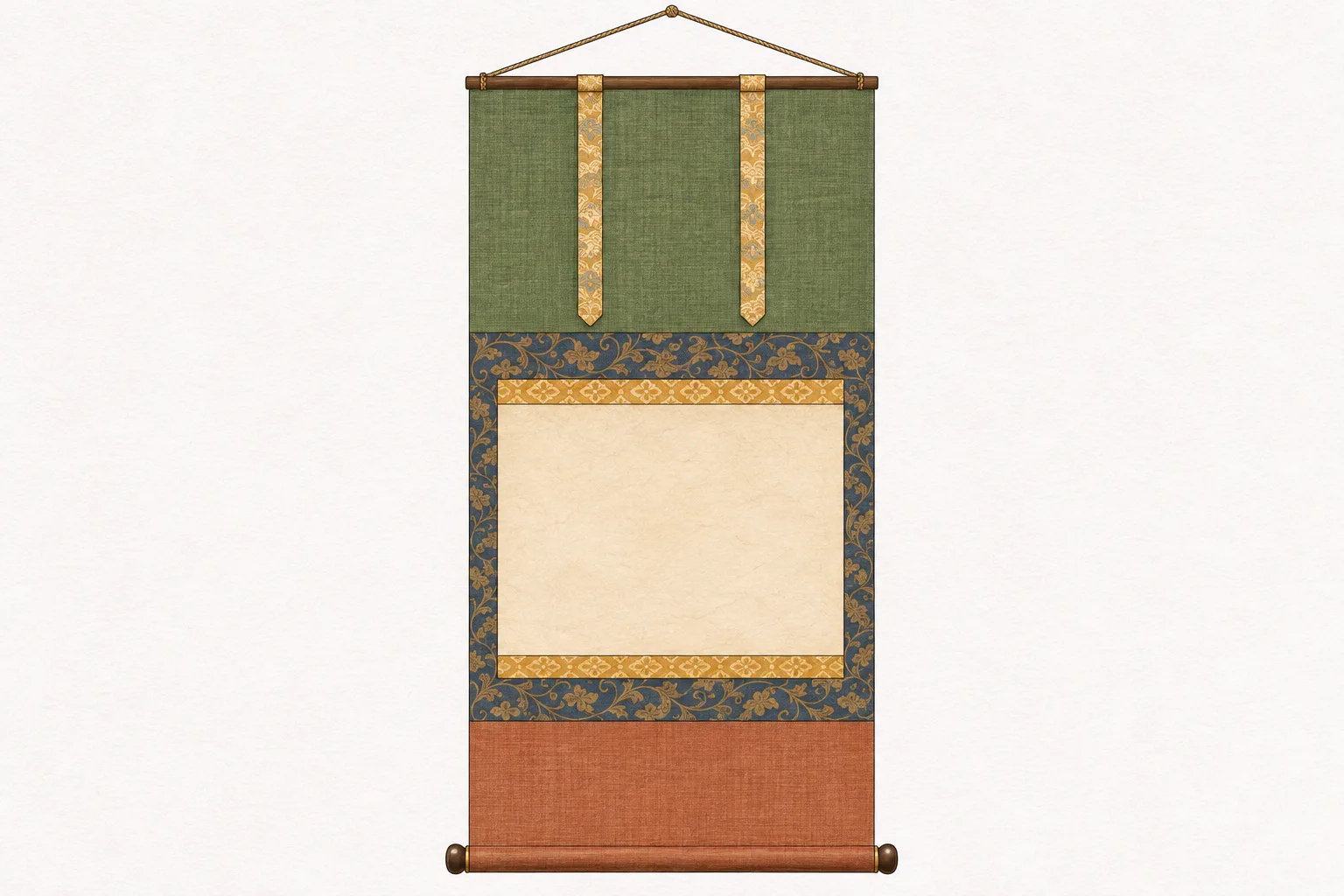
The parts of a tea scroll, from the top: the hassō batten with its cord; the green "heaven" panel with two fūtai ribbons; the blue patterned chūmawashi around the sheet, with gold ichimonji strips directly above and below it; the orange "earth" panel; and the roller with its jikusaki ends.
Mountings are graded in three levels, shin, gyō and sō, a scale used across Japanese arts: formal, semi-formal and informal. The formal shin style, used for Buddhist paintings, adds an outer frame, the sōberi, around the side borders and is the most layered and sumptuous, with plenty of gold brocade. The semi-formal gyō, often called the Yamato mounting, has ichimonji strips above and below, a border on all four sides, and the heaven and earth panels; most tea scrolls use it. The informal sō style is the simplest. One version, the rinpo, has only a narrow border running around the sheet and no ichimonji at all, giving a lean, quiet look favoured for Zen calligraphy in wabi tea. Each level is subdivided again into three, giving nine combinations that mounters match to the personality of the writing.
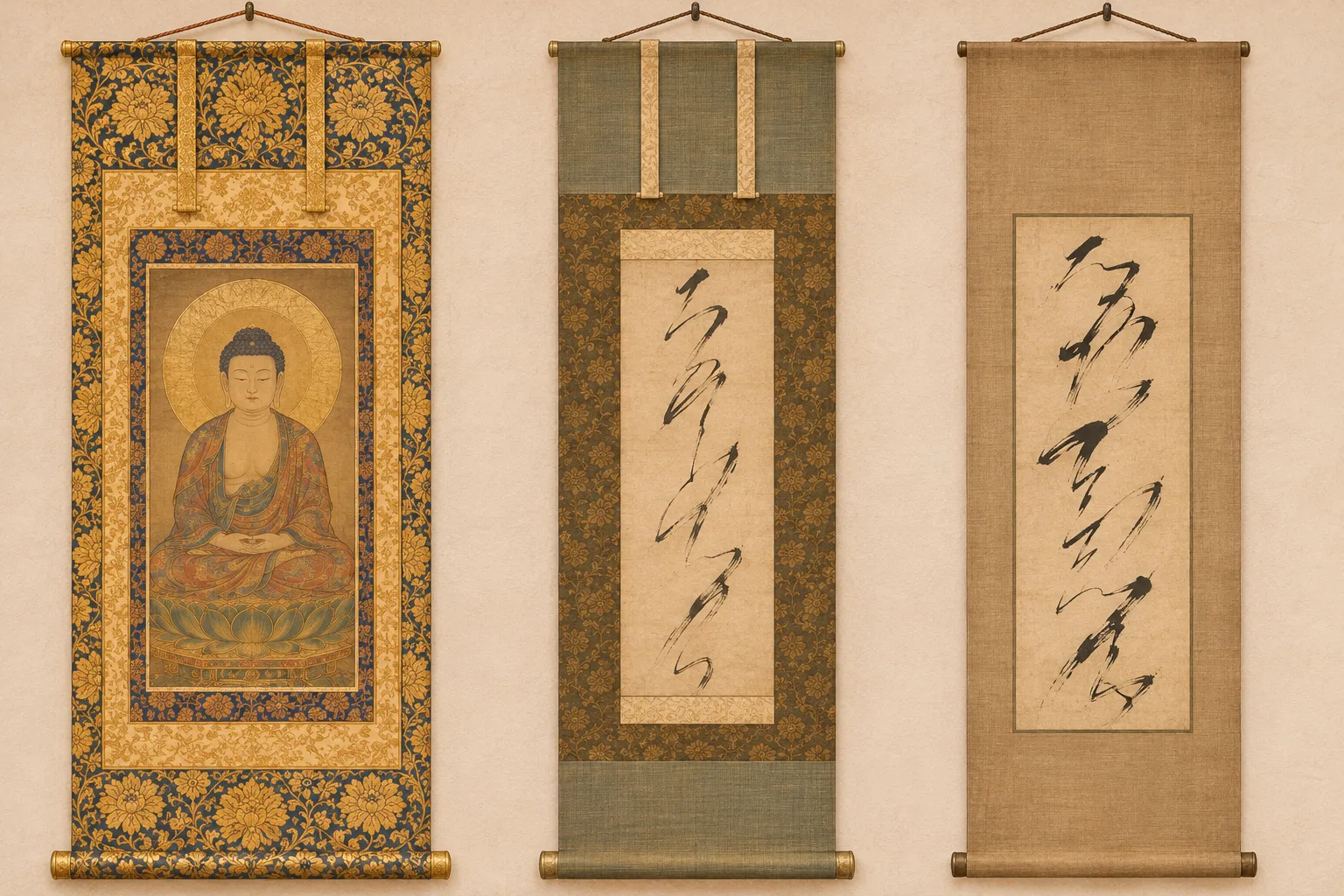
Three grades of mounting, from left: shin, for a Buddhist painting, with an outer sōberi frame and rich gold brocade; gyō, the usual Yamato mounting; and sō, here a rinpo with only a narrow border and no ichimonji.
Bold Zen writing tends to get sober, dark old textiles with small patterns; delicate court poetry gets pale silk or paper that echoes the decorated sheet. When a scroll is not in use it is rolled and stored in a paulownia box. The lid usually carries an inscription naming the work and writer, often added by a later expert or a tea school head. For collectors the box inscription matters almost as much as the scroll, because it records the piece’s history.
05Flowers "As They Are in the Field"
The main article quotes the guideline that flowers should be arranged as they grow in the field. It is usually listed among "Rikyū’s seven rules," a later summary of tea wisdom that may not all come from Rikyū himself, but it states the direction precisely.
Tea flowers are arranged in a style called nageire, literally "thrown in." Unlike the structured traditions of ikebana, there is no spiked holder, no prescribed ratio of main and secondary branches, and no sculptural intent. The host cuts one or two kinds of plant from the garden or a hillside, usually one to three stems, and places them in the vase so they keep the posture they had while growing. The front of the stem, the side that faced the sun, faces the guests. A leaning branch is left leaning. Buds or just-opening blooms are preferred over flowers in full blossom, which are thought to be past their moment. The vase is given plenty of water, and bamboo or ceramic vases are wetted on the outside first, so that guests see beads of water as if the vessel had just come from a stream.
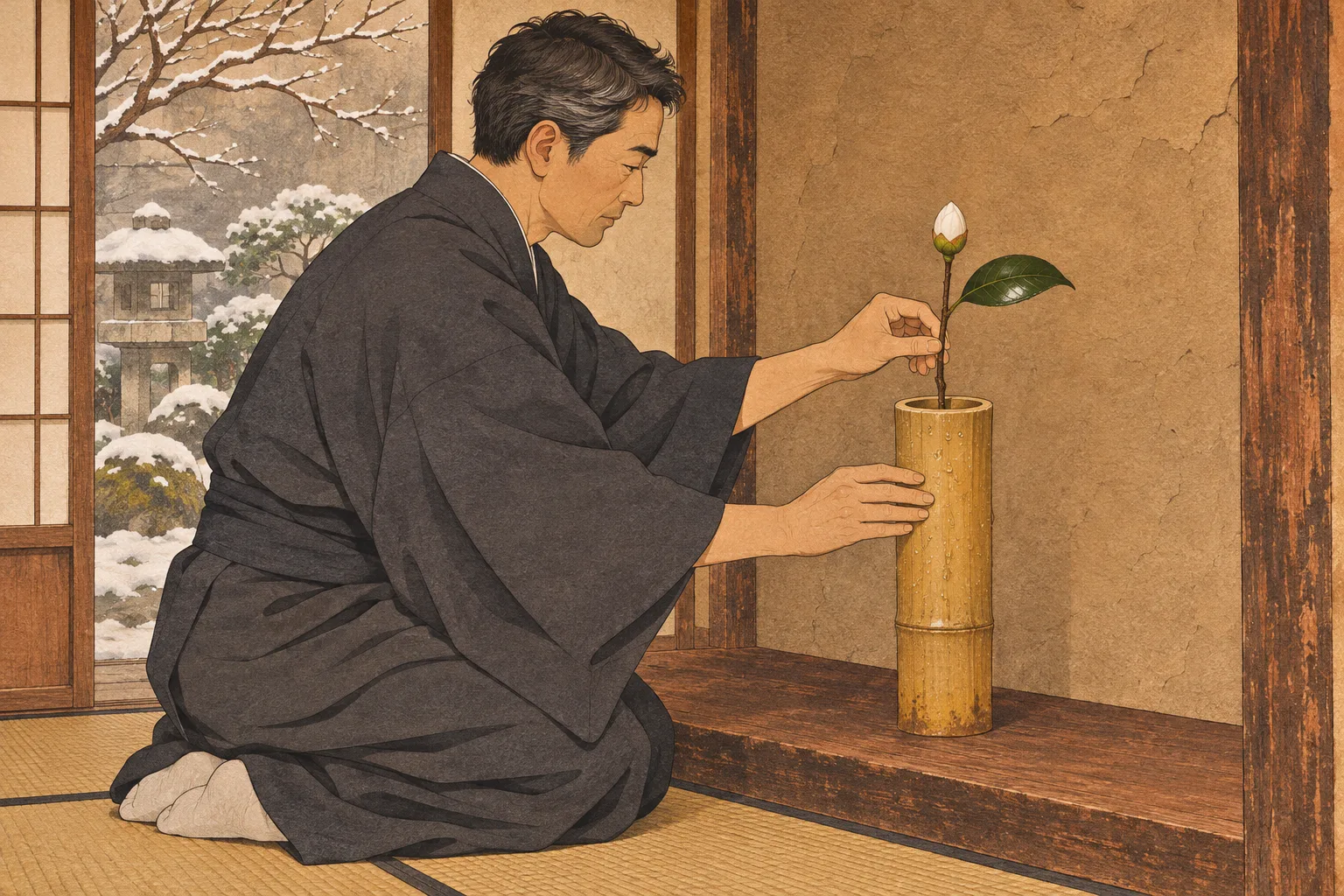
Nageire. The host sets a single white camellia bud with one leaf in a bamboo vase: no spiked holder, and the stem keeps the posture it had while growing.
Tea tradition passes down a list of "forbidden flowers" in the form of a short poem, often attributed to Rikyū. It names daphne, miyama-shikimi (Japanese skimmia), cockscomb, ominaeshi (patrinia), pomegranate, yellow pond lily and calendula, plus one more, senrei-ka, whose spelling varies between versions and whose identity is uncertain. The reasons given vary by school: daphne’s scent is overpowering and would fight with incense and tea; skimmia is poisonous; cockscomb is too garish; ominaeshi is written with characters meaning "maiden flower," considered unrefined. Beyond the list, hosts generally avoid heavy scents, loud garden cultivars, and poisonous or thorny plants. Schools apply these rules with varying strictness.
Above all, tea flowers follow the season, ideally running slightly ahead of it. In the sunken-hearth season, roughly November to April, the camellia rules: a tight bud of white camellia or the small wabisuke variety with a single red leaf when the hearth opens in November, willow and plum around New Year, then flowering quince and early blossoms. In the brazier season, roughly May to October, the choices widen: peony and clematis in early summer, rose of Sharon and morning glory in high summer, and in autumn a loose mixture of bellflower, pampas grass, burnet and other "autumn grasses" in a basket. In October, as the year winds down, tea people like faded flowers and dry leaves, a mood called nagori, the lingering farewell.
06Vases from Bronze to Bamboo
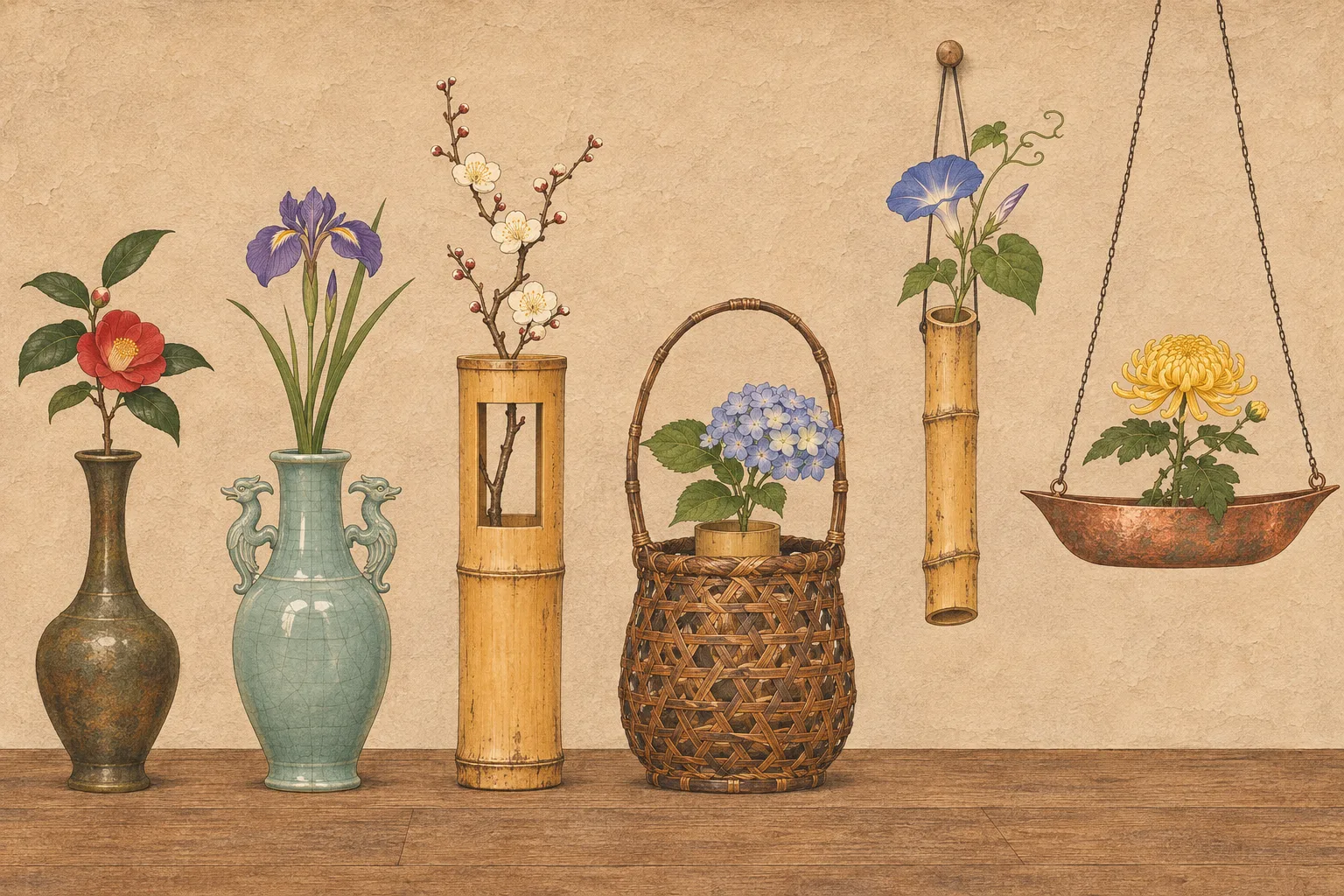
Six kinds of hanaire, from left: Chinese bronze, celadon, a bamboo ichijū-giri, a basket, a bamboo kakehanaire on a wall nail, and a boat-shaped tsurihanaire on a chain.
Tea people call a vase a hanaire, a "flower holder." Like mountings, vases fall into formal, semi-formal and informal grades: Chinese bronze and celadon are formal; glazed ceramics are semi-formal; bamboo, baskets and unglazed stoneware are informal.
Chinese bronze (karakane) vases are Song to Ming pieces modelled on ancient ritual vessels, with deep green and brown patina and a dull ring when tapped. Common shapes include the wide-mouthed son form, the shimokabura with a bulbous base like a turnip, the long-necked "crane neck," and the usubata with a broad flat lip originally designed for formal flower arrangements. They were stars of fifteenth-century reception room display and still appear at formal occasions such as the opening of the hearth or New Year.
Celadon vases come mainly from the Longquan kilns of southern China, with a glaze the colour of jade or a rain-washed sky. The most famous shape has handles shaped like phoenixes; several examples in Japan are designated National Treasures or Important Cultural Properties, among them "Bansei" (Ten Thousand Voices), once owned by the shogun Tokugawa Iemitsu and now a National Treasure in the Kubosō Memorial Museum of Arts, Izumi. A white or red camellia against that blue-green is a striking pairing.
Bamboo vases are simply a length of bamboo cut with one or two openings. A single window is ichijū-giri, two windows one above the other nijū-giri, an open tube zukiri, and an angled cut like the end of a bamboo flute shakuhachi. Rikyū made bamboo vases fashionable: the cheapest material, the plainest object, exactly the wabi idea. Many carry a poetic name and the cutter’s signature carved on the back.
The most famous, "Onjōji," is now in the Tokyo National Museum, which catalogues it as attributed to Rikyū. Tradition says he cut it in 1590 from bamboo at Nirayama in Izu while accompanying Toyotomi Hideyoshi’s campaign against Odawara, and later gave it to his son Shōan. It has a long vertical drying crack, and Rikyū is said to have named it after Onjōji (Miidera) temple, whose old bell, legend says, cracked when the warrior monk Benkei dragged it away. Another story holds that when someone complained the vase leaked, Rikyū replied that the leak was its charm. Whether or not every detail holds, the stories show how tea people regard bamboo: flawed, split and leaking, and loved all the more for it.
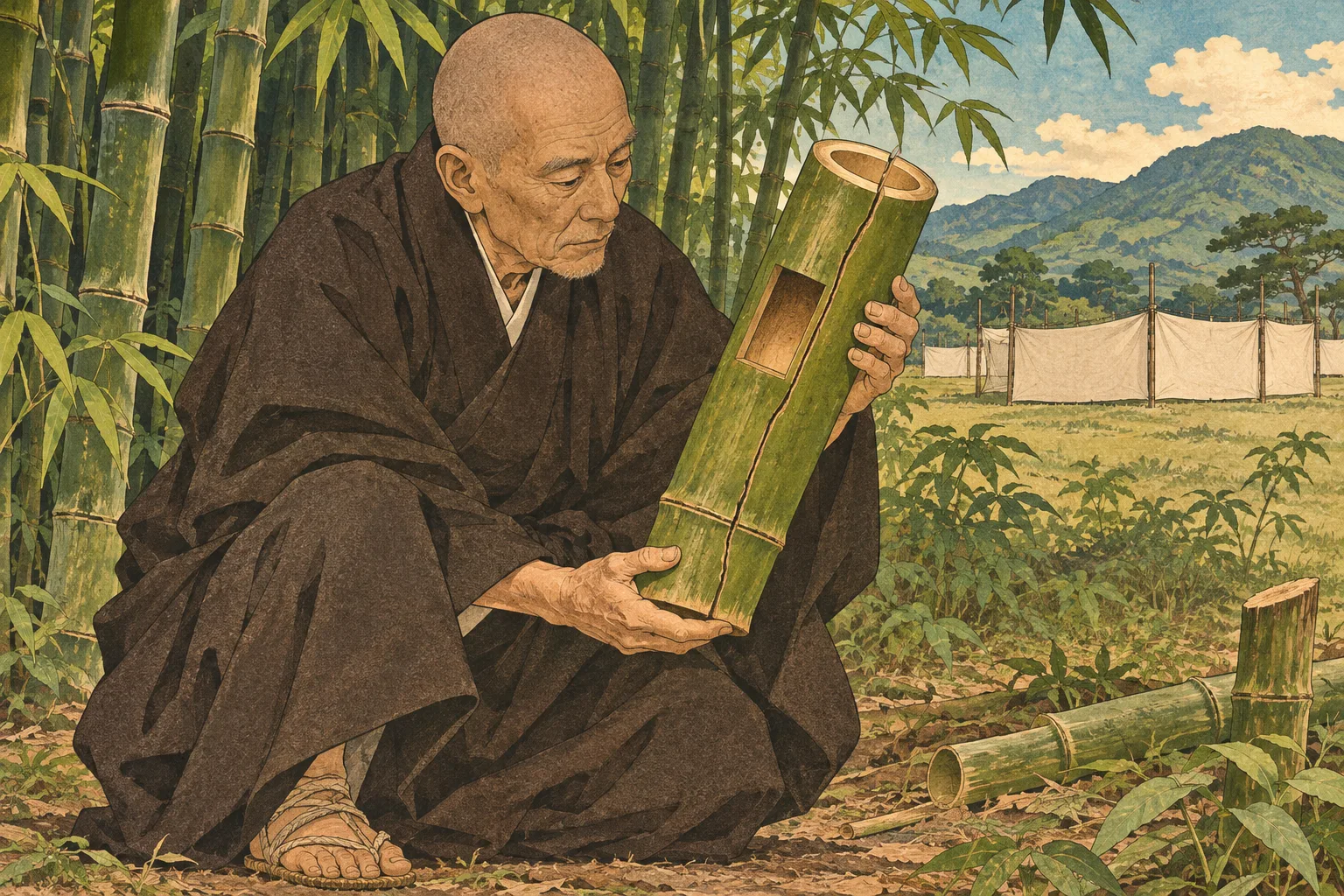
Tradition says that in 1590, during Hideyoshi’s Odawara campaign, Rikyū cut bamboo at Nirayama in Izu into a single-window vase with a long drying crack: the piece later named Onjōji (artist’s impression).
Baskets woven from bamboo or rattan hold an inner tube for water. Light and airy, they belong to the brazier season, especially summer and autumn, and are rarely used in winter. Chinese baskets are finely woven and darkened with age; Japanese ones, often designed by named tea masters, are rougher and more varied. Rikyū is said to have bought a fisherman’s creel on the banks of the Katsura River and hung it as a vase; the "Katsura basket" became a celebrated object.
Hanging vases (kakehanaire) hang from a nail on the back wall of the alcove or on the alcove post, leaving the floor empty and suiting trailing or drooping plants. Bamboo pieces, gourds and baskets are common.
Suspended vases (tsurihanaire) hang on a chain from a hook in the alcove ceiling. The classic form is a small boat of bronze or bamboo. A verse in the "hundred poems of Rikyū" says the chain length depends on the alcove and names "outgoing," "incoming" and "floating" boats. The outgoing boat, setting off to fish, gets a light, sparse arrangement; the incoming boat, returning with a full catch, a fuller one. Which way the prow should point for each is explained differently by different teachers.
07The Incense Box and the Change of Scene
The kōgō, or incense box, is small enough to sit in a palm, usually five to eight centimetres across. It belongs with the charcoal: when the host adds charcoal to the fire, a little incense goes in beside it, and guests may ask to examine the box. When the charcoal is not laid in front of guests, the box may be displayed alone in the alcove on a small paper or board.
The material follows a neat seasonal rule. In the brazier season the box is lacquer or wood and holds slivers of fragrant wood such as sandalwood. In the sunken-hearth season it is ceramic and holds neriko, kneaded incense made of powdered aromatics bound with honey and plum pulp into small moist balls. The sticky pellets would stain lacquer, so they go in glazed pottery; dry wood chips suit lacquer. A guest can tell the season from the box alone.
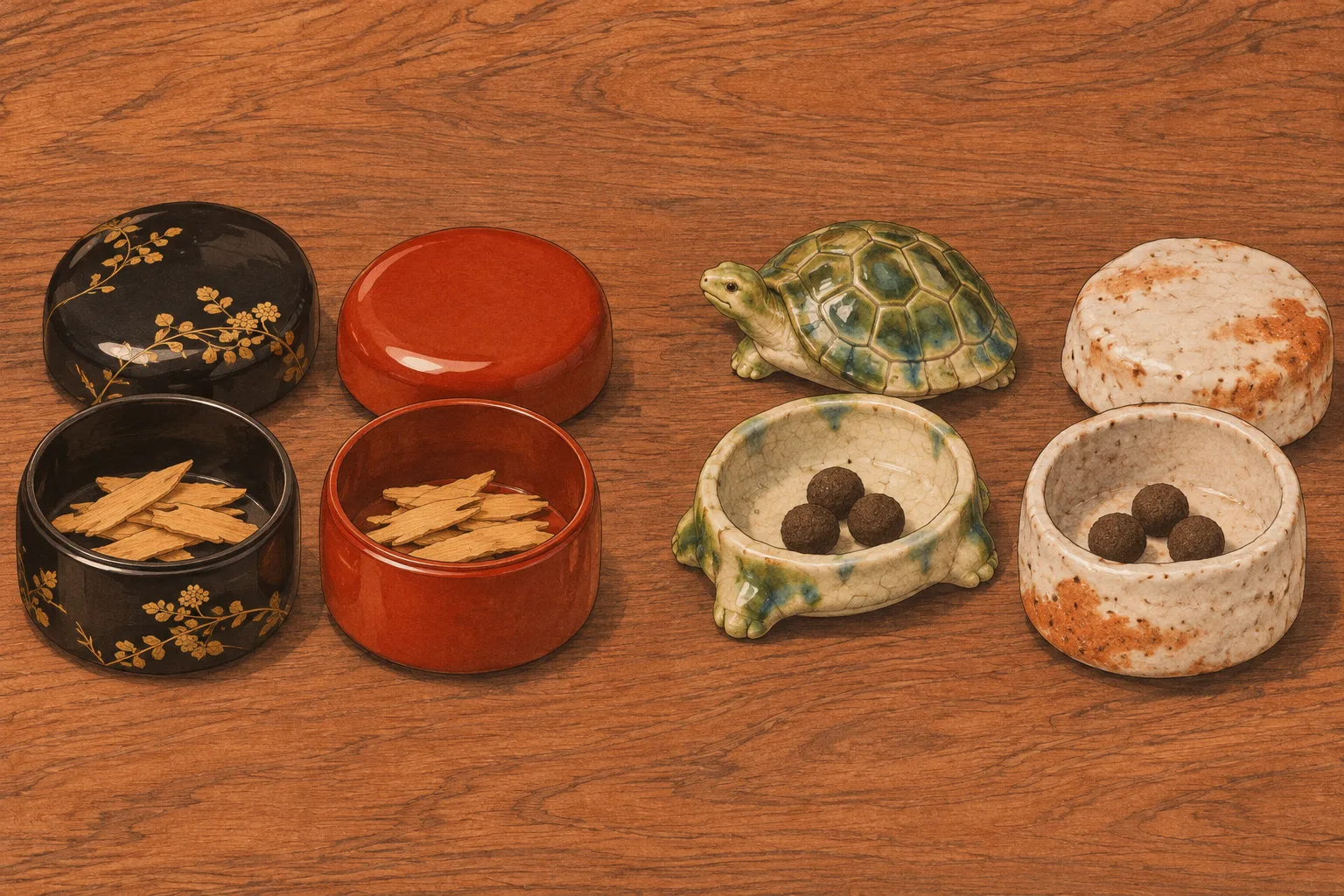
The kōgō in two seasons. Left: lacquer boxes for the brazier season, black with maki-e and plain red, holding slivers of sandalwood. Right: ceramic boxes for the hearth season, a turtle in kōchi ware and a Shino piece, holding pellets of neriko.
Lacquer boxes may be black, red or decorated with gold maki-e showing seasonal plants. Ceramic ones include colourful Chinese kōchi ware, often in animal shapes, blue-and-white porcelain, and Japanese Shino, Oribe and Raku. In the nineteenth century collectors even ranked famous ceramic incense boxes in a chart modelled on sumo rankings, with a turtle-shaped kōchi box, the "Great Turtle," at the top as East ōzeki. Shapes follow the calendar too: a wish-granting jewel at New Year, a persimmon in autumn, a little boar for the hearth-opening in November.
At a standard midday tea event the alcove changes once. In the first half, the scroll hangs alone, with no flowers and no incense box on display. Guests bow before it, the host lays the charcoal, bringing out the incense box for that, and a meal is served. Then the guests withdraw to the garden for a short break. While they are out, the host rolls up the scroll and places the vase with fresh flowers; blinds may be raised to brighten the room. When the guests return, they go first to the alcove to see the flowers, and thick tea follows. Writing in the first half, flowers in the second: the guest’s attention rests on one thing at a time.
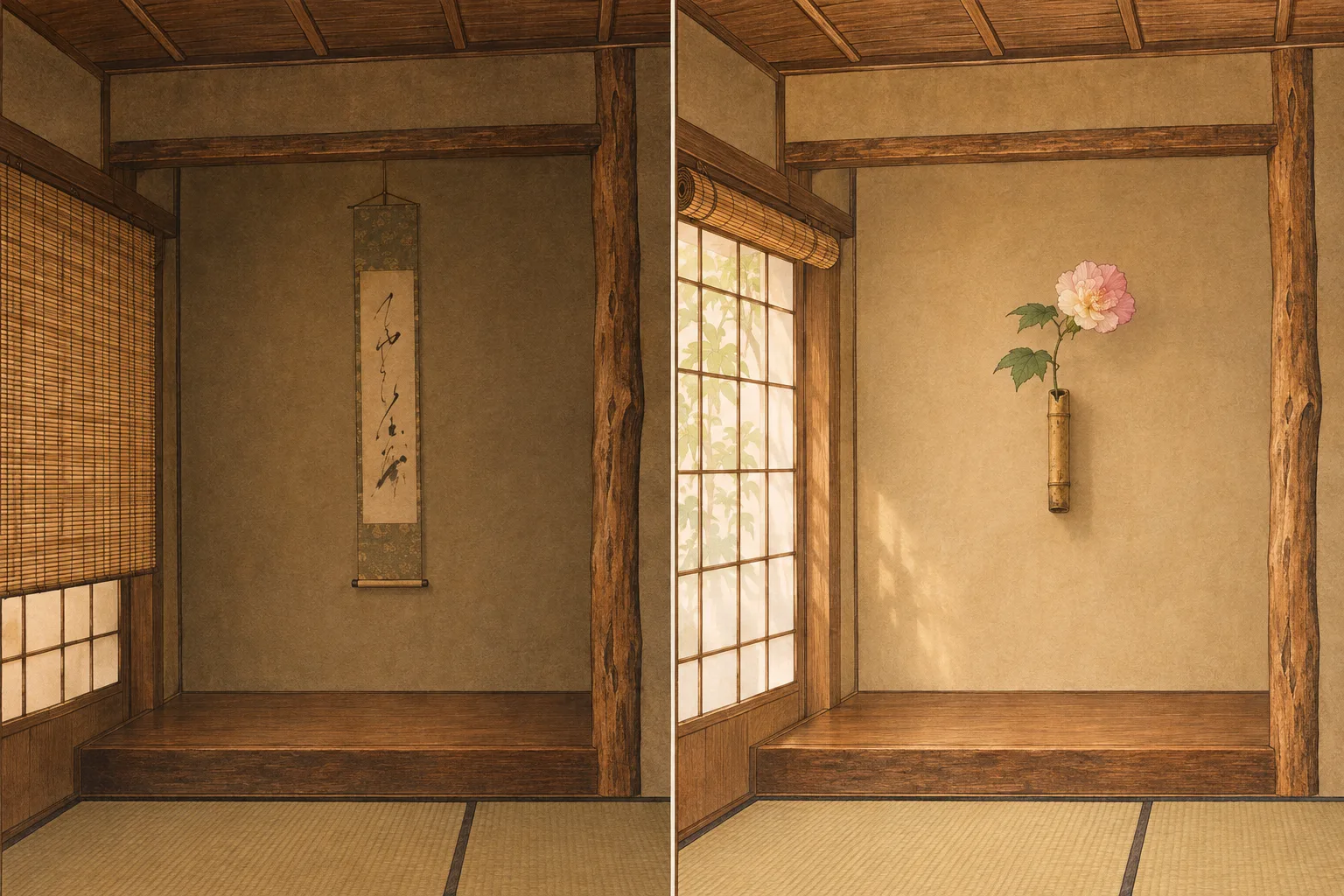
One alcove, before and after the break. Left: in the first half the scroll hangs alone and the blind is down. Right: the scroll has been rolled up, a vase with a fresh flower has taken its place, and the blind is raised to brighten the room.
This is the usual pattern, not the only one. At yobanashi, the candlelit winter evening gathering, flowers cast awkward shadows; the Omotesenke school arranges no flowers at all and places a Zen monk’s whisk or a ceremonial scepter in the alcove instead, while others set out a pot of sweet flag or use only white flowers such as white plum or camellia. At simplified gatherings, including the tea experiences offered to visitors, scroll and flowers are usually displayed together, a style called morokazari.
08Side by Side: Telling Them Apart
For scrolls, start with the writing. Bold Chinese characters in several lines with a date suggest bokuseki; one tall line is an ichigyōmono; a horizontal line is a yokomono; a picture with a verse is a gasan; flowing kana on patterned paper is kohitsu or kaishi; a few lines of running script with creases and a date is a letter. Then look at the mounting: layered borders suggest the formal style, clear upper and lower strips the common semi-formal style, and a thin wraparound border with no strips the informal rinpo.
For vases, check material, colour and position. Dark green-brown metal is Chinese bronze; glossy blue-green is celadon; varied glazes and finger marks mean Japanese glazed ware; a length of bamboo with a window and carved name is a bamboo vase; woven work with a hidden tube is a basket. Position then adds a layer: hung on wall or post, it is a hanging vase; dangling from the ceiling, often as a boat, a suspended vase. The same bamboo shakuhachi can stand on the floor or hang on the wall, and baskets come in standing, hanging and suspended forms, so judge by where the piece is, not only what it is made of.
For incense boxes, lacquer means the warm months and ceramic the cold ones. Put it all together and the alcove reads like a calendar: in winter and spring, white camellia, bronze or bamboo, ceramic box with kneaded incense; in summer and autumn, a basket of rose of Sharon or autumn grasses, lacquer box with sandalwood. Visitors who learn to read it can walk into a tea room and know roughly what month it is, and often what the host wants to say.
More deep dives on this topic
 ChawanAt the end of a tea ceremony, after the last sip, guests do something that puzzles first-time visitors.
 Tea UtensilsMost of what sits on a tea-room mat is small enough to hold in one hand.
 The Tea RoomA small Japanese tea room can look almost artless: a box of earth walls and straw mats, a few odd little windows, a recess with a single scroll.
 The AlcoveWhen guests enter a tea room, they do not sit down straight away.
 TemaeSit as a guest in a Japanese tea room and you will watch someone spend a quarter of an hour on a task that takes a minute in a kitchen, and it is natural to wonder what all the…
 The ChajiMost visitors to Japan meet the tea ceremony as a bowl of whisked matcha and a sweet, served in a temple garden or a tea school in Kyoto, over in fifteen minutes.
 The Tea YearWalk into the same tea room in January and in August and you might think you had come to two different houses.
 Schools of TeaWalk north up Ogawa-dōri in Kyoto, a narrow street lined with old townhouses, and you pass two quiet gates a few dozen metres apart.
- Back to the main article: The Way of Tea (Chanoyu) →