
Sit as a guest in a Japanese tea room and you will watch someone spend a quarter of an hour on a task that takes a minute in a kitchen, and it is natural to wonder what all the extra movement is for. The task itself is simple: spoon green powder into a bowl, add hot water, whisk. The extra time goes into carrying, wiping, placing and putting away, all done in front of you in a fixed order. This sequence is called temae (literally "in front of you"), the host’s procedure for making tea. It is not a show and not quite a craft skill either; it is the whole job of hospitality, from bringing in the utensils to closing the door, done in the guest’s full view. What follows walks through a thin-tea (usucha) service step by step, using the Urasenke school’s basic procedure as the example, then looks at the different kinds of temae and how to tell them apart from your seat. Schools and teachers differ in detail; the outline here is what most guests will recognise.
01Why the Kitchen Moves into the Room
In most homes, tea is made out of sight and carried out ready. The tea ceremony reverses this. The bowl, the tea, the water and the fire all sit in front of the guests, and nothing the host does happens behind a door once the procedure begins. The bowl he carries in is already clean. The lacquer tea caddy has already been wiped. He wipes them again anyway, so that the guest sees where this bowl of tea comes from and whose hands touched it.
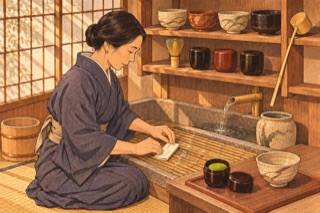
The real preparation happens out of sight, in the mizuya, a small preparation room behind the tea room with a sink, a drain of bamboo slats and shelves. There the host washes the bowl, soaks and wrings the linen cloth and folds it into a neat strip, soaks the whisk in warm water, and sifts matcha into the caddy, shaping it into a small flat-topped mound. By the time guests arrive the kettle has been heating for a long while and the charcoal is laid. What the host carries out is a set already made ready; what he repeats in front of you is the part that shows the care.
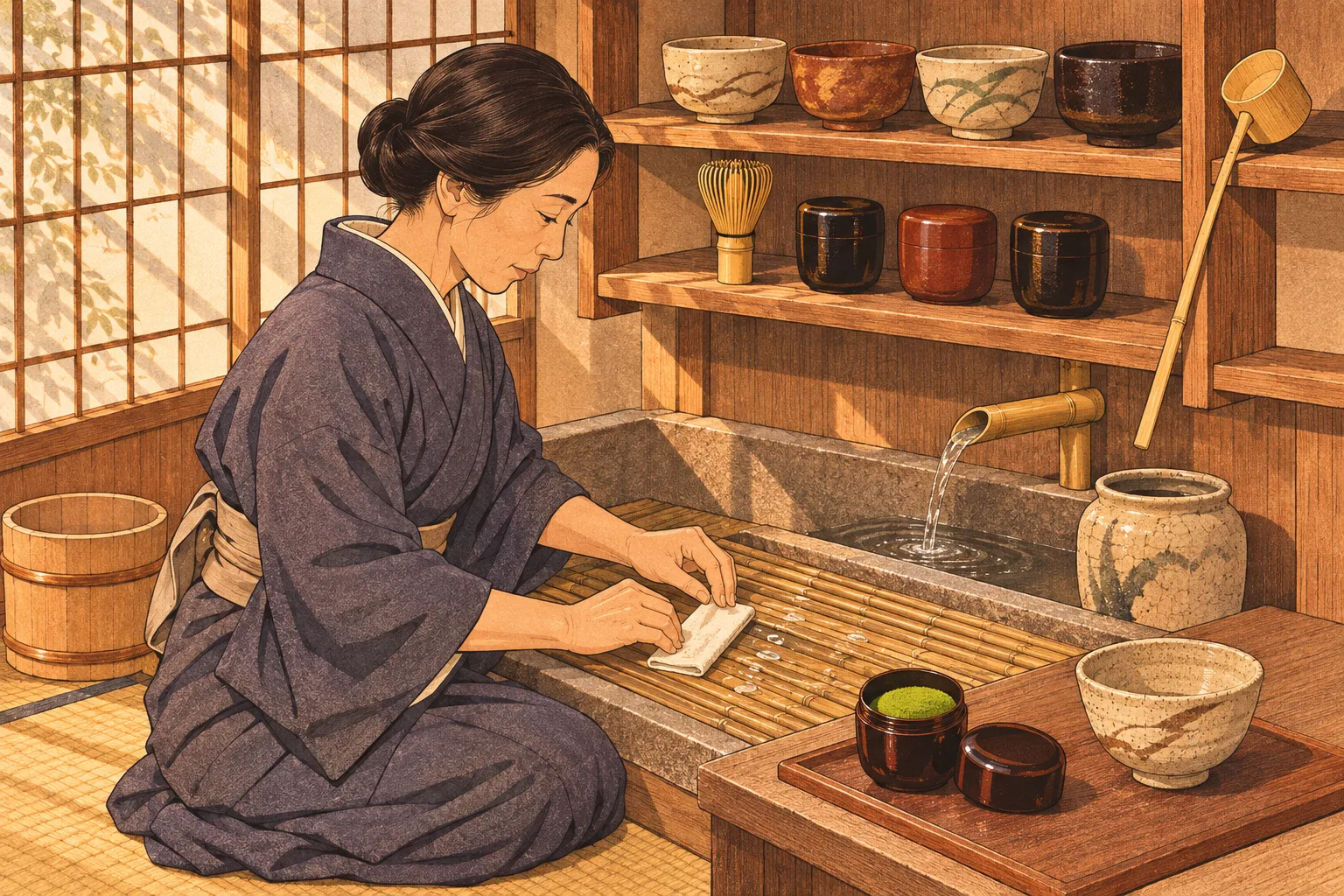
Preparation in the mizuya. The host folds the damp linen cloth into a neat strip; in the caddy at lower right, the sifted matcha is already shaped into a small flat-topped mound.
The rules are famously precise, down to which hand does what and where on its rest the ladle lands. The main tea ceremony article explains why: the forms are the cleanest, least wasteful way of doing each task, worn smooth over generations. What helps a guest is knowing the rhythm. Carrying and placing are brisk and continuous; wiping, scooping and whisking slow right down, with every pause distinct. The host barely speaks. There is a greeting, an invitation to eat the sweet, a word when closing, and answers to the guests’ questions at the end. Otherwise the room holds only the sound of the kettle, the click of the ladle on its rest, the tap of the scoop and the brush of the whisk.
The form took shape around Sen no Rikyū in the late 16th century, and during the Edo period the hereditary grand masters (iemoto) sorted it into graded curricula. Each school does things a little differently, but the skeleton is shared: bring in, purify, make, serve, rinse, put away, leave.
02Opening: Carrying In and the First Bow
The procedure starts at the sadōguchi, the host’s own entrance, a sliding door connecting the tea room to the mizuya, the preparation room behind it. After the guests have entered, admired the alcove and eaten their sweets, the door slides open and the host is seen kneeling on the threshold, the water jar beside him, hands on the mat, bowing. The guests bow in return.
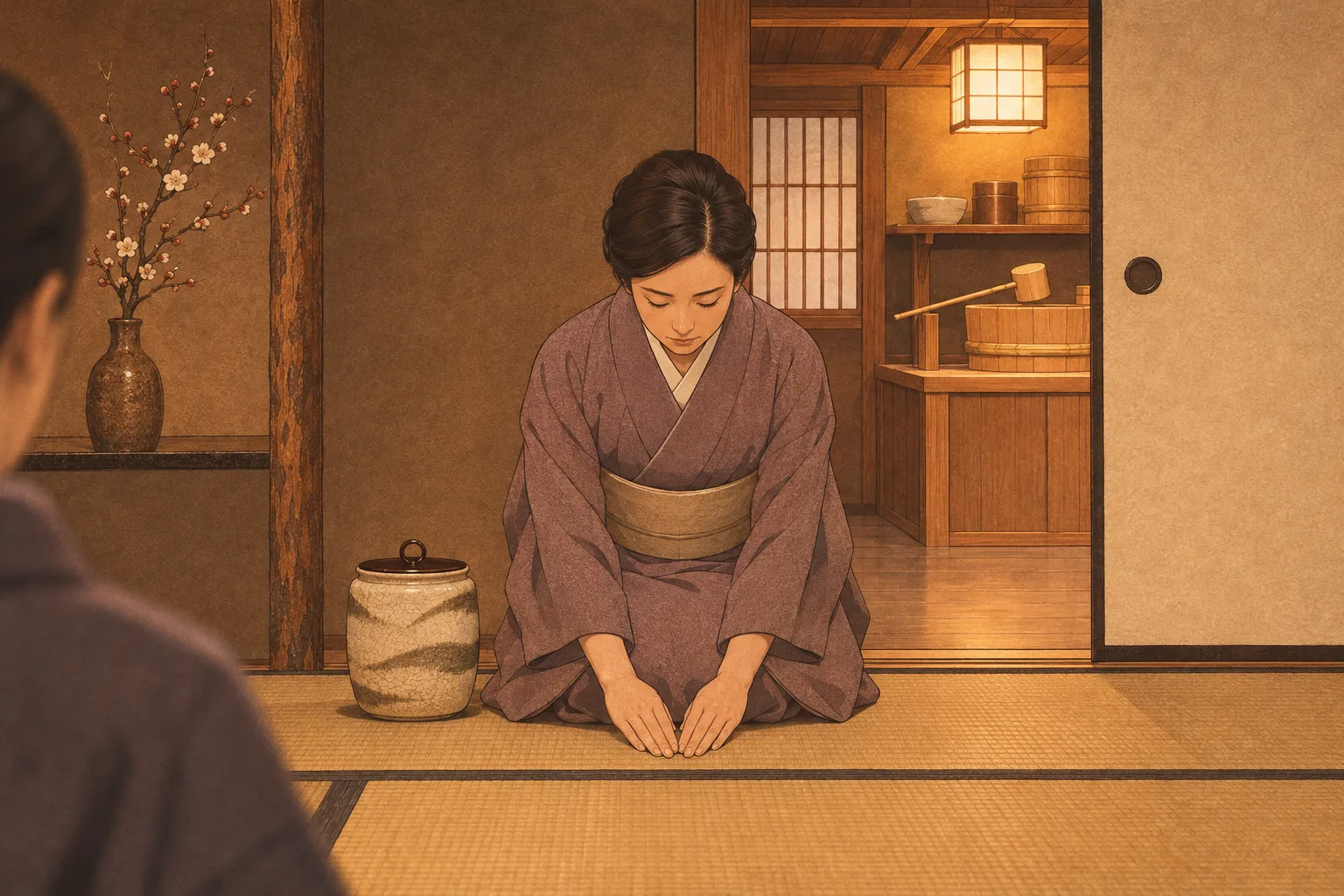
Temae begins at the sadōguchi. The door slides open and the host is kneeling at the threshold, the water jar beside her, hands on the mat, bowing.
In hakobi-demae, the "carrying" procedure, which is the foundation for almost everything else, every utensil is brought in from the mizuya by hand. The order matters. The fresh-water jar (mizusashi) usually comes first and is set beside the kettle. On the next trip the host carries the caddy in his right hand and the tea bowl in his left. Inside the bowl are the folded linen cloth (chakin) and the bamboo whisk (chasen), with the slender bamboo scoop (chashaku) resting across the rim. Bowl and caddy are set side by side in front of the water jar.
The last trip brings the waste-water bowl (kensui), with a small lid rest (futaoki) inside it and the long bamboo ladle (hishaku) laid across its mouth. The kensui carries used water, so it ranks lowest among the utensils. It comes in last, sits back by the host’s left knee, and stays as far from the guests’ eyes as the layout allows. The host first holds the ladle upright in front of him with both hands, a posture called kagami-bishaku, usually explained as holding it like a hand mirror. He takes out the lid rest, sets it to the left of the kettle and lays the ladle on it. Then he moves the kensui forward until it is level with his knees and straightens his posture. As it is commonly taught in Urasenke’s thin-tea hakobi procedure, host and guests have already bowed to each other when the door opened, so there is no further bow here and the purifying begins. In the thick-tea procedure, by contrast, this is usually where the formal bow (sōrei) comes, once the ladle is resting on the lid rest; other schools and teachers differ.
Almost every placement lines up with something: the edge of another utensil, or the woven pattern and cloth border of the tatami mat. Tea people use the mat’s weave as a ruler, and you will hear of placing things a certain number of weave rows (me) in from the edge. To an outsider the host is just putting things down. A knowing guest sees whether he puts them down steadily and in the right place.
The layout also changes with the season. From roughly May to October tea is made over a portable brazier (furo) set on the mat. From November to April a sunken hearth (ro) is opened in the floor and the kettle sits over it. The fire changes position, so the host’s seat and the angle of his body change with it, and every hand path shifts too. That is why students learn each procedure twice, once for each season.
03Purifying in Front of the Guests: the Silk Cloth, the Caddy and the Scoop
Seated, the host draws the bowl to just in front of his knees and sets the caddy (natsume, a small lacquer jar for thin tea) between his knees and the bowl. Then he takes the fukusa from his waist. It is a nearly square piece of double-layered silk, about 27 by 29 cm; in Urasenke it hangs from the left side of the sash.
Pulling it out, snapping it open, folding it into a triangle and then into a palm-sized square is a sequence called fukusa-sabaki. Done well it takes a few seconds, and when the edges are pulled taut there is a faint snap. Beginners struggle here more than anywhere: which hand holds which corner, which way the folded edge faces, which side folds in. The fold matters because it recurs throughout the procedure. The host refolds before wiping the caddy, refolds again for the scoop, and uses the cloth again to lift the hot kettle lid. Tea people often say those few seconds show roughly how long a host has studied.
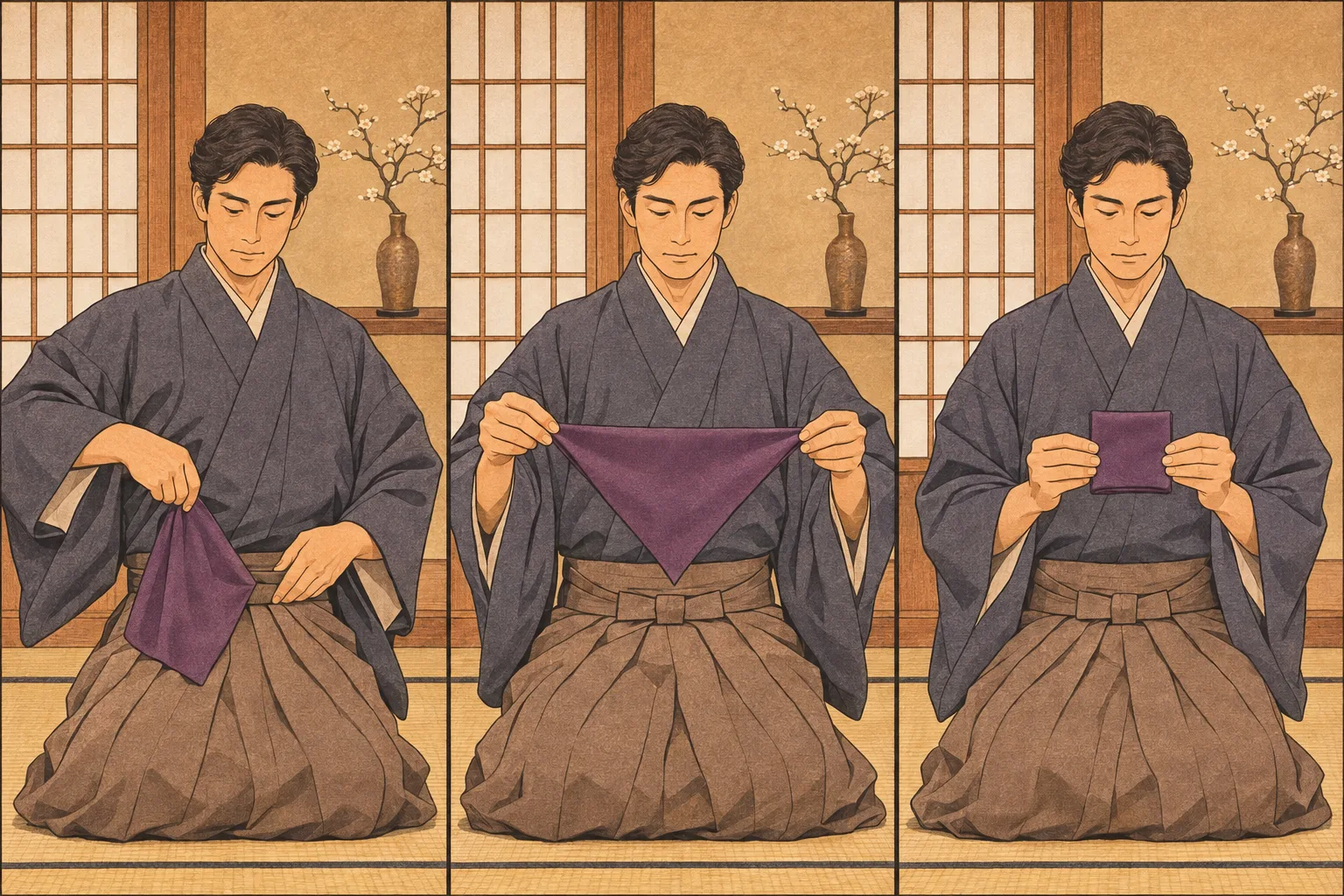
Fukusa-sabaki in three moments, from left: drawing the cloth from the obi, folding it into a triangle and pulling it taut, then folding it into a palm-sized square.
To purify the caddy, he holds it in his left hand and wipes the lid with the folded cloth. A pattern often described traces a shape like the kana こ, far side then near side. The caddy is then set down in front of the water jar. He refolds, picks up the scoop, and wipes it from near the node in its middle out to the curved tip, then rests it on the caddy lid. The scoop is a thin strip of bamboo bent up at the end like a narrow leaf. Many were carved by famous tea masters and carry poetic names (mei). It is treated as the most personal utensil in the set, and the wiping is done with particular care.
The whisk comes out of the bowl and stands to the right of the caddy. From the guests’ seats the layout is now complete: water jar at the back, caddy, scoop and whisk in a line in front of it, bowl at the host’s knees, waste bowl to his left and slightly behind.
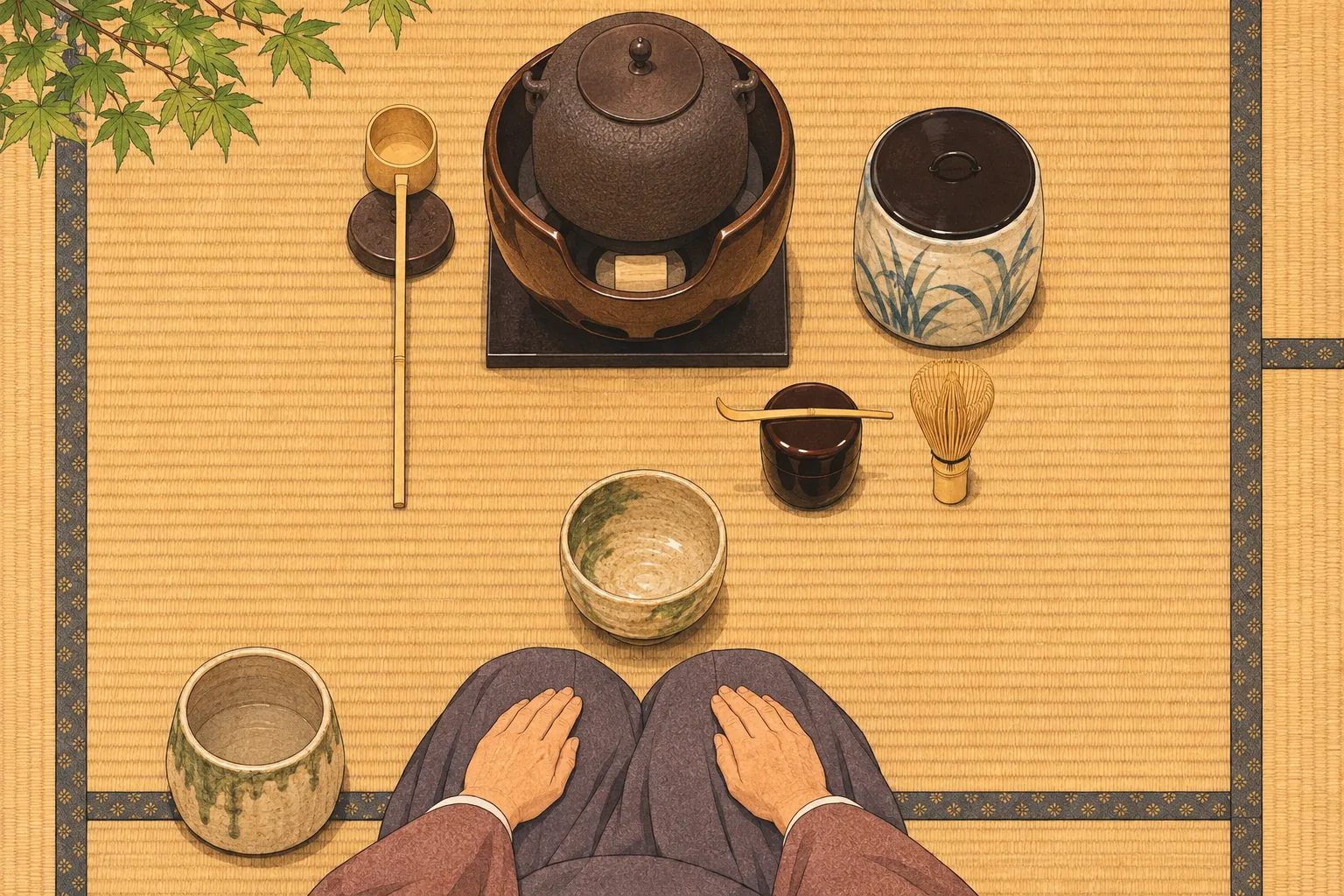
The layout of hakobi-demae seen from above: brazier and kettle at the top, the ladle resting on the lid rest to the left, the water jar to the right; in front of the jar the caddy with the scoop across its lid and the whisk; the bowl at the host’s knees and the waste bowl to his left, slightly behind.
04Warming, Whisking and Serving
The host takes up the ladle and, with the fukusa between his fingers and the metal, lifts the kettle lid and sets it on the lid rest. A plume of steam rises. This is often the first moment guests clearly hear the water. Tea people call the low hiss of water just below the boil matsukaze, "wind in the pines". The fukusa goes back to the waist.
A ladle of hot water goes into the bowl. The host lifts the whisk, turns it in the water, taps it lightly against the bottom, then raises it to eye level and turns it to look at the tines. This is chasen-tōshi, "passing the whisk through". It softens the bamboo so the tines don’t snap, checks for broken ones, and warms the bowl. The inspection is deliberately visible: a check for himself, and a demonstration for the guests.
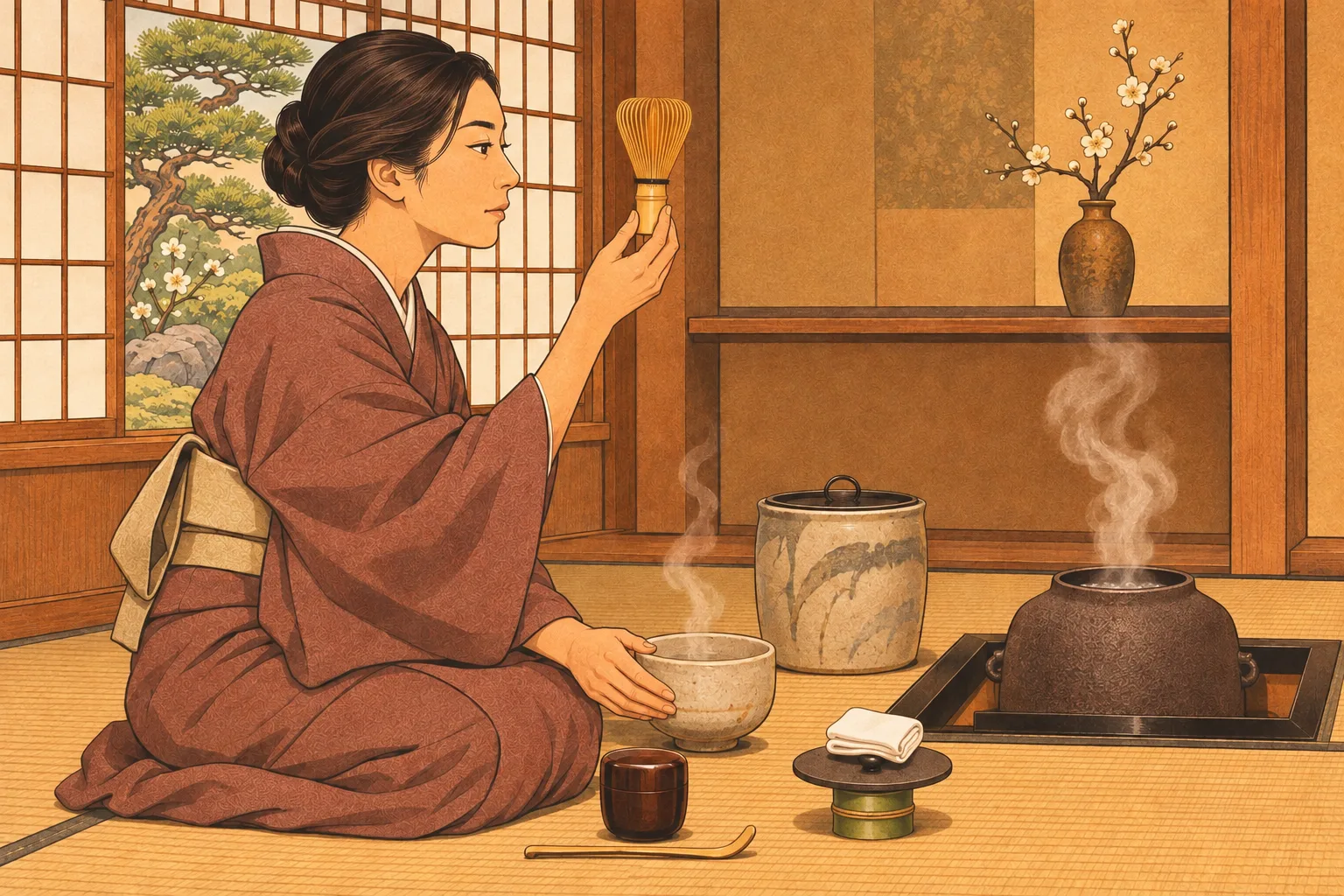
Chasen-tōshi. After turning the whisk in the hot water, the host raises it to eye level to look at the tines: a check for herself and a demonstration for the guests. The kettle lid already rests on the lid rest.
The water is emptied into the kensui and the bowl dried with the chakin, which follows its own pattern around the rim and across the bottom. In Urasenke the cloth then rests on the kettle lid. The host invites the guests to eat their sweets ("okashi o dōzo"). In a thin-tea service, guests finish the dry sweet before the tea arrives, so the sweetness meets the bitterness.
Scooping takes seconds. The host opens the caddy, lifts out about two scoops of powder, roughly 1.5 to 2 grams, and drops them into the bowl. Then he taps the scoop once against the rim to knock off the last of the powder. That small, dry tock is one of the clearest sounds in the whole procedure, and one many guests remember.
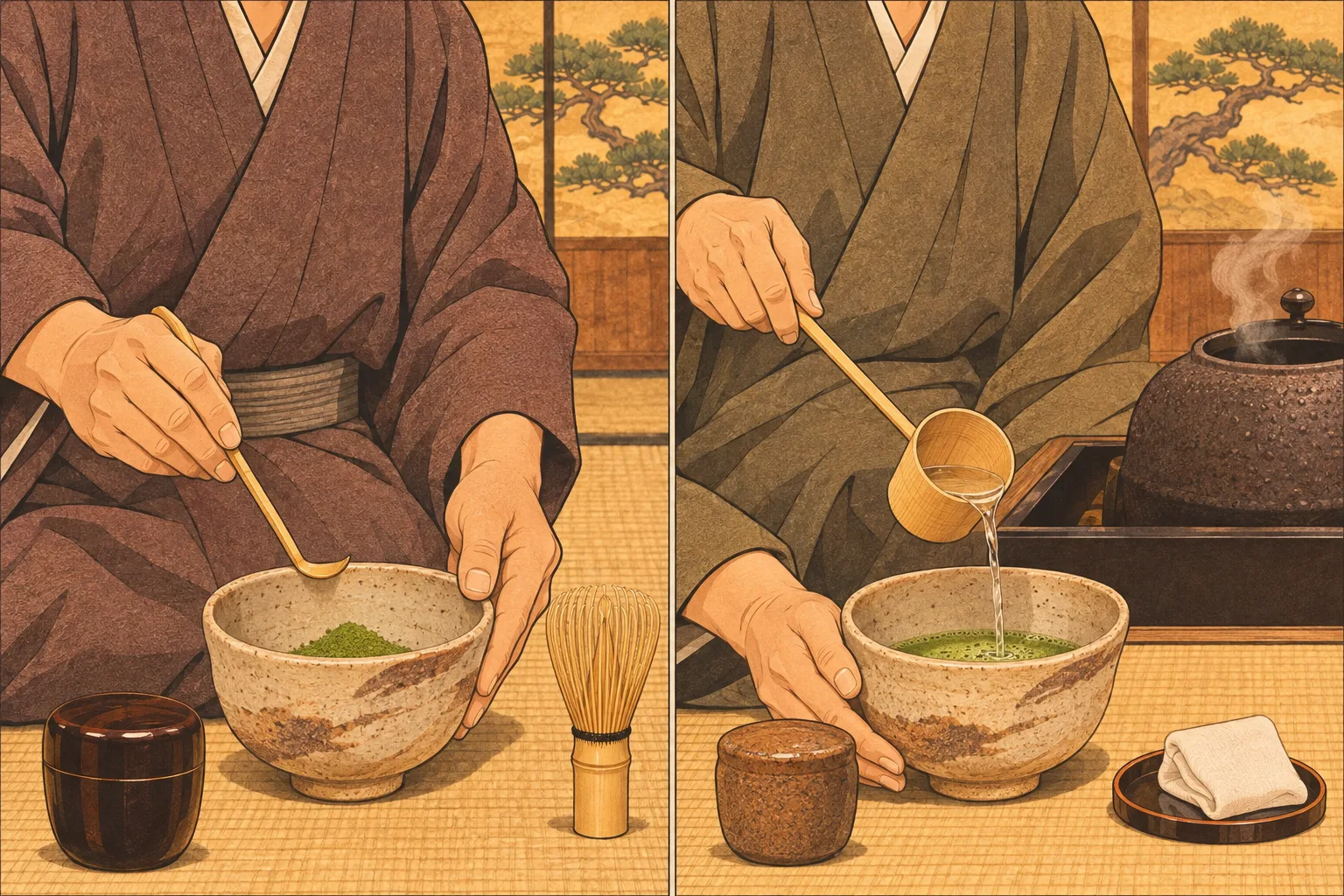
Left: the tea goes into the bowl, and the scoop is then tapped once on the rim to knock off the last powder. Right: the host fills the ladle at the kettle but pours only part of it into the bowl.
The ladle is the utensil guests watch most without realising it. A long, thin bamboo handle with a small cup at the end, it is held in the right hand and moved from the wrist and forearm while the body stays still. Besides the upright mirror hold at the start, Urasenke names several ways of resting it back on the kettle, such as oki-bishaku, kiri-bishaku and hiki-bishaku; which one is used depends on whether the ladle has just held hot or cold water and on the stage of the procedure. A guest need not know the names. What shows is that the ladle never drips, never knocks the kettle rim, and always returns to the same place.
He fills the ladle at the kettle but pours only part of it into the bowl, about 60 to 70 millilitres for thin tea, and returns the rest to the kettle. The quantity is judged by hand. Hot water is not thrown away; what is not needed goes back to keep heating.
Whisking is the only part of the procedure that actually makes tea. The host steadies the bowl with his left hand and, with his right, loosens the powder at the bottom, then whisks back and forth from the wrist, fast, with a continuous brushing sound. Urasenke thin tea is whipped to a fine, pale-green foam across the whole surface; other schools whisk less. The host stops when the bubbles are small and even. To finish, the whisk traces a light circle on the surface and lifts out from the centre.
The host places the bowl on his left palm and turns it, in two movements, so its "front", its best face, points at the guest. He has worked with that face towards himself all along. He sets the bowl at the serving spot just in front of his mat, and the principal guest comes forward on her knees to take it, or an assistant (hantō) carries it across. What the guest does next, turning the bowl, drinking, admiring it, belongs to the guest’s side of the ritual.
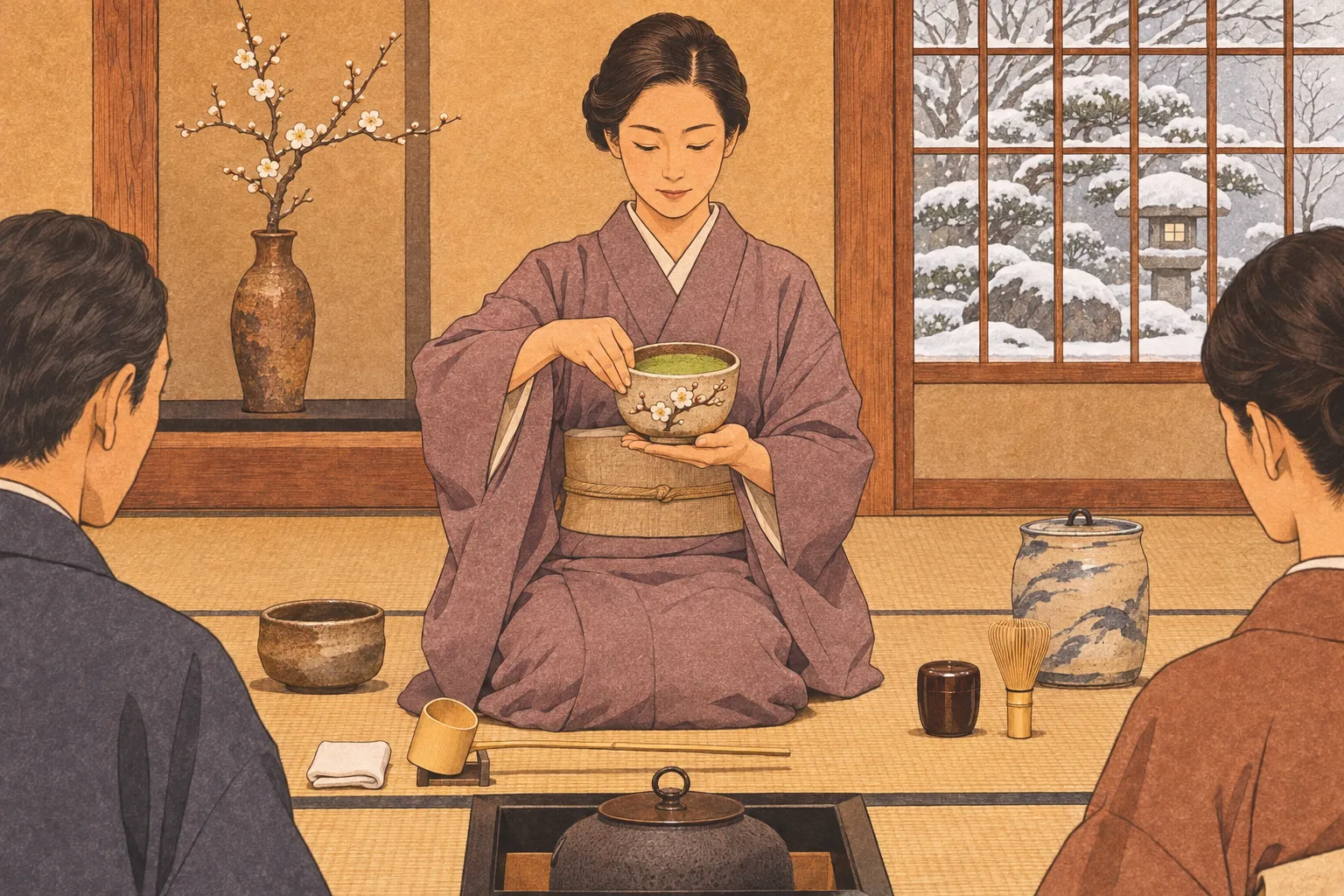
Serving. With the tea made, the host sets the bowl on her left palm and turns it so that its front, painted with plum blossom, faces the guest.
05Rinsing, Viewing and Leaving
While the guest drinks, the host waits, seated straight, not watching. When the bowl comes back he rinses it with hot water and empties it into the kensui. If another guest is to be served, he makes the next bowl. When the principal guest says "o-shimai kudasai", "please finish", the closing begins.
That division of labour matters: the guests, not the host, decide when tea is over. The host bows, says that he will now put things away, and does something that signals the change at once. Instead of hot water from the kettle, the ladle goes into the water jar, and cold water goes into the bowl. Guests who know the procedure read this as the beginning of the end.
He passes the whisk through again in the cold water, empties the bowl, puts the cloth back in it and stands the whisk in it. He wipes the scoop with the fukusa, first giving the cloth a small shake over the waste bowl to clear the powder (chiri-uchi), and lays the scoop across the bowl again. Bowl and caddy are set back as they were when he came in.
Then he ladles one scoop of cold water from the jar into the kettle. The boiling quietens, the pine-wind sound drops, and after a moment he closes the kettle lid. The ladle returns to its rest and the lid goes back on the water jar.
At this point the principal guest usually asks to see the caddy and scoop (haiken, "respectful viewing"). The host wipes the caddy once more, turns, and places caddy and scoop side by side on the guests’ side of the mat. While the guests pass them along, he begins carrying things out, typically in roughly the reverse order they came in: the kensui with the lid rest and ladle first, then the bowl, and finally the water jar.
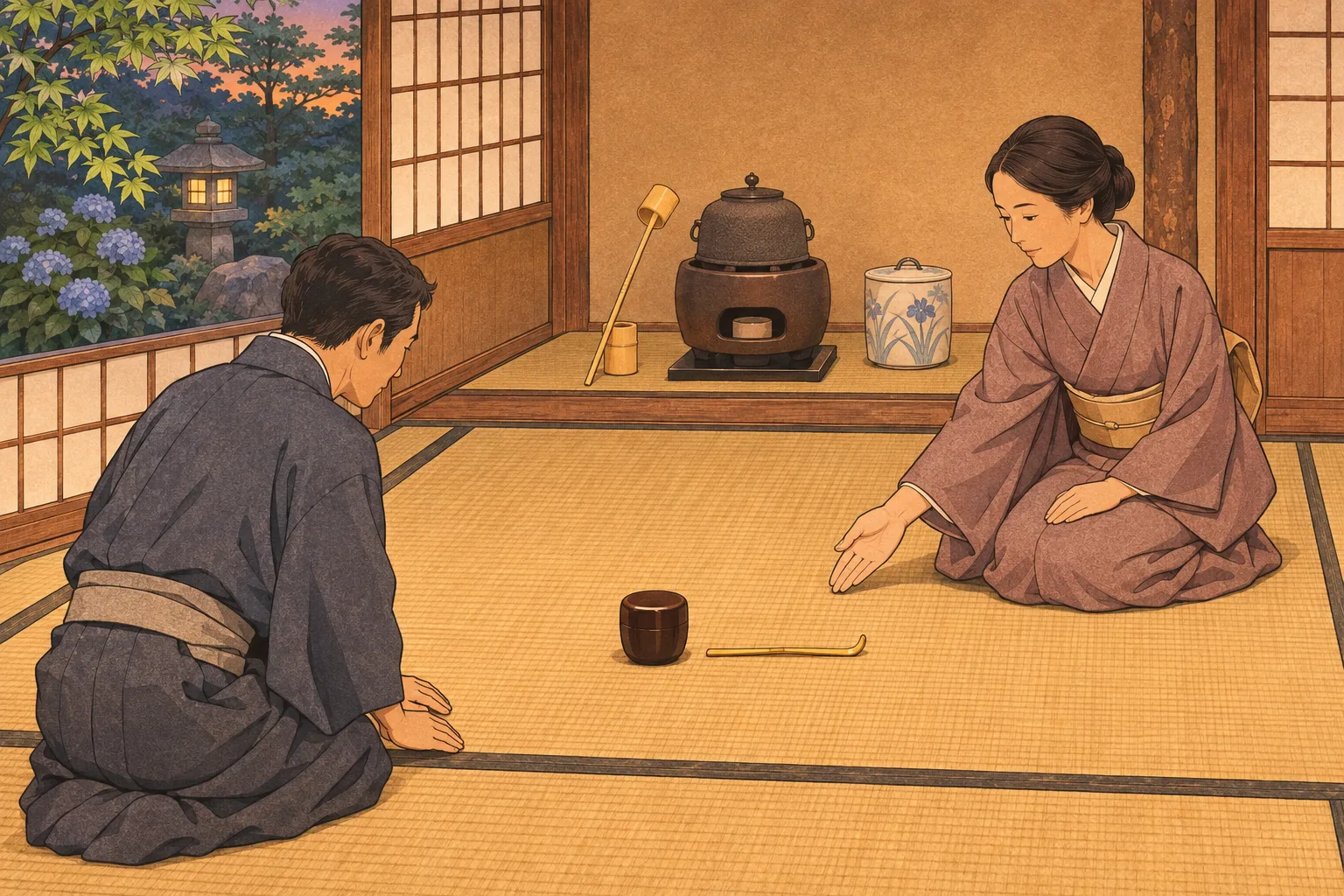
Haiken. The host has turned and placed the caddy and scoop side by side on the guests’ side of the mat; the principal guest bows before coming forward for them.
He returns to kneel at the door. The guests set the caddy and scoop back where they found them, and a set exchange follows. What is the shape of the caddy? Whose lacquer work? Who carved the scoop, and what is its name? Which tea house blended the tea, which confectioner made the sweet? The host answers each one. This is where the thinking behind the gathering comes out: a scoop’s name may tie it to the season, the occasion, or the guests. Then the host takes the caddy and scoop to the door, host and guests bow together a final time (sōrei), and he slides the door shut.
A full thin-tea hakobi procedure takes an experienced host about fifteen to twenty minutes.
06Thick Tea and Thin Tea: Two Different Procedures
Thick tea (koicha) and thin tea are different drinks, and they are made by different procedures. Koicha temae is slower and more formal, and almost every step gains an extra layer.
The most visible difference is the container. Thin tea comes from a lacquer natsume; thick tea from a chaire, a small glazed ceramic jar with full shoulders and an ivory lid, dressed in a fitted bag of brocade (shifuku). The host unties the cords and slips the jar out in front of the guests, a step thin tea does not have. He also folds the fukusa differently and wipes the lid and the shoulder of the jar separately.
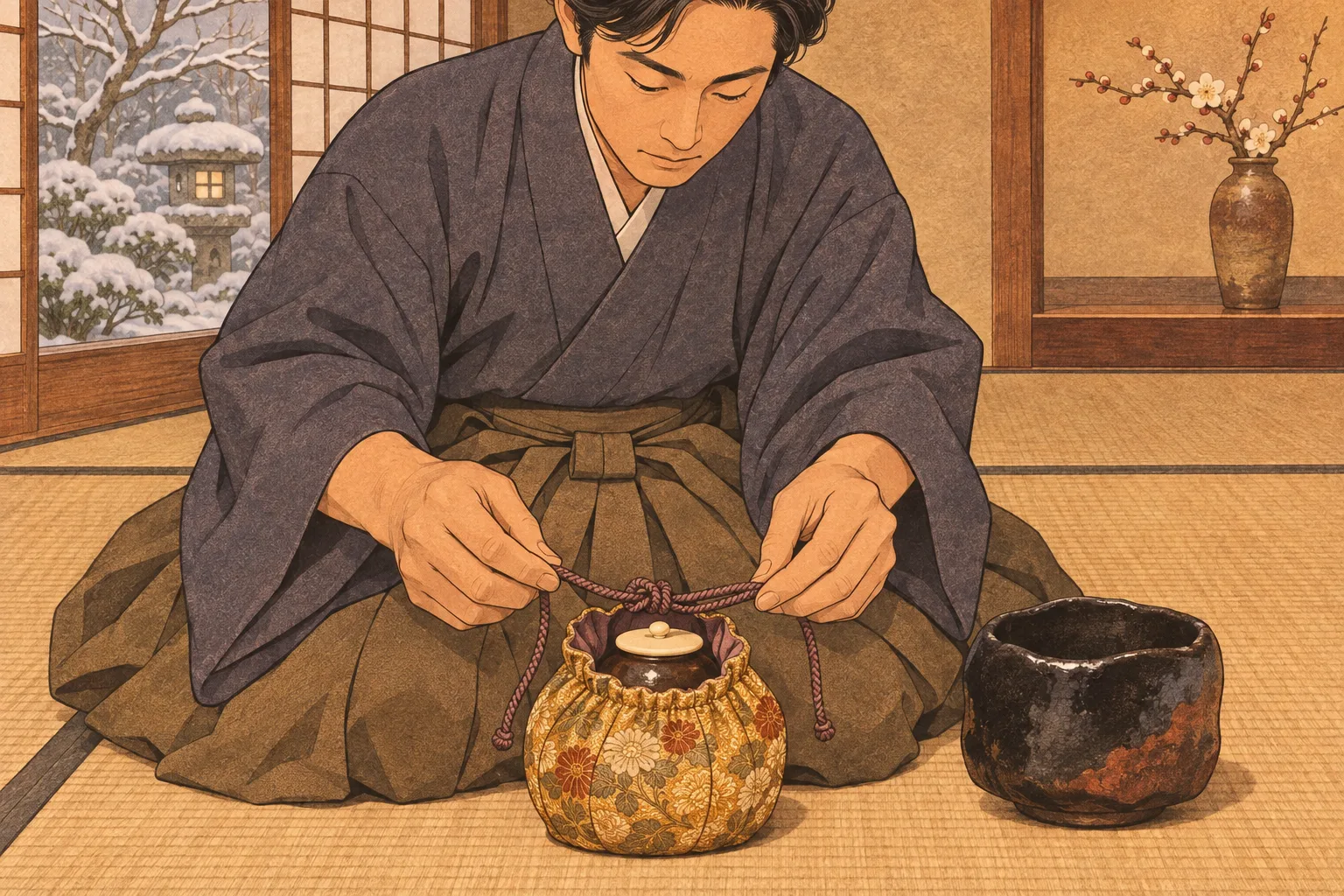
Thick tea. The host unties the cords of the shifuku in front of the guests and the ivory lid of the chaire appears, a step thin tea does not have. Beside it is a black Raku bowl.
The quantity changes. Thick tea is measured per person, about three scoops each, and three or four guests share a single bowl, so the bowl may hold well over ten grams of powder. After a few scoops, the host tilts the jar and rotates it, letting the remaining powder slide out (mawashi-dashi).
Thick tea is not whisked; it is "kneaded" (neru). The host adds a small amount of hot water and works the whisk slowly in pressing, folding circles until the tea is smooth and dense, then adds a little more water to adjust. There is almost no foam and far less sound. Because the guests share one bowl, the host makes only one, and does not take it back until all have drunk. A small cloth (kobukusa or dashibukusa) is usually set beside it for the guests to cradle the bowl.
After the principal guest’s first sip, the host asks "o-fuku-kagen wa ikaga desu ka", roughly "is the tea to your liking?", and the guest replies that it is excellent. The question tells the host whether his hand judged the strength correctly; the tea’s name and blender come up later, when the principal guest asks.
The opening often differs too. At many gatherings the chaire is already set out in front of the water jar when the guests come in, so they see the brocade-clad jar before the host appears, and he only needs to carry in the bowl to join it, followed by the waste-water bowl. Altogether a thick-tea procedure runs noticeably longer than thin tea, twenty minutes or more.
In a formal gathering, thick tea is the centre of the event and thin tea follows in a lighter mood. The final viewing after thick tea is grander too: the guests examine not only the scoop but the ceramic jar and its brocade bag, which often travels down the centuries with it.
07The Family of Procedures
Temae is not one procedure but a ladder. In Urasenke, students start at the bottom and work up through dozens of variations, each tied to a licence. A guest is most likely to meet the following.
Bonryaku-demae, the abbreviated tray procedure, is Urasenke’s entry point. Everything sits on a single tray: the bowl holding cloth and whisk, the scoop across its rim, the caddy beside it. There is no kettle, no water jar and no ladle. Hot water comes from an iron kettle with a handle (tetsubin) set on a small brazier stand (binkake), lifted and poured directly into the bowl. Only the core moves survive: folding the cloth, purifying caddy and scoop, warming, whisking, serving. It is used in first lessons, school tea clubs and many tourist experiences, and it works at a low table in an ordinary room.
Hakobi-demae, described above, uses no stand at all. Everything is carried in and carried out, and when the host leaves, only the kettle and fire remain. Once you know hakobi, most other procedures read as additions to it.
Tana-demae uses a small stand (tana) beside the host, a low shelf of one or two tiers, sometimes with a cabinet. There are round ones, square ones, and many shapes linked to the taste of a particular grand master. The water jar is placed on or under the stand before guests arrive, and the caddy may be displayed on the top shelf. At the end, rather than carrying out the ladle and lid rest, the host arranges them on the stand, so guests leave looking at a composed display.
Ryūrei is tea made at a table, with the host seated on a chair. A long table holds the brazier, kettle and water jar; guests sit on stools or chairs with small tables in front of them. According to Urasenke’s own account, Gengensai, the school’s eleventh grand master, devised it for the Kyoto exhibition held in the spring of 1872, so that foreign visitors who could not kneel on tatami could be served. The table was called a tenchaban. Today ryūrei tables come in many designs, and you will meet them at large tea gatherings, temple events, hotel tea rooms and tourist sessions. The movements are largely the same as on the floor, but every height has been raised, so arm and waist movements are reworked.
Daisu-demae is the most formal tier. A daisu is a large stand with two boards and four posts; the most formal version, the shin-daisu, is black lacquer throughout. On it stands a matched set (kaigu) of water jar, ladle-stand, waste bowl and lid rest, often bronze or Chinese-style porcelain. Tradition holds that the daisu came from China with Zen monastery tea ritual; it is the stand on which the shogun’s advisers made tea in the Muromachi reception halls, long before the small rustic tea hut. After Rikyū, mainstream tea turned towards the rustic style, and daisu procedures were kept as the highest level of teaching, available only with advanced licences and partly transmitted orally. A guest is most likely to see one at a formal tea offering at a shrine or temple.
Chabako and tabi-dansu are travelling procedures. A chabako is a small wooden box packed tightly with a bowl, a whisk in a case, a scoop, a caddy in a bag, a tube for the damp cloth and a little shaker of sugar sweets, rather like a picnic set. Unpacking and repacking, piece by piece, is the pleasure of watching it. Urasenke has several named chabako procedures; Gengensai devised the snow, moon and flower set and the unohana procedure, and the repertoire also includes others such as wakei and shikishi. A tabi-dansu is a small carrying cabinet with a front door and a handle; it is said Rikyū designed it to make tea in camp during Toyotomi Hideyoshi’s Odawara campaign of 1590.
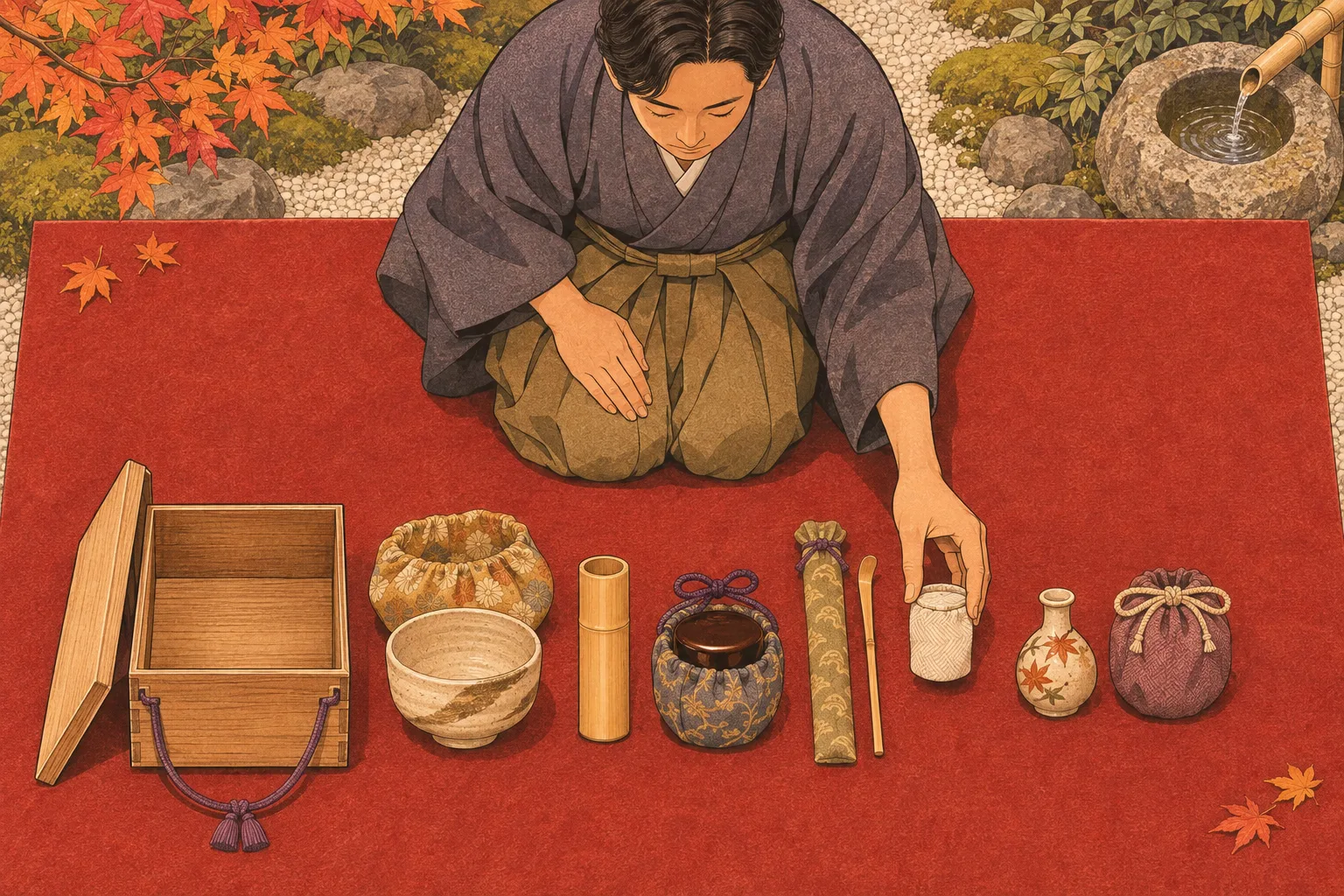
A chabako procedure. The small wooden box is unpacked piece by piece: bowl, whisk case, caddy in its bag, scoop, cloth tube and the little shaker of sugar sweets.
08Side by Side: Telling Them Apart from Your Seat
At a tea event you usually see a single procedure and may not know which it is. Three questions sort it out: where is the host sitting, is there a stand beside him, and where does the hot water come from?
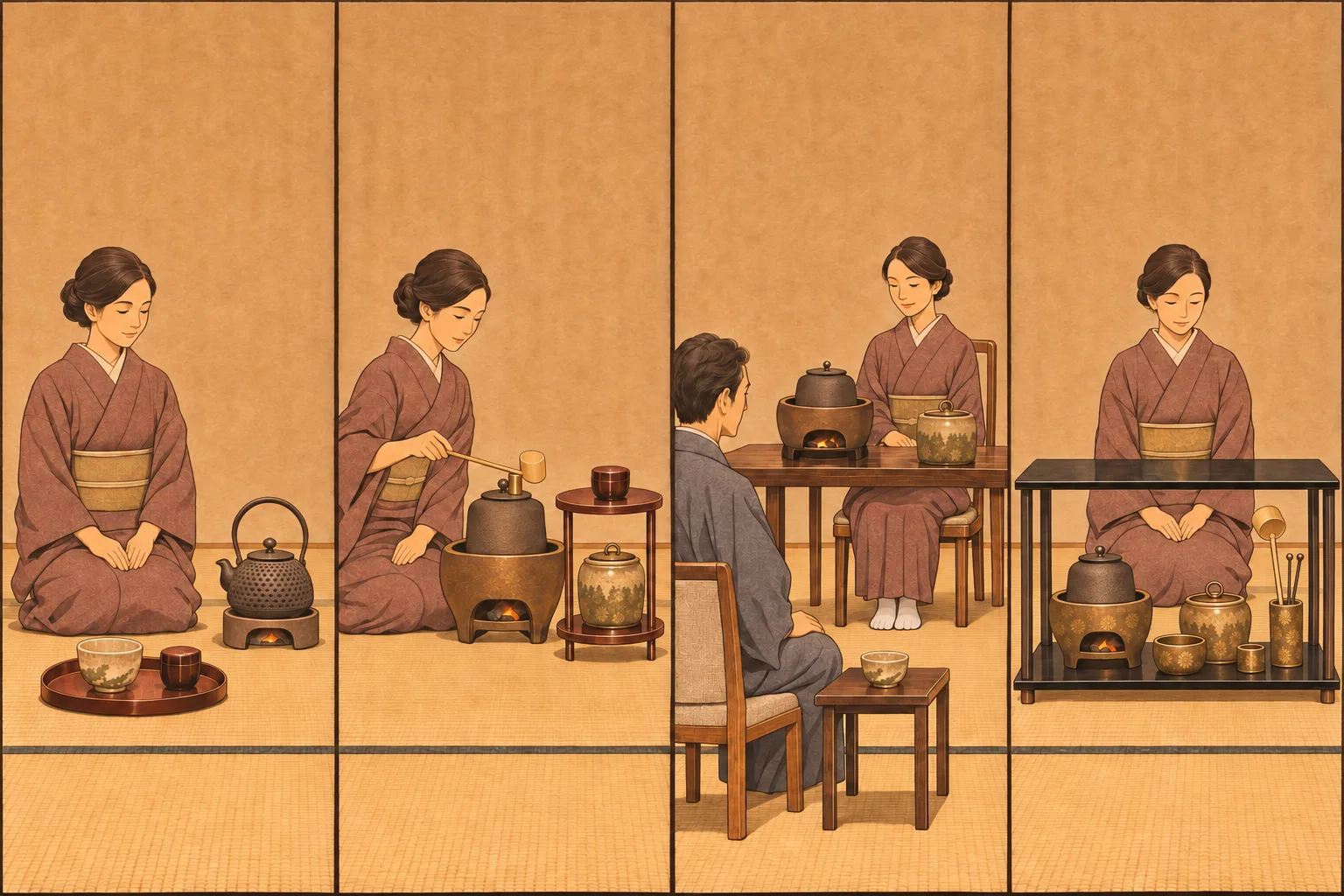
Four procedures, from left: bonryaku-demae, with a single tray and an iron kettle with a handle; tana-demae, with a low stand beside the host; ryūrei, with host and guest on chairs at tables; and daisu-demae, with a large four-posted, two-tiered stand, a matched set on its lower board and the ladle standing upright in its holder.
Tray procedure: the host kneels with a single tray in front of him, bowl and caddy close together on it, and an iron kettle with a handle sits beside him in place of the large kettle on a brazier. No water jar, no ladle. It is the barest scene and the most like everyday hospitality.
Stand procedure: the host kneels facing the kettle, and beside him is a compact shelf, lower than the kneeling host, with the water jar on or under it and perhaps the caddy on top. Kettle, ladle and lid rest are all present, and the scene has levels. At the end, the ladle is arranged back on the stand, which never happens in hakobi.
Table procedure: the host is on a chair. That alone settles it. Brazier, kettle and water jar sit on a long table; guests are on chairs too, a little distance away. The setting is often a hall, a garden tent or a hotel rather than a small tea room.
Daisu procedure: the host kneels before a large four-posted, two-tiered stand in black lacquer, with a matched set of bronze or porcelain vessels lined up on its lower board and the ladle standing upright in its holder. The scene is symmetrical, dark, a size larger than any tana and a step more solemn.
Hakobi sits between tray and stand: kettle, water jar and ladle are present, but there is no shelf, and the water jar stands directly on the mat. If the host is taking each utensil out of a wooden box or a small cabinet with a door, you are watching chabako or tabi-dansu.
Why so many forms? Partly the occasion: a private welcome in a small room, a hundred-guest gathering in a hall, a cherry-blossom party outdoors and a ceremonial offering each call for different weights of utensils and manners. Partly teaching: arranged from simple to complex, each step up gives the student a new combination of space and tools. For the guest, recognising which procedure is in front of you tells you roughly what kind of occasion this is, and how much the host has prepared for one bowl of tea.
More deep dives on this topic
 ChawanAt the end of a tea ceremony, after the last sip, guests do something that puzzles first-time visitors.
 Tea UtensilsMost of what sits on a tea-room mat is small enough to hold in one hand.
 The Tea RoomA small Japanese tea room can look almost artless: a box of earth walls and straw mats, a few odd little windows, a recess with a single scroll.
 The AlcoveWhen guests enter a tea room, they do not sit down straight away.
 TemaeSit as a guest in a Japanese tea room and you will watch someone spend a quarter of an hour on a task that takes a minute in a kitchen, and it is natural to wonder what all the…
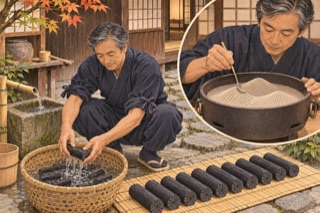 The ChajiMost visitors to Japan meet the tea ceremony as a bowl of whisked matcha and a sweet, served in a temple garden or a tea school in Kyoto, over in fifteen minutes.
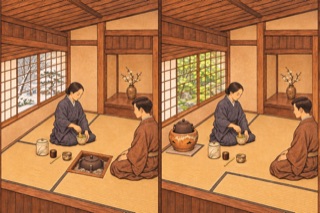 The Tea YearWalk into the same tea room in January and in August and you might think you had come to two different houses.
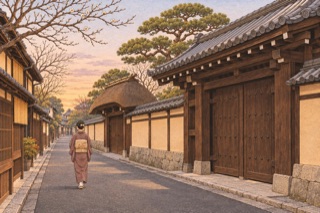 Schools of TeaWalk north up Ogawa-dōri in Kyoto, a narrow street lined with old townhouses, and you pass two quiet gates a few dozen metres apart.
- Back to the main article: The Way of Tea (Chanoyu) →