
Walk into the same tea room in January and in August and you might think you had come to two different houses. In winter the fire sits in a square pit cut into the floor, almost at the guests’ knees, and the tea bowl is tall and narrow like a section of bamboo. In summer the floor is flat, the fire has retreated into a portable brazier on the host’s side, the bowl is as wide and shallow as a dish, and the water jar may be made of glass, its lid replaced by a single leaf.
Japanese tea practice, chanoyu, runs on a calendar. Almost every object in the room, from the charcoal and the incense to the flowers, the sweets and the hanging scroll, changes with the months. This guide walks through that year as most practitioners of the two largest schools, Urasenke and Omotesenke, keep it. Other schools and regions shift some dates by a few weeks, and a few customs belong to one school only; those differences are noted where they matter.
01Two Halves of the Year: Ro and Furo
The single biggest seasonal switch in tea is where the fire lives.
From November to April, tea is made over the ro, a sunken hearth. In a standard four-and-a-half-mat room it is a square opening about 42 centimetres across, cut into one corner of the half mat at the centre. It is framed by a wooden rim, the robuchi: plain unlacquered wood for small rustic rooms, black or red lacquer, sometimes with gold decoration, for larger formal ones. Inside is a clay-lined box filled with damp ash. Charcoal sits on the ash, and the kettle rests above it on an iron trivet or hangs from the ceiling. Seen from the guests’ side, the kettle’s mouth is barely above floor level, and on a cold day you can feel the heat on your face.
From May to October, the hearth is covered with a full tatami mat and tea is made over the furo, a freestanding brazier. Furo come in unglazed earthenware, bronze and iron, in shapes that recall ancient Chinese ritual vessels: round bellies, flaring mouths, sometimes little legs. The furo stands on a tile or wooden board towards the left of the host’s mat, on the side away from the guests, noticeably farther from them than the sunken hearth.
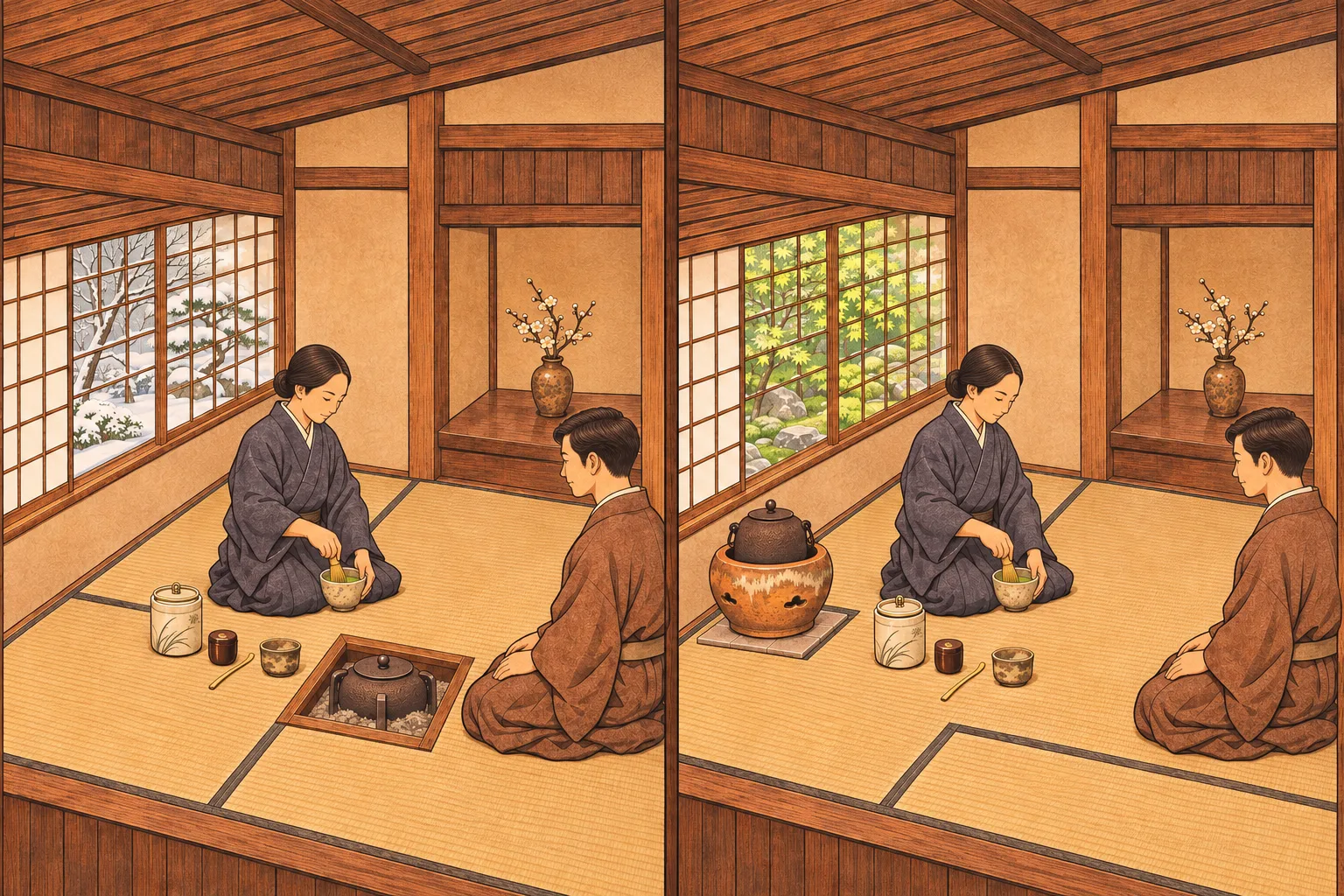
One room, two seasons. Left: the winter ro is cut into the floor, with the fire right in front of the guest. Right: in summer the hearth is covered and an earthenware furo stands to the left of the host’s mat, away from the guest.
The logic is simple. In winter, the host brings the fire towards the guests. In summer, the host pushes it away. Nearly every other seasonal adjustment in this article is a refinement of that one idea.
The change touches everything. The host’s movements, or temae, are different for ro and furo: where the ladle rests, how the bowl is placed, which way the body turns. Students relearn their hands twice a year, and the first sessions of May and November tend to produce a few fumbles.
The charcoal and ash change too. The sunken hearth uses dark, moist ash and fat pieces of charcoal that burn a long time. The brazier uses dry, sifted ash that the host shapes with a spatula into precise ridges and valleys before laying smaller charcoal on top. Incense follows the same divide. In furo season, a sliver of fragrant wood such as sandalwood goes on the fire, carried in a small lacquer or wooden box. In ro season, the host uses neriko, kneaded incense pellets that look a little like dark pills, carried in a ceramic box. An experienced guest can tell the season just by glancing at the incense container.
Historically the brazier came first. It arrived with tea drinking from China, and early Japanese tea gatherings all used it. Cutting a hearth into the floor of a small room developed in the fifteenth and sixteenth centuries alongside the rustic thatched tea hut. One account credits Murata Jukō, inspired by the open hearths of ordinary houses; Urasenke credits Sen no Rikyū, who drew on country farmhouse hearths. By Rikyū’s time the sunken hearth in a four-and-a-half-mat room was standard. The "May brazier, November hearth" rhythm became fixed only later. Originally it followed the old lunar calendar and the solar terms; today most people use the Western months.
02January: Hatsugama, the First Kettle
In early or mid January every tea school, teacher and group holds hatsugama, literally "first kettle", the first tea of the new year. At the head of a school it can be a grand affair: Urasenke’s in Kyoto runs for several days, with guests seated in turn. At a neighbourhood class it might be a dozen students in their best kimono, seated in two sittings in the teacher’s home.
Hatsugama falls in hearth season, but the room is dressed for celebration. The most striking decoration is musubi-yanagi, "knotted willow". A tube of fresh green bamboo hangs on the alcove pillar, and from it falls a long cascade of bare willow branches, one strand looped and tied into a circle near the bottom, often with a single Akebono camellia beside it. Some are long enough to reach the floor and coil there. The willow, which bends without breaking and puts out shoots early, and the closed loop, which suggests a cycle with no end, both carry the wish for a good year.
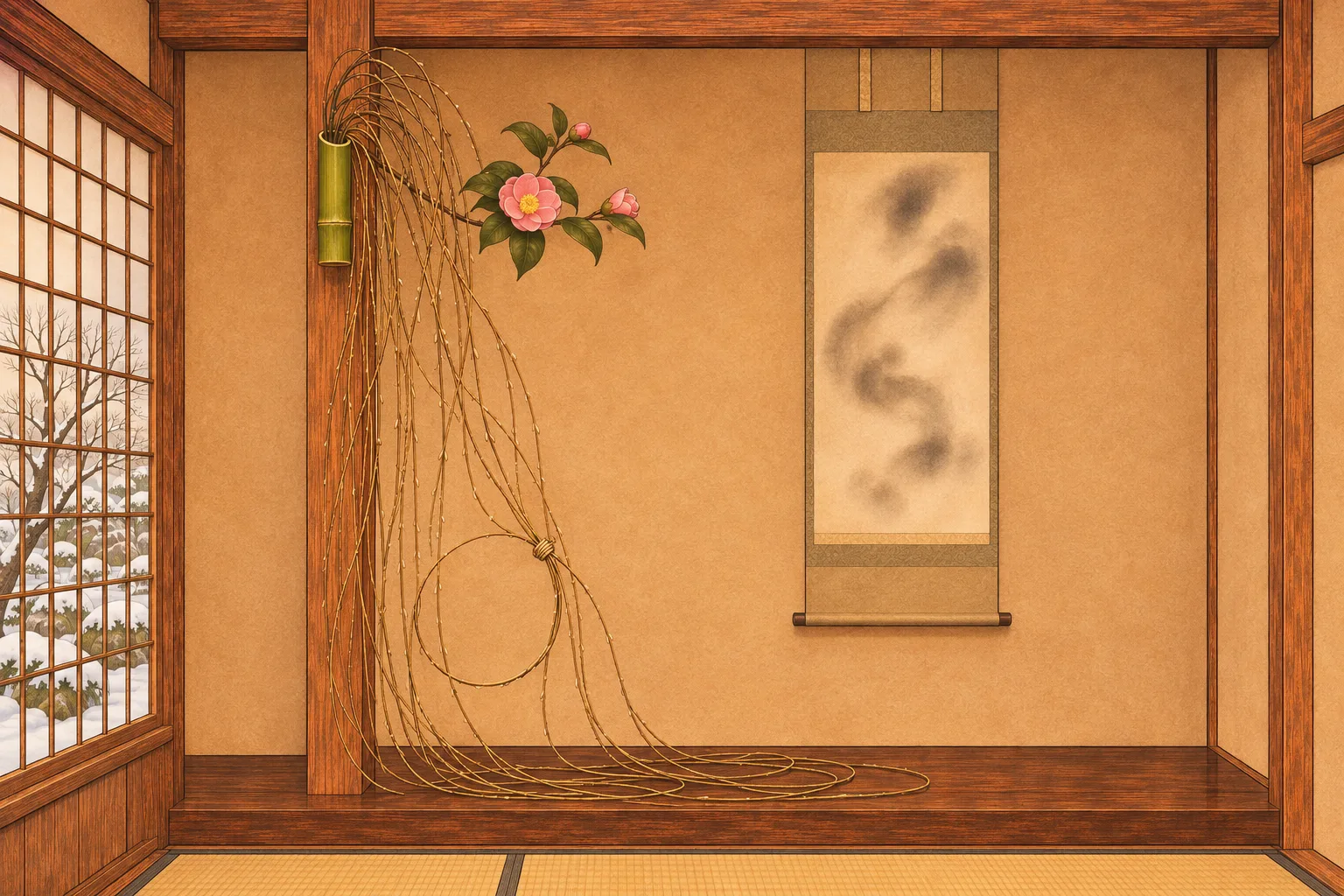
The alcove at hatsugama. Bare willow falls from a green bamboo tube on the pillar, one strand looped and tied into a circle, the ends coiling on the floor: musubi-yanagi, with a camellia beside it.
Scrolls tend towards auspicious single lines of calligraphy, pine trees and cranes. Many schools also use utensils linked to the year’s zodiac animal, and to the theme chosen for the Imperial Poetry Reading held each January. A Year of the Horse means horses painted on tea bowls, horse-shaped incense boxes, horse motifs on lacquer tea caddies. These pieces come out mostly at this time of year; the next time some of them see a full season is twelve years later. The thick tea at hatsugama is often served in shimadai, a pair of shallow raku bowls, one larger and one smaller, stacked one inside the other, their inner surfaces lined with gold and silver leaf. At Omotesenke, for example, the grand master’s hatsugama uses them, and the pair is traced to the taste of the grand master Joshinsai.
The sweet is the part everyone remembers. Urasenke serves hanabira-mochi, "petal mochi", the pale half-moon of soft dough with a pink diamond, white-miso bean paste and candied burdock inside, derived from a dish of the imperial New Year; Urasenke is generally said to have been permitted to use it at hatsugama in the Meiji era, a step usually credited to the eleventh grand master, Gengensai. Because it is large and the burdock long, it is awkward to cut with the pick, and guests commonly hold it on folded paper and eat it by hand. The burdock is often explained as a stand-in for the sweetfish once included in the court version. Omotesenke serves tokiwa manjū, a white bun brought out in a lidded box; broken open, it shows a deep green filling meant to recall pine under snow. Other schools and towns have their own choices.
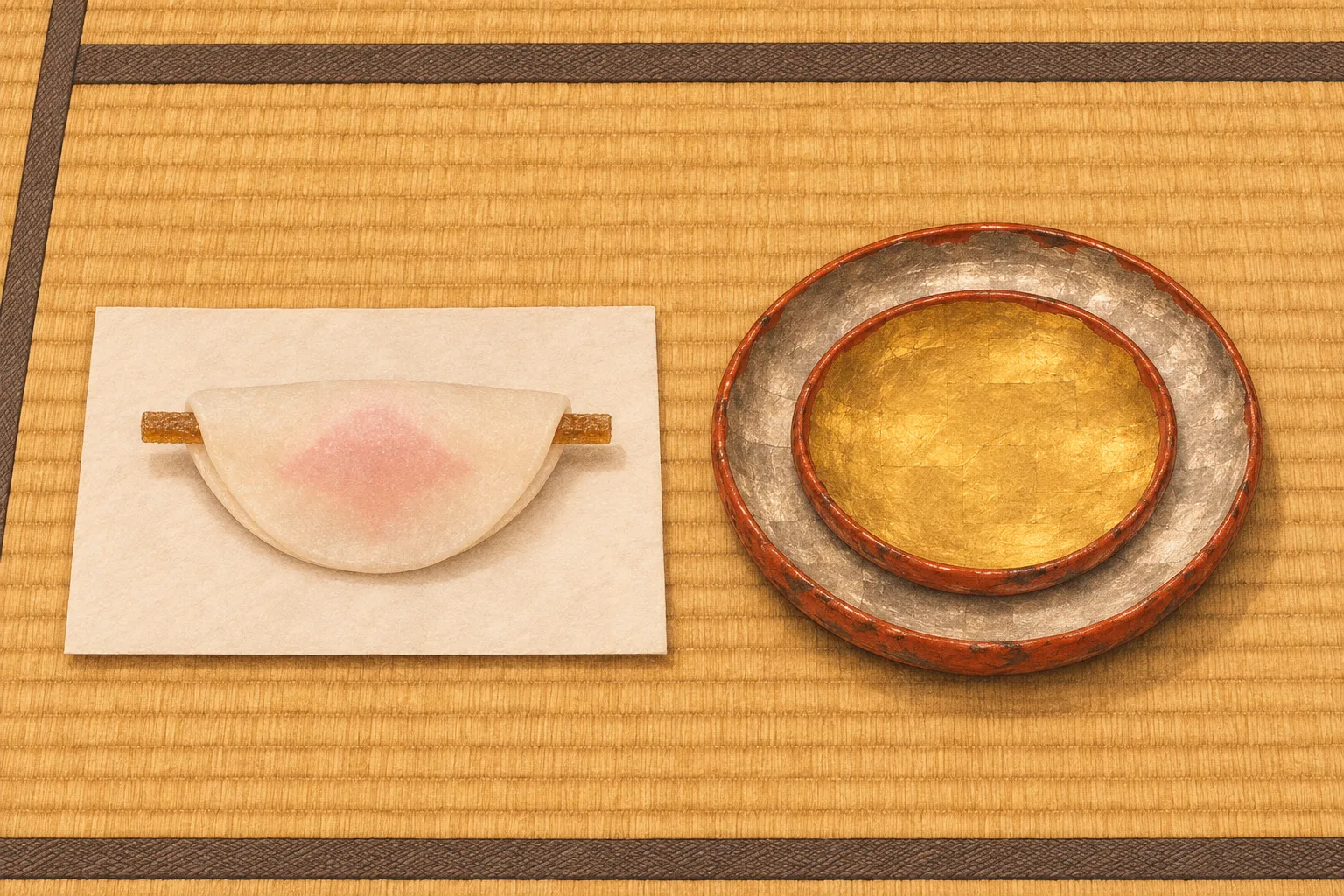
Left: hanabira-mochi on folded paper, a pale half-moon with a pink diamond showing through and burdock at both ends. Right: shimadai, a pair of shallow raku bowls stacked one inside the other and lined with gold and silver leaf.
Some hosts also serve ōbukucha, "great fortune tea". At home it is usually green tea with a pickled plum and a knotted strip of kelp, drunk in the first days of the year for good health; at a tea gathering it is thick tea. Legend traces it to the tenth-century monk Kūya of Rokuharamitsuji temple in Kyoto, who is said to have given such tea to the sick during an epidemic, and to Emperor Murakami, said to have recovered after drinking it. The temple still hands it out at New Year.
03The Deep Winter and the End of the Hearth
The months after hatsugama are the coldest of the year, and the tea room is built around keeping guests warm.
For flowers, the whole hearth season belongs to the camellia. From November to March the alcove most often holds one camellia, frequently a small single-flowered variety such as wabisuke, shown as a bud or a half-open bloom with a leaf or two, sometimes beside a sprig of something bare or budding. A fully open flower is generally avoided; the half-open bud suggests the moment just before, which tea people prefer. As spring arrives, plum, then peach, then late-spring flowers take over.
In the depth of winter, from early January to the start of spring in early February, the bowl often changes to a tsutsu-chawan, a cylinder bowl. It is about as tall as it is wide, narrower and deeper than an ordinary bowl, with straight sides. The small mouth and deep walls keep the tea hot longer and let the guest wrap both hands around it. The host’s whisk has less room to move, and the bowl is wiped from the bottom upwards rather than rim first, so the fingers need not reach back inside.
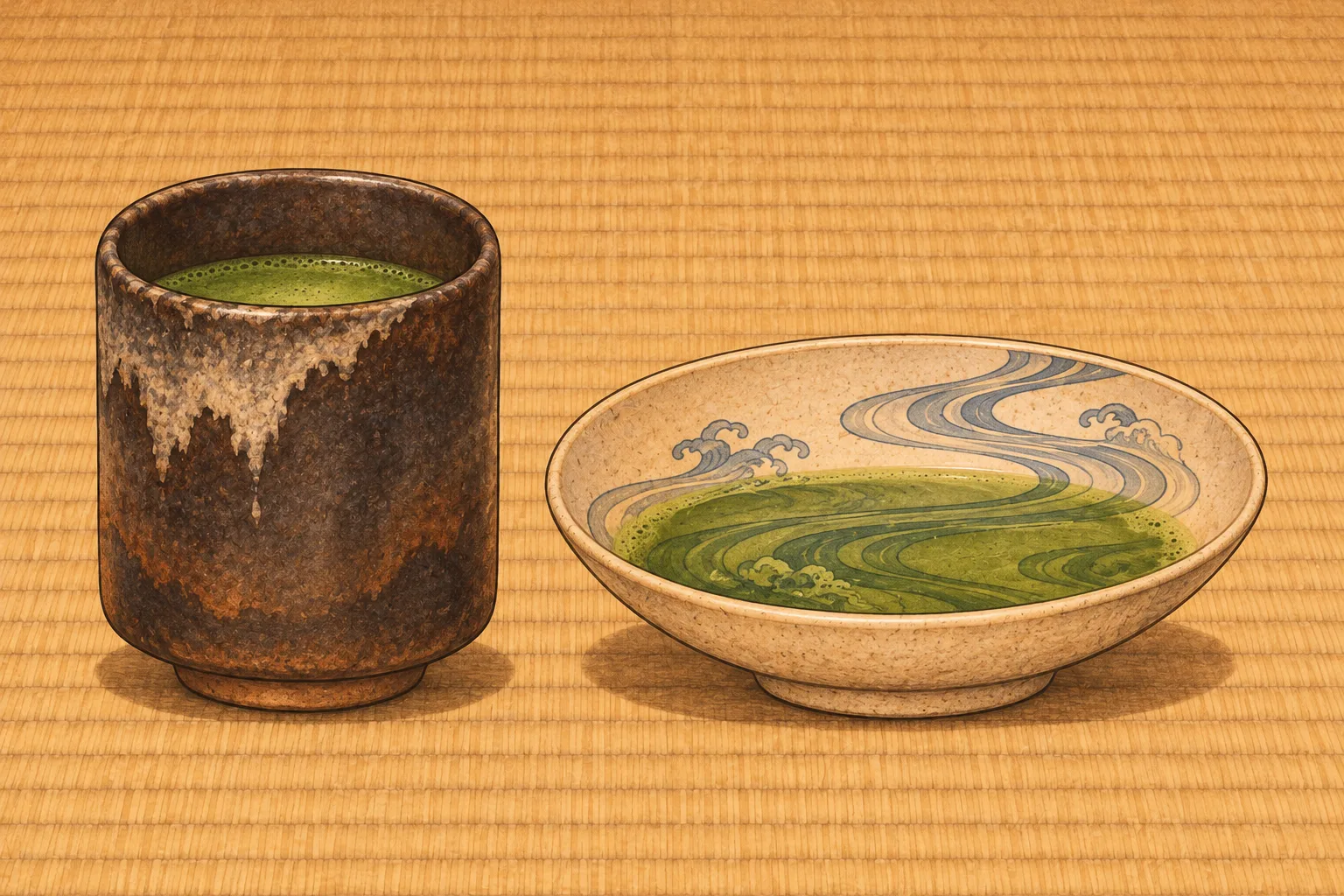
Left: the tsutsu-chawan of deep winter, straight-sided, narrow and deep, so the tea stays hot. Right: summer’s hira-chawan, wide and shallow, with flowing water painted inside and showing through the tea.
February brings, at Urasenke, the dairo, or "large hearth". Devised by the eleventh grand master, Gengensai, from the open hearths of country farmhouses, it is unique to Urasenke and is opened only in February, the coldest month. It is about 54.5 centimetres square against the standard 42, and is cut in a six-mat room next to the Totsutotsusai room at the Urasenke headquarters, known as the Dairo-no-ma, in a mirror-image layout (gyakugatte). The rim is plain wood, the walls are finished in mouse grey, and a snowflake-shaped tile divides the ash. A bigger fire and a large kettle fill the room with warmth and steam. Omotesenke and other schools do not use it.
Around Setsubun, the early-February festival that marks the end of winter on the old calendar, gatherings may play with demon-chasing themes, such as a box for roasted beans or an incense container in the shape of a round-cheeked Otafuku mask.
On March 3, the Doll Festival, Hina-matsuri, offers the first big seasonal gathering of the year. The alcove may hold a painting of the imperial doll couple, or a tiny pair of the dolls themselves, with a branch of peach blossom in the vase. In Kyoto the sweet is hichigiri, a small flat cake pinched up at one edge like a scoop and topped with a ball of bean paste, a Doll Festival sweet of Kyoto and western Japan.
From late March the sunken hearth starts to feel too warm, and two kinds of kettle exist mostly to solve this problem in the last weeks of hearth season.
The sukigi-gama has a wide horizontal flange around its waist, like the brim of a hat. Instead of sitting on the trivet, it rests on two narrow wooden bars, the sukigi, laid along the left and right edges of the hearth rim. The flange covers most of the opening, so the guests no longer see the glowing charcoal, and much of the heat stays trapped below, while the gap the bars create keeps air moving to the fire. Tea records show such kettles were already common in the 1560s.
The tsuri-gama hangs. A bamboo hook or iron chain drops from a fixture in the ceiling and the kettle dangles at the end of it, higher above the fire than usual, so it heats more gently. Urasenke explains it by the east wind of early spring: even a slight breeze sets the kettle slowly swaying, and host and guests feel spring approaching. It is generally hung from around the spring equinox in late March to mid-April, with regional leeway. The flanged kettle, too, belongs to April, the last step before the first brazier of May. Only rooms built with a ceiling fixture can use it, so it is not something every tea room can show.
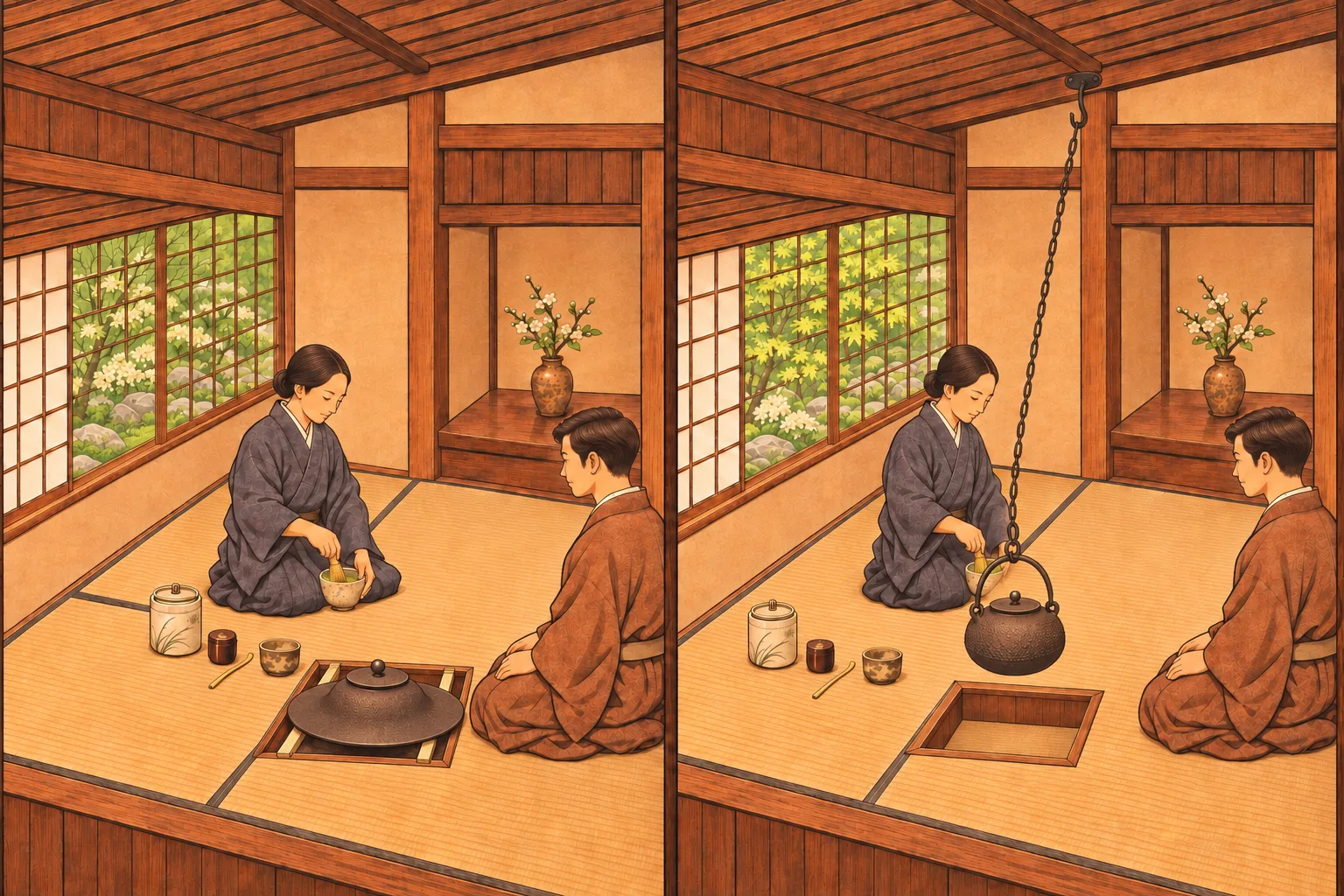
Two kettles for the end of the hearth season. Left: the sukigi-gama, its wide flange resting on wooden bars so that it almost covers the hearth. Right: the tsuri-gama, hung on an iron chain from the ceiling above the fire.
At the end of April the hearth season closes, ro-fusagi, "closing the hearth". After it, the hearth is filled, a tatami mat goes back over it, and it vanishes for six months.
04May: The First Brazier
Around the beginning of May, the brazier returns, and the first gathering of the warm half is called shoburo, the "first brazier". The mood is fresh and light. The host has shaped new ash and the brazier stands towards the left of the host’s mat. The kettle is smaller than in winter. The incense box is now lacquer or wood, holding a few chips of sandalwood.
Early May is the boys’ festival season, and the alcove often holds irises. The sweet may be kashiwa-mochi, rice cake wrapped in an oak leaf, or chimaki, wrapped in bamboo leaves. Bowls become less vertical and more open, the opposite of the winter cylinder.
June brings the rainy season, and scrolls may turn to waterfalls, streams or frogs. On June 30, the day of the summer purification rite, Kyoto tea rooms often serve minazuki, the red-bean-topped triangle eaten for the occasion.
05High Summer: Serving Coolness
In July and August the guest arrives already hot, sits near a charcoal fire, and drinks a hot drink. Tea’s answer is not to remove the fire but to make every other object say "cool".
The first move is timing. Summer is the season for asacha, morning tea, held just after dawn, before the heat builds. The garden path has been sprinkled with water, the stepping stones glisten, and the stone basin where guests rinse their hands overflows quietly.
The room itself is re-fitted. Paper sliding doors come out and reed doors, yoshido, go in, along with bamboo blinds. Light falls through them in thin stripes and the breeze passes through. Flowers often sit in woven baskets, which are a summer vessel: a single stem of rose of Sharon or Chinese bellflower. A rose of Sharon flower lasts a single day.
Several things appear only in this season.
Arai-jakin, the "washed cloth" procedure, opens with a wide, shallow bowl filled with clean water and the linen cloth already soaking in it. In front of the guests, the host lifts the cloth and wrings it out, and the water drops back into the bowl with a clear, small splash. The sound and the glint of water are the gift.
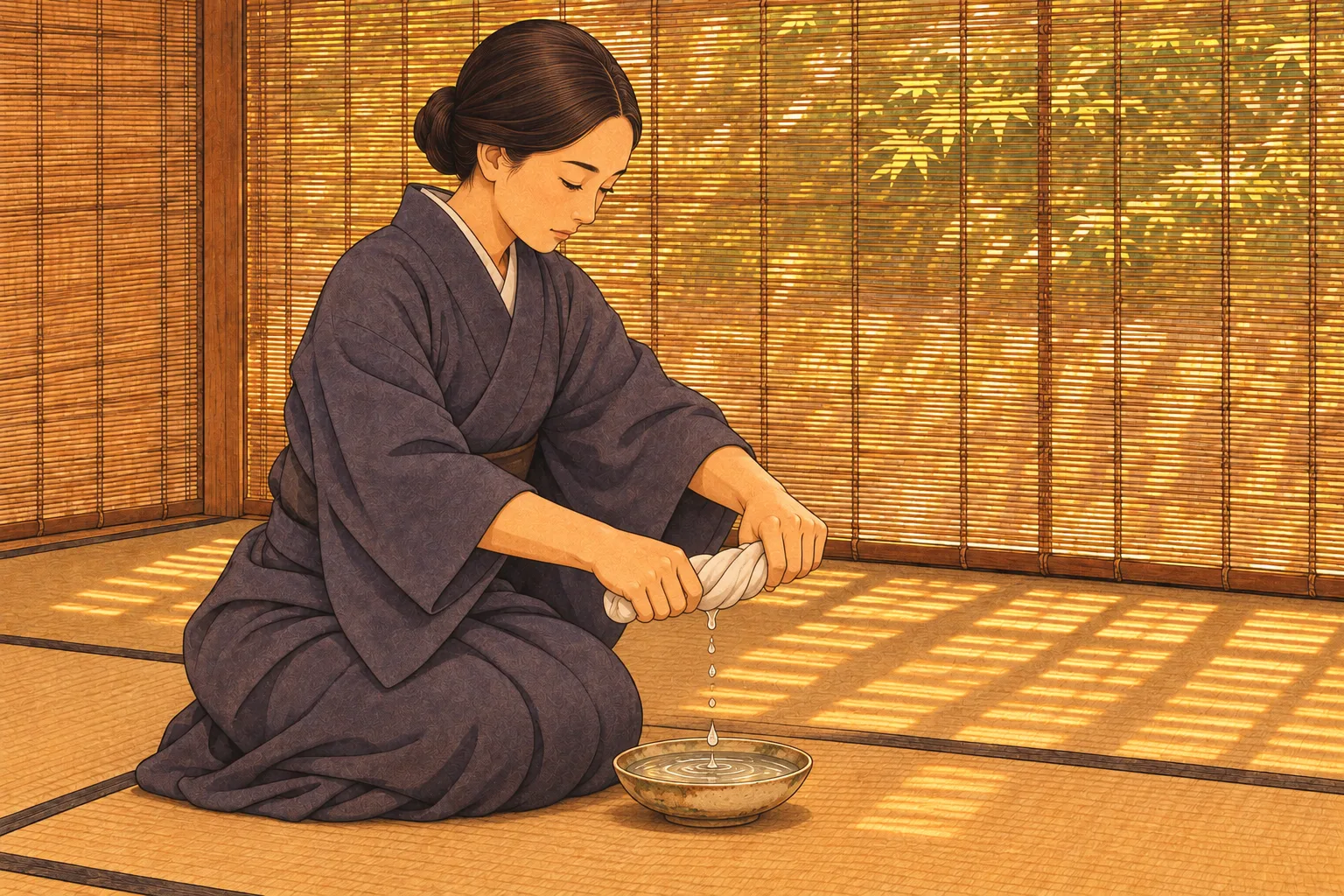
Arai-jakin. The host lifts the linen cloth from a shallow bowl of clean water and wrings it out in front of the guests, the drops falling back into the bowl. Behind her are summer’s reed doors.
Habuta, the "leaf lid", replaces the lid of the water jar with a large leaf, usually from the paper mulberry, kaji, whose leaf is broad and lobed. It is most closely tied to Tanabata, the star festival on July 7, because poems were once written on mulberry leaves for that festival. According to Urasenke, it began when the grand master Gengensai, for a Tanabata gathering, used the black-lacquered inner tube of a basket flower vase as a water jar and covered it with a mulberry leaf. Other jars and other leaves, such as taro, lotus or paulownia, may be used, but not leaves with bitter sap or a smell. The leaf is sprinkled with water so it carries dew. Partway through, the host lifts off the leaf, folds it small, pins it with its own stem, and drops it into the waste-water bowl.
Hira-chawan, the flat bowl, is summer’s standard tea bowl. It can be fifteen centimetres across and only a few deep, so the tea spreads into a wide green pool and cools quickly. The inside is often painted with flowing water, morning glories or herons, which show faintly through the tea.
Glass is another summer coolant. Western cut glass of the Edo period, known as giyaman from a Dutch or Portuguese word for diamond, was prized by tea people, and today glass water jars, lid rests and even cut-glass tea containers appear in summer. A glass jar full of water throws moving light across the mat.
Meisui-date, the "famous water" gathering, celebrates the water itself. The host draws water from a renowned spring or well, such as the Somei well at Nashinoki Shrine, one of Kyoto’s three famous waters. To signal that it is special, the host often ties a straw rope, shimenawa, with white paper streamers around a wooden water jar shaped like a well bucket, the same marker used on sacred objects at a shrine, and sometimes seals the kettle lid with twisted paper. When guests see it, they know to pay attention to the taste of the water.
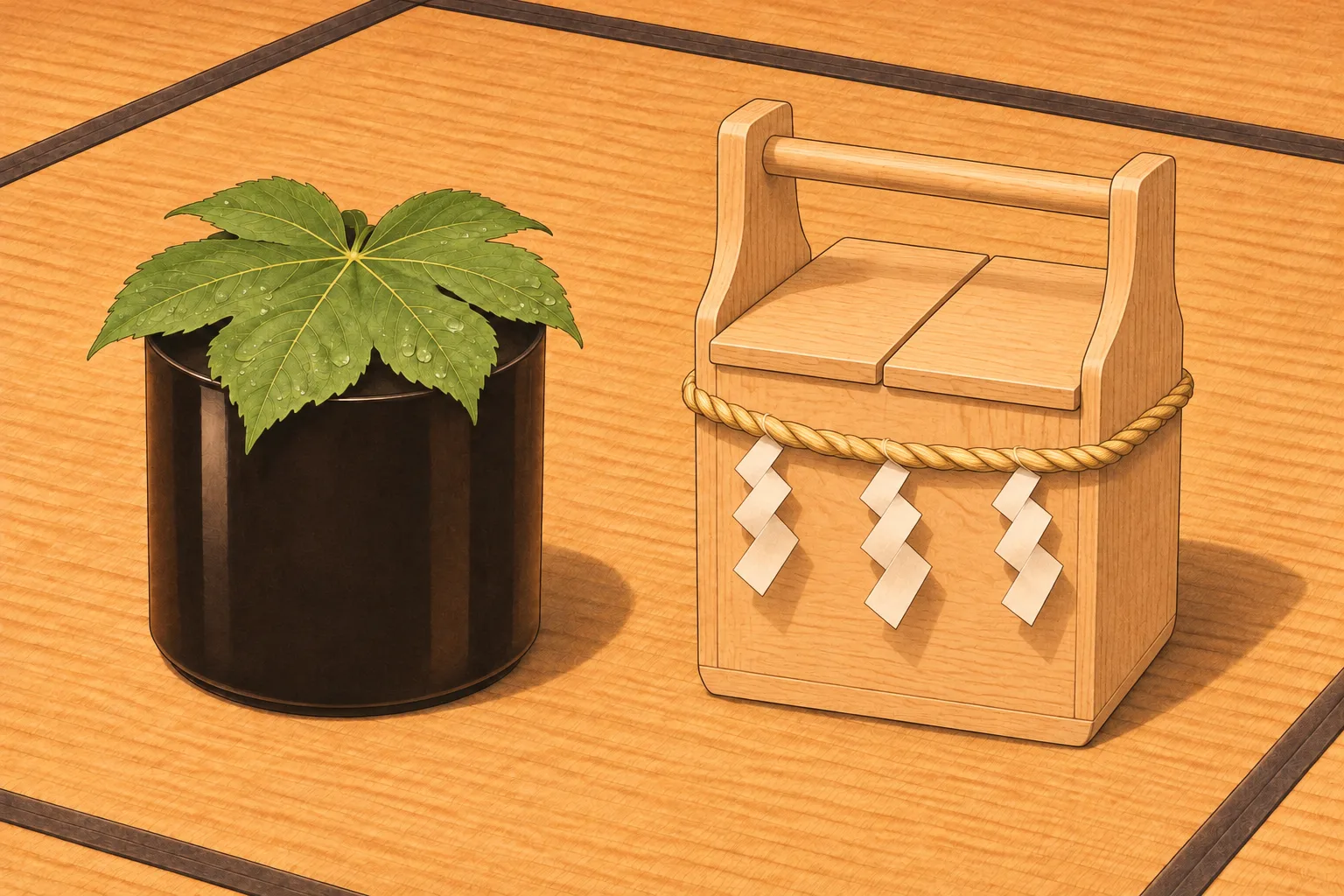
Left: habuta, a black-lacquered cylinder used as a water jar with a dewy mulberry leaf for a lid. Right: the well-bucket water jar of meisui-date, tied with a shimenawa and white paper streamers.
Summer sweets lean translucent: arrowroot-starch dumplings with dark bean paste showing through like a pearl in ice, firm mizu-yōkan bean jelly, served on glass or a fresh bamboo leaf. In Kyoto many classes simply take August off, especially around the Bon holidays.
06September and October: The Centred Brazier and the Season of Remnants
On September 9, the Chrysanthemum Festival, an old custom laid floss silk over chrysanthemums overnight and then wiped the body with the dew-soaked, scented silk the next morning, for long life. Tea sweets copy it as kisewata, "covered with floss": a small chrysanthemum of bean paste topped with a fluff of white threads. The moon-viewing night in mid-autumn brings pampas grass and dumplings.
October is the last month of the brazier, and the mornings are cold. Now the host wants the fire closer again. The solution is nakaoki, "placing in the middle". Instead of standing at the left of the host’s mat with a broad water jar to its right, the brazier moves to the centre of the mat, edging the fire towards the guests. That leaves little room on the left, so a tall, slender water jar stands there. Less cold water on show makes the setting feel a little warmer. The arrangement belongs to October; Omotesenke practice starts it around mid-October, and Urasenke uses it only in rooms of four and a half mats or larger, since a small room leaves too little space.
October is also nagori, a word for the lingering feeling of something about to leave; nagori gatherings run from about mid-October into early November. The tea leaves taken from the storage jar when it was opened last November are nearly gone. The brazier season is ending. Autumn grasses are at their fullest and about to wither.
Nagori gatherings deliberately prefer the worn and imperfect. Hosts bring out rough Iga or Bizen vases and tea bowls with visible repairs. Gold-lacquer repair, kintsugi, is used year-round, but in October it feels most at home. A rarer form, yobitsugi, assembles a bowl from fragments of two or three different bowls, each with its own glaze, joined with gold seams.
The signature object is the yatsure-buro, the "worn" or "broken" brazier: usually an iron brazier, sometimes earthenware, whose rim is deliberately broken away on one side. It is usually explained as imitating an old brazier that has cracked after years of use; later makers produced them broken on purpose. Each school has its own rules for placing the gap. At Urasenke the iron brazier is often bedded with straw ash for an even more rustic look. It belongs to the nagori season.
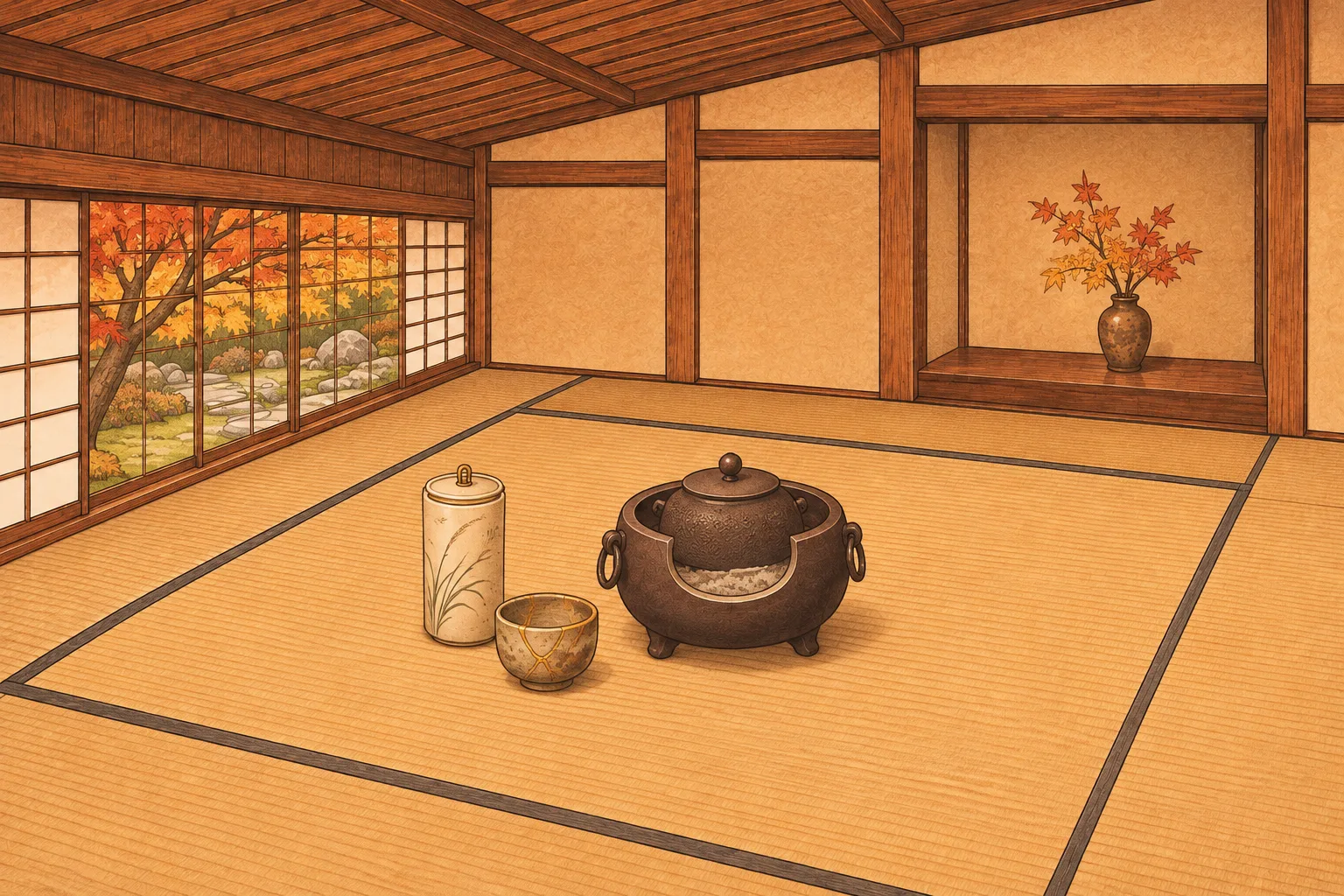
October’s nakaoki. A yatsure-buro with its rim broken away stands in the centre of the mat, a slender water jar to its left and a bowl with gold repair lines in front.
Flowers change too. Usually a tea flower arrangement means one or two stems. At a nagori gathering the vase may hold five, six or more autumn grasses together, some gone to seed, some half bare: pampas grass, burnet, a late chrysanthemum, a reddening twig. Sweets turn to chestnut, kuri-kinton in particular, earthy yellow.
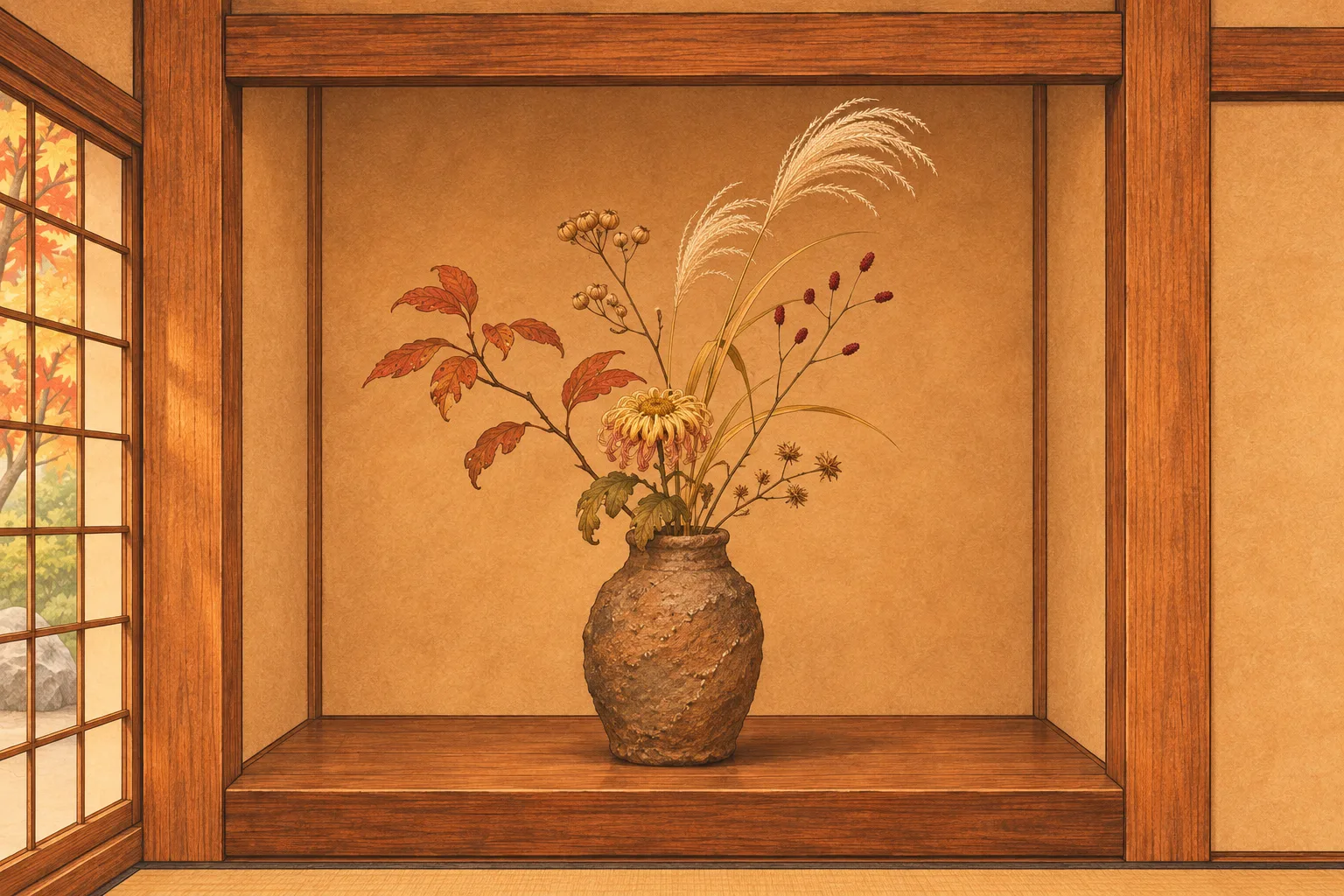
Nagori flowers: a rough ceramic vase holding several autumn plants at once, among them pampas grass, burnet, a late chrysanthemum and a reddening twig, some already gone to seed.
07November to New Year’s Eve: Opening the Hearth
In November the hearth reopens. This is robiraki, "opening the hearth", and many older practitioners call it the tea person’s New Year. Tatami are replaced, the hearth is uncovered and re-lined, paper doors are re-papered, and bamboo lid rests are cut fresh. Everything is clean and new, and the new tea is opened in the same season.
There is a pun attached to the day. Hosts like to use the "three be": Oribe ware, Inbe ware (another name for Bizen), and gourd, fukube. A common set is a new gourd charcoal container, an Inbe ash bowl and an Oribe incense box, though a gourd vase or an Oribe-style sweet can stand in. Its origin is unclear and it rests on the sound, but it has become a fixture, and guests smile when they spot all three.
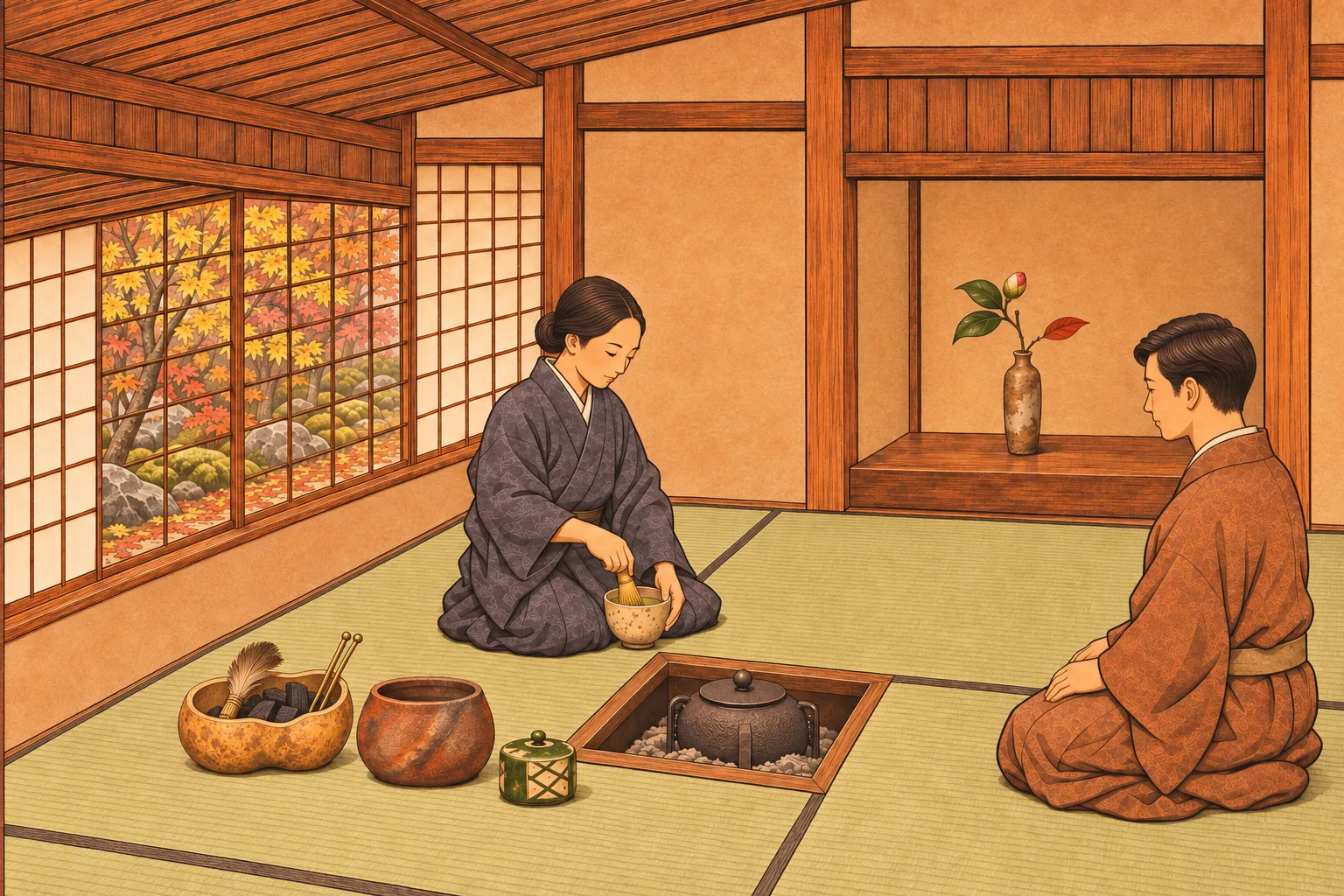
The "three be" at robiraki. Beside the reopened hearth, from left: a gourd charcoal container, an Inbe ash bowl and an Oribe incense box. In the alcove, a camellia bud with one autumn leaf.
The sweet is inoko-mochi, small mochi shaped like a wild boar piglet, the red beans showing through the thin skin like a piglet’s markings, eaten since court times on a boar day of the tenth lunar month to wish for health and many children. In the Edo period it was also the day households set out their kotatsu foot-warmers, and tea people came to open the hearth on a boar day around the start of winter. One explanation is that the boar is the messenger of a fire-protecting deity; a popular saying adds that in five-phase thinking the boar belongs to water and so guards against fire. Rikyū is said to have opened the hearth "when the yuzu turn yellow". Today many groups pick a boar day in November, while others simply choose November 1 or the start of winter on the solar calendar.
The camellia returns, often as a single tight bud with one or two autumn-red leaves, linking the last colour of autumn to the coming winter.
Around the opening of the hearth comes kuchikiri, "cutting the mouth", and the two are often combined: the jar of new tea sealed since early summer is opened, and the first leaves are ground into matcha. At the gathering, the host brings the tied jar before the guests, slits the paper seal with a small knife, removes the small paper packets of thick-tea leaf, and sends them to be ground. The guests drink the first new matcha of the year.
December has the year’s longest nights, and that invites yobanashi, "night conversation", one of the formal tea events, held at dusk from about the winter solstice until the start of spring in early February. Stone lanterns and hand lanterns light the garden path. Host and guests exchange small hand-held candlesticks at the middle gate as a greeting. Inside, the only light comes from low oil lamps and candles, so the scroll must be read by bringing a light close to it, and shadows move on the earthen walls.
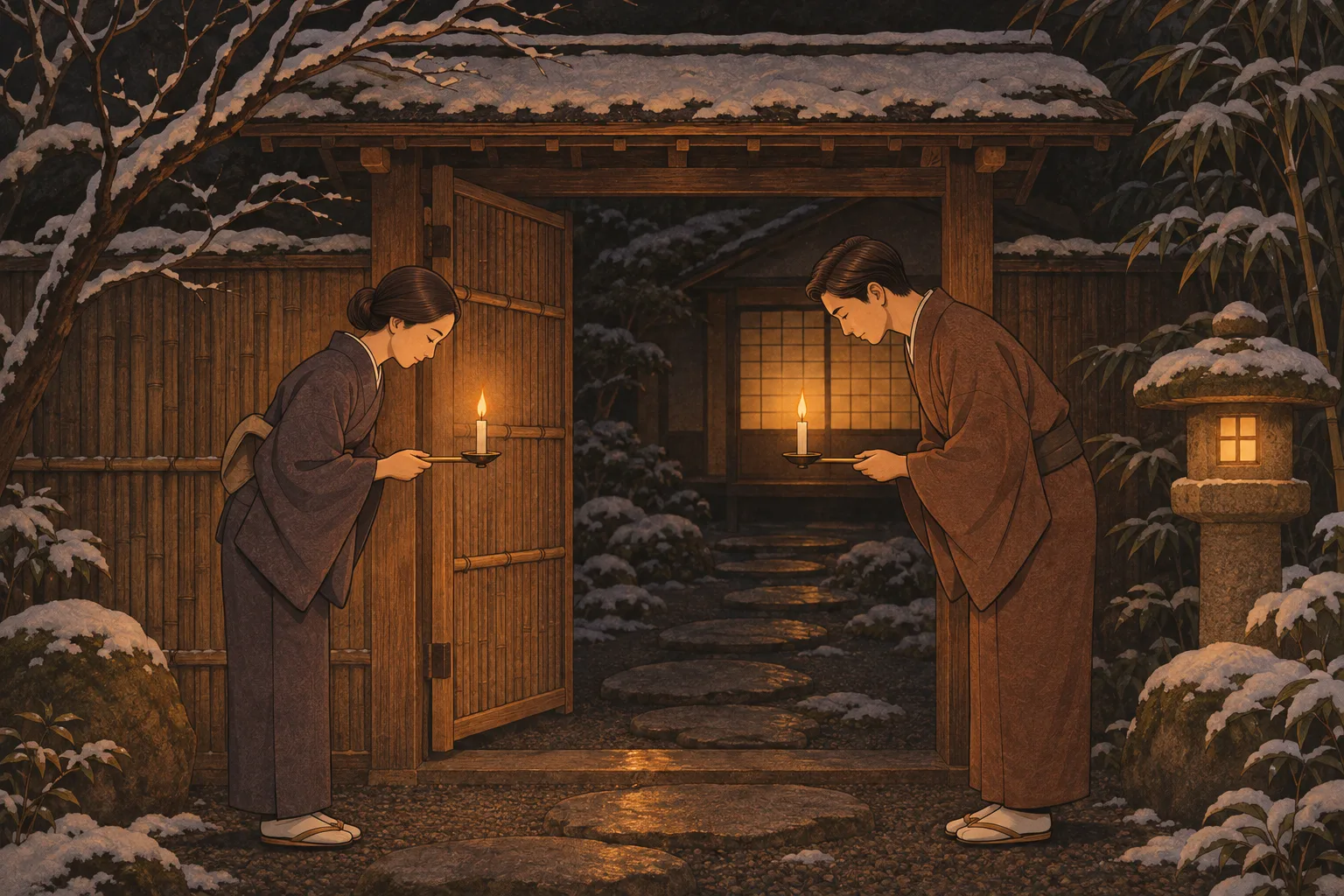
Yobanashi. On a winter night, host and principal guest meet at the middle gate, each holding a small candlestick, with a stone lantern lit beside the path.
Some hosts end the year with joya-gama, the "New Year’s Eve kettle", the last bowl of tea of the year on December 31; at the Urasenke headquarters, the Ryūseiken room is the one used for it. At the head house of the Enshū school, for example, the charcoal is afterwards banked under ash so the fire survives the night, and on New Year’s morning it is used to set the kettle again. The fire of the old year carries into the new one, and a few days later comes hatsugama. The circle closes.
08Side by Side: One Corner, Four Seasons
The easiest way to see the system is to stand in one tea room and look only at the host’s corner across four months.
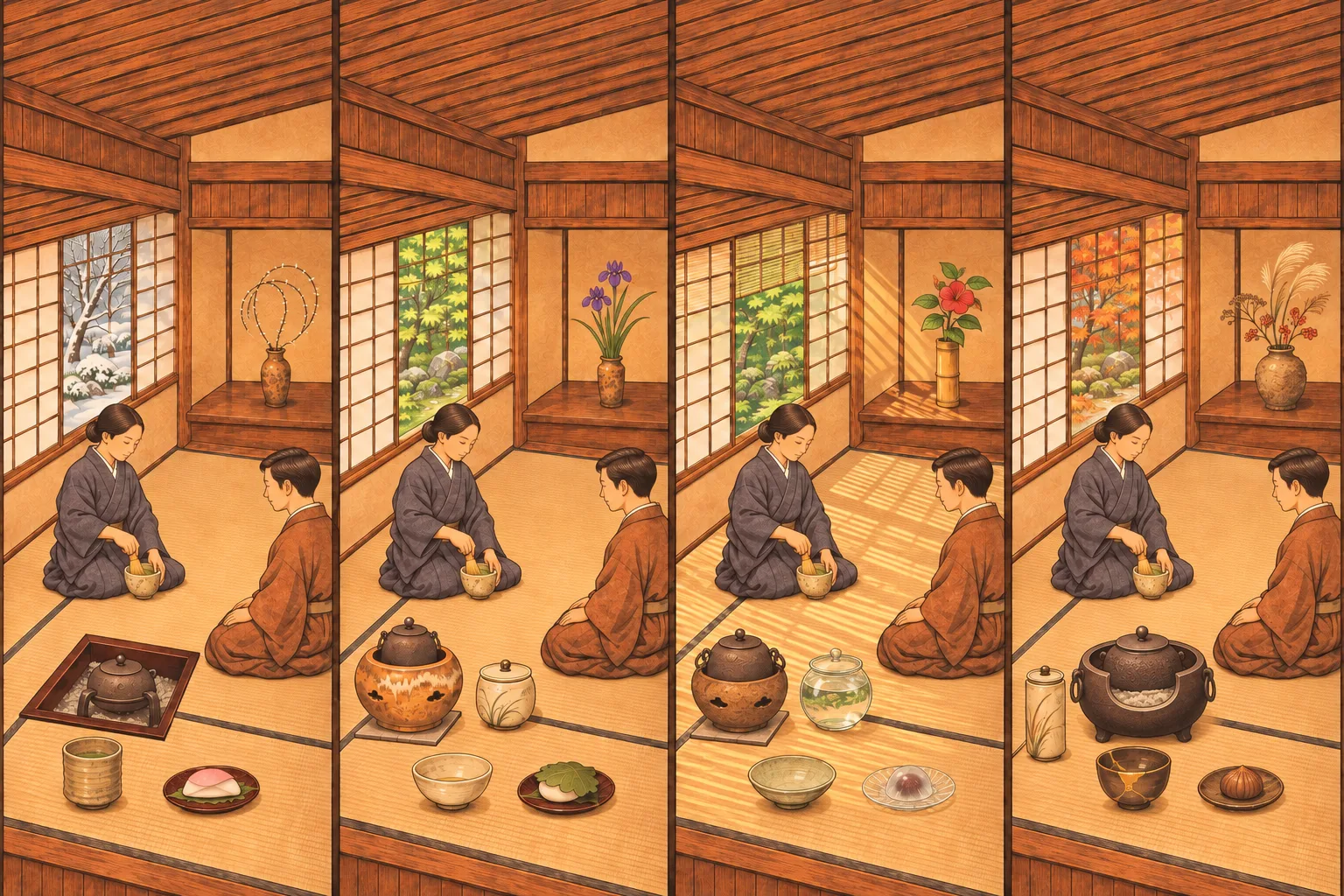
One corner in four months, from left. January: sunken hearth, cylinder bowl, knotted willow, petal mochi. May: earthenware brazier on the left, pale bowl, purple iris, rice cake in an oak leaf. August: striped light from reed doors, glass water jar, flat bowl, rose of Sharon, arrowroot dumpling. October: broken-rimmed brazier in the centre, slender water jar, gold-mended bowl, autumn grasses, chestnut sweet.
January: the sunken hearth glows in the floor, the kettle on its trivet, perhaps a gold-decorated lacquer rim. Beside the host is a tall cylinder bowl, or the gold-and-silver stacked pair. A long knotted willow loops down in the alcove. The sweet is a pink-tinged half-moon of petal mochi.
May: the hearth is gone and the floor is flat. An earthenware brazier stands towards the left of the host’s mat. The bowl is a moderate, open shape in a pale glaze. Purple irises stand in the vase, and the sweet is rice cake in an oak leaf.
August: reed doors stripe the light. The brazier is still on the left, but the water jar beside it is glass, or wears a mulberry leaf for a lid. The bowl is a wide flat dish with water painted inside. A basket holds a single rose of Sharon. The sweet is a translucent arrowroot dumpling.
October: the brazier has moved to the centre, its rim broken away on one side, a slender water jar beside it. The bowl carries gold repair lines. A rough ceramic vase overflows with half-dry grasses. The sweet is chestnut, the colour of soil.
Read across the four, and the threads appear. The fire goes from the floor, to the left, to the middle, and back into the floor. The bowl goes from deep, to moderate, to flat, to mended. The flowers go from a single willow to a single iris to a single day-flower to a crowd of fading grasses. The sweets go from white and pink, to green, to clear, to brown.
A few pairs are easy to confuse. The two late-spring kettles differ in how they are held: the flanged kettle presses down onto wooden bars on the hearth rim, while the hanging kettle is lifted from above on a chain. The October centred brazier differs from the ordinary layout by position and by the water jar: ordinary means brazier left and wide jar right; centred means brazier in the middle and slender jar to its left. And the summer flat bowl is easy to tell from an ordinary bowl by its proportions alone: it is much wider than it is deep.
Behind all of it is a plain idea. The host’s job is to make these particular guests comfortable on this particular day, and to make them feel when and where they are. A combination of utensils, flowers and sweets suits only one month of the year, and next year the weather and the choice of objects will be different again. Changing the hearth, the bowl, the flower and the sweet through the year is how a tea room tells its guests what season it is.
More deep dives on this topic
 ChawanAt the end of a tea ceremony, after the last sip, guests do something that puzzles first-time visitors.
 Tea UtensilsMost of what sits on a tea-room mat is small enough to hold in one hand.
 The Tea RoomA small Japanese tea room can look almost artless: a box of earth walls and straw mats, a few odd little windows, a recess with a single scroll.
 The AlcoveWhen guests enter a tea room, they do not sit down straight away.
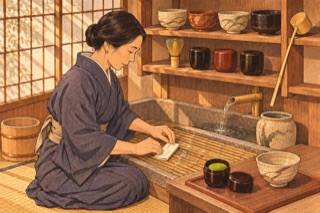 TemaeSit as a guest in a Japanese tea room and you will watch someone spend a quarter of an hour on a task that takes a minute in a kitchen, and it is natural to wonder what all the…
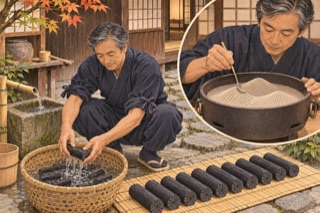 The ChajiMost visitors to Japan meet the tea ceremony as a bowl of whisked matcha and a sweet, served in a temple garden or a tea school in Kyoto, over in fifteen minutes.
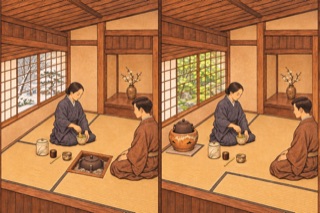 The Tea YearWalk into the same tea room in January and in August and you might think you had come to two different houses.
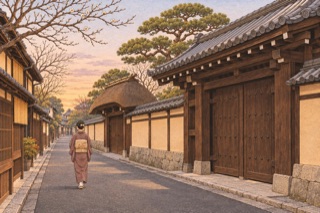 Schools of TeaWalk north up Ogawa-dōri in Kyoto, a narrow street lined with old townhouses, and you pass two quiet gates a few dozen metres apart.
- Back to the main article: The Way of Tea (Chanoyu) →