
Most of what sits on a tea-room mat is small enough to hold in one hand. A tea caddy might be eight centimetres tall; a tea scoop is a sliver of bamboo shorter than a pencil. Yet in the sixteenth century a single caddy could be handed to a general in place of a province, and a scoop could be kept in a shrine-like case and bowed to as if it were its maker. This guide walks through the utensils you will see at a Japanese tea gathering, from the caddies and lacquer containers that hold the tea to the iron kettle humming over the fire, and explains how to tell them apart, where they came from, and what their shapes are meant to say. Tea bowls have their own page and appear here only in passing.
01Why So Many Things?
Strictly speaking, a bowl of whisked green tea needs four things: powdered tea, hot water, a bowl, and something to stir with. Chanoyu, the Japanese way of tea, divides those needs among more than a dozen objects. The tea needs a container and a dedicated scoop. The water needs a kettle, the kettle needs a fire, and the fire needs a brazier or a sunken hearth. Fresh water needs a jar, used water needs a waste bowl, and the kettle lid and ladle need somewhere to rest. Each object answers one movement in the host’s procedure, called temae. The host carries them in, sets them down in fixed positions, uses them and carries them out again, and the guests watch the objects as much as the person.
The earliest tea utensils in Japan were Chinese. From the thirteenth to the fifteenth century, Zen monks and merchants brought back celadon, glossy brown-black tenmoku bowls, bronze vessels and lacquer from Song and Yuan China. The Ashikaga shoguns assembled a famous collection of these imports, known as karamono, "Chinese things". Over the late fifteenth and sixteenth centuries, tea masters from Murata Jukō to Takeno Jōō to Sen no Rikyū shrank the tea room and began using local stoneware, bamboo, plain wood and even repurposed household objects. A modern tea gathering still blends both lines: imported-style bronze and lacquer for formal occasions, bamboo and rough local pottery for intimate ones.
That blend is organised by a three-step scale borrowed from calligraphy: shin (formal), gyō (semi-formal) and sō (informal, "grass-style"). A scoop with no node is shin; one with a node in the middle is sō. Among caddies, a Chinese piece is usually counted as formal, a Seto piece as semi-formal and one from a provincial kiln as informal. Hosts choose a set whose pieces sit comfortably together on this scale, then season it to the month, the guests and the theme. After a gathering, the list of utensils with their makers and poetic names is often written up as a kaiki, a record that experienced guests read the way diners read a tasting menu.
Fine utensils travel in paulownia-wood boxes. The lid is often inscribed by the maker or by the head of a tea school, giving the object’s name and confirming who made or approved it. These box inscriptions, layered over generations, are a large part of an object’s value. Museums with strong tea collections, such as the Seikadō Bunko, the Tokugawa Art Museum, the Gotoh Museum and the Nezu Museum, are good places to see utensils up close.
02The Chaire: A Ceramic Caddy for Thick Tea
The chaire is a small ceramic jar for the powdered tea used in koicha, thick tea, the more formal and concentrated of the two styles of preparation. Most stand between six and ten centimetres tall. The lid is a disc of ivory, its underside lined with gold leaf. The jar itself is dressed in a fitted silk bag called a shifuku. At a gathering it always enters wearing that bag; the host unties the cord, slips the jar out, and after the thick tea has been served the guests usually ask to examine it, together with its bag and the tea scoop.
Caddies are sorted by silhouette, and the names are pictures. The katatsuki, "shouldered", has a shoulder that juts out flat before dropping straight down, like a person standing very upright; it is the most common and the most formal-looking shape. The bunrin is round with a small mouth; the name is a literary word for an apple, which is exactly what it resembles. The nasu, "eggplant", is narrow above and heavy below, its weight sagging toward the base. The taikai, "great sea", is wide-mouthed, low and noticeably larger than the rest. The marutsubo, "round jar", is a squat sphere with a short neck. Other shapes include the shiribukura, with a swollen lower belly, the long-necked tsurukubi, "crane neck", and the gourd-shaped hyōtan. A quick test: look for a shoulder first. If there is a flat shoulder, it is a katatsuki. If not, check the mouth: small means bunrin or marutsubo, wide means taikai. If the weight sits low, it is an eggplant.
Caddies are also divided by origin. Karamono caddies are small jars made in southern China in the Song and Yuan periods. They were probably ordinary containers for spices, medicine or oil, chosen in Japan for a new purpose. Their walls are thin, their glazes run from deep brown to persimmon, and the glaze often pools and drips down from the shoulder. Tea people call those runs keshiki, "scenery", and the most striking one marks the front of the jar. The base is usually left unglazed and shows the spiral mark left when the pot was cut from the wheel with a thread.
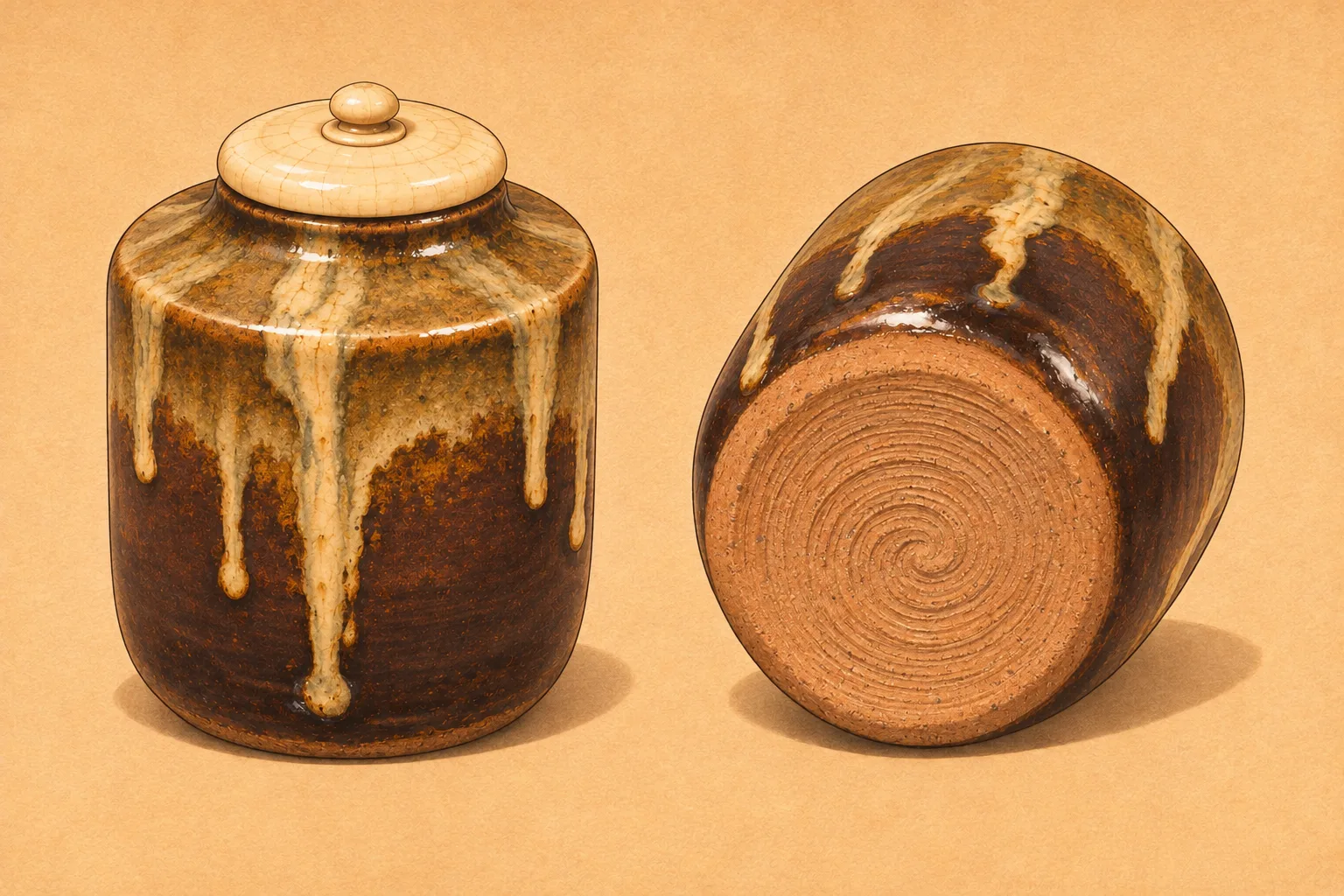
A karamono katatsuki caddy. Left: the glaze runs from the shoulder that tea people call keshiki. Right: the unglazed base, with the spiral left when the pot was cut from the wheel with a thread.
Japanese-made caddies, wamono, are led by those from Seto in present-day Aichi. Tradition credits a potter called Katō Shirozaemon Kagemasa, known as Tōshirō, with travelling to Song China in the thirteenth century, possibly with the monk Dōgen, and returning to make Chinese-style caddies at Seto. The story is late and doubtful in its details, but it shows that Seto caddies were seen from the start as heirs to the Chinese ones. From the late sixteenth century, kilns in Tamba, Bizen, Shigaraki, Takatori and Satsuma also made caddies, often freer in shape and glaze. In the early seventeenth century the tea master Kobori Enshū selected and named a group of mostly Japanese caddies now called chūkō meibutsu, "revival masterpieces", ranked alongside the older ō-meibutsu (great masterpieces chosen before Rikyū) and meibutsu (those of Rikyū’s day).
The silk bag matters almost as much as the jar. Shifuku are often sewn from meibutsu-gire, "famous fabrics": silks imported from China, India and Southeast Asia between the fourteenth and seventeenth centuries and treasured by tea collectors. They include gold-brocade kinran, glossy satin damasks, and striped cloths called kantō. Many carry names: one damask shows carp leaping from rough waves; a striped fabric is traditionally linked to the Kyoto courtesan Yoshino. A celebrated caddy may own several bags, swapped according to occasion.
The prestige of caddies peaked in the age of Oda Nobunaga. Nobunaga gathered famous tea objects from merchants and temples and gave them to retainers as rewards in place of land; contemporaries and later writers liked to say a single caddy could be worth a province. The best known is Tsukumo Nasu, an eggplant-shaped Chinese caddy. According to tradition it belonged to the shogun Ashikaga Yoshimitsu, then to Murata Jukō, who is said to have paid ninety-nine kan of coin for it; another explanation links the name to a poem about white hair in the Tales of Ise. It later passed to the warlord Matsunaga Hisahide, who presented it to Nobunaga. It is said to have been damaged in the fire at Honnōji in 1582 and again when Osaka Castle burned in 1615, and to have been restored by lacquer craftsmen. Today it is in the Seikadō Bunko Art Museum. The chain of owners comes from tea writings and family records that do not always agree, but the repairs are real.
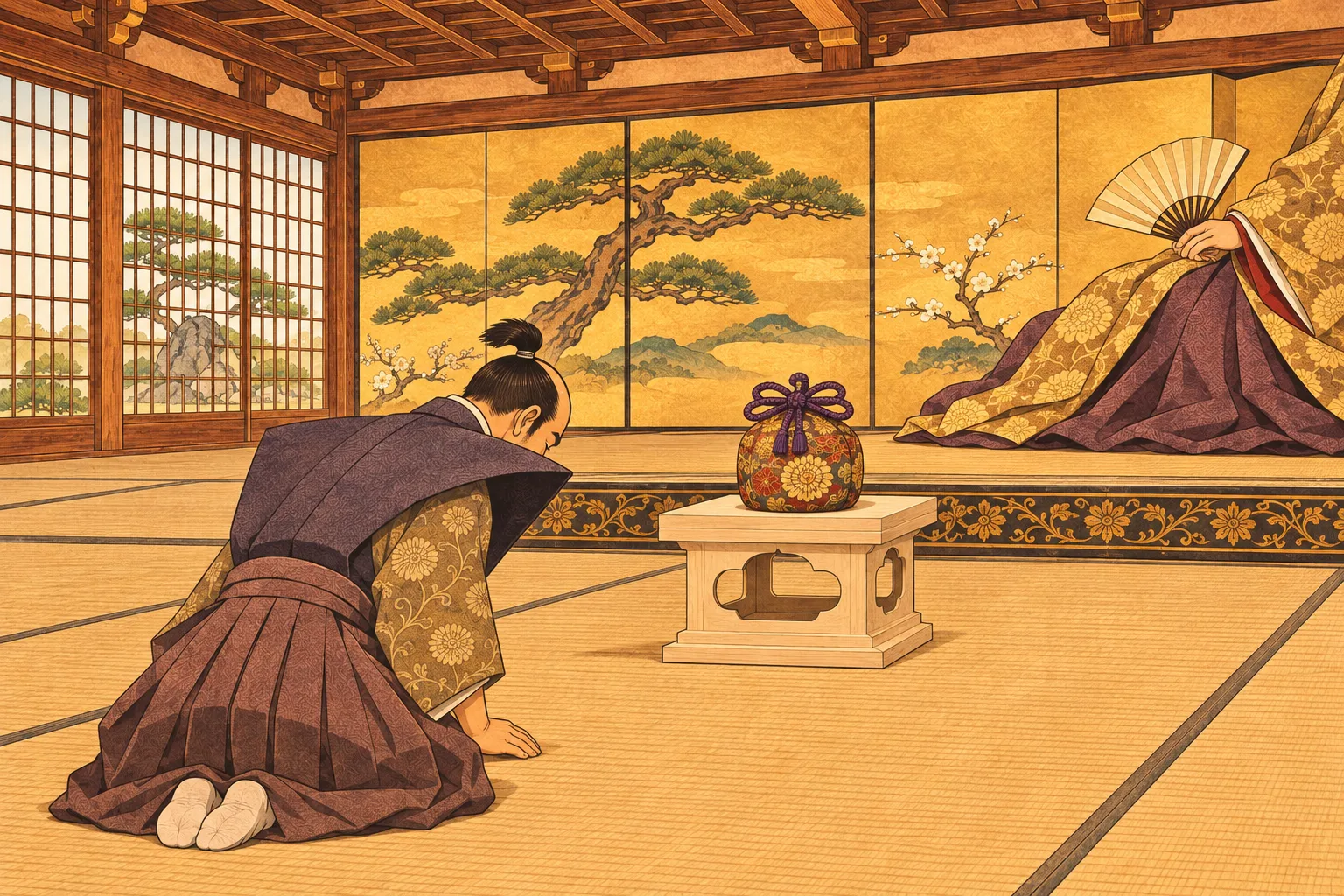
A sixteenth-century retainer bows before a famous caddy in its silk bag, set on a plain wooden stand: a reward given in place of land (artist’s impression).
Another is Hatsuhana Katatsuki, "First Blossom", one of the so-called three great shouldered caddies with Nitta and Narashiba. By tradition it went from Nobunaga to his heir Nobutada, left the family after Honnōji, and reached Tokugawa Ieyasu, who gave it to Toyotomi Hideyoshi to congratulate him after the battle of Shizugatake in 1583. After Hideyoshi’s death it passed to Ukita Hideie and, after the battle of Sekigahara, back to Ieyasu. It is now an Important Cultural Property held by the Tokugawa Kinen Zaidan, the foundation of the main Tokugawa line. Narashiba is said to have been lost in the great Meireki fire of Edo in 1657. Whether or not every step is accurate, these stories explain why a modest brown jar can make visitors fall silent: it carries centuries of owners.
03The Natsume: Lacquer for Thin Tea
For usucha, the lighter, frothier "thin tea", the powder is held in a lacquered wooden container. The commonest is the natsume, named after the jujube fruit it resembles. The rule of thumb at almost every gathering is simple: ceramic chaire for thick tea, lacquer natsume for thin tea. Thin-tea containers as a group are called usuchaki, and they also include the cylindrical nakatsugi, whose lid seam runs around the middle, and various bamboo and plain-wood shapes.
The standard natsume is the Rikyū-gata, the Rikyū model, whose proportions are traditionally credited to Sen no Rikyū and to lacquerers of his circle such as Seiami. It comes in three sizes. The chū-natsume, medium, is the workhorse: roughly seven centimetres high and wide, with the lid seam high up, a gently domed top, and rounded shoulders that curve in toward the seam. The ō-natsume, large, is a size up and used when more tea is needed or a fuller look is wanted. The ko-natsume, small, appears in compact procedures such as those using a portable tea box. Set side by side, the three look like the same container photographed at different distances.
Beyond the standard there are many variants, most of them designs favoured by later heads of the tea schools. The hira-natsume is flat, much wider than it is tall, and has a cool, light look suited to summer. The fubuki, "snowstorm", has both the top and bottom edges bevelled so that it is nearly symmetrical; you cannot easily tell lid from body, just as you cannot tell up from down in a blizzard. The shiribari flares outward at the base, sitting low and stable. There are also tall, slim versions and faceted ones.
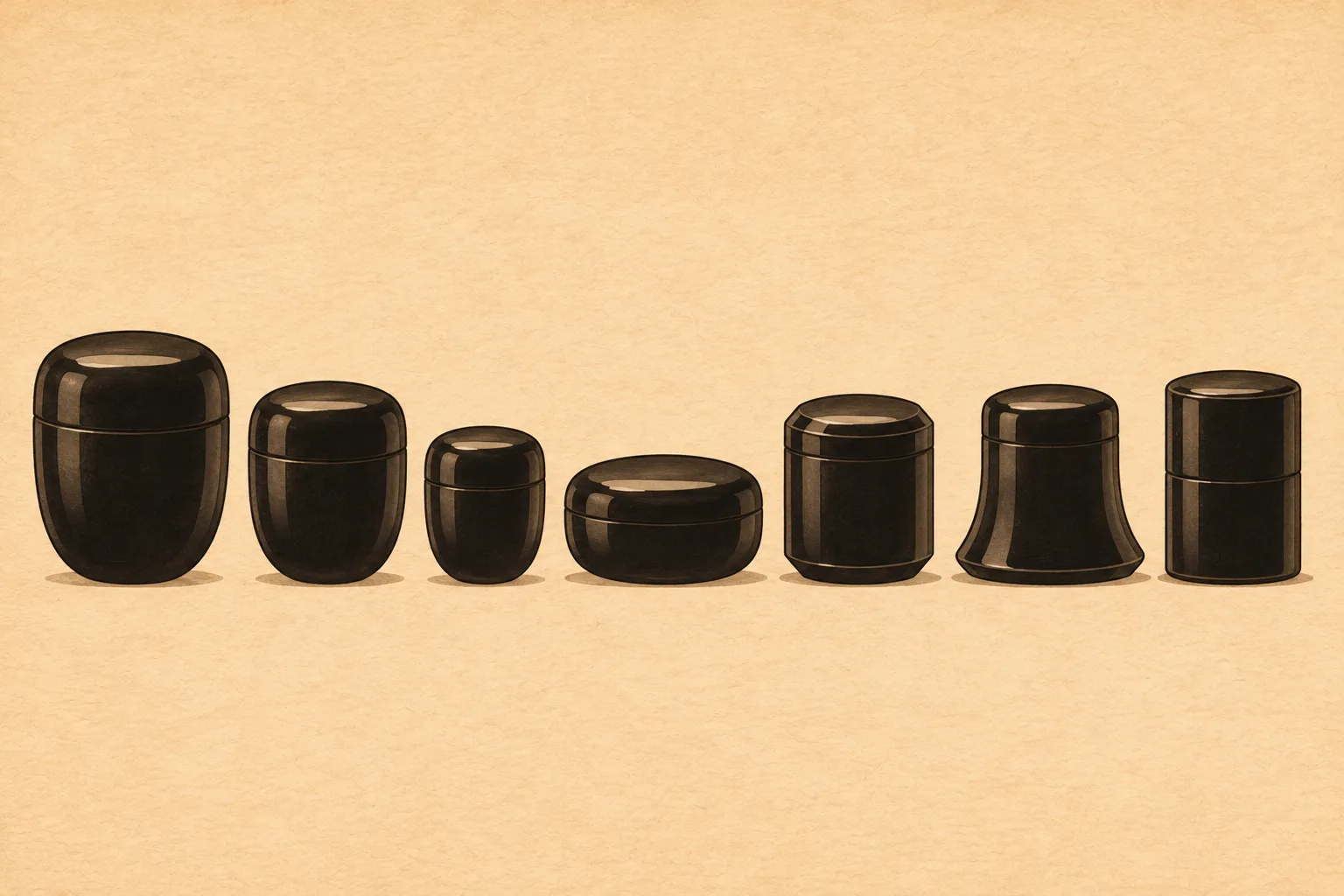
Seven thin-tea containers, from left: large, medium and small Rikyū-gata natsume, hira-natsume, fubuki, shiribari and nakatsugi. Compare the proportions and where the lid seam falls.
Lacquer finish tells you the level of formality and often the season. The basic natsume is plain black lacquer with no decoration: dignified, neutral and right for any month. Maki-e natsume carry designs in sprinkled gold or silver powder, usually seasonal: cherry blossom in spring, flowing water and fireflies in summer, autumn grasses and the moon, snow-laden pine. The Kōdaiji style of the late sixteenth century, with flat gold autumn grasses spread across black lacquer, remains a favourite model. Other finishes include red lacquer, translucent tame-nuri that lets a red undercoat glow through, and ikkanbari, lacquer over a paper core.
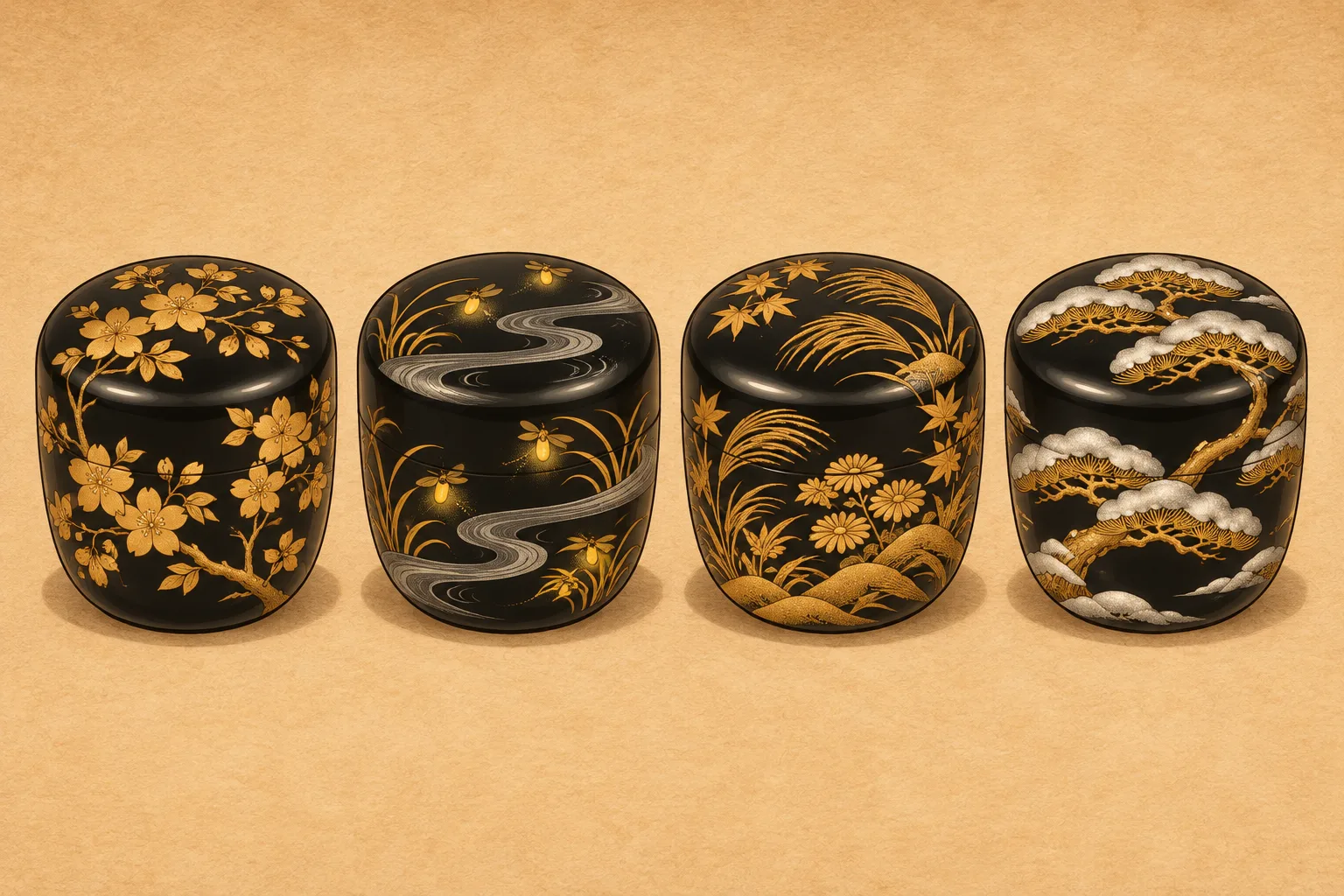
Four maki-e natsume, from left: cherry blossom for spring, flowing water and fireflies for summer, autumn grasses, and snow-laden pine. The design runs over the lid as well as the body.
Watch a host handle one and you see how much attention it gets. The lid is wiped with a silk cloth along a fixed path, the container is opened, and tea is lifted out with the scoop. Inside, the powder is often shaped into a small mound, sometimes with a faint line drawn across it. After thin tea, guests may ask to see the container and scoop. They lift the natsume with both hands, look at the top, the decoration on the side and any mark underneath, then return it.
04The Chashaku: A Strip of Bamboo with a Name
The chashaku is the scoop that lifts tea from caddy to bowl. It is about eighteen centimetres long and less than a centimetre wide. The tip, the kaisaki, is bent into a shallow scoop; the other end, the kiridome, is cut square. It is the simplest object on the mat and often the most personal, because many scoops are carved by tea masters themselves.
The first scoops came from China with the tea and were made of ivory or metal, shaped like medicine spoons. Japanese tea people turned to bamboo in the fifteenth and sixteenth centuries, and by Rikyū’s time bamboo had become standard. Ivory scoops still appear in the most formal procedures; nearly every other gathering uses bamboo.
Bamboo scoops are classed by where the node falls. A scoop with no node, fushinashi, is the most formal. One with the node near the end, called tomebushi or motobushi, comes next. One with the node in the middle, nakabushi, is the most informal and the most common in the rustic style of tea; it is traditionally associated with Rikyū. The raised ridge of the node, the slight colour change in the skin on either side, the freckles in the bamboo and the curve of the carving together give each scoop its character.
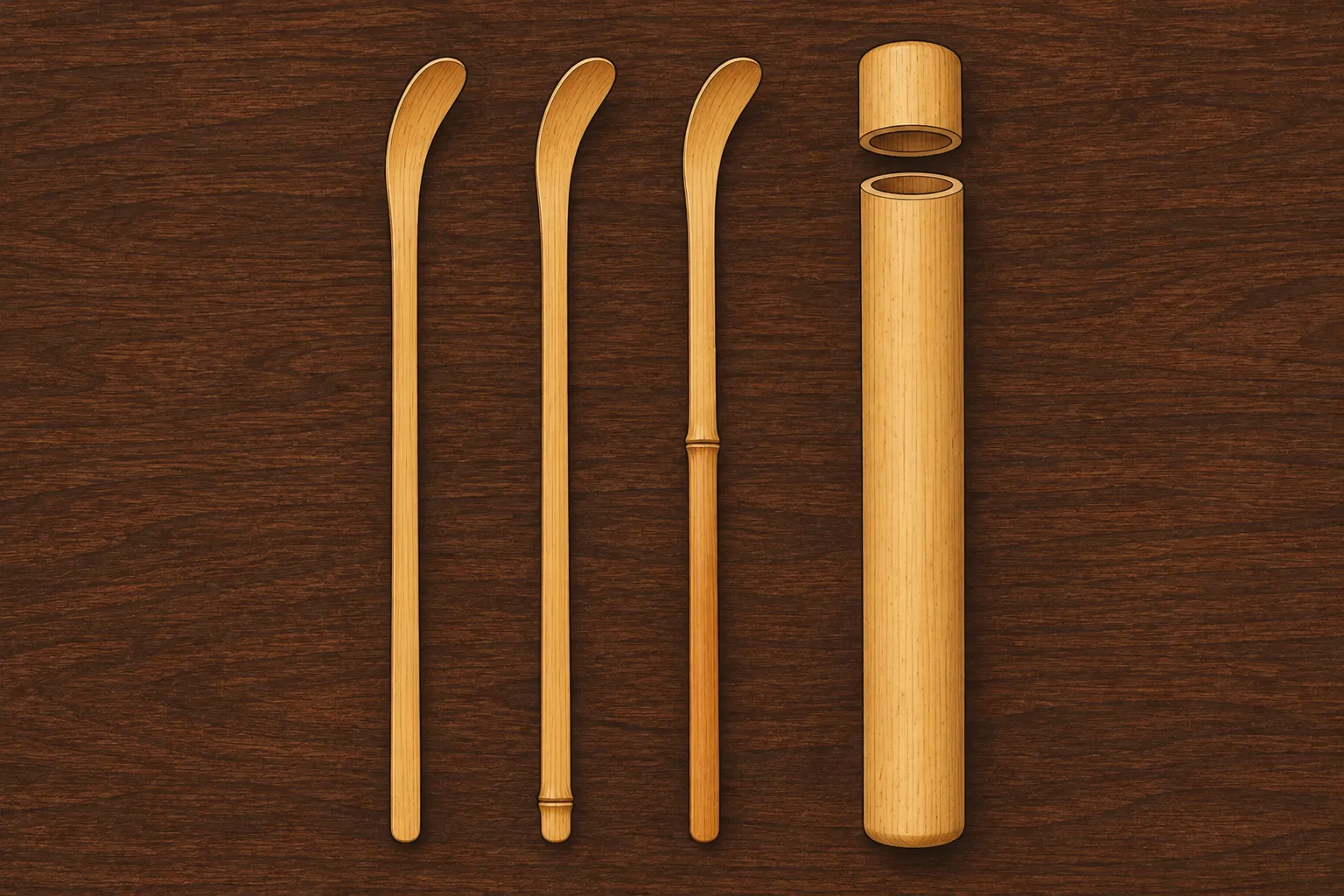
Three bamboo chashaku, from left: fushinashi with no node, tomebushi with the node near the end, and nakabushi with the node in the middle. On the right, the bamboo tube and its cap.
What lifts a scoop above its material is its name and its tube. A good scoop is kept in a bamboo case, the tsutsu, inscribed with a poetic name, the mei. A case made by the carver of the scoop is a tomozutsu, "companion tube", and is the most prized; one added later by someone else is an oizutsu. Names come from seasons, poems, Zen phrases and stories: "First Frost", "Fallen Leaves", "Old Pine". At a gathering, a guest will often ask the name of the scoop, and the one-word answer quietly states the theme of the whole occasion.
The most famous scoop, Rikyū’s Namida, "Tears", with the windowed tube his disciple Furuta Oribe made for it, is told in the main tea article. What is worth adding is how the tube looks: lacquered black, with a small rectangular opening through which a section of the scoop is visible, shaped much like the case for a memorial tablet. Set beside an ordinary plain bamboo tube with a name brushed on it, it is plainly made for veneration rather than storage, which shows how far a strip of bamboo could come to stand for a person.
The heads of the tea schools still carve scoops every year, name them and make cases for them, and students treasure them. Beginners in tea classes use plain, mass-produced scoops without names. When examining any scoop, guests rest it lightly across their fingers and avoid touching the tip.
05The Chasen: A Whisk Split from One Piece of Bamboo
The chasen is the whisk that turns powder and hot water into tea. It is cut from a single section of bamboo: the lower part stays a tube and serves as the handle, while the upper part is split into dozens of fine tines. The outer tines curl outward and the inner ones gather toward the centre, held apart by a thread woven around their base. For thin tea the host whisks briskly back and forth to raise a fine foam; for thick tea the whisk moves slowly, kneading the tea into a glossy paste.
Whisks are described by the number of tines, with common types such as 80, 100 and 120. More tines mean finer, denser bristles that foam thin tea easily. Coarser whisks with fewer, sturdier tines suit the heavy body of thick tea. There are also small whisks for outdoor tea and portable sets. Whisks wear out as tines snap and bend, and some temples and tea groups hold chasen kuyō, memorial services where used whisks are burned with thanks.
The colour of the bamboo is the quickest clue to a whisk’s type. Shiradake, "white bamboo", split from henon bamboo, is pale straw-coloured and the most widely used. Susudake, "soot bamboo", comes from the rafters of old farmhouses where it was smoked for decades, sometimes more than a century, over an open hearth; it is dark brown and mottled, and scarce. Kurotake, black bamboo, has naturally dark skin, cooler and more even in tone than soot bamboo.
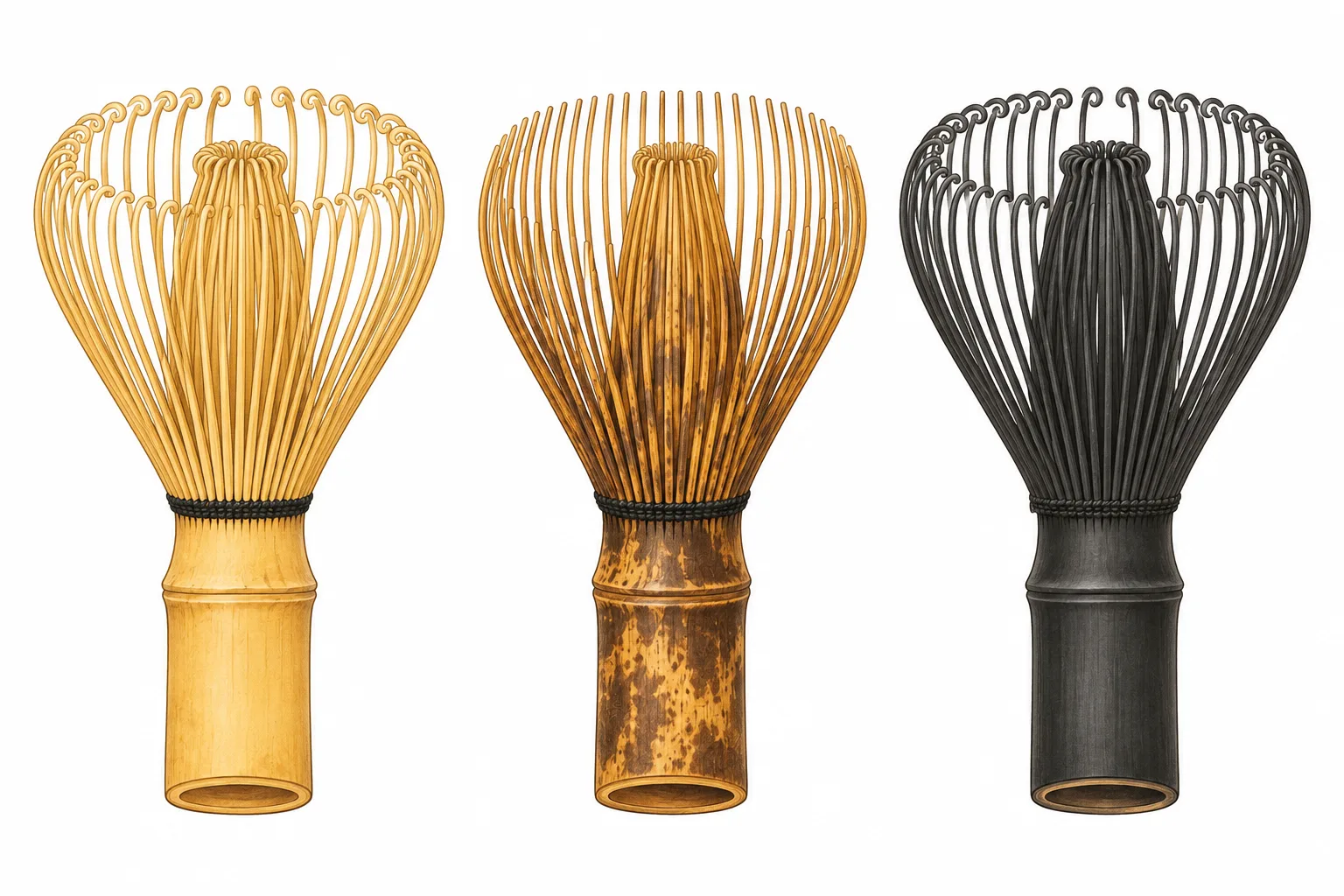
Whisks in three bamboos, from left: pale shiradake, mottled brown susudake and even-toned kurotake. The tips of the outer two curl inward; the middle one is left straight.
Bamboo type follows the tea school. The usual summary is that the Urasenke school uses white bamboo, Omotesenke uses soot bamboo, and Mushanokōjisenke uses black bamboo. The shape differs too: some schools curl the tips of the tines inward into a neat ring, others leave them straight. At a tea experience for visitors you will almost always see a pale whisk; a dark brown one hints at an Omotesenke host. Each school has finer rules about which whisk suits which procedure.
Almost all Japanese whisks come from Takayama in Ikoma, Nara Prefecture. Tradition says a member of the local lord’s family made the first whisk there in the fifteenth century at the request of Murata Jukō, and the craft passed down as a family secret. Takayama remains the centre of production, with each workshop’s whisks recognisable to tea people by their curve and feel.
06Kettle, Brazier and Hearth: Fire and Sound
The kama, or kettle, is the largest metal object in the room: cast iron, heavy, and already simmering when guests enter. Its sound is called matsukaze, "wind in the pines", a low hiss that rises and falls. Some kettles have small pieces of iron fixed inside to make the sound clearer. On either side are lugs called kantsuki, through which iron rings are passed to lift the kettle; they are often cast as demon masks, lion heads or pine cones, and they are one of the details to look for.
Kettles fall into three main traditions. Ashiya kettles were made at Ashiya in Chikuzen, in present-day Fukuoka, and flourished in the fourteenth to sixteenth centuries. Their surface is smooth and fine-grained, likened to catfish skin, and often cast with delicate scenes of pine beaches, landscapes or birds and flowers; most are of the classic shinnari shape. Tenmyō kettles came from Tenmyō in Sano, present-day Tochigi. Their surface is rough and usually plain, heavy and rustic, matching the taste of wabi tea. Tea people pair them as "Ashiya in the west, Tenmyō in the east". Ashiya production ended in the early Edo period, but the reputation never faded: of the nine tea kettles designated Important Cultural Properties, eight are Ashiya kettles. The town of Ashiya opened a workshop in 1995 to revive the craft.
Kyōgama, Kyoto kettles, rose in the late sixteenth century around the Sanjō foundry quarter as tea’s centre of gravity moved to the capital. Kyoto founders made kettles to order for tea masters, and their range of shapes became the mainstream. The best known early maker is Tsuji Yojirō, who is said to have worked for Rikyū. The Ōnishi family of kettle makers, one of the ten craft families that serve the Sen schools, continues this line.
Shapes have their own names. The shinnari, "true form", is the classical kettle: a raised collar around the mouth and a flange, the hane, running around the waist like a hat brim. On many old kettles the flange has been cut away after long use, a state called haochi. The amidadō kettle is full and round with broad shoulders and is often attributed to Tsuji Yojirō; tradition links its name to Rikyū and a hall of Amida at the hot springs of Arima, though the story’s source is unclear. The fuji-gata narrows toward the top like Mount Fuji. Others include straight-sided cylinders, the ubaguchi or "old woman’s mouth" with a sunken rim, the arare covered in small raised dots, and the odare with a ragged lower edge. Matsunaga Hisahide is said to have destroyed himself together with his treasured flat kettle Hiragumo, "flat spider", in 1577 rather than surrender it to Nobunaga; the tale is famous, but its details come from later writings.
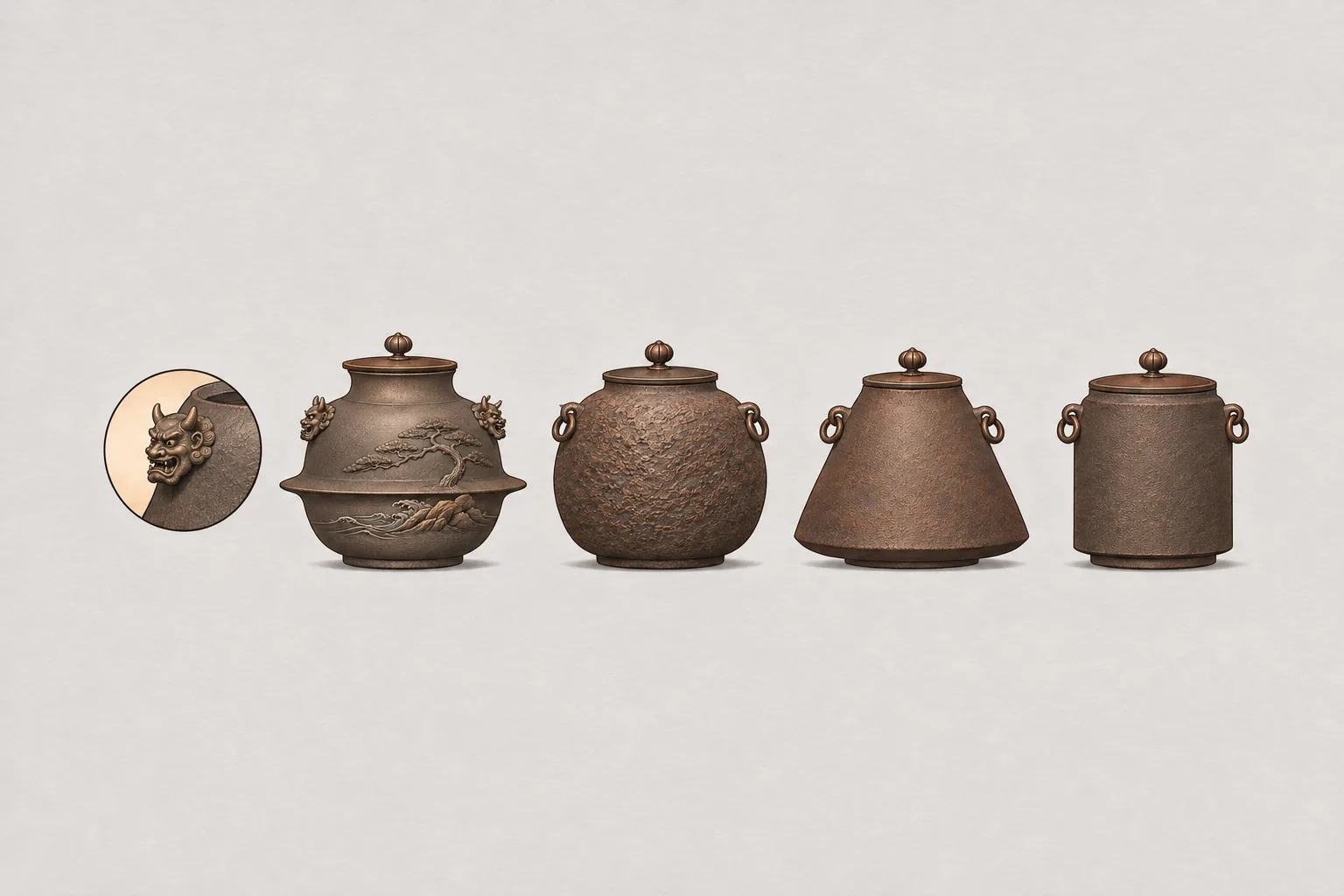
Four kettle shapes, from left: shinnari with its flange at the waist, the round amidadō, the fuji-gata narrowing toward the top, and a straight-sided cylinder. The circle at far left enlarges a demon-mask kantsuki lug.
Where the kettle sits depends on the season. From November to April it rests in a ro, a square hearth sunk into the floor, about forty-two centimetres across, so that the fire is near the guests on cold days. From May to October it sits on a furo, a portable brazier on the mat, moving the heat a little away from the guests. The opening of the hearth in November is called "the tea person’s New Year", and is also when the jar of new-season leaf tea, sealed since early summer, is ceremonially opened.
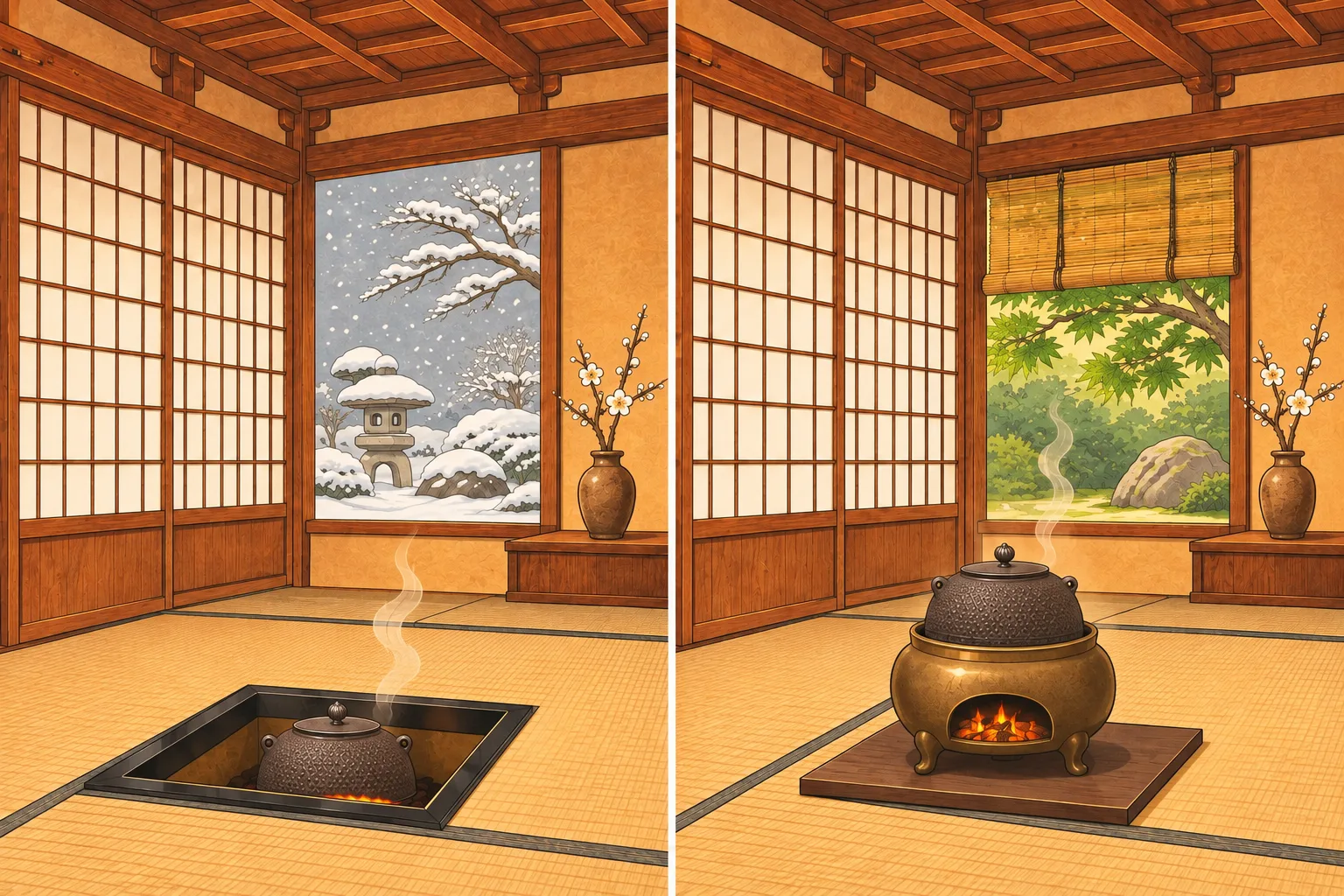
Left: the winter ro, sunk into the floor inside a black-lacquered frame. Right: the summer furo, a free-standing brazier on a board, with the kettle sitting noticeably higher.
Braziers come in several materials. Bronze ones often appear at formal gatherings. Clay ones, burnished to a dark sheen and softer in outline, are a speciality of the Eiraku family of potters. Schools differ on which kind ranks highest. October, the month of nagori, "lingering farewell", sometimes brings out a brazier with a deliberately broken or worn rim. Inside every brazier the ash is sculpted into precise forms before the charcoal goes in, and guests see only a faint red glow.
The sunken hearth is framed by a wooden border, the robuchi, which becomes the most visible object in front of winter guests. Large formal rooms usually take a black-lacquered frame, sometimes with gold decoration; small rustic rooms prefer unlacquered wood such as mulberry, with its natural grain. Fitting a new hearth frame in November is the opening act of the winter season.
07Water Jar, Waste Bowl, Lid Rest and Ladle
The mizusashi is the lidded jar of fresh water, placed at the back of the host’s area before the procedure begins and one of the largest utensils on the mat. It tops up the kettle and supplies water for rinsing. Bronze jars are the most formal. Ceramic ones are most common, from rough Shigaraki, Bizen and Iga stoneware to Ming blue-and-white porcelain. The tsurube, a fresh white-wood jar modelled on a well bucket, was a summer favourite of Rikyū’s for its cool look. Some ceramic jars wear a lacquer lid, which lets a lidless vessel serve as a water jar. In high summer a wide, shallow jar shows the guests a pool of clear water.
The kensui is the waste-water bowl. It is the lowliest utensil, placed behind the host to the left where guests hardly see it, and the last to come in and the first to go out. It is usually plain: bronze, ceramic, bent wood or bamboo, in shapes with names such as bōnosaki (a straight cylinder) and kanadarai (a shallow basin). The host often carries it in with the lid rest and ladle sitting inside, like a tray.
The futaoki is a small stand for the kettle lid and the ladle, only a few centimetres tall. The most common is a section of bamboo, a humble form associated with Takeno Jōō. A widely stated rule places the node near the top for the brazier season and in the middle for the hearth season. Metal and ceramic lid rests come in a classic set of seven: a miniature incense burner, a trivet, three little figures standing back to back, a single small figure peering over a well curb, a turban shell, three leaves and a crab. These appear in the more formal procedures.
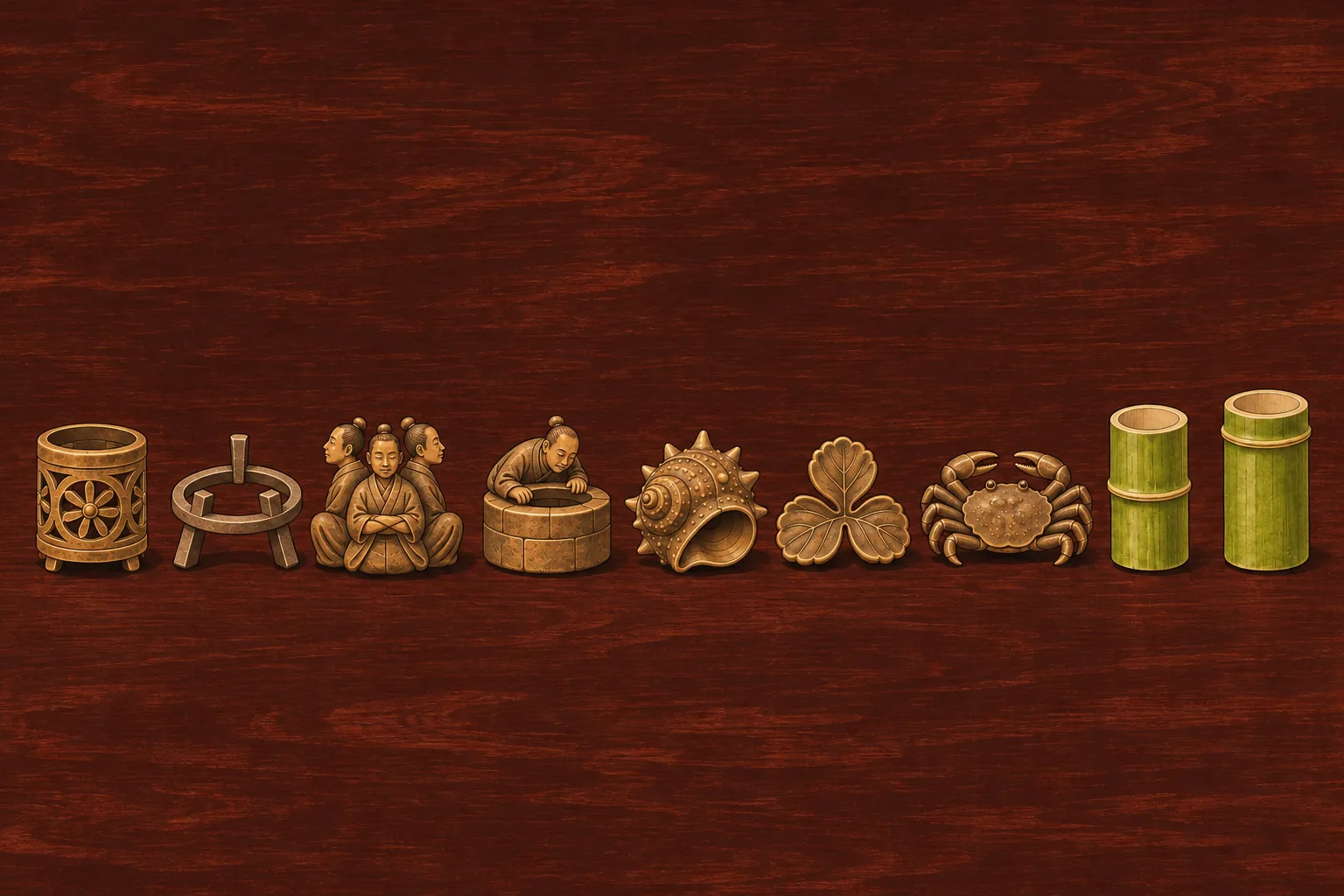
The classic seven lid rests, from left: incense burner, trivet, three figures back to back, a figure leaning over a well curb, turban shell, three leaves and crab. Far right, two bamboo futaoki: node in the middle for the hearth season, node near the top for the brazier season.
The hishaku is the bamboo ladle used to take hot water from the kettle and cold water from the jar: a long handle ending in a small cylindrical cup. It changes with the seasons. The hearth ladle has a longer handle and a larger cup, and its handle end is cut on a slant from the skin side; the brazier ladle is shorter, with a smaller cup and a handle end slanted from the inner side. The Kuroda family of bamboo craftsmen specialises in ladles. The ladle has more movements in a procedure than almost any other object, being set down on the kettle or the lid rest in several fixed ways, chosen according to whether it has just held hot or cold water and whether the hearth or brazier is in use. Shrine purification basins also use long-handled bamboo ladles, which look similar but belong to a different practice.
08Side by Side: Telling Them Apart
Chaire versus natsume is the first distinction. The chaire is ceramic, with glaze runs and an ivory lid, and arrives in a silk bag; the natsume is lacquer, smooth or decorated in gold, and comes out bare. The chaire holds thick tea; the natsume holds thin. If you see the host untie a silk bag and draw out a small brown jar, thick tea is coming.
Among caddies, read the outline. The katatsuki has a flat, squared shoulder; the bunrin is a small-mouthed sphere like an apple; the nasu sags heavily at the bottom; the taikai is wide-mouthed, low and larger than the rest; the marutsubo is a squat ball with a short neck. Hosts pick a shape partly for mood: the shouldered jar looks upright and formal, the eggplant soft, the great sea generous.
Among natsume, check proportions and the lid seam. The standard medium Rikyū natsume is about as tall as it is wide, with a high seam and round shoulders. The hira-natsume is clearly wider than tall. The fubuki is bevelled top and bottom and nearly symmetrical. The shiribari spreads at the base. Large, medium and small Rikyū natsume differ only in size.
For scoops, find the node: none for formal, near the end for semi-formal, in the middle for informal. For whisks, look at the colour: pale for white bamboo, dark mottled brown for soot bamboo, even black for black bamboo.
For kettles, feel the surface with your eyes. Smooth and finely decorated suggests Ashiya; rough and plain suggests Tenmyō; inventive, individual shapes are usually Kyoto. For shape, look at the profile: a flange and raised collar mean shinnari, a broad round body means amidadō, a tapering top means fuji-gata.
Finally, the fire tells you the season. A kettle set into the floor within a wooden frame means the hearth and the colder half of the year. A kettle on a free-standing brazier means the warmer half. Around it, the lidded jar at the back is the mizusashi, the plain open vessel behind the host is the kensui, the small stand by the kettle is the futaoki, and the long bamboo ladle resting on it is the hishaku. Read together, these objects tell a guest the month, the level of formality and the host’s school before a word is spoken. The tea bowl, the one object a guest actually lifts to the lips, has a page of its own.
More deep dives on this topic
 ChawanAt the end of a tea ceremony, after the last sip, guests do something that puzzles first-time visitors.
 Tea UtensilsMost of what sits on a tea-room mat is small enough to hold in one hand.
 The Tea RoomA small Japanese tea room can look almost artless: a box of earth walls and straw mats, a few odd little windows, a recess with a single scroll.
 The AlcoveWhen guests enter a tea room, they do not sit down straight away.
 TemaeSit as a guest in a Japanese tea room and you will watch someone spend a quarter of an hour on a task that takes a minute in a kitchen, and it is natural to wonder what all the…
 The ChajiMost visitors to Japan meet the tea ceremony as a bowl of whisked matcha and a sweet, served in a temple garden or a tea school in Kyoto, over in fifteen minutes.
 The Tea YearWalk into the same tea room in January and in August and you might think you had come to two different houses.
 Schools of TeaWalk north up Ogawa-dōri in Kyoto, a narrow street lined with old townhouses, and you pass two quiet gates a few dozen metres apart.
- Back to the main article: The Way of Tea (Chanoyu) →