
Japan has fought many wars, but far fewer of them changed who held power and by what rules. The ten below did. One settled the throne, others put warriors above the court, dismantled a system of government, cleared the ground for two and a half centuries of peace, or ended the samurai habit of answering the state with swords. Most can be traced to a battlefield or site you can still walk.
They run in order, from the seventh-century Jinshin War to the Satsuma Rebellion of 1877. Read together, they show how often the outcome turned on legitimacy, letters, hesitation and defection rather than a single day of fighting, and how many famous scenes come from later war tales. Each section notes where historians still disagree.
01The Jinshin War: A Throne Decided by Arms
The Jinshin War grew out of a succession problem. In 671, at the dying Emperor Tenji’s bedside, his brother Prince Ōama declined the succession, became a monk and withdrew to Yoshino; after Tenji’s death his son Prince Ōtomo led the Ōmi court. In the sixth month of 672 Ōama left Yoshino, had the Fuwa road closed and drew the eastern provinces to his side. Late in the seventh month his army broke the Ōmi forces at the Seta bridge, and Ōtomo hanged himself. In 673 Ōama took the throne as Emperor Tenmu.
The victory reshaped government. Tenmu relied little on ministers, pushed forward legal codes and in 684 reorganized the clan titles; many scholars see his reign as decisive for the imperial system. He returned to Asuka, where you can begin at Asuka and Fujiwara: Ancient Capitals. Almost everything we know comes from the winners’ own chronicle, the Nihon shoki.
02Dan-no-ura: The End of the Court in Exile
In the seventh month of 1183 the Taira left Kyoto with Emperor Antoku and the three regalia, and Kyoto enthroned Go-Toba without them. In the second month of 1185 Yoshitsune attacked Yashima (see the HO Guide to Yashima), and the Taira fell back on Hikoshima in the Kanmon Strait. In the third month, with ships from Kōno, Kumano and Suō, Yoshitsune met them at Dan-no-ura.
The Taira were defeated. Antoku drowned, the jewel and mirror were recovered, the sword was lost, and from then on Japan had only one emperor. The victor, Minamoto no Yoritomo, soon broke with Yoshitsune and built a new center of power in the east. The modern idea that a turning tide decided the battle is no longer accepted by most historians. For the shore and Akama Jingū today, read the HO Guide to Dan-no-ura.
03The Jōkyū War: Warrior Rule Takes Its Final Shape
In the fifth month of 1221 Retired Emperor Go-Toba gathered warriors and ordered the provinces to hunt down Hōjō Yoshitoki. In Kamakura Hōjō Masako rallied the vassals, and three columns marched west. In the sixth month they broke through on the Owari River, forced the Uji crossing, broke through at Seta and entered Kyoto. This was the Jōkyū War.
Three retired emperors were exiled, the child emperor was deposed, and over three thousand holdings were confiscated, many of them going to eastern warriors as estate stewards in the west. The shogunate set up a permanent office at Rokuhara to watch the court; its area is now the Rokuharamitsu-ji–Rokuhara Tandai Historic Area. Only now did warrior rule take its settled form. Go-Toba died in exile in 1239 (see Oki: Go-Toba-in Museum and Related Exile Sites). His surviving orders target Yoshitoki, and whether he meant to abolish the shogunate is debated.
04The Ōnin War: The Muromachi System Fails
In the first month of 1467 Hatakeyama Masanaga occupied the Kami-Goryō Shrine and fought his kinsman Yoshinari. In the fifth month Hosokawa Katsumoto's side struck first, and the camps of Katsumoto and Yamana Sōzen became the Eastern and Western Armies. The Ōnin War went on in Kyoto for eleven years; ashigaru raids, arson and looting left much of the upper city in ashes. Both leaders died in 1473, and the Western Army dissolved in 1477.
The war broke the Muromachi system in which provincial governors lived in Kyoto under the shogun and his deputy. Many went home afterward to run their provinces by their own strength, which is why the war is often taken as the start of the Warring States era. The old story of a mother fighting for her son’s succession is no longer accepted by most historians. Only shrines, markers and place names remain; the name Nishijin comes from the Western camp. See the Nishijin–Kamigoryō Ōnin War Historic Area.
05Nagashino: The Takeda Turn to Defense
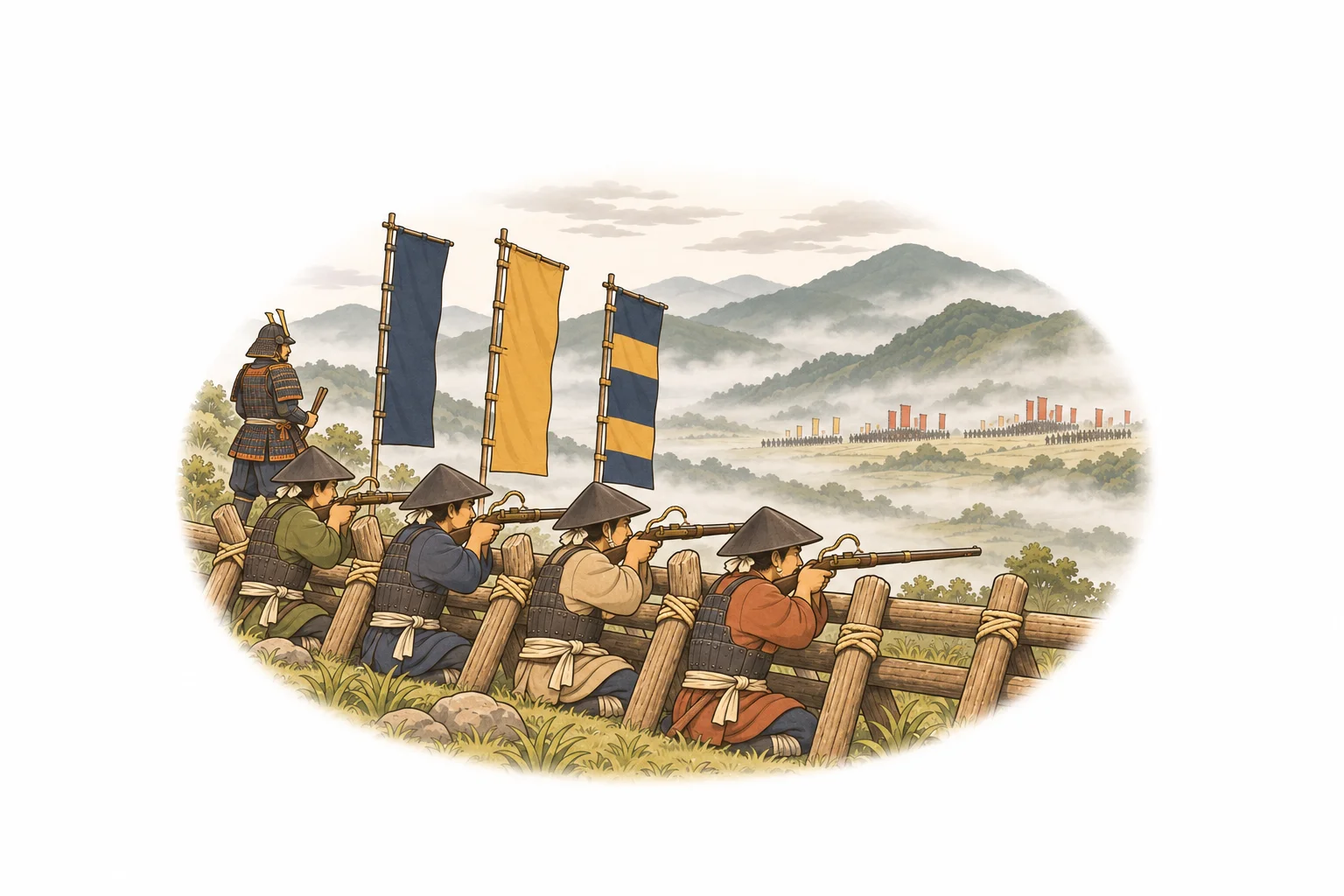
In the spring of 1575 Takeda Katsuyori besieged Nagashino Castle in Mikawa, held by Okudaira Sadamasa, twenty-one by traditional count. In the middle of the fifth month Oda Nobunaga and Tokugawa Ieyasu deployed at Shitaragahara behind a palisade along the Rengogawa. The night before the battle, Sakai Tadatsugu led a detachment around through the hills to the south; at dawn his raid on Tobinosuyama broke the siege. The same day the Takeda attacked the allied line from sunrise until their line broke in the afternoon, losing Yamagata Masakage, Baba Nobuharu and many other senior commanders.
After Nagashino the Takeda stayed on the defensive, though they were destroyed only in 1582. The "three thousand guns in three ranks" comes from Oze Hoan’s Shinchōki; Shinchō kōki says about a thousand. Numbers, position and a severed rear mattered more than any firing drill. For the castle cliffs and the rebuilt palisade, read the HO Guide to Nagashino and Shitaragahara.
06Sekigahara: A Toyotomi Civil War
After Hideyoshi died in 1598, Tokugawa Ieyasu moved into Ōsaka Castle in 1599 as the regime’s effective head. In the seventh month of 1600 Ishida Mitsunari rose, Mōri Terumoto became the western commander-in-chief, and both sides claimed to act for Hideyori. At Sekigahara in the middle of the ninth month, Kobayakawa Hideaki’s defection and the Mōri’s inaction broke the western army.
The battle of Sekigahara was followed by confiscations and reductions covering roughly a third of the country’s assessed yield. Tokugawa kinsmen and hereditary vassals took the Tōkaidō and the Kantō, laying out the Edo-period pattern of outside lords on the periphery. Yet Ieyasu still acted within the Toyotomi order and became shogun only in 1603. The toi-deppō episode and the Oyama council remain disputed. The same pass was the Fuwa road Ōama seized in 672; walk it with the HO Guide to Sekigahara.
07The Ōsaka Campaigns: The Last Rival Center Falls
After Sekigahara the Toyotomi held about 650,000 koku, but Toyotomi Hideyori remained in Ōsaka Castle beside the Tokugawa. In 1614 a dispute over the Hōkō-ji bell inscription led to war. Early in the twelfth month Sanada-maru threw back a Tokugawa assault, and under the peace that followed the second and third enclosures were demolished and the moats filled. War resumed in the fourth month of 1615; in the fifth month the castle fell, and Hideyori and Yodo-dono killed themselves.
The Ōsaka Campaigns removed the last authority that could stand beside the Tokugawa. In the intercalary sixth month of 1615 the shogunate issued the One Province, One Castle order; in the seventh month the era became Genna and the Laws for the Military Houses were proclaimed. The age of war that began with Ōnin is seen as ending here. The tale that the Tokugawa broke the treaty by filling more than the outer moat lacks contemporary support. Today’s walls are mostly Tokugawa work over a buried Toyotomi castle; see the HO Guide to Ōsaka Castle.
08Shimabara–Amakusa: The Last Great War before the Long Peace
In the tenth month of 1637, after harsh taxes and repeated poor harvests, villagers around Arima killed a domain intendant, and Amakusa rose almost at once under the boy Amakusa Shirō. The rebels occupied the abandoned Hara Castle, usually counted at about 37,000 people. Early in 1638 the envoy Itakura Shigemasa was killed in an assault; Matsudaira Nobutsuna starved the castle with more than 120,000 men, and it fell late in the second month.
The Shimabara–Amakusa Uprising was the largest war of the Edo period, and nothing on its scale followed until the end of the shogunate. Afterward temple registration spread nationwide, and in 1639 Portuguese ships were barred. Whether it was a tax revolt or a war of faith is still argued. Excavation has uncovered the toppled walls and the bones of the dead; see the HO Guide to Hara Castle Ruins.
09The Boshin War: Who Spoke for the Emperor
In 1867 Tokugawa Yoshinobu returned political authority to the court, and the Restoration of Imperial Rule followed. Early in 1868 the shogunate’s army was defeated at Toba–Fushimi, the new government raised the brocade banner, and Yoshinobu sailed from Ōsaka to Edo on the Kaiyō Maru, branded an enemy of the court. Edo Castle was handed over in the fourth month, Aizu surrendered in the ninth, and in the fifth month of 1869 Enomoto Takeaki surrendered at Goryōkaku, ending the Boshin War.
Neither side denied the emperor’s authority, but the new government held the banner and the name of the imperial army. The war lasted a year and a half, with commonly cited deaths of a little over 8,200, and left a central government built around the emperor. The first fighting is traced in the HO Guide to the Toba–Fushimi battlefield, the last in the HO Guide to Goryōkaku.
10The Satsuma Rebellion: The End of Armed Samurai Resistance
After the political crisis of 1873, Saigō Takamori resigned and went home to Kagoshima. In mid-February 1877 the Satsuma army marched with "questions to put to the government" and besieged Kumamoto Castle in vain. After about seventeen days of fighting at Tabaruzaka in March (March 4–20), the government broke through, and the siege was lifted in mid-April. The remnant reached Shiroyama in Kagoshima in early September; in late September the government stormed it, and Saigō, wounded, died with Beppu Shinsuke acting as his second.
The Satsuma Rebellion was modern Japan’s last large civil war. Armed resistance by former samurai ended, and opposition turned to speech and the campaign for a parliament. The defense of Kumamoto Castle also showed that the conscript army could be relied on. Tabaruzaka is now a memorial park; its bullet-scarred storehouse is a reconstruction, and the slope still follows the old road.
11Closing
Set side by side, these wars changed the order in different ways. Jinshin and Sekigahara changed who ruled; Jōkyū and Boshin changed the balance between court and warriors; Ōnin broke a system; Ōsaka and Shimabara cleared the way for a long peace; and the Satsuma Rebellion took the sword out of politics. On the ground you will mostly find markers, earthworks and later rebuilding. The famous battlefield scenes and the decisions that really changed the order are often not the same thing.