
01A Table-Top Mountain on the Inland Sea
Seen from the city of Takamatsu, on the north coast of Shikoku, Yashima looks less like a mountain than a piece of furniture: a long, flat-topped block with steep sides, sitting at the edge of the Seto Inland Sea. Geologists call it a lava plateau, or mesa. A cap of hard lava protects the easily weathered granite beneath it, and over millions of years erosion has cut the edges into cliffs while leaving the summit almost level. The highest point is a little under 300 meters. The plateau is divided into a southern ridge and a northern ridge, joined by a low saddle.
The name, written with characters meaning "roof island," is usually explained by that shape. The word "island" is not decorative. For most of its history Yashima really was an island, separated from the Shikoku mainland by a narrow, shallow channel. Salt fields and land reclamation from the Edo period (1603–1868) onward gradually joined it to the shore, and today the only trace of the old strait is the Aibiki River, a narrow waterway along its southern and western foot.
Three layers of history sit on this mesa. In the seventh century the Yamato court built a mountain fortress here against a feared invasion from the continent. In the twelfth century the Taira clan made Yashima their base and brought a child emperor to its shore, and it was here that Minamoto no Yoshitsune surprised them in the spring of 1185, in the episode that gave Japan one of its best-loved stories: the young archer Nasu no Yoichi shooting a fan from a swaying boat. And on the summit, for more than a thousand years, a Buddhist temple, Yashima-ji, has received pilgrims. The whole of Yashima is protected as a national Historic Site and Natural Monument.
02After Baekgang: The Fortress of Yashima
Yashima’s first appearance in the written record is military. In 663, an expeditionary force from Japan, sent to help restore the fallen Korean kingdom of Baekje, was destroyed by the allied fleets of Tang China and Silla at the mouth of the Baekgang (known in Japan as Hakusukinoe). The court of Emperor Tenji expected the victors to follow up with an invasion. It posted frontier guards and signal fires in Tsushima, Iki and northern Kyūshū, built the great earthwork called Mizuki and the mountain fortress of Ōno near Dazaifu, and then lined the sea route toward the capital with further hilltop strongholds.
The Nihon Shoki (Chronicles of Japan), the court history completed in 720, records that in the eleventh month of the sixth year of Tenji (667), Takayasu castle was built in Yamato, Yashima castle in Yamada district of Sanuki province, and Kaneda castle on Tsushima. These forts are usually called "Korean-style mountain castles" because refugee Baekje aristocrats, experienced in this kind of construction, are recorded as supervising some of them. Yashima was well placed: it overlooked the main shipping lane through the Inland Sea, and its cliffs supplied most of a defensive wall for free.
For more than thirteen centuries the fortress existed only on paper. Nobody could point to it. Then in 1998 a local amateur researcher found ancient stone walling on the southwestern slope just below the top of the southern ridge. Takamatsu city’s surveys traced a defensive circuit of about 7 kilometers, only about a tenth of it built wall; the rest is natural cliff. In 2002 excavators confirmed a gate, one of the largest known at any ancient mountain fort in Japan. It turned out to be of a type known from Korean sites: its threshold stood about 2.5 meters above the ground outside, so attackers could not simply walk in; defenders reached it with ladders or a removable bridge. Inside, the passage was bent so that anyone who got through would have to turn, exposed to the defenders above.
The city spent years restoring the gate area, dismantling and relaying the stonework on the basis of the excavation, and opened it to visitors in 2016. What visitors see there now is a mix of original seventh-century masonry and modern reconstruction. The invasion never came: Tang and Silla soon fell out with each other, and Yashima’s fortress, like most of its kind, was eventually abandoned; no record says when.
03Yashima-ji: Ganjin and Kūkai
Yashima-ji (the "-ji" means temple) is Temple 84 of the Shikoku pilgrimage, the 88-temple circuit associated with the monk Kūkai. It belongs to the Omuro branch of Shingon Buddhism.
The temple’s own tradition gives it two founders. In the first story, the Chinese monk Ganjin (Jianzhen), who after five failed attempts finally reached Japan in 753–754 to establish proper monastic ordination, was sailing toward Nara when he saw an auspicious glow over Yashima. He climbed the mountain and founded a temple on the northern ridge, later entrusted to his disciple Eun. In the second story, Kūkai, posthumously known as Kōbō Daishi and founder of Japanese Shingon, came here in the early ninth century, moved the temple to the southern ridge, and carved its principal image, a seated Eleven-Headed Thousand-Armed Kannon (the bodhisattva of compassion). Neither story can be checked against contemporary documents, but both show how the temple has always understood itself.
The temple’s Kannon is a wooden statue of about the tenth century, from the middle of the Heian period (794–1185), and an Important Cultural Property. The original is now displayed in the temple’s treasure hall; a replica takes its place in the main hall. The temple also owns a bronze bell inscribed with the date Jōō 2 (1223), likewise an Important Cultural Property.
04The Taira Come to Yashima
In the summer of 1183 the Taira, who had dominated the court for two decades under Taira no Kiyomori, could no longer hold Kyoto against the army of Minamoto (Kiso) no Yoshinaka coming down from the north. They fled west, taking with them the child Emperor Antoku, Kiyomori’s grandson, then six by the traditional count, and the imperial regalia. After being pushed out of Kyūshū, they settled at Yashima.
It was a sensible choice. The Taira’s power had long rested on the Inland Sea: on its ports, its trade and its seafaring warriors. Yashima sat in the middle of that sea, with a channel in front of it as a moat and boats always at hand. Taira no Munemori, the clan’s head after Kiyomori’s death, had a palace built for the emperor at Yashima, using the nearby temple of Rokuman-ji as a stopgap residence, it is said, until the palace was ready. A small shrine at the eastern foot of the mesa, the Antoku Tennōsha, is traditionally identified as the palace site, though excavation in the area has not turned up clear remains of the period. Under Munemori the Taira recovered enough to push back east as far as their old base at Fukuhara (modern Kōbe).
In early 1184 Yoshitsune smashed that position at Ichi-no-Tani, attacking down the cliffs behind the Taira camp. The survivors returned to Yashima. On land the Minamoto now had the upper hand, but they had few ships, and without ships they could not reach the island. Yoshitsune’s half-brother Minamoto no Noriyori, marching west along the San’yō road, spent much of 1184 short of food and boats.
05Sailing Into the Storm
Early in 1185, Yoshitsune assembled a force at Watanabe, the port at the mouth of the Yodo River in what is now Ōsaka, to cross to Shikoku.
The Heike monogatari (The Tale of the Heike), the great war tale of these years, places a famous quarrel here. Kajiwara Kagetoki, a senior vassal of Yoshitsune’s brother Minamoto no Yoritomo, proposed fitting the ships with "reverse oars" at the bow so they could back away quickly. Yoshitsune mocked the idea: an army that planned its retreat before the battle had already lost. The two men nearly came to blows. Kagetoki later slandered Yoshitsune to Yoritomo, and storytellers have often traced the brothers’ fatal breach to this argument. It is a literary scene, and there is no way to confirm it.
When it came time to sail, a gale was blowing and the boatmen refused to put out. Yoshitsune argued that the enemy would never expect anyone to cross in such weather, and, according to the Heike, threatened to have any boatman who refused shot. Only five ships went, carrying about 150 horsemen. The Azuma kagami (Mirror of the East), the Kamakura shogunate’s own chronicle, has them sailing in the small hours of the eighteenth day of the second month and reaching Awa province (modern Tokushima) by dawn. The Heike names the landing place as Katsuura and says the crossing, normally three days, took about six hours. The two sources differ by a day or two on dates; the dates below follow the Azuma kagami.
06The Ride to Yashima
At Katsuura a local warrior, Kondō Chikaie, joined Yoshitsune and told him what he needed to know. A Taira commander, Dennai Noriyoshi, had taken some three thousand riders to Iyo province to punish Kōno Michinobu, who had gone over to the Minamoto. Yashima itself was held by perhaps a thousand.
Yoshitsune did not wait. He defeated a nearby Taira supporter, the Awa warrior known as Sakuranosuke, then rode north through the night over the Ōsaka pass between Awa and Sanuki. On the way, the story goes, his men captured a courier carrying a letter to Yashima, which confirmed the picture. On the nineteenth day of the second month (March 22, 1185 in the Julian calendar) he was across from the island.
The tide was out, and the channel was shallow enough for horses to wade. Yoshitsune set fire to houses around Takamatsu and raised many white banners, and the Taira, seeing the smoke and the riders, assumed a great army had arrived overland. They abandoned the palace and took the emperor out onto their ships. By the time they realized how few the attackers were, they had given up the land.
The battle that followed was an odd one. The Minamoto were on horseback along the shore and in the shallows; the Taira were afloat. Arrows flew across the water, horsemen rode out into the surf, and boats ran in to fight at the beach.
07Satō Tsuginobu
The fiercest Taira fighter was Taira no Noritsune, Kiyomori’s nephew, famous for his bow. In the Heike he aims straight at Yoshitsune, and Satō Tsuginobu throws himself in front of his lord and takes the arrow through the body. Noritsune’s page, Kikuōmaru, leaps from the boat to take Tsuginobu’s head, and Tsuginobu’s younger brother Tadanobu shoots him down. Noritsune carries the boy back aboard, where he dies.
The Satō brothers had been given to Yoshitsune by Fujiwara no Hidehira, the lord of northern Japan who had sheltered Yoshitsune in his youth. Grieving, Yoshitsune asked a local monk (later tradition makes him Kakua of Shido-ji) to perform rites for Tsuginobu and gave him his own prized horse, Tayūguro, as an offering. The episode became central to Yoshitsune’s reputation as a lord who loved his men.
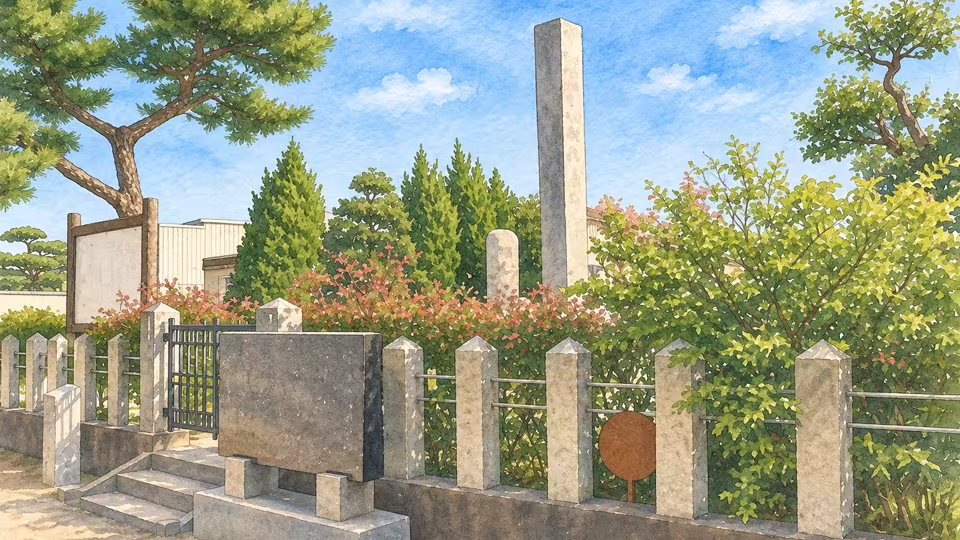
Below the eastern face of Yashima there are memorials tied to this scene: Tsuginobu’s grave, the field where he is said to have fallen, the grave of Kikuōmaru, and Suzaki-ji, a temple whose door, by tradition, served as a stretcher for Tsuginobu’s body. The grave marker was set up beside the pilgrim road in the Edo period by Matsudaira Yorishige, first lord of the Takamatsu domain.
08Nasu no Yoichi and the Fan
The scene everyone knows came at dusk on the day of the attack; the Heike, by its own reckoning, sets it around the hour of the Rooster on the eighteenth.
As the Heike tells it, fighting paused, and a small, richly decorated boat rowed out from the Taira fleet toward the shore. In it stood a woman of eighteen or nineteen, in willow-colored layered robes and crimson trousers. She set up a pole at the gunwale and hung from it a fan, all crimson, with a golden sun painted on it, and beckoned to the Minamoto.
Yoshitsune asked what it meant. It was a challenge, he was told: can any of you hit it? It might also be bait, to draw a famous warrior within range. Yoshitsune asked for an archer, and someone named Nasu no Yoichi Munetaka of Shimotsuke province, in the north Kantō, young but able to hit two birds out of three on the wing.
Yoichi, about twenty years old, tried to excuse himself. Yoshitsune told him that anyone who would not obey had better leave the army at once. Yoichi rode his horse out into the sea, but the fan was still about seven tan away, some 70 to 80 meters. A strong north wind was blowing; the boat pitched on the waves and the fan swung on its pole. The Taira watched from their ships in a line; the Minamoto watched from their saddles along the beach.
Yoichi shut his eyes and prayed to Hachiman, the war god, and to the gods of his home province: the deities of Nikkō, of Utsunomiya, and of the hot springs of Nasu. Let me hit the center of that fan, he prayed; if I miss, I will break my bow and kill myself, and never show my face again. When he opened his eyes the wind had eased a little. He fitted a humming-bulb arrow, drew, and loosed. The arrow screamed across the water and struck the fan about an inch from the rivet where the ribs join. The fan flew up into the sky, fluttered in the spring wind, and fell onto the waves, where it rose and sank, crimson and gold on the white surf. The Taira beat on their gunwales in applause; the Minamoto drummed on their quivers.
The Heike does not end the scene there, though retellings usually do. A Taira warrior of about fifty, moved by the shot, began to dance on the deck of his boat. Ise no Yoshimori brought word from Yoshitsune’s side: shoot him. Yoichi shot him through the neck, and he fell into the sea. The Taira fell silent. Some of the Minamoto cheered; others said it was a heartless thing to do.
The story comes from the Heike monogatari. The Azuma kagami does not mention it, so how much is history and how much is storytelling cannot be settled. That has not mattered to its fame. Japanese schoolchildren read this passage in class, and the fan target has been painted on screens, staged in Noh and puppet theater, and printed on souvenirs ever since. Later tradition named the woman in the boat Tamamushi; the Heike itself leaves her nameless.
On the shore east of Yashima, small monuments mark the Komadate-iwa, the rock where Yoichi is said to have halted his horse in the water, and the Inori-iwa, the rock where he prayed. Land reclamation has moved the coastline, and these spots now sit in fields or shallows. Picturing the sea that once covered them takes some effort.
09The Dropped Bow and the Torn Neck-Guard
Two more episodes from the Heike belong to Yashima.
When the fighting resumed, Akushichibyōe Kagekiyo, one of the toughest Taira warriors, grabbed the neck-guard of a Minamoto warrior, Mionoya no Jūrō, from behind. Jūrō pulled free, the neck-guard tore away in Kagekiyo’s hand, and Jūrō escaped. This "neck-guard pulling," shikoro-biki, later became a favorite subject for Kabuki and woodblock prints.
In the melee, a Taira grappling hook caught at Yoshitsune and his bow fell into the sea. He leaned out from his horse and fished it back with his whip, under enemy fire. His men scolded him for risking his life for a bow. Yoshitsune answered that if it were a mighty bow like his uncle Tametomo’s, he would have let the enemy have it; but his was a weak one, and he would not have the Taira hold it up and laugh: so this is the Minamoto general’s bow. The scene, called yumi-nagashi, "the swept-away bow," is one of the key moments in the literary image of Yoshitsune as a commander who cared more for honor than safety.
10Shido, and the End at Dan-no-ura
Yashima did not end in a single day. On the twenty-first the Taira, who had withdrawn east along the coast to Shido, fought again there, and lost again. Meanwhile Kōno Michinobu of Iyo arrived with his ships, and Tanzō, the superintendent of the Kumano shrines, brought the Kumano fleet over to the Minamoto. With their command of the sea slipping away, the Taira abandoned Yashima and sailed west to Hikoshima, at the western end of the Inland Sea.
About a month later, on the twenty-fourth day of the third month of 1185, the two sides met in the Kanmon Strait at Dan-no-ura. The Taira lost. Antoku’s grandmother, Kiyomori’s widow, took the child emperor, eight by the traditional count, in her arms and went into the sea; Noritsune and Tomomori died; Munemori was captured. The Taira as a political force were finished.
What Yashima did was strip the Taira of their central base on the Inland Sea. Yoshitsune’s small force won by speed, surprise and fire, making the enemy believe it was much larger than it was. The island’s position had favored the Taira, but their instinct, faced with a threat on land, was to take to the water, and in doing so they handed over the shore without a real fight.
Visitors should note that there is also a Dan-no-ura at Yashima, the bay on its eastern side between the mesa and Mure. It is not the Dan-no-ura where the Taira were destroyed, which lies some 300 kilometers to the west, but the shared name confuses many people.
11Yashima-ji and the Memory of the Battle
After the war, the temple on the summit gathered battle legends around itself. Its pond, formally the Ruri-hō no Ike but known as the Chi-no-ike or "Blood Pond," is said to have been made by Kūkai and to have turned red when warriors washed their swords in it. The temple’s treasure hall holds, besides the Kannon and other statues, objects linked to the Genpei War (the 1180–1185 war between the Taira and Minamoto), including paintings and illustrated accounts of the battle. Most are later works or later attributions, but they have long served pilgrims as an introduction to what happened below.
The main hall is single-storied, with a hip-and-gable roof covered in tiles, and was designated an Important Cultural Property in 1955. It was rebuilt in 1618 under a temple monk and long taken for a Momoyama-period building. When it was dismantled and repaired in 1957, much of its timber and many of its techniques proved to come from a Kamakura-period predecessor, and it was restored to that Kamakura form, in black lacquer and red. The hall visitors see today is the result of that restoration. Through the Edo period the temple was supported by the Matsudaira lords of Takamatsu.
The temple has another guardian, more popular than any samurai. Tasaburō, the tanuki (raccoon dog) of Yashima, is counted among Japan’s three famous tanuki. In one legend he guided Kūkai up the mountain in the guise of an old man in a straw raincoat; in others he could conjure up the Battle of Yashima as an illusion. He is enshrined as Minoyama Daimyōjin in a shrine beside the main hall, and stone tanuki crowd the grounds. These are folk legends, unconnected with the real battle.
From the Edo period, as the Shikoku pilgrimage grew popular, pilgrims in white with sedge hats climbed to Temple 84 on foot. The old stone-paved path from the base of the mountain is still used.
12Walking Yashima
At the top of the southern ridge, start with Yashima-ji: the main hall, the bell, the Blood Pond, the tanuki shrine, and the treasure hall with the original Kannon.
From the temple, walk to the lookouts on the eastern edge of the plateau. Below you lies the battlefield. The bay to the northeast, between Yashima and the Mure shore with the jagged peaks of Goken-zan behind, is the local Dan-no-ura. Fill it, in your mind, with sea reaching much farther inland than it does now, Taira boats scattered across it, and Minamoto riders splashing through the shallows.
Turn north and look out over the islands and shipping lanes of the Inland Sea. This is the route the seventh-century court built its fortress to watch, and the route on which the Taira’s power depended.
On the southwestern side of the southern ridge, visit the restored gate of the ancient fortress, and stand below that 2.5-meter step to see the problem it posed to an attacker.
Finally, at the eastern foot of the mesa, the small sites of the Heike story are scattered among houses and rice fields: the Antoku Tennō shrine, Tsuginobu’s grave, the field where he fell, Suzaki-ji, the Komadate-iwa and the Inori-iwa. None is grand, and most were marked in the Edo period or later. But from any of them, look up at the flat roof-line of Yashima, and the words of the Heike fit the ground.