
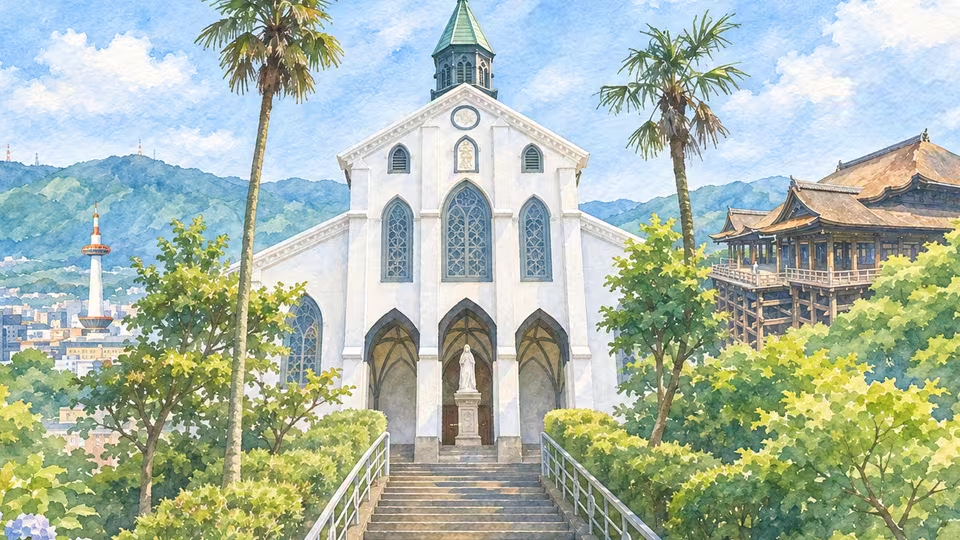
01A Church Above the Harbor
Walk up from the Ōura waterfront in Nagasaki and the street narrows into a slope lined with souvenir shops. At the top, above a flight of stone steps, stands a white Gothic church with a single pointed spire. This is Ōura Cathedral, officially the Basilica of the Twenty-Six Holy Martyrs of Japan. It is the oldest surviving church in Japan and the first Western-style building in the country to be designated a National Treasure.
The hillside around it is Minamiyamate, literally "the southern bluff," one of the districts set aside for foreign residents when Nagasaki opened to Western trade in 1859. Next door is Glover Garden, where the houses of British merchants still look out over the harbor. Below lay the Bund, the waterfront strip of trading houses, banks and consulates.
Three stories meet on this slope. The church was built to honor twenty-six Christians crucified in Nagasaki in 1597. It was made possible by the treaties that opened the port and created a foreign settlement. And within weeks of its dedication in 1865, it became the scene of one of the most remarkable moments in the history of Christianity in Asia: the day Japan’s hidden Christians, after some 250 years without priests, revealed themselves to a French missionary.
02The Twenty-Six Martyrs
Christianity reached Japan with the Jesuit Francis Xavier in 1549 and spread quickly in Kyūshū. Nagasaki itself was a creation of the Christian century. The Christian lord Ōmura Sumitada opened it to Portuguese ships in 1571, and in 1580 he handed the town over to the Jesuits. For a decade it was effectively a church-run port.
Toyotomi Hideyoshi, the warlord who unified Japan, took Nagasaki under his direct control in 1587 and issued an edict expelling missionaries. The order was loosely enforced; trade with the Portuguese mattered too much. What hardened his attitude was a shipwreck. In 1596 the Spanish galleon San Felipe, bound from Manila to Mexico, ran aground on the coast of Tosa in Shikoku. Its cargo was confiscated, and according to accounts circulating soon afterward, a crew member boasted that Spain sent missionaries ahead of its soldiers. At the same time, Spanish Franciscans who had come from the Philippines were preaching openly in Kyoto and Ōsaka, in defiance of the edict.
Hideyoshi ordered the arrest of the Franciscans and their followers. The prisoners had part of their left ears cut off and were paraded through Kyoto, then marched overland to Nagasaki in the depths of winter, a journey of about a month. Two men who tended to them on the road were arrested and added to the group. On February 5, 1597, twenty-six people were tied to crosses on Nishizaka, a hill overlooking Nagasaki harbor, and killed with spears.
They were six Franciscans from Spain, Mexico and India, three Japanese Jesuits, among them the preacher Paul Miki, and seventeen Japanese laymen. The youngest were boys of twelve, thirteen and fourteen. Jesuit accounts record that Paul Miki preached from the cross and forgave his executioners. The martyrs were beatified in 1627 and canonized by Pope Pius IX in 1862, while Japan was still closed to Christianity.
03Two and a Half Centuries Underground
The Tokugawa shogunate banned Christianity nationwide in 1614. Missionaries were expelled, churches were torn down, and thousands of believers were executed over the following decades, many of them at Nishizaka. After the Shimabara Rebellion of 1637–38, the regime cut off the Portuguese and confined European trade to the Dutch on the artificial island of Dejima.
Every household had to register with a Buddhist temple, and in the Nagasaki area residents were made to step on Christian images, a ritual called e-fumi ("picture-treading"), each New Year. Yet in villages around Nagasaki, in Urakami just north of the town, in Sotome, on the Gotō Islands and on Ikitsuki, communities kept the faith in secret. They passed the church calendar from leader to leader, baptized their children through a lay baptizer, and memorized prayers whose Latin and Portuguese words slowly wore down into sounds. Images of the Virgin Mary were hidden or disguised as the Buddhist bodhisattva Kannon. Historians call them senpuku kirishitan, "hidden Christians."
A prophecy circulated among the Urakami believers, attributed to a legendary seventeenth-century catechist named Bastian: after seven generations, priests would return on great ships, and Christians would be able to sing their prayers aloud. Whether Bastian ever said it cannot be proved, but the expectation was real, and it shaped what happened in 1865.
04The Treaty Port and Its Settlement
In 1858 the shogunate signed the Ansei Treaties with the United States, the Netherlands, Russia, Britain and France. Nagasaki, Yokohama and Hakodate opened in 1859. Foreigners could live and trade only within designated settlements.
Nagasaki’s settlement took shape south of Dejima. The shoreline at Ōura was reclaimed to make the Bund, where trading firms, banks, warehouses and consulates faced the water. The hills behind were divided into Higashiyamate (the eastern bluff) and Minamiyamate, where merchants and consuls built houses with broad verandas overlooking the harbor. A municipal council of foreign residents managed roads, lighting and policing.
The best-known resident was Thomas Blake Glover, a young Scot who arrived in 1859 at the age of twenty-one. He started out in the tea trade, founded Glover & Co., and moved into ships and arms for the domains of Satsuma and Chōshū, the powers that would overthrow the shogunate. He helped young samurai from Chōshū travel secretly to Britain and later worked closely with Mitsubishi. His house on Minamiyamate, completed in 1863, is the oldest surviving Western-style wooden building in Japan.
05The French Church
The treaties allowed foreigners to build places of worship for their own use. The Vatican had entrusted Japan to the Paris Foreign Missions Society, whose priests had been waiting in the Ryūkyū Islands for a chance to enter. Father Louis Furet came to Nagasaki and began a church on Minamiyamate; Father Bernard Petitjean soon joined him and saw it through. It was dedicated to the newly canonized Twenty-Six Martyrs and, by tradition, set to face toward Nishizaka.
The builder was Koyama Hidenoshin, a carpenter from the Amakusa Islands. Japanese craftsmen, working from the missionaries’ drawings, built a wooden Gothic church with three towers. It was completed at the end of 1864 and dedicated on February 19, 1865. Locals called it the "French temple" and came in crowds to look.
Officially it served foreigners. Japanese were still forbidden to become Christians. But the missionaries knew Nagasaki’s history and quietly hoped that descendants of the old believers might still exist.
06The Discovery of the Hidden Christians
On the afternoon of March 17, 1865, about a month after the dedication, a group of some fifteen men, women and children from Urakami came to the church. Petitjean let them in. As he knelt in prayer, a middle-aged woman came close and whispered that their hearts were the same as his. Then she asked where the statue of Santa Maria was.
The woman is traditionally identified as Sugimoto Yuri, baptized Isabelina. Petitjean led the group to a statue of the Virgin and Child at a side altar, and they rejoiced. In the conversations that followed they asked questions that tested him against what their ancestors had taught: did he obey the great chief in Rome, and was he unmarried? The answers matched.
Petitjean reported the encounter to his superiors, and when the news reached Rome, Pius IX hailed it as a miracle of the Orient. Over the following months hidden Christians from Urakami, Sotome and the Gotō Islands came secretly to Ōura to confess and receive instruction, and the priests slipped out in disguise to visit their villages. The Catholic Church remembers the day as the "Discovery of the Christians." The statue, still in the church, is known as the Virgin of the Discovery.
07The Urakami Persecution
Coming into the open put the believers on a collision course with the law. In 1867 Urakami Christians refused to have Buddhist priests conduct their funerals and declared that they would no longer be parishioners of the temple. In July the Nagasaki magistrate’s office raided the village at night and arrested sixty-eight leaders. This was the fourth great crackdown on Urakami, known as the Urakami Yonban Kuzure, "the fourth collapse of Urakami."
Foreign envoys protested, but before the case was settled the shogunate fell. The new Meiji government kept the ban. Its public notice boards of 1868 repeated that Christianity was an evil creed, and the government decided to deport the entire Christian population of Urakami. Leaders were sent away in 1868, and in early 1870 more than three thousand villagers were scattered among some twenty domains in western Japan. The survivors called their exile the tabi, "the journey."
Treatment varied. In Tsuwano and Hagi, officials used hunger, cold and torture to force recantation; in Tsuwano believers were confined in tiny cages. More than six hundred exiles died, and many renounced their faith under pressure.
Western governments protested loudly, and when the Iwakura Mission toured the United States and Europe from 1871, its members were confronted about the persecution and saw that it stood in the way of revising the unequal treaties. In 1873 the government took down the notice boards banning Christianity. The exiles returned to find their fields overgrown and homes in ruins. On land that had once belonged to the village headman, where e-fumi had been administered, they built Urakami Cathedral over three decades. The atomic bomb destroyed it on August 9, 1945.
08Rebuilding, War Damage and Recognition
With Christianity tolerated, Japanese believers flocked to Ōura, and the original church became too small. Between 1875 and 1879 it was enlarged and rebuilt: the outer walls were redone in plastered brick, the interior widened from three aisles to five, and the single central spire seen today replaced the three towers. The new church was consecrated in May 1879, and the present building is essentially that church.
Next to it Petitjean built a seminary to train Japanese priests in 1875, designed by Father Marc de Rotz and now an Important Cultural Property. The red-brick former archbishop’s residence beside it dates from 1915. Both now house the Ōura Cathedral Christian Museum, with objects used by the hidden Christians and records of the persecution. Petitjean became Vicar Apostolic of Japan in 1866, died in 1884, and was buried in Ōura Cathedral.
Ōura Cathedral was designated a National Treasure in 1933, the first Western building to receive the title. The 1945 atomic bomb, which exploded over Urakami several kilometers away, wrecked its roof, windows and stained glass; repairs were completed in 1952, and it was redesignated a National Treasure under the new Law for the Protection of Cultural Properties in 1953. It became Japan’s first minor basilica in 2016, and in 2018 it was inscribed as one of the components of the UNESCO World Heritage Site "Hidden Christian Sites in the Nagasaki and Amakusa Region," representing the moment the hidden era ended. Because of visitor numbers, regular parish Masses are mostly held in a newer church built next door in 1975.
09Life in the Settlement
For forty years, Ōura and the bluffs were home to British, American, French, Russian and Portuguese merchants, consuls and missionaries, alongside a large Chinese community. Frederick Ringer’s firm, Holme Ringer & Co., dealt in tea, shipping and insurance; William Alt was another early tea merchant. Their houses were bungalows of a colonial type, with deep verandas facing the sea but Japanese tile roofs, built by Japanese carpenters who learned as they went.
Protestant missionaries opened schools on Higashiyamate, the origin of several of Nagasaki’s present-day mission schools. The Oranda-zaka, the "Dutch slope," climbs through that district on the other side of the Ōura River.
When the revised treaties took effect in 1899, the settlement system ended and foreigners could live anywhere in Japan. The foreign community dwindled as the harbor’s center shifted to the Mitsubishi shipyard, and most foreigners left during the Second World War. In 1974 the city opened Glover Garden, preserving the houses on Minamiyamate and moving several others there from elsewhere in Nagasaki. In 1991 Minamiyamate and Higashiyamate were designated Important Preservation Districts for Groups of Traditional Buildings.
10Walking the Slope
Start at the waterfront, where the stone former Nagasaki branch of the Hong Kong and Shanghai Bank, completed in the early twentieth century, recalls the Bund. Then climb the shop-lined slope toward the church, which follows the route foreigners used to reach the bluff.
At the top of the steps, look up at the façade and the white statue of the Virgin that greets visitors. Inside, the slender ribbed vault is not stone but wood and plaster, Japanese carpentry imitating a European cathedral. Behind the main altar is stained glass of Christ on the cross. At the side altar stands the Virgin of the Discovery, before which Sugimoto Yuri and her companions stood in 1865.
Beside the church, the old seminary and archbishop’s residence hold the museum collections. Beyond lies Glover Garden: Glover’s clover-shaped house with its veranda looking toward the shipyard, the stone-walled Ringer and Alt houses, and other buildings moved here. Take the narrow Kinen-zaka, the "Prayer Slope," alongside the church for a quieter view of stone walls and old houses. From the heights of Minamiyamate, look north along the harbor toward Nishizaka, where the twenty-six died in 1597, and which the church was built to face.