
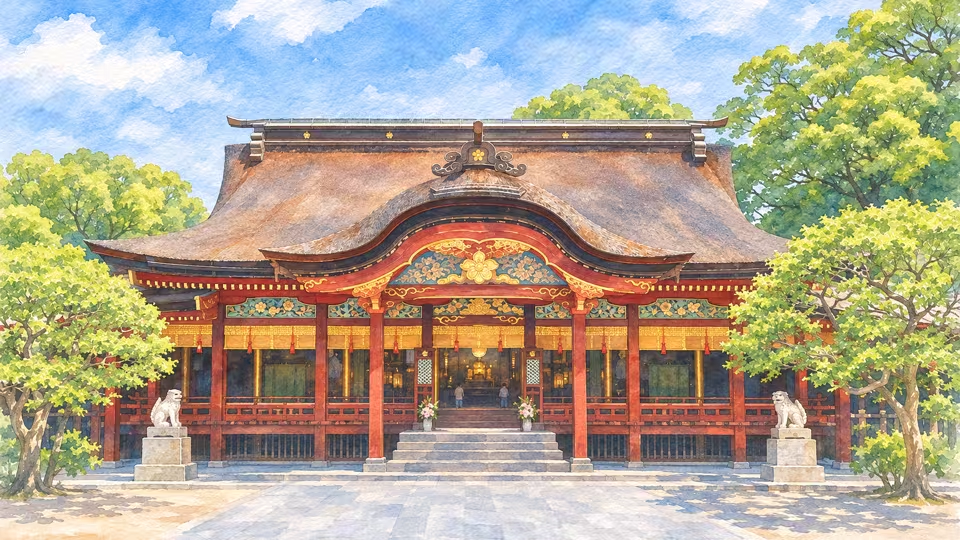
01A Shrine Built on a Grave
Most Shinto shrines are dwellings for a god who has no body. Dazaifu Tenmangū is different. Its main sanctuary stands over the grave of a real man, the scholar-statesman Sugawara no Michizane, who died here in exile in 903. Thousands of shrines across Japan, called Tenmangū or Tenjin-sha, worship Michizane as Tenjin, the "heavenly deity." Most were founded by transferring his spirit from Kitano Tenmangū in Kyoto or from here. Only Dazaifu can say that the man himself lies beneath the floor.
That fact explains almost everything you see: the bronze oxen lying along the approach, the plum trees, the crowds of students buying charms before entrance exams, and the name of the town itself, which grew up as the shrine’s gate town. To make sense of it, you have to start in the imperial capital in the late ninth century.
02The Scholar Who Rose Too High
Sugawara no Michizane was born in 845 into a family of court scholars. His grandfather and father had both held the post of monjō hakase, professor of Chinese literature and history at the state academy, and Michizane followed them. He was a precocious poet in Chinese, passed the most demanding civil examination of his day, and became a professor himself in his early thirties.
In his forties his career turned. After a term as governor of Sanuki province on Shikoku, where he wrote poems about the hardships of the farmers he governed, he caught the eye of Emperor Uda. Uda wanted to limit the grip of the Fujiwara regents on the court and promoted men from outside that family. Michizane rose rapidly. In 894 he was named ambassador to Tang China, and he responded by recommending that the embassy be reconsidered, citing the chaos in China and the dangers of the sea crossing. No embassy was ever sent again. This is often described as Michizane "abolishing" the missions to China, though no formal abolition was ever proclaimed; the voyages simply stopped.
When Uda abdicated in 897 in favor of his young son, Emperor Daigo, he left written advice urging the new ruler to rely on two men: Michizane and Fujiwara no Tokihira, heir of the most powerful branch of the Fujiwara. In 899 Tokihira became Minister of the Left and Michizane Minister of the Right. For a man from a scholarly family of modest rank, this was an extraordinary height, and it made him enemies.
03Exile to Dazaifu
In the first month of 901, Michizane was abruptly stripped of his post and appointed supernumerary Governor-General of Dazaifu (often called Provisional Governor-General), a title that was in practice a sentence of exile. He was accused of plotting to depose Emperor Daigo in favor of Prince Tokiyo, Daigo’s brother and Michizane’s son-in-law. Historians generally see the charge as a fabrication engineered by Tokihira’s faction. The retired emperor Uda reportedly hurried to the palace to plead for him but was refused entry. Michizane’s sons were exiled to different provinces.
Before leaving his house in Kyoto, Michizane addressed a poem to the plum tree in his garden. It is among the most famous verses in Japanese:
Kochi fukaba / nioi okoseyo / ume no hana / aruji nashi tote / haru na wasure so.
"When the east wind blows, send me your fragrance, plum blossoms; even without your master, do not forget the spring."
Dazaifu, where he was going, was the government’s headquarters for Kyūshū, a regional capital that oversaw the island’s provinces, coastal defense, and diplomatic contact with the continent. It was sometimes called the "distant court." But Michizane was given no real duties. His salary and servants were cut off, and he lived as a prisoner in a dilapidated official residence south of the government compound, known as the Minami-no-kan, the South Lodge. The site is now marked by a small shrine called Enoki-sha, about two kilometers from the Tenmangū.
His Chinese poems from these two years, later collected as the Kanke Kōshū, record a man in poor health, short of food, nursing his grief. In one he remembers a banquet a year earlier at which the emperor had given him a robe; he still has the robe and bows to it every day. In another he writes that he does not go out of his gate; he looks at the roof tiles of the government hall from a distance, and only hears the bell of Kanzeon-ji temple. Both places still exist in modern Dazaifu.
Michizane died at the South Lodge on the twenty-fifth day of the second month of Engi 3, which corresponds to March 26, 903 (Julian calendar). He was fifty-nine by Japanese count, fifty-seven by Western reckoning.
04Where the Ox Lay Down
The shrine’s founding legend tells that Michizane’s disciple, Umasake no Yasuyuki, set out with his master’s body on an ox-drawn cart. At a certain point the ox lay down and refused to move. Taking this as Michizane’s own wish, his followers buried him on that spot. That spot is the site of today’s main sanctuary.
The story cannot be verified, but it is the reason oxen are everywhere here. They are Tenjin’s messengers, and you will find them in bronze and stone around the grounds, their heads rubbed to a shine by visitors who believe that touching the head will make them wiser, or that touching the part of the ox matching their own ailment will heal it.
According to the shrine, Yasuyuki built a small sanctuary over the grave in 905. In 919, on the orders of Emperor Daigo, a proper set of buildings was raised by Fujiwara no Nakahira, who was, curiously, the younger brother of Michizane’s rival Tokihira; some accounts of this founding differ. The complex that grew around the grave was a Buddhist temple as much as a shrine, and for nearly a thousand years its formal name was Anraku-ji, the "temple of peace and joy," or Anraku-ji Tenmangū.
05Thunder over Kyoto
What happened in the capital after Michizane’s death turned an exiled official into a god. In 909 Tokihira died at the age of thirty-nine. In 923 Crown Prince Yasuakira, Tokihira’s nephew, died at twenty-one, and his own young son and successor died two years later. The frightened court restored Michizane to his former office posthumously, raised his rank, and burned the edict that had sent him into exile.
Then, in the sixth month of 930, lightning struck the Seiryōden, the emperor’s residential hall in the palace, killing several courtiers. Emperor Daigo fell ill and died three months later. To contemporaries the pattern was obvious: Michizane’s angry spirit was taking revenge, and he had become a god of thunder. Tenjin, "heavenly deity," had long been a name for the thunder god, and it attached itself to him.
A shrine to appease him was founded at Kitano, on the northwestern edge of Kyoto, around 947, and in 993 the court granted him the highest posthumous honors: Senior First Rank, Minister of the Left, and, later that same year, the title of Chancellor. Over the following centuries the fearsome spirit slowly changed character. Courtiers remembered him as a master of poetry and learning; medieval poets made him the patron of linked verse; and in the Edo period, when village schools spread across the country, children bowed to his image on their first day. By modern times Tenjin was, above all, the god of scholarship, which is why the shrine is so busy every winter before the university entrance examinations.
06Anraku-ji in the Middle Ages
Through the Heian period the temple-shrine flourished. It received land and donations from the court and aristocracy and became one of the great religious institutions of Kyūshū. Its chief administrators were often members of the Sugawara family, keeping a link with the capital. According to the temple’s own records, a poetry gathering beside a winding stream, the kyokusui no en, was first held here in 958 by Ono no Yoshifuru, the deputy governor-general of Dazaifu. The custom later lapsed; a revived version, restored in 1963, takes place in the shrine garden every March. Michizane’s great-grandson Sugawara no Sukemasa, who served at Dazaifu in the 980s, is credited with starting the New Year fire ritual called oni-sube.
As the Dazaifu government itself declined in the medieval period, northern Kyūshū became contested ground among warrior houses, and Anraku-ji’s estates were steadily eaten away. Its buildings burned more than once. The linked-verse master Sōgi visited in the fifteenth century and wrote about the pilgrimage. In the wars of the late sixteenth century the sanctuary was set on fire in 1578 by the troops of the local warlord Akizuki Tanezane.
07Kobayakawa Takakage’s Sanctuary
After Toyotomi Hideyoshi brought Kyūshū under his control in 1587, he gave the province of Chikuzen to Kobayakawa Takakage, a son of the great western warlord Mōri Motonari. Takakage undertook to restore the shrine, and in 1591 he completed a new main sanctuary. That building is the one that still stands, designated an Important Cultural Property.
It is a five-bay structure in the nagare-zukuri style, with a long, gently curving roof of cypress bark that sweeps forward over the steps, and a front porch with an undulating karahafu gable. Its gilded and painted details are typical of the showy Momoyama era. When you bow and clap in front of it, you are, according to tradition, praying at Michizane’s grave.
Under the Kuroda lords of Fukuoka domain during the Edo period, the shrine prospered again. Kuroda Josui (Kanbei), father of the first lord, spent part of his retirement at Dazaifu and worked to restore the precinct. Pilgrims came from all over western Japan, and the approach filled with teahouses and inns. Most of the stone torii gates and lanterns along the way were donated in this era by merchants and believers.
08The Flying Plum
To the right of the sanctuary, inside a low fence, grows a white plum called the Tobiume, the Flying Plum. According to legend, the plum tree in Michizane’s Kyoto garden, longing for its master after hearing his farewell poem, flew overnight to Dazaifu to be with him. Whatever its age (the shrine describes it as over a thousand years old, a figure best understood as a matter of faith), it is traditionally the first of the roughly six thousand plum trees on the grounds to blossom each year.
Opposite it, to the left of the sanctuary, is the Empress’s Plum.
The local sweet, umegae mochi, a thin rice cake filled with red bean paste and stamped with a plum blossom, has its own legend. An old woman living near Michizane’s lodging is said to have passed him rice cakes on the end of a plum branch through the fence. The shops lining the approach grill them all day.
09Five Nobles in Exile
Near the end of the approach, before you reach the pond, is the gated residence called Enjuō-in. It was once the residence of the temple’s administrators and today is the home of the chief priest, so it is not open to visitors.
In the 1860s it sheltered a later group of exiles. After a coup in Kyoto in 1863 drove the radical anti-foreign faction from the court, seven nobles led by Sanjō Sanetomi fled to Chōshū. Five of them were moved to Dazaifu in 1865 and lived at Enjuō-in for nearly three years, until the restoration of imperial rule allowed them to return. Activists from Satsuma, Chōshū, and Tosa came to see them, among them Sakamoto Ryōma and Saigō Takamori. A stone monument outside the gate commemorates their stay.
10From Temple to Shrine
In 1868 the new Meiji government ordered the separation of Shinto and Buddhism. Anraku-ji ceased to exist as a temple; its Buddhist images and buildings were removed, and its monks became Shinto priests. In 1871 the institution was renamed Dazaifu Jinja and given a place in the state ranking of shrines, rising by 1895 to the middle grade of imperial government shrines (kanpei chūsha). In 1947 it took back the name Dazaifu Tenmangū.
The chief priests come from the Nishitakatsuji family, descendants of Michizane, so the man buried here is still in a sense cared for by his own family.
The vermilion tower gate, the rōmon, was rebuilt in 1914. Seen from the pond side it has two tiers of roof; from the sanctuary side it appears to have only one. The three bridges over the heart-shaped pond, two arched and one flat between them, are popularly said to stand for past, present, and future; you are advised not to look back on the first or stop on the second.
11Treasures and the Museum
The shrine owns a large collection. Its most important single object is the Kan’en, a fragment of a Tang-dynasty Chinese encyclopedia lost in China and preserved here in a Heian-period manuscript copy. It contains early descriptions of the Korean kingdoms and of Japan and is a National Treasure. There are also swords, documents, and paintings related to Michizane, some displayed in the treasure hall.
On the hill to the east stands the Kyushu National Museum, opened in 2005 and connected to the shrine grounds by an escalator tunnel. The shrine is said to have promoted the idea of a museum at Dazaifu since the Meiji period, and it provided land for the project.
12A Walk Through the Grounds
From Dazaifu Station on the Nishitetsu line, the approach runs for about four hundred meters, lined with shops selling umegae mochi and souvenirs and spanned by a series of stone torii. Bronze oxen lie along the way.
At the end, the path turns toward the pond and the three bridges. Cross carefully: the arched ones are steep. Beside the bridges, look for the small Shika Shrine, a compact building generally dated to 1458 and the oldest surviving structure in the precinct, also an Important Cultural Property.
Past the purification fountain is the rōmon gate, and through it the sanctuary. The Flying Plum is on your right and the Empress’s Plum on your left. Between 2023 and 2026 the main sanctuary underwent its first major restoration in more than a century: the cypress-bark roof was replaced, the lacquer renewed, and the metal fittings repaired. During the work, worship took place at a temporary hall designed by the architect Fujimoto Sōsuke, with a grove of trees planted on its roof.
Behind the sanctuary are smaller shrines and plum groves, and a path up the hill to the Tenkai Inari shrine and on to the museum. If you have more time, the stone foundations of the ancient Dazaifu government hall, the temple of Kanzeon-ji with its ancient bronze bell, and the Enoki-sha shrine on the site of the South Lodge are all within reach. These are the roofs Michizane watched from a distance and the bell he listened to in the last two years of his life.