
01A House at the Top of the Steps
Nagasaki is a city of slopes, and the climb to Kameyama Shachū is one of its steepest. From the temple district of Teramachi, a stone stairway winds up the Irabayashi hillside between cemetery walls and tightly packed houses. Near the top, below Mount Kazagashira, stands a modest two-story wooden house. In the last years of the Tokugawa shogunate, a band of young men who had abandoned their home domains used this neighborhood as their base. They ran ships, brokered arms deals, and helped bring together two great domains that had been enemies. Their organizer was Sakamoto Ryōma, a lower-ranking samurai from Tosa (modern Kōchi Prefecture), who has since become one of the most popular figures in Japanese history.
The group called itself simply the shachū, meaning "the company" or "the association." The name Kameyama, "Turtle Hill," came from the place: from around 1807 a kiln here produced Kameyama ware, white porcelain painted with imported Chinese cobalt. The kiln had been abandoned by the time the company arrived, and "Kameyama Shachū" is a label that settled on the group later.
Modern books and tourist literature often call Kameyama Shachū "Japan’s first trading company" or even "Japan’s first joint-stock company." That is a generous description. There were no shares and no charter. But the group did live by shipping and brokerage rather than by stipends from a lord, and its members drew regular monthly pay, which was unusual for samurai of the day.
02From Katsu Kaishū’s Naval School
Most of the men who came to Kameyama had trained at the naval school run by Katsu Kaishū, the shogunate’s leading naval expert, in Kōbe. In 1864 Katsu, then commissioner of warships, opened the Kōbe Naval Training Center, alongside a private academy that admitted samurai from many domains and even masterless men. Ryōma had left Tosa without permission in 1862, an act called dappan ("fleeing the domain") that was a serious crime. He soon attached himself to Katsu and became a leading figure among the students, and other Tosa men followed him. In 1864 Ryōma accompanied Katsu on an official trip to Nagasaki and stayed for over a month at Fukusai-ji temple, his first look at the port.
The year 1864 was violent in Kyoto. In the Ikedaya Incident and the Kinmon Incident, radicals clashed with shogunal forces, and some of Katsu’s students were involved on the anti-shogunate side. Katsu fell under suspicion, was dismissed and recalled to Edo, and in the spring of 1865 the Kōbe school was closed. Ryōma and his companions had learned to handle ships but had none, and returning to Tosa could mean punishment.
Satsuma, the powerful domain in southern Kyūshū, took them in. Katsu had commended Ryōma to Satsuma, and the Satsuma elder Komatsu Tatewaki saw a use for men who could sail. In mid-1865 Ryōma’s group was settled in Nagasaki under Satsuma’s protection, and the company began. That is the traditional account; some recent historians argue the group took shape more gradually. From the start, the wealthy Kosone merchant family of Nagasaki backed them with money and lodging.
03The Men of the Company
Membership fluctuated, but the core was perhaps a dozen to twenty men. Besides Ryōma, the best known were Kondō Chōjirō, Sawamura Sōnojō, Takamatsu Tarō (Ryōma’s nephew), Chiya Toranosuke, Shingū Umanosuke, Ike Kurata, and Mutsu Yōnosuke from Kii domain, who as Mutsu Munemitsu would later serve as Meiji Japan’s foreign minister.
Kondō Chōjirō’s story shows what kind of men these were. He was the son of a bun-seller in the castle town of Kōchi, nicknamed "Manjūya Chōjirō," the bun-shop boy. His learning earned him a chance to study in Edo, and he joined Katsu’s school. In Nagasaki he proved a capable negotiator. Most of the others were rural samurai (gōshi) or lower-ranking retainers from Tosa, men whose prospects at home were limited by birth.
Life was not comfortable. Satsuma paid the men a small allowance; records show Ryōma and several others later receiving three ryō two bu a month each. Between jobs the men studied English and navigation, and they were familiar figures in the Maruyama pleasure quarter.
04Guns for Chōshū
The company’s first major business was political. In 1864 the domain of Chōshū (modern Yamaguchi Prefecture) had fought Satsuma and Aizu troops in Kyoto and been branded an enemy of the court. The shogunate launched a punitive campaign against it and was preparing another. Chōshū badly needed modern rifles, but a shogunal ban stopped it from buying from foreign merchants. Satsuma and Chōshū were bitter rivals, yet both were growing hostile to the shogunate.
Ryōma and his fellow Tosa exile Nakaoka Shintarō had been working to reconcile the two domains, and the company offered a practical route: buy weapons in Nagasaki in Satsuma’s name and pass them to Chōshū. In the summer of 1865 the Chōshū men Inoue Kaoru and Itō Hirobumi came to Nagasaki in secret and stayed at the Satsuma residence. With Kondō Chōjirō’s help they negotiated with the Scottish merchant Thomas Blake Glover. Chōshū bought 7,300 rifles, 4,300 Minié rifles and 3,000 older Gewehr muskets, which were shipped home on a Satsuma vessel.
Chōshū also wanted a steamship. In the tenth month of 1865 the company bought one from Glover & Co., again in Satsuma’s name, with Kondō taking delivery. Satsuma called her the Sakurajima Maru, Chōshū the Itchū Maru, and her English name was Union. Who owned her and who could use her caused months of friction among Satsuma, Chōshū and the company, and Ryōma had to mediate repeatedly. In the end she belonged to Chōshū, was crewed by the company, and could carry Satsuma cargo when needed. Chōshū offered Satsuma rice in thanks, though Satsuma in the end declined it. Through the company, the two domains were already doing business before they had any formal agreement.
05The Alliance, and a Death in Nagasaki
On March 7, 1866 (the twenty-first day of the first month of Keiō 2; some accounts give other dates) Saigō Takamori and Komatsu Tatewaki of Satsuma met Kido Takayoshi (then called Katsura Kogorō) of Chōshū at Komatsu’s residence in Kyoto and reached a six-point understanding, known as the Satsuma–Chōshū Alliance. Ryōma arrived late in the talks to help close the deal; some historians argue the terms were largely settled before he came. Afterwards Kido wrote the six points from memory in a letter to Ryōma, who endorsed it in red ink on the back and returned it. That document survives in the archives of the Imperial Household Agency. Days after the meeting, at the Teradaya inn in Fushimi, shogunal police tried to arrest Ryōma. Warned by Oryō, the young woman who would become his wife, he escaped with wounded hands and took refuge with Satsuma.
Around the same time, in Nagasaki, Kondō Chōjirō died. He had been rewarded by Chōshū for his part in the arms deal and planned to travel secretly to Britain with Glover’s help. He had already boarded one of Glover’s ships when bad weather delayed the sailing, and his comrades caught him as he came ashore. He had not told them, and they treated it as a breach of the company’s pact. On February 28, 1866 Kondō committed ritual suicide in a room of the Kosone family house. He was twenty-nine by the traditional count. Who exactly pressed him to it is unclear. Ryōma was in Kyoto; Oryō recalled years later that he said Kondō would not have died had he been there.
06Shipwreck and War
In the spring of 1866 Ryōma and Oryō traveled to Satsuma so he could recover from his wounds. They toured the Kirishima mountains and climbed Takachiho-no-mine, a trip often described today as Japan’s first honeymoon. Ryōma described it in a long illustrated letter to his elder sister Otome.
Then came disaster. The company had bought a small sailing ship, the Wild Wave, on Chōshū’s behalf for training and cargo. On the second day of the fifth month of 1866, under tow by the Union from Nagasaki toward Satsuma, she was caught in a storm and sank off Shioaizaki on Nakadōri Island in the Gotō Islands. More than ten men drowned, among them Ike Kurata. A memorial stone at Enohama on the island is traditionally said to have been raised by Ryōma.
In the summer of 1866 the shogunate launched its second campaign against Chōshū. Ryōma took the Union into action in the Shimonoseki Strait, bombarding shogunal positions on the Kokura side. He described the fight in a letter home, though one view holds that he watched from shore. It was the company’s only direct experience of battle. The shogunate’s armies failed on every front, the shogun Tokugawa Iemochi died at Ōsaka Castle, and the campaign was abandoned, a humiliation from which the shogunate never recovered.
07From Company to Kaientai
Business remained poor. Ships were scarce, ventures lost money, and the men were often short of funds. Ryōma needed a more secure patron, and it came from an unexpected direction: his own domain.
Tosa’s dominant figure, the retired lord Yamauchi Yōdō, had favored cooperation between court and shogunate and had crushed Tosa’s loyalist faction, to which Ryōma once belonged. But by 1867 the Tosa minister Gotō Shōjirō saw that Tosa needed allies in the Satsuma–Chōshū camp. In early 1867 Gotō and Ryōma met at the Seifūtei, a restaurant in Nagasaki. The meeting was striking because Gotō’s uncle, the reformer Yoshida Tōyō, had been assassinated by Ryōma’s former loyalist comrades.
The two came to terms. Tosa pardoned Ryōma’s flight, and in the fourth month of 1867 the company was reorganized as the Kaientai, the "Naval Auxiliary Force," under Tosa’s sponsorship with Ryōma as its head. Its rules opened membership to any man who had left his domain and aimed to work overseas. Tosa covered part of its costs, and the rest was to come from shipping and trade. Tosa also set up a trading office in Nagasaki, the Tosa Shōkai, run by Iwasaki Yatarō, who handled the Kaientai’s accounts. Iwasaki would go on to found Mitsubishi.
08The Iroha Maru and the Eight-Point Plan
Soon after its founding the Kaientai chartered a steamer, the Iroha Maru, from Ōzu domain. On May 26, 1867, sailing from Nagasaki toward Ōsaka, she collided with the Meikō Maru, a much larger steamer belonging to Kii domain, near the island of Mushima in the Inland Sea, and sank while being towed toward the port of Tomo-no-ura. No one was killed.
Kii was one of the three senior branch houses of the Tokugawa, but Ryōma would not back down. He negotiated first at Tomo and then in Nagasaki, citing international maritime law from Wanguo Gongfa, a Chinese translation of Henry Wheaton’s Elements of International Law. He also wrote a satirical song mocking Kii that spread through the pleasure quarters. With Gotō Shōjirō pressing Tosa’s case and Satsuma’s Godai Tomoatsu mediating, Kii agreed to pay 83,526 ryō for the ship and the cargo Ryōma declared, later reduced to 70,000. Later surveys of the wreck found none of the rifles Ryōma claimed she carried, and the cargo was probably exaggerated.
In the sixth month of 1867 Ryōma and Gotō left Nagasaki for Kyoto aboard the Tosa ship Yūgao. According to tradition, during the voyage Ryōma set out eight proposals for a new political order, the Senchū Hassaku ("Eight-Point Plan Drafted Aboard Ship"): return of power from the shogun to the emperor, a bicameral assembly, revision of the unequal treaties, a stronger navy, and more. No original survives, and historians debate how the text took shape. A similar program in Ryōma’s own hand, written in the eleventh month of 1867, does survive. Gotō used these ideas to persuade Yamauchi Yōdō, Tosa formally urged the shogun Tokugawa Yoshinobu to surrender his authority, and in the tenth month of 1867 Yoshinobu did so.
09The Icarus Affair and the End
In the seventh month of 1867 two sailors from the British warship Icarus were killed in Maruyama. The British minister Sir Harry Parkes suspected the Kaientai and pressed the shogunate and Tosa hard, even traveling to Tosa himself. Ryōma and Gotō spent weeks dealing with the affair. For lack of evidence the charges against the Kaientai were dropped that autumn. The killer was later identified as Kaneko Saikichi, a samurai of Fukuoka domain, who had taken his own life.
By then Ryōma’s Nagasaki years were nearly over. After the return of power he was busy in Kyoto and Echizen planning the finances and personnel of a new government. On the fifteenth day of the eleventh month of Keiō 3 (December 10, 1867), assassins attacked him at the Ōmiya, a soy-sauce merchant’s house in Kyoto’s Kawaramachi, killing him and Nakaoka Shintarō. The day is generally believed to have been his birthday; he was thirty-three by the traditional count. The killers are generally thought to have been the Kyoto Mimawarigumi, a shogunal police unit, though other theories persist.
Without Ryōma the Kaientai lost its center, and Tosa dissolved it in 1868. Mutsu Munemitsu went on to a career in the new government, and as foreign minister in the 1890s he negotiated the first revisions of the unequal treaties.
10What You See Today
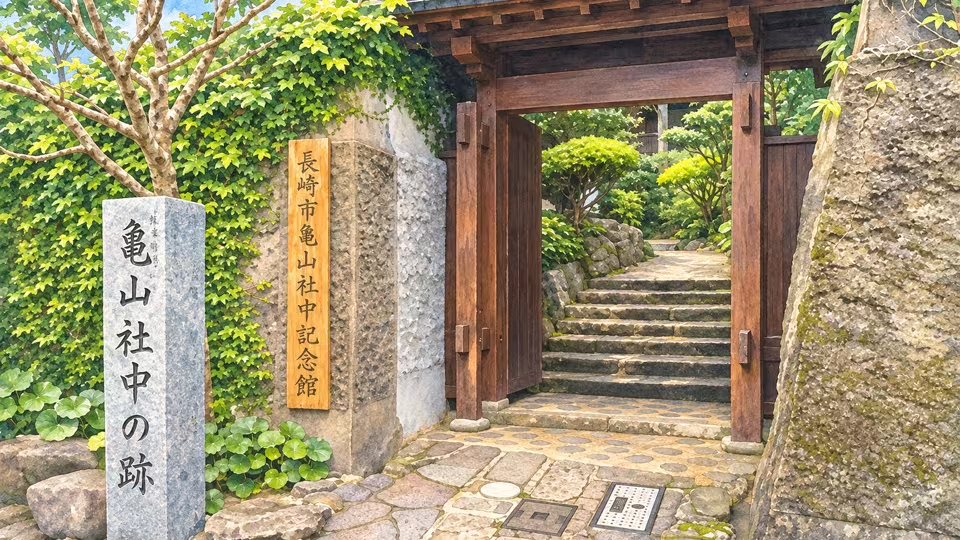
The Nagasaki City Kameyama Shachū Memorial Museum opened in August 2009. The house is traditionally identified as the company’s lodging. It was opened privately to visitors from 1989, closed as it deteriorated, and was then restored by the city to an appearance close to that of the late Edo period. A stone at the gate marks the site. Inside, the ten-mat room has a rebuilt pillar that Ryōma is said to have leaned against, and above the entrance and a small three-mat room is a low mezzanine said to have been a hiding place in emergencies; you can peer into it from the stairs. Displays include replicas of Ryōma’s boots and pistol, reproductions of his letters, a moon lute, and photographs of company members.
The stepped lane outside is known as Ryōma-dōri, Ryōma Street. A short way up is a large bronze pair of boots, modeled on the ones Ryōma wears in his best-known photograph; visitors step into them for pictures. Further up, Kazagashira Park holds a bronze statue of Ryōma, arms folded, looking out over the harbor toward Mount Inasa. In Ryōma’s day the harbor was narrower, and the foreign settlement at Ōura, with Glover’s house, lay on the slopes across the water.
Nearby, the small Wakamiya Inari Shrine is said to have been visited by the young activists of the period and is nicknamed the "Loyalist Inari." At its autumn festival, performers in fox masks climb tall bamboo poles in a display called takengei. Down the hill in Teramachi, the cemetery of Kōtai-ji temple holds Kondō Chōjirō’s grave, inscribed with the name of the Kosone family’s annex, Baika Shooku; the calligraphy is said to be Ryōma’s. It first stood high on the hill behind the temple and was later moved beside the Kosone family graves.
11Ryōma’s Nagasaki
Kameyama is one stop in a wider Nagasaki tied to Ryōma. After the Kaientai was formed, the Tosa Shōkai stood near the Nakashima River in the old town, and much Kaientai business was done there.
The Kosone family house stood in today’s Manzai-machi, near the present courts, where a stone marks the site. The Kosone were among Nagasaki’s richest merchants, and the head of the house, Kosone Kendō, was a noted calligrapher and seal carver. Katsu Kaishū had known the family since his years in Nagasaki and introduced Ryōma to them. Local accounts say Ryōma spent more time working here than at Kameyama. Kondō Chōjirō died here, and from 1866 Oryō lived with the family at Ryōma’s wish; she is said to have learned the moon lute there. Another figure often linked to the Kaientai is Ōura Kei, a merchant who had made a fortune exporting Kyūshū tea and is said to have helped its members.
Ryōma’s famous standing portrait, in kimono and boots with one hand tucked into his robe, was taken at the Nagasaki studio of the photographer Ueno Hikoma, by Ueno himself or his pupil Inoue Shunzō, probably early in 1867. A monument marks the studio site by the Nakashima River.
In Maruyama, the restaurant Kagetsu, known in the pleasure-quarter days as Hikitaya, shows a sword cut in its great hall said to have been made by Ryōma, another cherished local story. It also keeps a document connected with Ryōma and the Icarus affair. The site of the Seifūtei, where Ryōma and Gotō made peace, is marked nearby.
12A Walk
A good route starts in Maruyama, near Shian-bashi. See Kagetsu and the Seifūtei marker, then walk northeast through Teramachi, past Kōtai-ji, and climb the steps of Ryōma-dōri. The stairs are steep, and the climb is part of the experience. After the museum, continue up to the bronze boots and to Kazagashira Park.
From the park you look down on a harbor full of modern ships and cranes. In the 1860s the men of the company watched foreign merchantmen and the steamers of Satsuma and Chōshū come and go from these slopes. Most were in their twenties or early thirties, without rank or domain, making a living from boats and deals. Many of them did not live to see the Meiji era.